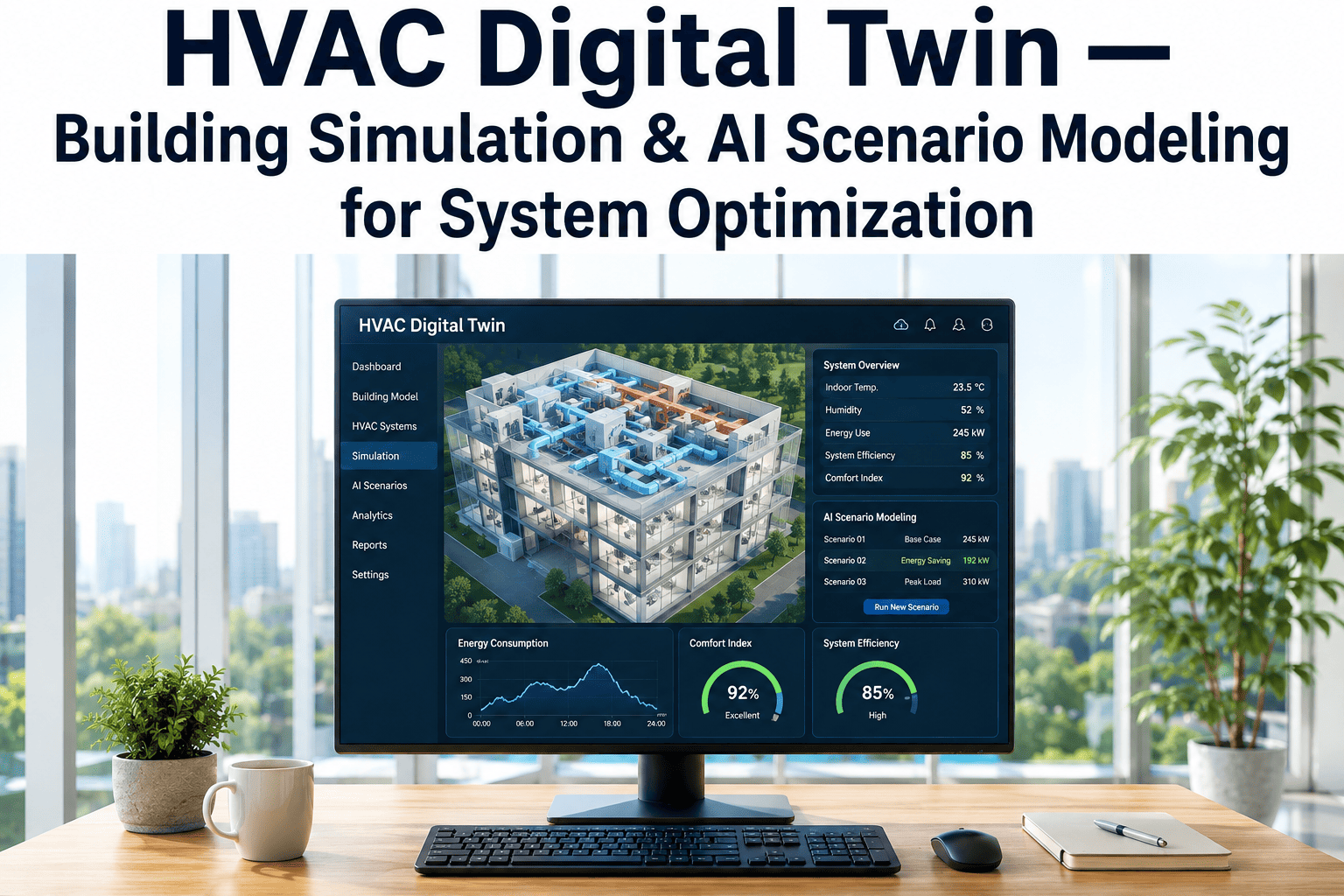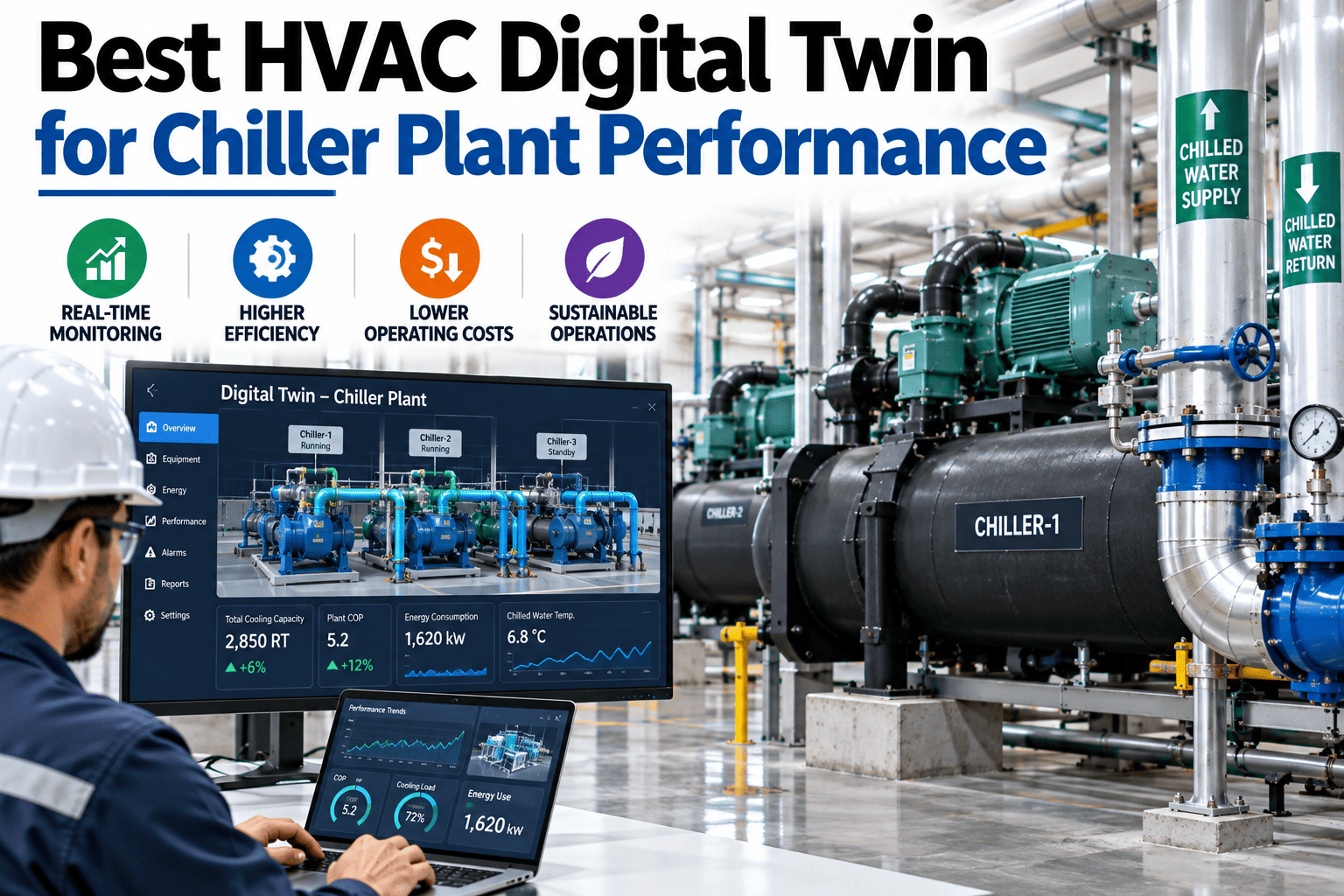
A chiller's coefficient of performance drifts for months before anyone notices, because the number that actually matters — how much cooling the plant delivers per unit of energy it consumes — gets buried under normal day-to-day swings in load and outdoor temperature. A digital twin solves this by running a physics-based model of the chiller plant alongside the real one, continuously, so the twin's predicted COP under today's exact conditions becomes the baseline the real plant gets measured against. The gap between the two isn't noise — it's degradation, isolated from every variable that would otherwise hide it. The same twin can then test sequencing and staging decisions in simulation before committing them to the real plant. Facilities teams wanting to see this modeled against their own chiller plant can walk through a digital twin build with iFactory AI's team.
See COP Degradation the Moment It Starts — Not After the Utility Bill Shows It
iFactory pairs a physics-based chiller plant model with live sensor telemetry, so real performance gets compared against what the plant should be doing right now — not last year's average.
Why a Fixed COP Number Hides Real Degradation
A chiller's coefficient of performance is not one number — it changes with part-load ratio, outdoor conditions, and chilled water setpoint, typically peaking near full load and falling off at lower loads. Comparing today's COP against yesterday's, or against the nameplate rating, conflates normal operating variation with actual mechanical degradation, and the two get impossible to tell apart without a model of what COP should be under today's specific conditions.
Today's COP against nameplate or a flat historical average — a drop could mean degradation, or it could just mean today is a low-load day. The two look identical without more context.
Today's actual COP against what the physics model predicts for today's exact load, outdoor temperature, and setpoint — so a gap between the two numbers is degradation, isolated from everything else.
What the Physics Model Actually Tracks
A chiller plant twin isn't a black-box prediction — it's built from the same physical relationships an engineer would use to size and evaluate the equipment, continuously fed with live telemetry so the model's assumptions stay current with what the plant is actually doing.
Approach Temperature
The gap between leaving condenser water and refrigerant condensing temperature — the earliest and most direct signal of tube fouling, well before it shows up in leaving water temperature.
Refrigerant State
Superheat and subcooling trends flag refrigerant charge loss or expansion valve wear long before cooling capacity is visibly affected.
Compressor Load Signature
Amp draw and oil pressure differential at a given load reveal mechanical stress developing inside the compressor before a hard alarm ever fires.
kW/Ton Efficiency
The composite efficiency figure the twin's physics model predicts for current conditions, compared continuously against what the plant is actually drawing.
See Your Chiller Plant's Twin-Predicted vs. Actual COP
Book a 30-minute session and iFactory AI will walk through what a physics-based twin looks like against your specific chiller plant telemetry.
Reading a Degradation Trend Instead of a Single Number
The value of the twin isn't a single day's comparison — it's watching the gap between predicted and actual performance move over weeks, which is where a developing fault separates itself from ordinary day-to-day noise.
| Week | Approach Temp | Twin-Predicted COP Gap | Status |
|---|---|---|---|
| Week 1 | 2.0°C | 0.1% | Within normal variation |
| Week 3 | 2.4°C | 1.8% | Early drift, monitor |
| Week 5 | 3.1°C | 4.5% | Consistent trend, schedule cleaning |
| Week 6 | 4.0°C | 6.2% | Efficiency penalty accelerating |
A chiller that maintained a 2°C approach temperature for six months can drift to 4°C within two — and each degree above design typically adds three to five percent to that chiller's energy consumption, which is exactly the kind of trend a twin surfaces weeks before the utility bill would.
Sequencing: The Other Half of What the Twin Does
Detecting degradation is one job. The other is testing how a multi-chiller plant should actually be staged, since the intuitive sequencing choice — run the biggest chiller first — is frequently not the most efficient one once part-load efficiency curves are accounted for.
Part-Load Efficiency Isn't Linear
A large chiller running at a moderate part-load ratio can be more efficient than a smaller chiller pushed near its own maximum — the crossover point depends on each unit's specific efficiency curve, not just its rated tonnage.
The Twin Tests Combinations Before Committing
Different equipment combinations across the day's load profile can be simulated in the twin, comparing predicted energy draw for each staging option before any change is made on the real plant.
Degradation Changes the Right Answer
A sequencing plan built on nameplate efficiency stops being optimal once one unit in the plant has degraded — the twin's live model updates the recommendation as real performance shifts, not just once a year.
Setpoint Reset Within Safe Limits
Chilled and condenser water temperature reset strategies get evaluated the same way — tested in the model against defined operating limits before being applied to the live plant.
A Composite Scenario: The Sequencing Fix That Cost Nothing
A commercial office building running two 1,000-ton chillers and one 500-ton chiller had staged its plant the same way for years, defaulting to the larger units first and bringing the smaller chiller online only once demand exceeded what the two large units could comfortably cover.
When the plant's actual load and efficiency data were run through a physics-based twin, the model showed that during a specific band of peak daytime demand, running all three chillers together at a moderate part-load ratio was more efficient than the existing two-plus-one staging — because the 500-ton unit's efficiency at high part-load was worse than the 1,000-ton units' efficiency at a more moderate load. Reprogramming the sequencing logic to reflect the twin's recommendation, with no equipment changes and no capital spend, recovered a meaningful share of the plant's peak-period energy consumption.
Physics-Based vs. Purely Data-Driven Models
Not every digital twin is built the same way, and the distinction matters for how much you can trust its predictions under conditions the plant hasn't seen recently.
Many production twins combine both approaches — a physics-based core handles the well-understood thermodynamics, while a data-driven layer on top corrects for the plant-specific quirks a pure physics model can't capture from first principles alone.
Where iFactory's Twin Connects to Your Plant
Existing BMS Integration
Chiller plant controller telemetry — supply and return temperatures, refrigerant pressures, oil temperature, approach temperatures, kW/ton — connects through standard BACnet, Modbus, or API integration, without new hardware.
Four-State Health Classification
Each chiller's condition is classified as healthy, moderately stressed, highly stressed, or critical, so engineers can prioritize interventions before a threshold is breached rather than reacting to a single alarm.
Scheduling Windows, Not Just Alerts
A degradation trend surfaces with enough lead time to schedule tube cleaning or a compressor service during a planned low-occupancy window instead of discovering it during peak demand.
Sequencing Recommendations That Update
Staging logic reflects each chiller's current, real efficiency curve rather than a fixed assumption set once at commissioning and never revisited.
iFactory connects to your existing chiller plant controllers and BMS — Siemens, Johnson Controls, Honeywell, Schneider, Tridium — to build a calibrated physics-based twin without new sensors or a plant shutdown, so COP degradation and sequencing opportunities surface from data your plant is already generating.
Frequently Asked Questions
How is a digital twin different from just monitoring chiller sensors?
Raw sensor monitoring shows you what the plant is currently doing. A digital twin adds a physics-based model that predicts what the plant should be doing under those exact conditions — load, outdoor temperature, setpoint — so the gap between predicted and actual performance isolates real degradation from normal operating variation. Without that model, a COP drop on a low-load day looks identical to a COP drop caused by genuine tube fouling, and the two require very different responses. iFactory AI's team can walk through how this distinction plays out on your specific chiller plant.
Does building a chiller plant twin require new sensors or a shutdown?
Typically not. Roughly 60 to 70 percent of the sensing a predictive program needs is already flowing through a building's existing automation system, and iFactory integrates with existing BMS platforms through standard protocols like BACnet, Modbus, or API connections. The gap most facilities have isn't instrumentation — it's that chiller controller data, approach temperature trends, and compressor signatures were never connected to a model that turns a slow drift into a scheduled action.
How much can sequencing optimization actually save without any equipment changes?
Facilities commonly find 10 to 15 percent savings from sequencing and staging corrections alone, discovered once a physics-based model reveals that the intuitive staging choice — running the largest chiller first — isn't actually the most efficient one across a real load profile. Because part-load efficiency curves differ between units, the right combination changes with load and with each chiller's current condition, which is why a static staging rule set once at commissioning tends to leave savings on the table for years. Book a demo to see this modeled against your plant's actual chiller mix.
How early does a twin catch condenser fouling compared to waiting for the utility bill?
Condenser fouling reduces heat transfer efficiency by 10 to 30 percent before it becomes visible in leaving water temperature, and rising approach temperature is the earliest reliable signal — sometimes appearing weeks before any efficiency penalty would show up in a utility bill or a hard alarm. A chiller maintaining a stable approach temperature for months can drift meaningfully within a couple of weeks once fouling accelerates, which is exactly the trend a continuously running twin is positioned to catch early.
Can a physics-based twin handle unusual operating conditions the plant hasn't experienced recently?
Generally, yes, and this is one of the practical advantages over a purely data-driven model. A physics-based model is built from known thermodynamic and mechanical relationships rather than learned entirely from historical examples, so it tends to predict sensibly and degrade gracefully under rare conditions instead of failing unpredictably the way a model with no exposure to that scenario in its training history might. Many production twins pair this physics core with a data-driven correction layer to capture plant-specific quirks the physics alone wouldn't account for.
Give Your Chiller Plant a Live Performance Baseline, Not a Yearly Average
iFactory's digital twin compares real chiller performance against what the physics model predicts for today's exact conditions, isolating degradation and surfacing sequencing savings your existing equipment already has to give. Book a walkthrough to see it on your plant.