Cement kilns, refineries, and semiconductor cleanrooms have run digital twins for a decade, but commercial and campus HVAC systems are only now catching up — and the gap is costly. Facility teams still test new control sequences on live equipment, discover retrofit savings only after the capital is spent, and troubleshoot comfort complaints by trial and error across thousands of square feet. A building digital twin closes that gap by giving operations directors a living, data-driven replica of every air handler, chiller, and zone — one that can be interrogated, stress-tested, and rewound before a single valve is touched in the real building. If your team is still making six-figure HVAC decisions on gut feel and spreadsheets, Book a Demo to see how iFactory turns your building data into a decision engine.
Test Every HVAC Decision Before You Make It
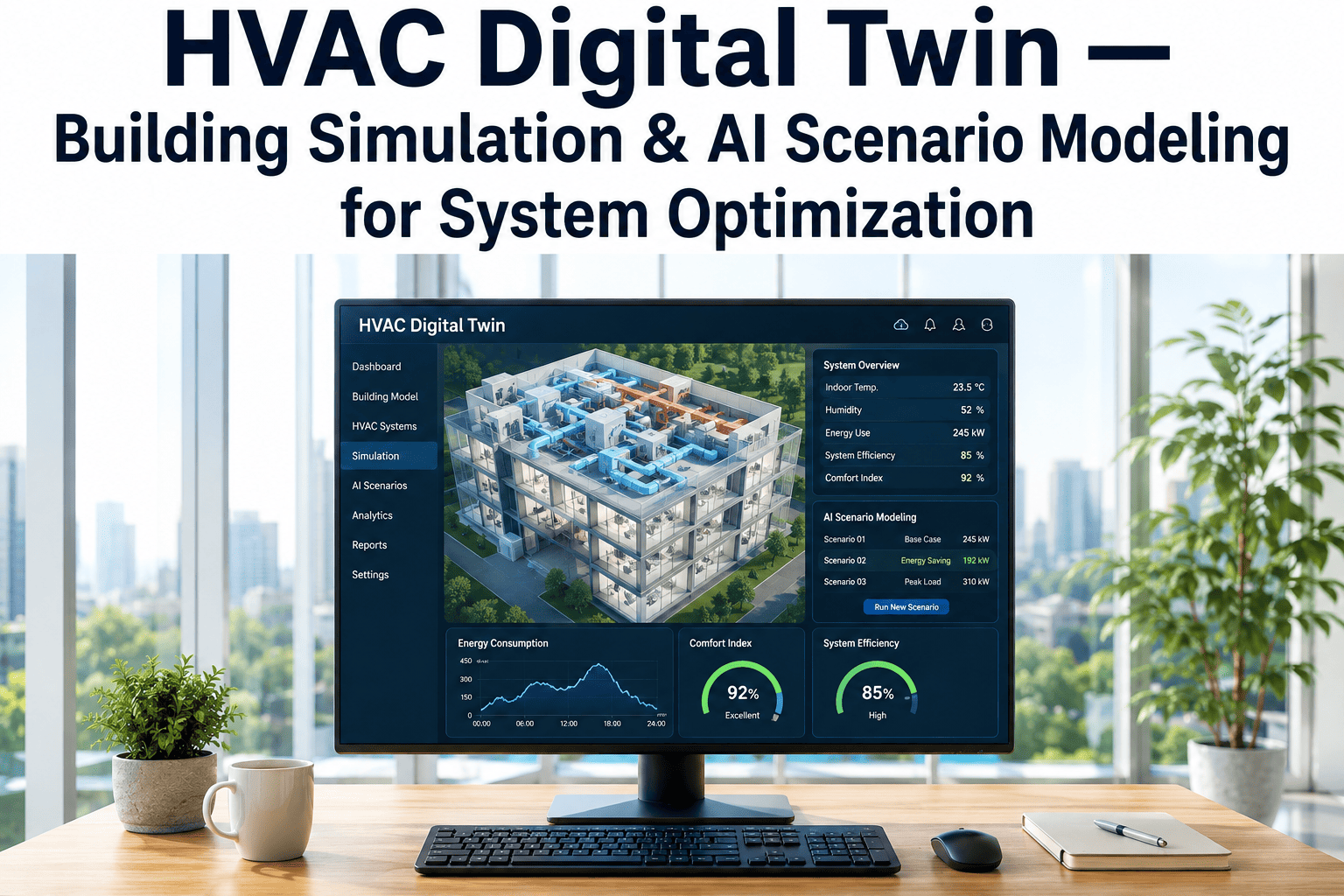
iFactory's digital twin platform simulates control strategy changes, equipment staging, and retrofit scenarios against your real building data — so operations directors commit capital with evidence, not estimates.
Why Static HVAC Planning Breaks Down at Scale
Most operations teams plan HVAC changes the same way they did fifteen years ago: a spreadsheet estimate, a pilot on one floor, and a hope that the results generalize. That approach was tolerable when energy was cheap and buildings were simple. Neither is true anymore. Multi-building portfolios, tighter emissions targets, and aging mechanical plants mean every control change now carries real financial and comfort risk. Three failure patterns show up again and again when planning happens without a simulation layer underneath it.
Blind Retrofits
Chiller and AHU upgrades get sized on rule-of-thumb load estimates, leaving real savings and payback timelines undiscovered until after the check clears.
Untested Control Logic
New sequences of operation get pushed live and debugged in real time, risking comfort complaints, nuisance alarms, and equipment short-cycling.
Reactive Commissioning
Faults surface as occupant complaints months after startup, long after the commissioning team has moved to the next project.
The Building Digital Twin: From Model to Decision Engine
Live Model Synchronization
The twin ingests BAS points, meter data, and weather feeds continuously, so the virtual building always mirrors real occupancy, load, and equipment condition rather than a static as-built drawing.
Scenario Sandbox for Control Logic
New sequences of operation, setpoint schedules, and staging strategies run against the simulated building first, exposing comfort or efficiency issues before they ever touch live equipment.
Retrofit & Capital Project Simulation
Model chiller replacements, VFD retrofits, or economizer upgrades against a full year of real load data, producing defensible payback and risk estimates before capital is committed.
What-If Scenario Modeling
Compare staging strategies, occupancy shifts, or extreme weather scenarios side by side, giving operations directors a way to pressure-test resilience plans without waiting for the actual event.
Portfolio-Wide Twin Rollout
Once validated on one building, the twin template extends across a portfolio, letting operations directors compare performance and retrofit priority across every site from one view.
Digital Twin Maturity Model: Where Does Your Portfolio Sit?
Most facility teams sit at Level 1 or Level 2 today, relying on static models built once during design and never updated. Reaching Level 4 changes how every future retrofit and control decision gets made. Schedule a Maturity Review to see where your buildings stand.
| Maturity Level | Model Basis | Update Frequency | Decision Confidence |
|---|---|---|---|
| Level 1: As-Built Only | Design Drawings | Never Updated | Low |
| Level 2: Periodic Model | Manual Re-Calibration | Annual | Moderate |
| Level 3: Connected Model | BAS + Meter Feeds | Daily | High |
| Level 4: Live Decision Twin | Real-Time IoT + AI | Continuous | Predictive |
We used to argue for months over which chiller plant upgrade would pay back fastest. Now we run the scenario in the twin, look at the simulated energy curve, and have an answer in an afternoon. The twin has changed how our capital committee makes decisions.
How Scenario Modeling Actually Works
Behind every simulated decision is a continuous loop that keeps the virtual building honest against reality. Here is the sequence that runs every time a new scenario is tested.
Stop Guessing. Start Simulating.
See how a live digital twin gives your operations team the confidence to test HVAC strategy changes before they ever touch equipment.
From First Sync to First Scenario: Your Rollout Timeline
Building a usable twin does not require a multi-year IT project. iFactory's deployment is structured to deliver a working, calibrated model and your first validated scenario inside six weeks.
Weeks 1–2: Data Connection
BAS points, meters, and weather data are mapped and streamed into the twin environment for the target building or campus.
Weeks 3–4: Model Calibration
The virtual model is tuned against historical performance until simulated and actual energy curves align closely.
Week 5: First Scenario Run
Your team defines a real retrofit or control question, and the twin produces a side-by-side comparison of outcomes.
Week 6: Decision Dashboard Live
Operations directors get a standing dashboard to run future scenarios independently, without waiting on outside consultants.
Beyond Energy: Comfort, Resilience, and Team Confidence
Energy savings get the headline numbers, but operations directors who have run a digital twin for a full year usually point to something less quantifiable as the bigger win: fewer surprises. Comfort complaints that used to take weeks of trial-and-error troubleshooting now get diagnosed against the twin in an afternoon, because the model can isolate whether a zone issue traces back to a failed damper, a miscalibrated sensor, or a sequence that never accounted for that space's actual occupancy pattern. Resilience planning benefits the same way. Extreme heat events, chiller failures, and utility curtailment requests can all be simulated against the twin ahead of time, so the emergency response plan is based on tested outcomes rather than a binder nobody has opened since it was written. And for younger engineers on the operations team, the twin becomes a training tool in its own right — a safe place to see how a change ripples through the mechanical system before they are ever responsible for making that change on a live building.
Where the Twin Pays for Itself First
Not every building sees the same return from a digital twin on day one. Operations directors managing mixed portfolios typically prioritize rollout based on where scenario testing removes the most risk or unlocks the largest capital decision. These three building types consistently show the fastest payback from twin adoption.
Critical Air Change Compliance
Twins let teams test air change rate changes, pressure relationships, and filtration upgrades against simulated occupancy before touching spaces where downtime is not an option, reducing the risk of a failed compliance inspection.
Seasonal Load Swing Planning
Semester-driven occupancy swings make load forecasting difficult with static models. The twin captures multi-year occupancy patterns, giving facilities teams a realistic basis for chiller plant sizing and staging decisions.
Cooling Redundancy Stress Testing
Operations teams simulate equipment failure scenarios and extreme heat events against the twin to validate N+1 cooling redundancy without ever risking an actual outage during testing.
Frequently Asked Questions
How accurate does a digital twin need to be before it can be trusted for capital decisions?
A twin used for capital planning should be calibrated until its simulated energy and comfort outputs track actual building performance within a narrow margin across a full seasonal cycle. iFactory's calibration process checks this against 12 months of historical data before any scenario results are surfaced to your team, and the model is continuously re-validated as new data arrives so accuracy does not drift over time.
Do we need new sensors or IoT hardware to build a digital twin of our building?
In most cases, no. The twin is built from data your BAS, meters, and controllers are already generating. iFactory connects to existing points through standard protocols and fills gaps with soft sensing where needed, which keeps the initial rollout fast and avoids a large hardware capital outlay before you have proven the value of the model.
Can the twin simulate multi-building portfolios or only a single site?
Once a twin template is validated on one building, it can be replicated across a portfolio, letting operations directors compare retrofit priority, energy performance, and control strategy outcomes across every site from a single view. This is particularly useful for portfolios with similar building types where lessons from one site inform capital planning at others.
How is this different from the energy model our design engineer built during construction?
A design-phase energy model is a one-time estimate built before the building existed and is rarely updated afterward. iFactory's twin stays synchronized with live operating data for the life of the building, so it reflects actual occupancy, equipment condition, and weather rather than design-day assumptions, which is why it can be trusted for ongoing operational decisions.
What kind of team is needed to run scenarios day to day?
Most operations directors run scenarios themselves through a guided dashboard without needing simulation expertise on staff. For more complex modeling questions, iFactory's team is available through Support to help structure the scenario and interpret results before a capital decision is finalized.
Give Your Next HVAC Decision the Evidence It Deserves
iFactory's digital twin platform turns building data into a live decision engine — so operations directors test first and commit capital with confidence.