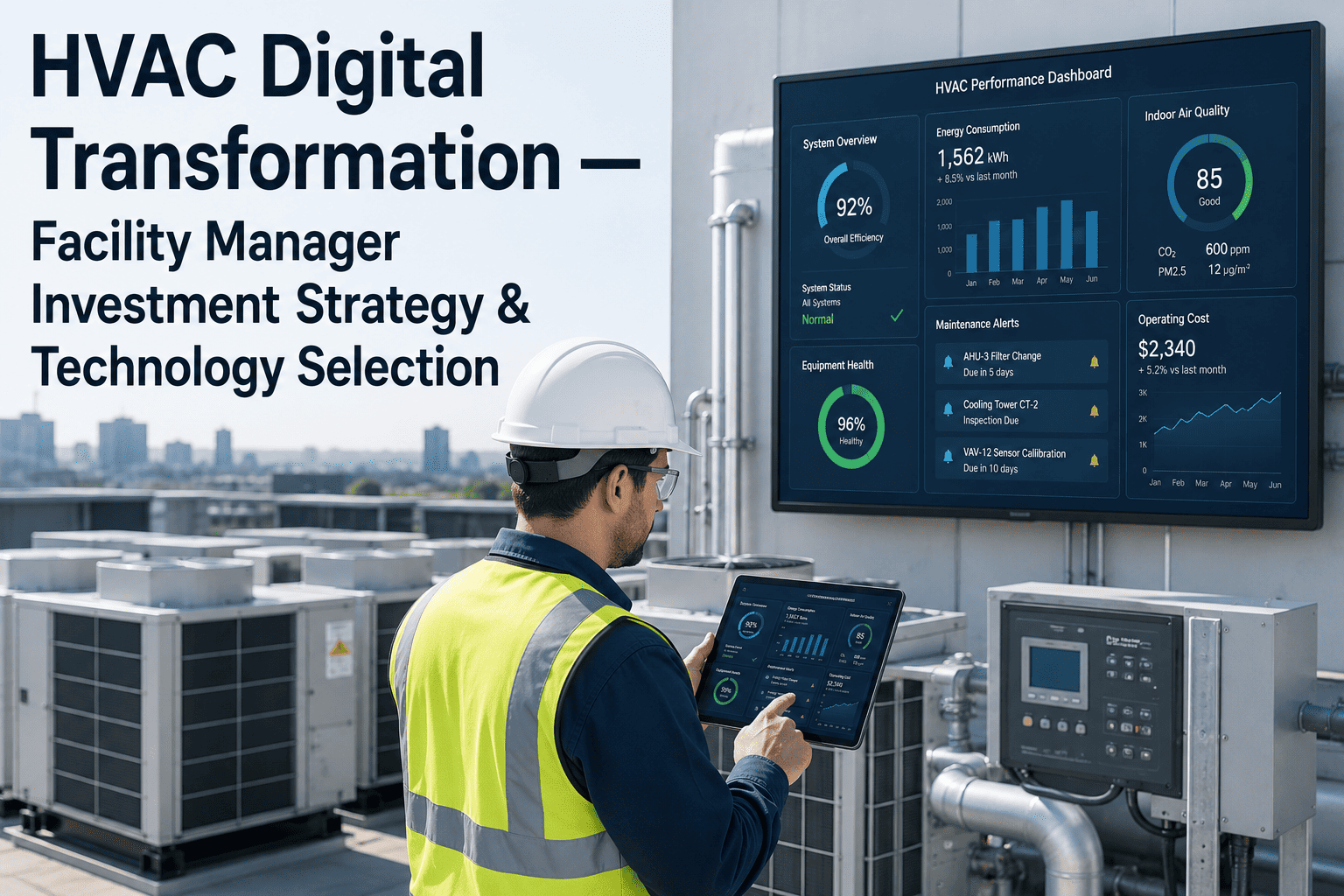
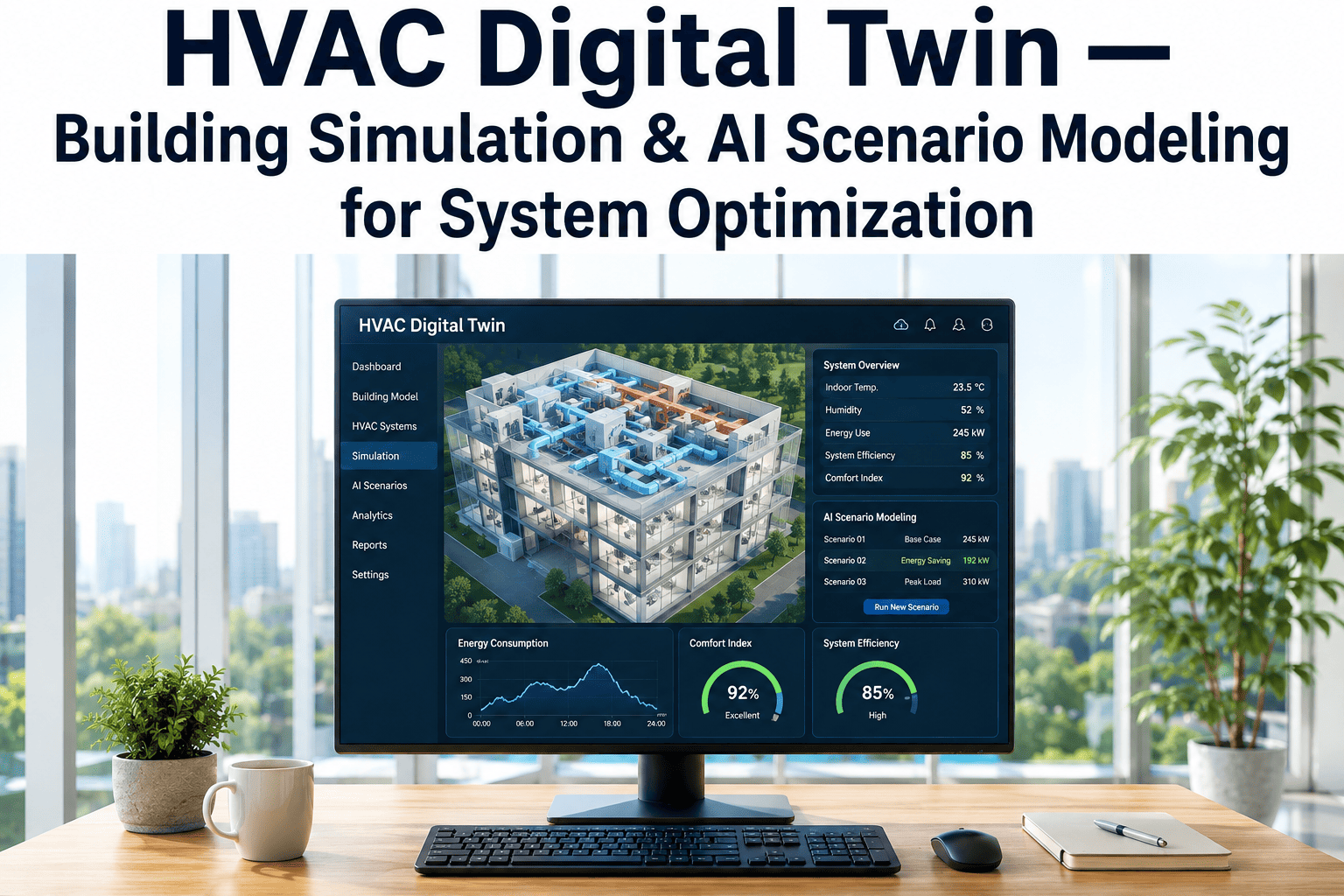
Digital transformation budgets for HVAC tend to get spent in the wrong order. A facility team buys a dashboard before it has reliable sensor data to feed it, or commits to a full building management system overhaul before proving out fault detection on a single chiller plant. The investment strategy that actually works runs the other direction — small, proven steps first, larger platform commitments only after the smaller ones show measurable results. To build an investment sequence around your own facility's current state, book a demo.
INVESTMENT STRATEGY · FACILITY MANAGEMENT
HVAC Digital Transformation: An Investment Strategy for Facility Managers
Align AFDD, predictive maintenance, and smart building investment with measurable energy, comfort, and sustainability targets — in a sequence that proves value before asking for the next budget line.
THE FOUR-TIER INVESTMENT LADDER
Climbing From Visibility to Autonomy, One Proven Step at a Time
Facility managers who secure recurring digital transformation budget almost always follow the same pattern: each tier of investment is justified by results from the tier before it, rather than asking finance to fund the full vision upfront on projected savings alone.
TIER 1
Visibility — Baseline Metering and Monitoring
Install submetering and basic condition sensors on the highest-cost equipment to establish a measured baseline for energy use, run-time, and fault frequency before any AI layer is added.
Typical Investment: Lowest tier, fastest payback
TIER 2
Detection — Automated Fault Detection and Diagnostics (AFDD)
Layer AFDD analytics onto the baseline sensor data to catch degrading equipment and inefficient sequences of operation automatically, rather than relying on manual review of trend logs.
Typical Investment: Moderate, justified by baseline data from Tier 1
TIER 3
Prediction — Predictive Maintenance and Work Order Automation
Move from detecting existing faults to predicting equipment degradation ahead of failure, with automated work orders routed directly to maintenance teams or contracted technicians.
Typical Investment: Higher, justified by avoided downtime from Tier 2
TIER 4
Optimization — Smart Building Orchestration
Coordinate HVAC, lighting, and demand response as one optimized system, adjusting setpoints and sequencing in near real time based on occupancy, weather, and utility signals.
Typical Investment: Highest, reserved for portfolios with mature Tier 1–3 data
Find Out Which Tier Your Facility Is Actually Ready For
Most facility teams overestimate their tier readiness. We'll assess your current sensor coverage and data maturity honestly before recommending next steps.
Book a Demo
MAKING THE CASE TO FINANCE
Tying Each Tier to a Metric Finance Actually Cares About
Facility managers frequently struggle to secure digital transformation budget not because the case is weak, but because it is presented in facility-team language rather than the metrics finance evaluates capital requests against. Each tier above maps cleanly to a business metric worth naming explicitly in a budget request.
Tier 1 → Baseline Energy Cost per Square Foot
Submetering data establishes the number finance will use to measure every subsequent tier's savings against.
Tier 2 → Avoided Emergency Repair Spend
AFDD catch rates translate directly into a reduction in unplanned, premium-rate emergency service calls.
Tier 3 → Equipment Lifespan Extension
Predictive maintenance defers capital replacement cost by addressing degradation before it shortens equipment life.
Tier 4 → Utility Demand Charge Reduction
Orchestrated setpoint and sequencing adjustments reduce peak demand charges, a line item finance tracks closely.
COMMON SEQUENCING MISTAKES
Where Facility Teams Skip Ahead and Pay for It Later
The tier structure above is not arbitrary — skipping a tier tends to produce a specific, predictable failure mode rather than simply a less efficient path to the same outcome.
Skip Tier 1Jumping straight to AFDD without a measured baseline means there is no way to prove the savings AFDD actually produced.
Skip Tier 2Deploying predictive maintenance without prior fault-detection experience means the team has no track record to trust the model's alerts, leading to alert fatigue.
Skip Tier 3Attempting full smart building orchestration without a proven predictive maintenance layer risks the system optimizing around equipment that is already silently failing.
SUSTAINABILITY ALIGNMENT
Where Decarbonization Targets Fit Into the Ladder
Facility managers increasingly carry sustainability reporting obligations alongside operational ones, and the good news is that the same investment ladder that improves reliability also generates the data most decarbonization reporting frameworks require. Tier 1 submetering produces the granular energy data needed for accurate emissions reporting, Tier 2 and Tier 3 reduce energy waste from degraded equipment, and Tier 4 orchestration directly supports demand flexibility programs many utilities now incentivize as part of grid decarbonization efforts.
FREQUENTLY ASKED QUESTIONS
What Facility Managers Ask When Building an Investment Case
How long does it typically take to move from Tier 1 to Tier 4?
Most facility teams spend the first several months establishing Tier 1 baseline data, then layer in Tier 2 AFDD once that baseline is validated, with the full progression to Tier 4 orchestration commonly spanning multiple budget cycles rather than a single fiscal year. Attempting to compress the timeline usually means sacrificing the proof points that make each subsequent budget request easier to win.
Book a demo to map a realistic timeline for your facility.
Can we start at Tier 2 if we already have submetering in place?
If genuine, validated baseline data already exists across the equipment you want to monitor, starting at Tier 2 is reasonable, though it is worth confirming the existing submetering actually covers the equipment and time resolution AFDD analytics need, since gaps here are a common and costly discovery mid-project.
Contact our support team to audit your existing metering coverage.
How do we present this ladder to finance without it sounding like four separate budget requests?
Framing it as a single multi-year roadmap with tier-specific milestones and metrics, as outlined above, tends to land better with finance than four disconnected requests, because it shows a plan with built-in accountability checkpoints rather than an open-ended commitment.
Book a demo to get a roadmap document formatted for a finance audience.
Does this ladder apply the same way to a single building versus a multi-site portfolio?
The tier logic holds at both scales, but a multi-site portfolio typically runs Tier 1 and Tier 2 in parallel across several buildings at once rather than sequentially, since the baseline and detection work does not need to fully complete at one site before starting at another.
Reach out to support to discuss parallel rollout planning across multiple sites.
BUILD A ROADMAP FINANCE WILL APPROVE
Get an Investment Sequence Matched to Your Facility's Actual Readiness
iFactory helps facility managers assess their current tier, prove out the next step, and build the metric-backed case for the tier after that.