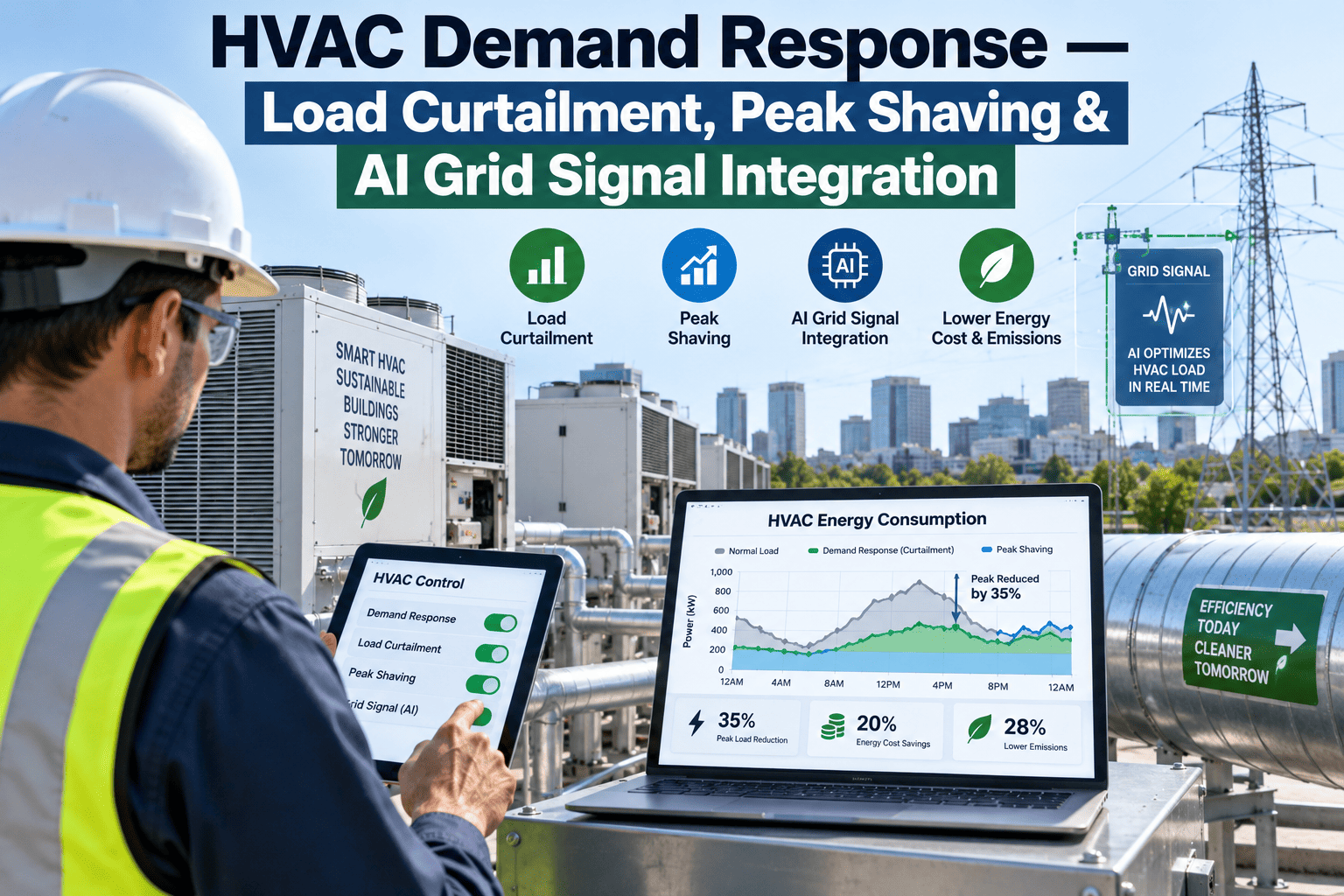
A demand response event asks a building to do something most facility teams have never practiced: cut electrical load on command, within a set window, without anyone inside noticing. Utilities pay real money for that capability — commercial facilities with curtailable HVAC load can earn well over $100,000 per megawatt annually through programs like PJM's Emergency Load Response Program — but the payment only shows up if the building can actually deliver the reduction every time it's called, without turning the event into a comfort complaint. The difference between a building that participates successfully and one that quietly drops out after a bad first event usually comes down to whether the curtailment strategy was zone-aware or just a blunt, building-wide setback. Facilities evaluating whether their HVAC load qualifies for a program can review their curtailment potential with iFactory AI's team.
Get Paid to Cut Load — Without Anyone Inside the Building Noticing
iFactory's zone-level control lets HVAC deliver the curtailment a demand response event requires while keeping occupied spaces inside comfort limits, so the revenue doesn't come at the cost of tenant experience.
What a Demand Response Event Actually Asks a Building to Do
A DR event isn't a vague request to "use less power" — it's a specific commitment with a notice period, a duration, and a measurable reduction target, and a building's revenue depends on hitting that target every time it's called, not just when it's convenient.
The Notice
Most programs require at least 90 minutes' notice before an event begins, giving a building a short window to prepare — which is exactly the window a good curtailment strategy uses to pre-cool before load has to drop.
The Window
Events commonly run one to three hours, often falling in the afternoon or early evening when grid demand peaks — the exact hours a building's own HVAC load also tends to be highest.
The Commitment
A facility nominates a specific curtailable load figure it's committing to deliver — this "nominated DR value" is what payments are calculated against, and what non-performance penalties are calculated against too.
The Verification
Performance is measured against a baseline load calculation, confirming the reduction actually happened — this is also why interval meter data matters well before enrollment, not just during an event.
What Buildings Actually Get Paid
Compensation structures vary meaningfully by market, program type, and how much curtailable load a facility can reliably deliver — but the range across current programs gives a useful sense of what's actually on the table.
| Program Type | Typical Compensation | What Drives the Payment |
|---|---|---|
| Capacity Programs (e.g. PJM ELRP) | $98,000–$170,000+ per MW annually | Committed curtailable capacity, availability, performance |
| Peak-Demand Performance Programs | ~$8/kW per month | Reduction during the utility's coincident monthly peak hour |
| Event-Based Curtailment | $10–$30/kW per event | Actual load reduction delivered during each called event |
| Economic / Wholesale Market DR | $50–$200/MWh | Real-time or day-ahead market pricing at time of curtailment |
A mid-size commercial building with 200–500 kW of curtailable HVAC load can realistically generate tens of thousands of dollars annually — and a facility with several megawatts of curtailable load moves into six-figure territory, all without any change to the building's core operations.
Estimate What Your Building's Curtailable Load Is Worth
Book a 30-minute session and iFactory AI will model expected DR revenue against a year of your building's actual interval data.
Blunt Load-Shedding Versus Zone-Aware Curtailment
The single biggest factor separating a demand response program that lasts from one that gets abandoned after the first bad event is whether the curtailment strategy treats the whole building the same or actually knows where people are.
The Standard Tactics That Deliver Curtailment Without Wrecking Comfort
Most automated demand response strategies lean on a small, well-tested set of tactics rather than anything dramatic — the goal is a measurable reduction that occupants genuinely don't notice, not a visible sacrifice.
Setpoint Shift
A one to two degree adjustment during the event window, small enough to stay within comfort tolerance for most occupants for the typical one-to-three-hour duration.
Pre-Cooling Ahead of the Call
Using the notice window to pre-cool occupied zones before the event starts, so the building enters curtailment with thermal headroom already banked.
Non-Critical Load Pausing
Pausing secondary loads — auxiliary equipment, non-essential ventilation in unoccupied zones — that contribute to the reduction without touching comfort at all.
Priority Zone Exemption
Defining which zones — server rooms, active conference spaces, sensitive tenant areas — are excluded from curtailment entirely, with the reduction target met elsewhere.
A Composite Scenario: The Event That Almost Ended a DR Program
A mixed-tenant office building had enrolled in a utility DR program its first year, running a straightforward building-wide setpoint shift across every zone during each called event to hit its nominated curtailment target.
The strategy worked on paper — the building consistently delivered its committed reduction — but tenant comfort complaints spiked every time an event ran during business hours, concentrated specifically in the fully occupied floors rather than the largely empty storage and back-office areas that made up a meaningful share of the building's total square footage. By the third event of the season, the facilities team was seriously considering dropping out of the program entirely rather than continuing to field complaints. Switching to a zone-aware strategy — concentrating the setpoint drift in the underoccupied floors and pre-cooling the fully occupied ones ahead of each event's notice window — let the building keep hitting the same nominated curtailment target while comfort complaints during events dropped to a level the facilities team considered a non-issue.
Aggregators and Curtailment Service Providers: Who Handles What
Most commercial buildings don't enroll directly in a wholesale market program — a curtailment service provider or aggregator sits between the building and the market, handling enrollment, compliance, and settlement in exchange for a share of the payment.
Handles Everything, Takes a Cut
The provider manages enrollment, event notification, performance reporting, and compliance in exchange for a revenue share commonly in the 15 to 50 percent range depending on the provider and market.
Fixed Fee, Payments Pass Through
The provider supplies the hardware and software gateway for a set monthly fee, while the full market payment flows to the building rather than being split as a percentage.
Full Control, Full Responsibility
A facility registers directly as its own curtailment service provider, keeping the entire payment but taking on compliance, training, and settlement responsibilities itself.
Non-Performance: The Risk Side of the Revenue
Demand response isn't free money — most capacity programs carry real penalties for failing to deliver a nominated reduction during a called event, and in some markets those penalties can exceed the payment the building would have earned for performing correctly.
Nominate a load figure you can reliably hit, not the maximum theoretical number
Overcommitting to chase a bigger payment increases the odds of a non-performance penalty that erases the gain — a conservative, consistently-deliverable figure performs better over a full season.
Verify the curtailment strategy actually works before the first real event
Running a practice curtailment against the building's own systems, outside of a paid event, is the cheapest way to catch a strategy that looks good on paper but underperforms in practice.
Know your baseline calculation before you're relying on it for payment
Performance payments are measured against a calculated baseline load, and understanding how that baseline is derived avoids disputes over whether a curtailment target was actually met.
iFactory connects to your existing BMS to execute zone-aware curtailment automatically the moment a DR event is called — pre-cooling occupied zones during the notice window, concentrating setpoint drift where it won't be noticed, and logging performance data for settlement.
Frequently Asked Questions
How much can a commercial building actually earn from HVAC demand response?
It depends heavily on the program, market, and how much curtailable load the building can reliably deliver, but current benchmarks give a useful range — capacity programs like PJM's Emergency Load Response Program can pay well over $100,000 per megawatt annually, while smaller event-based programs pay per kilowatt per event. A mid-size building with 200 to 500 kW of curtailable HVAC load can realistically generate tens of thousands of dollars a year, and larger facilities with several megawatts of flexibility move into six-figure territory. iFactory AI's team can model a realistic revenue range against your building's actual load profile.
Will demand response participation make our building uncomfortable for tenants?
It doesn't have to, and this is precisely where strategy matters most. A blunt, building-wide setpoint shift applied equally across every zone regardless of occupancy is the version that generates complaints, while a zone-aware strategy that concentrates setpoint drift in unoccupied or lower-priority spaces and pre-cools occupied zones ahead of the event window can deliver the same total reduction with far less occupant impact. Most automated strategies also use only a modest one to two degree setpoint shift, which stays within most people's comfort tolerance for the typical one-to-three-hour event duration.
What happens if a building fails to deliver its committed curtailment during an event?
Most capacity-based programs carry non-performance penalties, and in stricter markets those penalties can exceed the payment the building would have received for performing correctly, which is why nominating a conservative, reliably-deliverable load figure matters more than maximizing the theoretical commitment. Book a demo to see how automated, zone-level control reduces the risk of missing a committed reduction target.
Do we need to work through an aggregator, or can we participate directly?
Most buildings work through a curtailment service provider or aggregator, which handles enrollment, event notification, and settlement in exchange for a share of the payment, commonly in the 15 to 50 percent range depending on the provider and market. Smaller facilities in particular — those with as little as 100 kW of curtailable load — typically need an aggregator to access wholesale market programs at all, since direct registration usually involves compliance and reporting requirements not worth taking on below a certain scale.
How much advance notice do we get before a demand response event starts?
Notice periods vary by program, but a common minimum is around 90 minutes before an event begins, with events typically running one to three hours and often falling between noon and evening hours when grid demand peaks. That notice window is what a good curtailment strategy actually uses — pre-cooling occupied zones before the reduction has to start, rather than waiting until the event begins to react.
Capture DR Revenue Without Trading Away Tenant Comfort
iFactory's zone-level control automates curtailment from the moment an event is called, concentrating setpoint drift where it won't be felt and keeping occupied spaces comfortable. Book a walkthrough to see your building's DR revenue potential.