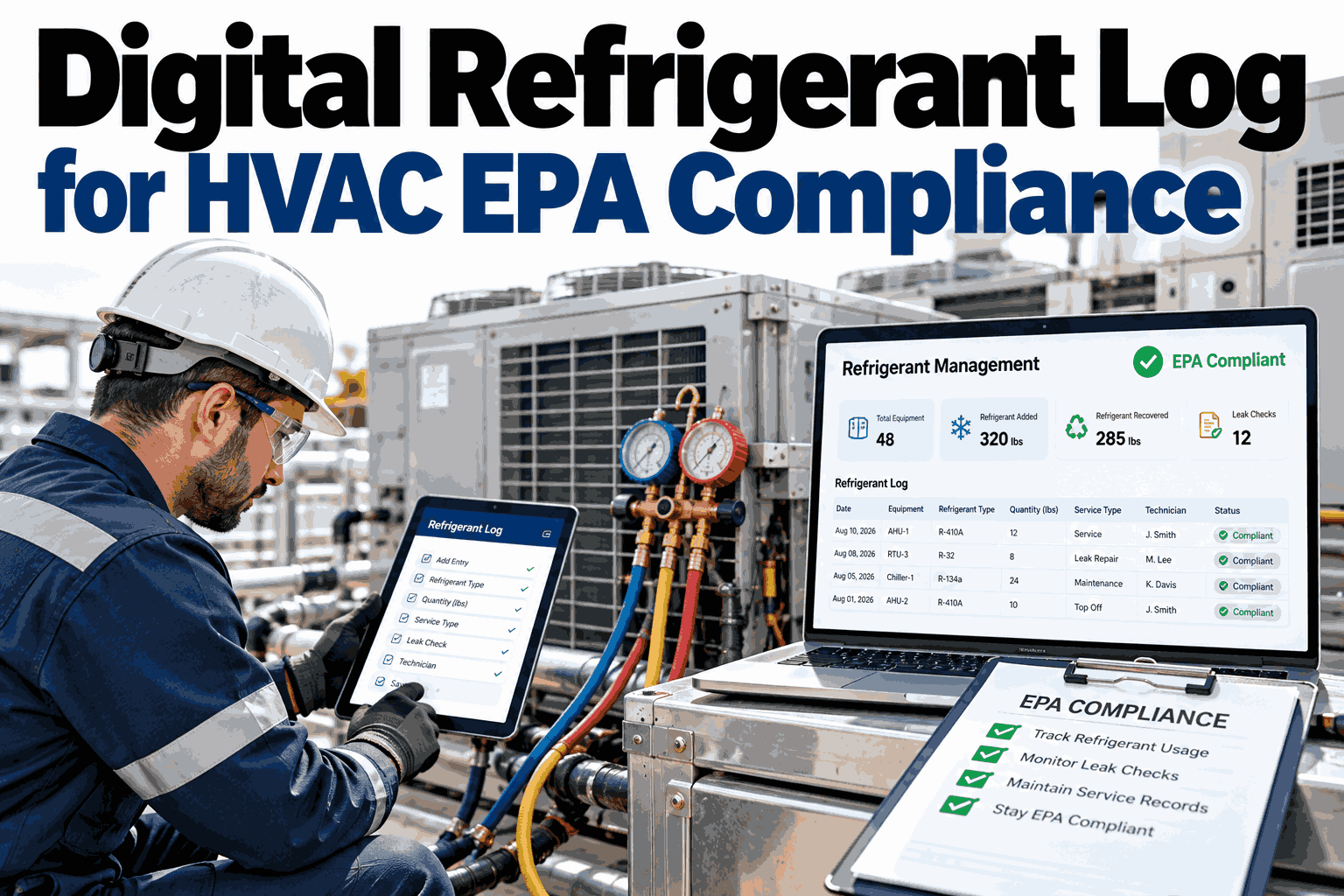
A refrigerant log only proves something if the numbers in it add up against each other. Purchased refrigerant, charged refrigerant, recovered refrigerant, and disposed refrigerant should reconcile within a reasonable margin, and most paper or spreadsheet logs never actually get checked that way. The gap is usually found by an auditor, not by the business. Talk through a reconciliation setup with the iFactory AI team before the next review.
A Refrigerant Log That Reconciles, Not Just Records
Cylinder tracking, charge and recovery events, and a reconciliation report that checks the numbers against each other automatically, instead of waiting for an audit to find the gap.
The Four Numbers a Compliant Log Has to Connect
A refrigerant program is really four separate counts, and a log that records them in isolation misses the point. They are supposed to check against each other.
Purchased
Refrigerant bought from a distributor, tied to a certified technician or employer at the point of sale.
Charged
Refrigerant added to a specific appliance during installation or service, logged against that unit's record.
Recovered
Refrigerant pulled from an appliance during service or decommissioning, logged with the certified technician who recovered it.
Disposed or Reclaimed
Recovered refrigerant sent for reclamation or destruction, with the quantity and destination on record.
When these four numbers are kept in separate systems, or not kept at all, nobody notices when the math stops making sense until someone goes looking for it.
What a Reconciliation Report Actually Checks
Reconciliation is not a new EPA form. It is the arithmetic check that turns four separate logs into one defensible answer.
The Basic Equation
Refrigerant purchased in a period should roughly equal refrigerant charged into equipment plus refrigerant added as top-off, minus any refrigerant still sitting unused in a cylinder.
The Recovery Side
Refrigerant recovered from service and decommissioning jobs should roughly equal refrigerant sent for reclamation plus refrigerant reused on another job, accounting for documented loss during recovery.
A gap on either side is not automatically a violation, but it is always a question worth answering before an auditor asks it first. Book a 30-minute demo and walk through a reconciliation report built from a real cylinder count.
Where the Gap Usually Comes From
A reconciliation gap rarely means refrigerant was vented or sold off the books. It almost always traces back to one of a few ordinary breakdowns in how the log was kept.
A Top-Off Never Logged
A technician adds half a pound during a routine call and moves on to the next job without recording it, breaking the charge-side total for that appliance going forward.
Recovered Refrigerant Reused Off-Book
Refrigerant recovered from one job gets reused on another the same day, which is legal, but only if both the recovery and the reuse are logged against the respective appliances.
A Cylinder Changes Hands Unrecorded
A partially full cylinder moves from one truck to another at a yard, and the new technician's log starts fresh without carrying over what was already in it.
None of these require bad intent. They require a log that does not catch a gap the moment it opens, which is exactly what a paper sheet or a disconnected spreadsheet cannot do. Industry surveys of field service recordkeeping have pointed to the same underlying weakness for years: businesses track pieces of the refrigerant picture in isolation, across trucks, offices, and individual technicians, but rarely connect those pieces into one running total that anyone actually checks.
Run a Reconciliation Check Against Your Own Cylinder Count
Bring a sample of recent purchase, charge, and recovery records to a 30-minute session and see where the gaps actually are.
What a Compliant Record Actually Has to Contain
EPA's recordkeeping requirements are specific about what belongs on each type of record, and a digital log only counts as compliant if these fields are actually present.
| Record Type | Who Keeps It | Required Fields |
|---|---|---|
| Service Record | Owner or operator, 50+ lb appliances | Date of service, type of service performed, quantity of refrigerant added |
| Service Invoice | Servicing technician | Amount of refrigerant added, issued to the appliance owner |
| Leak Inspection Record | Owner or operator, 50+ lb appliances | Inspections and tests performed to verify a leak repair |
| Disposal Record | Technician, 5 to 50 lb appliances | Location and date of recovery, refrigerant type, monthly totals recovered, amount sent for reclamation |
| Certification Proof | Technician | Copy of certification kept at the place of business |
Missing even one field does not always void a record, but it does weaken it in exactly the moment it needs to hold up. Schedule a demo to see every required field populated from a logged event automatically.
Cylinder-Level Tracking: Why the Container Matters as Much as the Job
Most logs track refrigerant by job. A reconciling log also has to track it by cylinder, because a cylinder is where the running balance actually lives between jobs.
Each Cylinder Carries a Running Balance
A cylinder's logged weight after every withdrawal or addition is what lets a reconciliation report catch a discrepancy at the container level, not just at the fleet level.
Transfers Between Trucks Get Logged Too
When a cylinder moves between technicians or vehicles, the transfer itself is an event worth recording, with the weight confirmed at handoff.
A cylinder that nobody has weighed in months is the single most common source of an unexplained reconciliation gap. Ask the iFactory AI team how cylinder-level balances are tracked between trucks.
Paper Log vs Connected Digital Log
The gap between a paper or spreadsheet log and a connected digital one is not about neatness. It is about whether a mismatch gets caught in days or in months.
Paper or Spreadsheet Log
Connected Digital Log
Neither approach changes what EPA requires a record to contain. The difference is how quickly a business finds out when its own numbers stop agreeing with each other. Get a live walkthrough of a connected log running against a real fleet.
What iFactory AI Adds to Digital Refrigerant Logging
iFactory AI is smart manufacturing and industrial software, and the same event-tracking engine that runs inventory reconciliation on a plant floor applies directly to field refrigerant management: every event logged, tied to a cylinder, and checked against the others automatically.
iFactory AI arrives pre-configured on an NVIDIA server that ships racked and ready with the refrigerant logging and leak register module pre-loaded. Rack it, connect power and Ethernet, and cylinder tracking starts running. Scope covers cabling, network, field-service software integration, team training, and 24x7 remote monitoring.
Digital Log Readiness Self-Check
Use these ten checks to find where a refrigerant log is recording events but not actually reconciling them.
Each unchecked box is a place where a logged event and the real world could quietly drift apart.
Frequently Asked Questions
Is reconciliation itself an EPA requirement, or just good practice?
EPA requires specific records to be kept, such as service dates, quantities added, and disposal details, but it does not mandate a formal reconciliation report. Reconciling those records against each other is the practical way a business confirms its own compliance before an auditor does it for them. Request a demo to see how a reconciliation report is actually structured.
How often should a reconciliation check actually run?
Monthly is common for active fleets, since a gap caught within a month is far easier to trace back to a specific job than one discovered a year later during an annual review. Smaller operations may reconcile quarterly without losing much traceability.
What counts as an acceptable reconciliation margin?
There is no fixed EPA number for an acceptable gap, since small discrepancies from metering and documented recovery loss are expected. A business should set its own threshold with its compliance advisor and treat anything above it as worth investigating, not automatically as a violation.
Does a cylinder need its own ID if the fleet is small?
Cylinder-level tracking matters more as a fleet grows and cylinders move between trucks and technicians, but even a small operation benefits from it the first time a reconciliation gap needs to be traced to a specific container rather than guessed at.
How long should these records be kept on file?
Retention periods vary by record type and the specific rule that applies, and some leak-repair records under newer requirements carry longer retention than older Section 608 service records. Confirming the right period for a specific record type is worth a direct conversation with the compliance team.
Make the Numbers Reconcile Before an Auditor Checks Them
iFactory AI ties every purchase, charge, recovery, and disposal event to a cylinder and checks the totals automatically. Book a walkthrough using your own cylinder and service records.