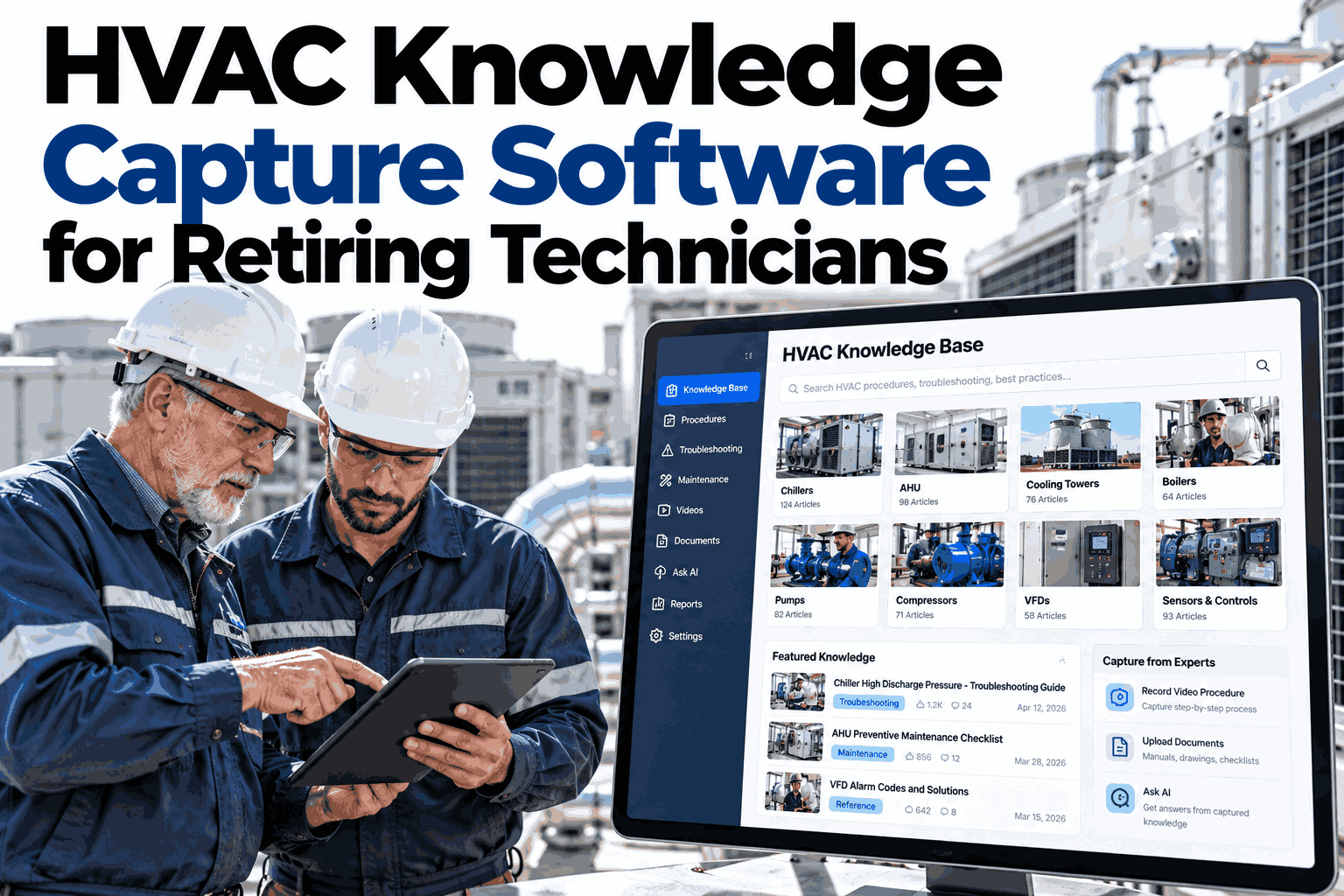
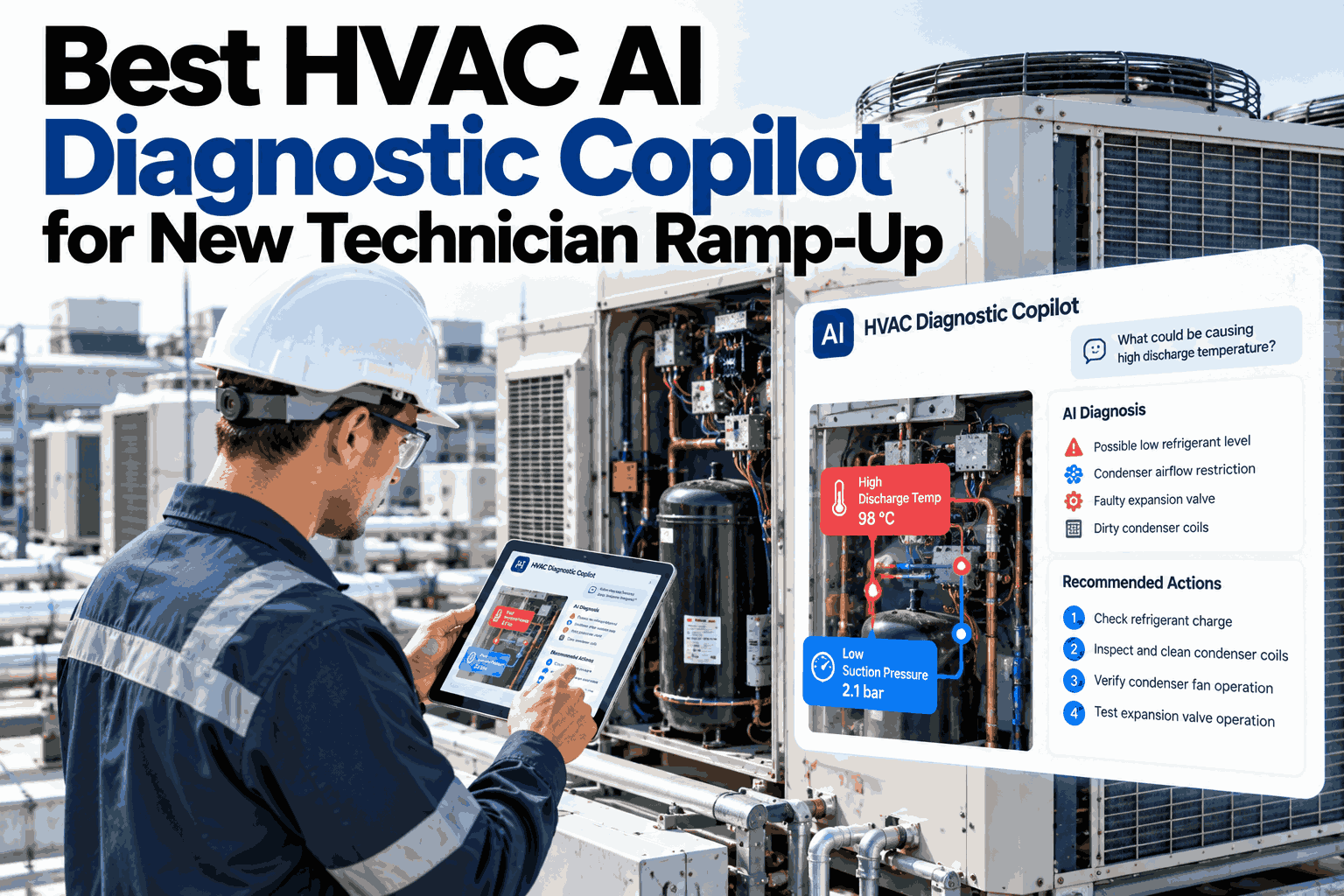
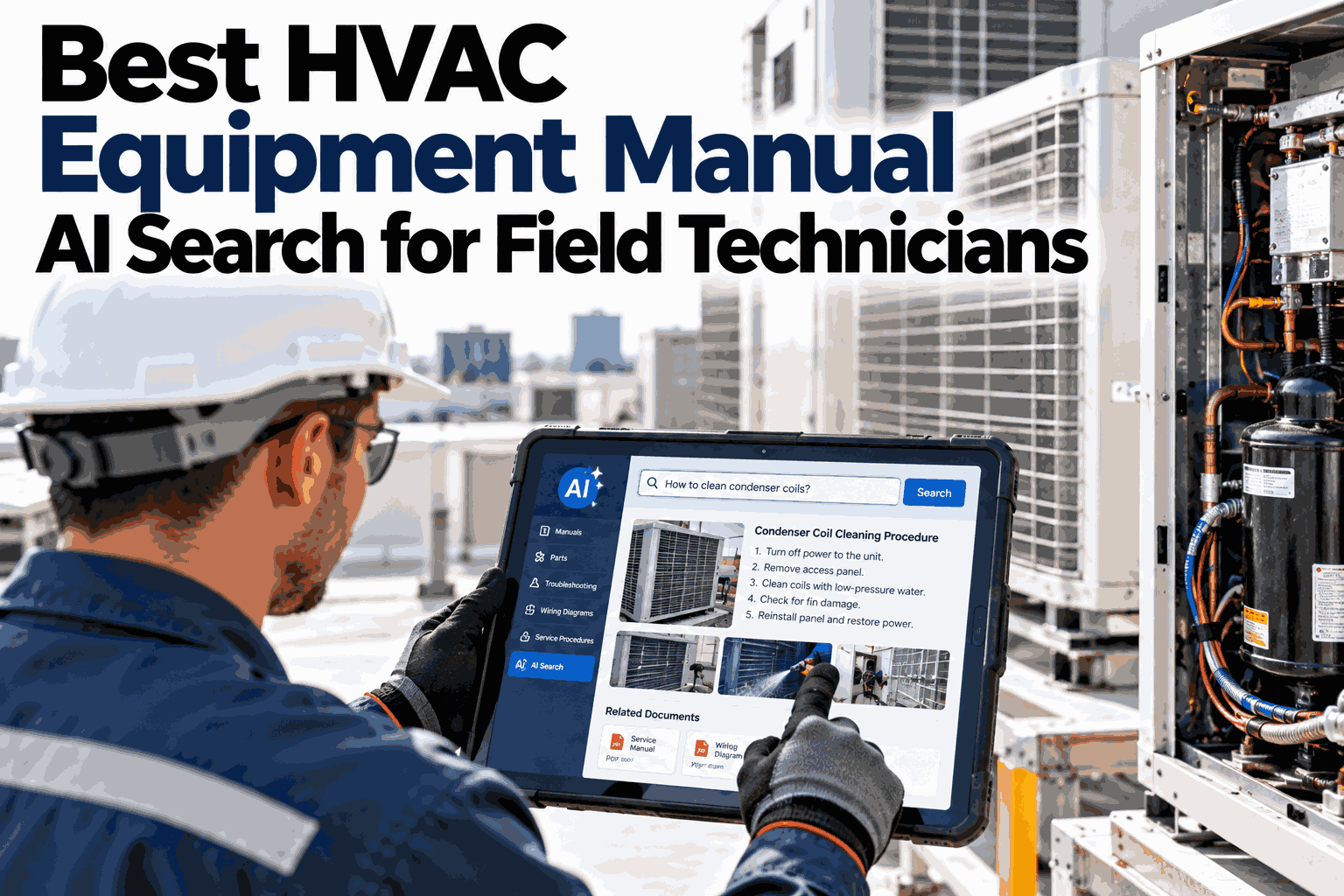
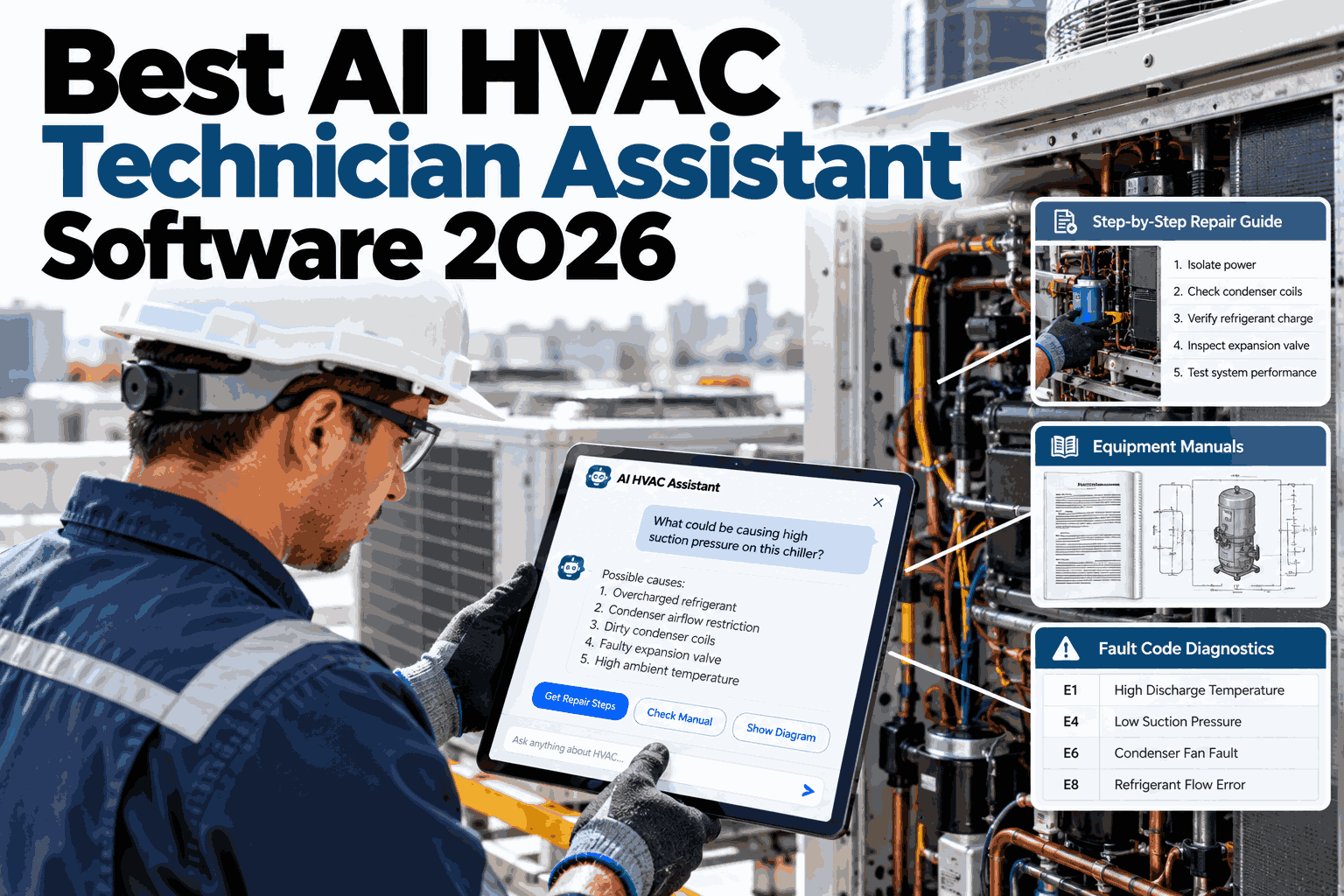
When a thirty-year HVAC technician retires, the exit interview rarely captures what actually made them good at the job. Nobody writes down the sound a failing compressor makes before it actually fails, or the specific sequence they check on a particular chiller brand that nothing in the manual mentions. That knowledge either transfers informally to whoever happens to ride along with them in their final months, or it leaves the building entirely and shows up later as longer diagnostic times and more callbacks. Structured capture before the retirement date, not during the farewell lunch, is what actually preserves it, and if you want to see how a capture program gets built around a specific retiring tech, you can walk through a capture plan with our team.
Knowledge capture, 2026
Capture a Retiring Technician's Knowledge Before It Walks Out the Door
Structured interviews, video walkthroughs, and AI transcription that turn decades of tribal knowledge into something the next technician can actually search and learn from.
What's typically at risk per retiring senior tech
Years of hands-on service experience20-35 yrs
Equipment-specific fault patterns knownHundreds
Patterns ever written downVery few
Typical notice before departureWeeks
The real problem
Why Tribal Knowledge Disappears So Quietly
Nobody decides to lose this knowledge. It simply never gets written down because the person who has it is too busy doing the job to document how they do it, and nobody asks the right questions before it is too late.
Experts don't self-document
Pattern recognition becomes instinct over time, which makes it genuinely hard for an expert to explain unprompted.
Shadowing is inconsistent
A new hire riding along for a few weeks only sees whatever faults happen to occur during that window.
Exit timing is late
Capture conversations often start only after a retirement date is announced, leaving little runway.
No searchable format
Even when something gets written down, it usually sits in a personal notebook nobody else can find.
Three methods
The Three Capture Methods That Actually Work
No single method captures everything a senior tech knows. Combining all three gets closer to the full picture than any one approach used alone.
1
Structured interviews
Guided questions pull out specific fault patterns and judgment calls a free-form conversation would miss entirely.
2
Video walkthroughs
Recording a real diagnostic on an actual unit captures sequence, posture, and tool use that words alone cannot.
3
AI transcription
Interviews and walkthroughs are transcribed and tagged automatically, turning raw footage into searchable text.
Interview design
What a Structured Interview Actually Asks
A good capture interview does not ask "tell me what you know." It asks specific, scenario-based questions that force concrete, reusable answers.
What's the first thing you check on a unit that's short cycling, before you even open a panel?
I listen to it run a full cycle first. If it cuts out early and restarts fast, I'm already thinking sensor or airflow before refrigerant.
Is there a sound or smell on this equipment line that tells you something before a gauge would?
A slight rattle on startup on these older units usually means the fan blade is loosening, months before it actually fails.
Questions like these turn instinct into a reusable pattern, the kind of detail that never shows up in a manual but shows up constantly on real calls.
Build an Interview Plan for Your Next Retiring Tech
Tell us who is retiring and when, and we will put together a structured interview and video capture schedule around their timeline.
On camera
How a Video Walkthrough Capture Session Runs
Video sessions work best scheduled around real service calls rather than staged demonstrations, since the small habits that matter most usually show up under normal working conditions.
1
A real or recent fault is chosen as the walkthrough subject, matched to equipment common across the fleet.
2
The tech narrates their reasoning out loud while performing the actual diagnostic steps on camera.
3
A second camera or close-up angle captures gauge readings, tool positioning, and panel access points.
4
The session is reviewed with the tech afterward to fill in anything they skipped or assumed was obvious.
From footage to search
How AI Transcription Turns Raw Capture Into Usable Knowledge
Hours of interview and video footage are only useful if the next technician can actually find the specific moment they need. This is where transcription and tagging do the real work.
Raw interview or video
→
AI transcription with timestamps
→
Tagged by equipment and fault type
→
Searchable knowledge entry
A tech troubleshooting a short-cycling unit months later can search that exact symptom and land directly on the timestamped moment where the retired expert explained it, instead of scrubbing through hours of unlabeled footage.
Measured impact
What Changes Before and After a Capture Program
The difference shows up most clearly in how a new tech handles a fault type they have never personally seen before.
No capture program
Knowledge leaves entirely when the tech retires
New techs relearn the same patterns by trial and error
Nobody can confirm what a departed tech actually knew
With structured capture
Patterns remain searchable long after the tech is gone
New techs learn from real scenarios, not just manuals
Institutional knowledge becomes a reviewable asset
Timing it right
Building a Capture Schedule Around an Actual Retirement Date
Capture quality depends heavily on how much runway exists before the last day. A rushed single interview captures far less than a planned sequence spread across the final months.
12+ weeks out
Schedule structured interviews on core equipment types and most common fault categories first.
6-8 weeks out
Record video walkthroughs on real calls as they come up naturally across the remaining weeks.
2-4 weeks out
Review transcribed and tagged entries with the tech directly to fill gaps before the last day.
After departure
The captured library stays searchable for every tech who faces a fault type the retired expert once handled.
Frequently asked questions
What Service Managers Ask Before Starting a Capture Program
How much of a retiring tech's time does a full capture program actually require?
What if the retirement date comes with very little notice?
Even a compressed two to three week capture sprint focused on the highest-value equipment and fault types is far better than no structured capture at all.
Ask about rapid capture options for short timelines.
Does the captured knowledge stay tied to one person, or merge into a shared library?
Entries are tagged by equipment and fault type rather than by individual, so techs find the right pattern without needing to know who originally captured it.
See how tagging works on a short walkthrough.
Can this also capture knowledge from techs who are not retiring, just experienced?
Yes, the same structured interview and video format works for any senior tech, and many companies run it continuously rather than only triggering it at retirement.
Discuss an ongoing capture cadence with support.
How accurate is AI transcription on noisy mechanical room audio?
Transcription accuracy holds up well in typical field conditions, and any unclear sections are flagged for a quick manual review rather than silently guessed at.
Review transcription quality on a sample session.
Don't let decades of judgment walk out the door
Start Capturing Your Retiring Technician's Knowledge Today
Book a session with iFactory AI to plan structured interviews, video walkthroughs, and AI transcription around your next retirement.