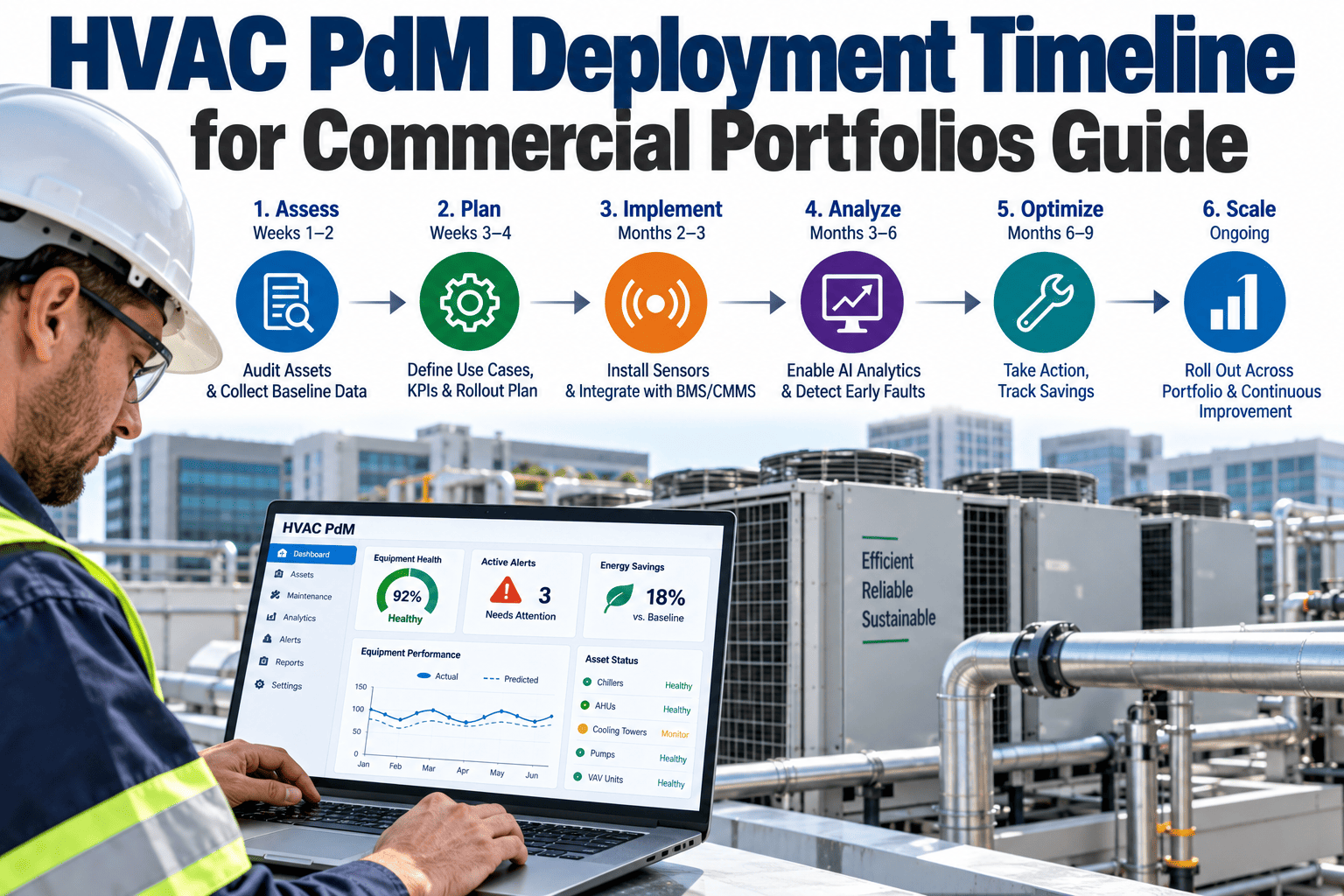
A striking share of AI maintenance pilots never make it to production, and the reason is almost never that the algorithm didn't work. It's that the rollout skipped the structured sequence that turns a proof of concept into a program — instrumenting every building at once instead of proving value on one, training a model on six weeks of data and expecting it to predict a failure it's never seen, or discovering three months in that the sensors, the BAS, and the CMMS were never actually built to talk to each other. A portfolio-wide HVAC PdM deployment succeeds or stalls based on how deliberately those phases are sequenced, not on how sophisticated the underlying AI is. iFactory structures the rollout as a pilot building, a defined expansion phase, and a full-portfolio scale-up, each with gating criteria that have to be met before moving to the next — see a realistic timeline built against your own portfolio.
Most PdM Programs Don't Fail on the Algorithm. They Fail on the Rollout.
A pilot proven on one building, an expansion phase that stress-tests the process, and a full-portfolio rollout that scales what already worked — iFactory sequences HVAC PdM deployment with real gating criteria at each stage, not a single big-bang launch.
The Deployment Mistakes That Have Nothing to Do With the AI
The same handful of failure patterns show up at portfolio after portfolio attempting to move from reactive HVAC maintenance to predictive, and almost all of them are organizational and sequencing mistakes rather than technology gaps.
None of these mistakes are unique to HVAC — the same pattern derails predictive maintenance programs across industrial plants, aviation fleets, and commercial buildings alike. What's specific to a commercial real estate portfolio is the scale of the fix: dozens or hundreds of buildings, each with its own BAS vintage, its own equipment mix, and its own operating team, all of which the rollout sequence has to account for.
What tends to compound these mistakes on a real estate portfolio specifically is organizational pressure that doesn't exist the same way in a single industrial plant. A portfolio manager reporting to an investment committee wants to show progress across the whole footprint quickly, which creates exactly the incentive to skip a phase or compress a baseline period that a deliberate rollout is designed to resist.
Pilot, Expansion, Full Portfolio — What Each One Is Actually For
Each phase of the rollout exists to answer a specific question before the next phase commits more capital and more operational disruption to the answer. Skipping a phase, or treating all three as one continuous rollout, is where most of the risk in a portfolio deployment actually lives.
See a phased rollout plan built around your portfolio
iFactory can recommend the right pilot buildings and a realistic timeline for your specific portfolio, before you commit to anything.
What Actually Has to Be True Before Advancing
A gate isn't a calendar date, it's a specific, measurable condition that has to be satisfied before the next phase begins — advancing on a schedule rather than on evidence is exactly how a portfolio ends up scaling a program that hasn't actually been proven.
| Gate | What Must Be True | Why It Matters |
|---|---|---|
| Pilot → Expansion | Baseline data covers a full seasonal cycle; at least one predicted fault confirmed against an actual repair | Confirms the model's predictions are grounded in real failure behavior, not just plausible-looking noise |
| Pilot → Expansion | Work orders generated from alerts are actually being actioned by the maintenance team | A technically accurate prediction that nobody acts on delivers zero operational value |
| Expansion → Full Rollout | The integration pattern works across at least two different BAS platforms or vendor mixes | Confirms the pilot's success wasn't dependent on one building's unusually clean system setup |
| Expansion → Full Rollout | Model thresholds transfer to equivalent equipment with acceptable false-alert rates | Verifies the detection logic generalizes rather than being overfit to the pilot building's specific quirks |
These gates exist to catch exactly the failure pattern that derails most programs — advancing on optimism rather than evidence, and discovering the gap only once the full portfolio budget is already committed.
It's worth being explicit that a gate is a pass or investigate decision, not an automatic pass or fail. A pilot that falls short of a threshold usually points to something specific and fixable — an integration gap, a threshold that needs recalibrating, a workflow step the maintenance team isn't following — rather than evidence the whole approach doesn't work. The gate's value is in forcing that investigation before more capital is committed, not in being a strict cutoff.
What Each Phase Actually Takes
Facilities teams under pressure to show results often compress the timeline in the pitch even when the underlying work can't compress with it. Here's what each phase realistically requires when done in the right order.
Compressing this timeline doesn't actually save time, it just moves the risk downstream — a portfolio that skips the baseline period or advances past a gate on hope rather than evidence tends to discover the gap during full rollout, which is the most expensive place for it to surface.
Seasonal coverage in particular is not a step that can be shortcut by throwing more resources at it. A building's HVAC load in July looks nothing like its load in January, and a model trained only on summer data has never seen how the system behaves under a winter heating cycle — no amount of additional computing power changes the fact that the calendar has to actually pass for that data to exist.
Choosing the Right First Building, Not the Convenient One
The instinct is often to pilot in whichever building is easiest to access or has the friendliest facilities team, but that's frequently the wrong choice — the pilot exists to prove something specific, and an unrepresentative building proves the wrong thing.
A pilot chosen for convenience can look successful and still fail to predict how the approach performs on the harder buildings in the portfolio, which is exactly the gap that shows up expensively once full rollout begins.
There's a temptation to pilot in the newest, best-instrumented building in the portfolio because it's the easiest place to get a clean result quickly. That instinct produces a pilot that proves the technology works under ideal conditions, which is a different and less useful question than whether it works on the twenty-year-old building with a legacy BAS that represents most of the actual portfolio.
Delivered as a Phased Program, Not a Single Installation
iFactory's HVAC PdM deployment is structured around this same pilot-expansion-rollout sequence from the start, so the gating criteria are built into the engagement rather than left to your team to define and enforce.
Scope covers the cabling, network configuration, BAS integration, and staff training at each phase, so what your team gets is a program built to scale from the outset rather than a pilot that has to be re-architected once portfolio-wide rollout is approved. Trusted by 1000+ clients with 99.9% uptime, the deployment is built to fit around a live, occupied portfolio.
That distinction — built to scale versus rebuilt to scale — is where a surprising amount of wasted effort in industry-wide PdM rollouts actually originates. A pilot architected as a one-off proof of concept, with integration choices and data structures specific to that single building, routinely has to be substantially reworked before it can support a second site, let alone a hundred. Designing for the eventual portfolio scale from day one avoids paying for that rework twice.
What Portfolio Teams Ask Before Starting a Rollout
Deploy HVAC PdM the Way Programs That Actually Reach Full Scale Do
iFactory sequences the rollout as a pilot building, a tested expansion phase, and a systematic full-portfolio scale-up — with real gating criteria at every step, not a single big-bang launch.