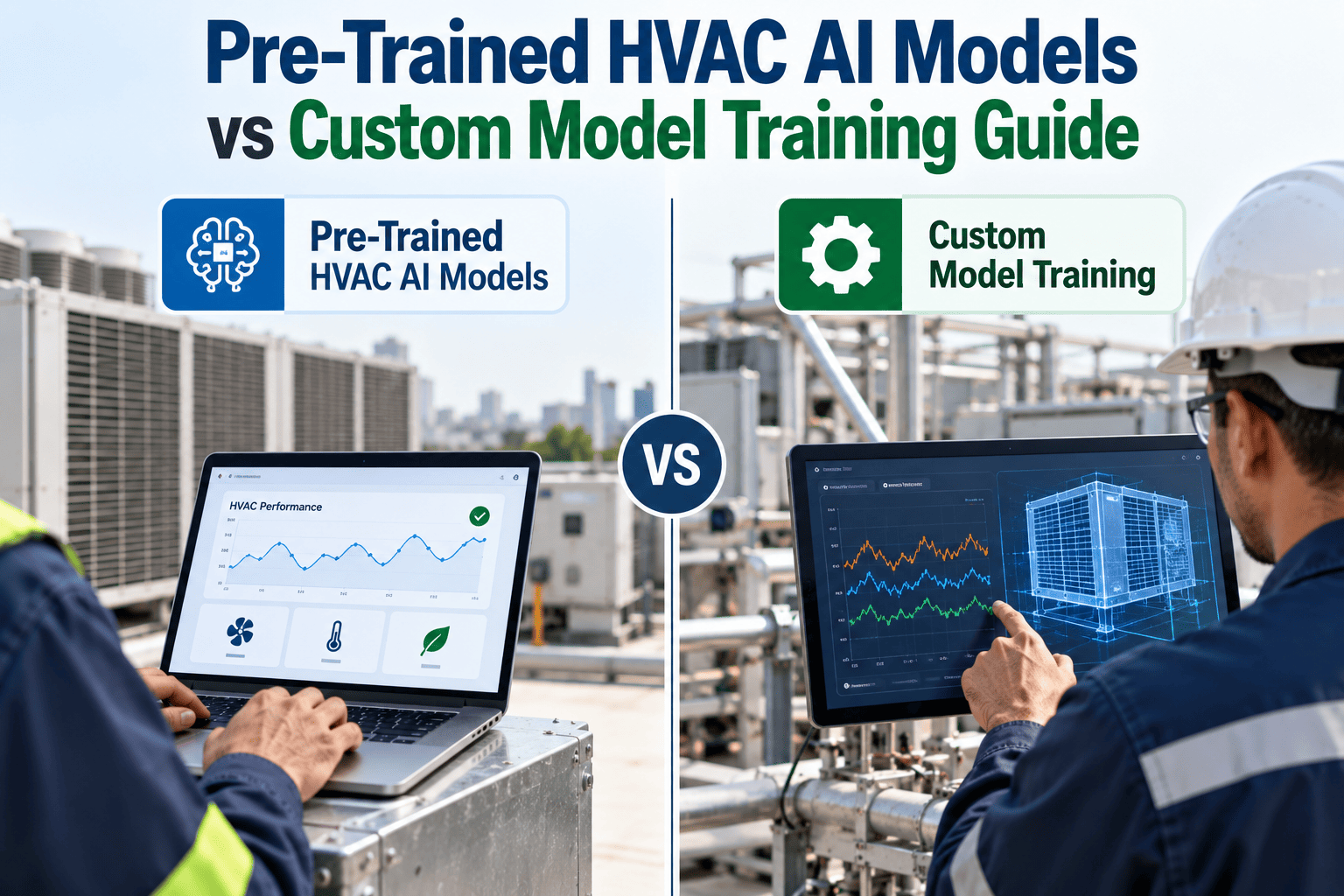
The first real decision in any HVAC AI program isn't which vendor to pick — it's whether the models should start pre-trained on industry-wide patterns or be built from scratch on your own building's data. Pre-trained models solve the cold-start problem: a facility with no digital work order history has nothing for a from-scratch model to learn from, and pre-trained models deploy from day one using patterns learned across thousands of similar chillers, AHUs, and RTUs elsewhere. Custom training solves a different problem: no two buildings behave identically, and a model tuned specifically to your equipment's actual signature will eventually outperform a generic one. Most working programs use both, in a specific order, and getting that order wrong costs weeks of avoidable downtime. Facilities weighing this decision for their own portfolio can talk through the tradeoffs with iFactory AI's team.
Pre-Trained Gets You Live This Week — Custom Gets You Precision Over Time
iFactory deploys pre-trained models on day one to solve the cold-start problem, then layers in custom training on your specific equipment as real operating data accumulates.
The Cold-Start Problem Pre-Trained Models Actually Solve
A from-scratch model needs historical failure patterns to learn from, and most facilities don't have them in usable form — work orders are handwritten, failure timestamps are approximate, and the equipment hasn't failed enough times to generate a real training set. Pre-trained models sidestep that entirely by starting from patterns learned across thousands of similar assets elsewhere, then applying that knowledge to a building with zero historical failure data.
No Digital Work Order History
A building running on paper logs or informal notes has no structured failure record for a custom model to train against, no matter how much sensor data is available.
Equipment Hasn't Failed Enough Times
A well-maintained chiller may have had one or two documented failures in years of operation — nowhere near enough examples for a model to learn a reliable failure signature from scratch.
New Equipment, No Baseline Yet
A newly commissioned AHU or chiller has no operating history at all — a pre-trained model provides a reasonable starting baseline while the unit's own data accumulates.
What Each Approach Is Actually Good At
Pre-trained and custom models aren't competing for the same job — they're solving different problems at different points in a program's life, and comparing them head-to-head on accuracy alone misses why both exist.
Deploy immediately, with no data science team required. Trained on patterns from thousands of similar chillers, AHUs, and RTUs across many buildings. Provide day-one visibility and catch common, well-understood fault patterns right away — the cost is that they don't know your specific equipment's quirks yet.
Built from your own building's historical BAS data and operating signature. Take weeks to train initially, and improve as more of your own operating data accumulates. Eventually outperform a generic model because they've learned your specific equipment's actual behavior, not an industry average.
Find Out Which Approach Fits Your Portfolio
Book a 30-minute session and iFactory AI will review your existing data maturity to recommend a pre-trained, custom, or hybrid deployment path.
The Maturity Curve Most Working Programs Actually Follow
Rather than choosing one approach permanently, most successful deployments move through a sequence — starting pre-trained for immediate coverage, then layering in custom training as real operating data builds up underneath it.
Immediate Visibility
Pre-trained models connect to existing sensor data and surface active anomalies right away — many facilities discover several genuine issues just from the initial connection, before any custom training has begun.
Rule-Based Alerts Mature
Threshold and rule-based detection begins generating consistently actionable alerts, while the equipment's own operating data continues accumulating in the background for the custom layer to eventually use.
Custom Models Take Over
Machine learning models trained on the building's own accumulated history begin surpassing the generic pre-trained baseline in detection accuracy, as the training set matures.
Full Program ROI
Measurable return on the full program typically lands in this window for most commercial building portfolios, once the custom layer has had enough time to mature past the pre-trained baseline.
The Week-Count Difference That Actually Changes a Program
The gap between pre-trained and custom isn't abstract — it shows up directly in how long a facility waits before the AI layer is doing useful work, and that gap compounds across a portfolio of many buildings.
| Approach | Time to First Useful Signal | Data Required to Start |
|---|---|---|
| Pre-Trained Deployment | Immediate — day one | Live sensor connection only |
| Custom Model Pilot | 6–12 weeks | 60–90 days historical BAS data |
| Custom Model Full Maturity | 7–9 months | Sustained live operating data |
| Hybrid (Pre-Trained → Custom) | Immediate, improving continuously | Live connection, then accumulated history |
A facility choosing custom-only training waits 6 to 12 weeks before seeing anything, and months more before the model outperforms what a pre-trained baseline would have delivered on day one — the hybrid path gets both the immediate coverage and the eventual precision.
A Composite Scenario: The Portfolio That Almost Waited Too Long
A commercial property group managing several mid-size office buildings was evaluating AI predictive maintenance and initially scoped the project as custom model training only, reasoning that a model built specifically on their equipment would deliver more precise results than a generic one.
Partway through data collection, a rooftop unit at one property began showing early signs of compressor stress — exactly the kind of fault a mature model would have caught, but the custom training pipeline was still weeks from having enough historical data to detect it reliably. Switching that specific asset to a pre-trained baseline mid-project caught the developing fault in time for a scheduled repair, while the custom training continued running in parallel across the rest of the portfolio. The property group kept the hybrid approach going forward rather than reverting to custom-only.
When Each Approach Makes the Most Sense on Its Own
While hybrid is the common default, some situations genuinely favor leaning more heavily toward one approach than the other.
Lean Pre-Trained When...
You're deploying across a large, fast-moving portfolio and need broad coverage immediately; the building lacks any usable digital maintenance history; or the equipment is new with no operating baseline yet.
Lean Custom When...
A single critical asset justifies dedicated attention; the equipment has unusual operating conditions a generic model wouldn't anticipate; or years of clean historical data already exist and are simply unused.
What Transfer Learning Actually Means Here
The technical bridge between pre-trained and custom is transfer learning — starting from a model already trained on a large, general dataset, then adapting its learned parameters to a new building's specific data rather than training from a blank slate.
Starts From Learned Patterns
The model's initial parameters already encode general relationships learned from a broad training set, rather than starting from random initialization with nothing to build on.
Adapts With Less Building-Specific Data
Because the model isn't learning from zero, it typically needs substantially less building-specific data to reach useful accuracy than a fully custom model trained from scratch would.
Retrains Continuously
As more of the building's own operating data accumulates, the model continues adapting to seasonal load patterns, weather conditions, and occupancy shifts specific to that site.
Improves Without Starting Over
The transition from pre-trained to increasingly custom-tuned is gradual and continuous, not a hard switchover that requires redeploying or retraining from scratch at a fixed milestone.
This is also why the choice between pre-trained and custom rarely needs to be made once and locked in. A facility can start every asset on the pre-trained baseline, let transfer learning quietly adapt each model as real data accumulates, and never face a hard cutover date where one system gets swapped for another. The model simply gets more precise over time, on its own schedule, without the facilities team needing to track which assets have "graduated" to custom training and which haven't.
iFactory deploys pre-trained models across your HVAC fleet immediately, then layers in custom training on your critical assets as real operating data accumulates — so coverage starts on day one and precision builds continuously on top of it, without a hard switchover.
Frequently Asked Questions
Do we need a data science team to use pre-trained HVAC AI models?
No — that's the specific advantage of starting pre-trained. These models deploy from day one using patterns already learned from thousands of similar chillers, AHUs, and RTUs, so a facilities team can connect existing sensor data and start seeing anomaly detection immediately without building or maintaining a model from scratch. Custom training, when it's added later, happens in the background using your own accumulating data rather than requiring in-house data science expertise. iFactory AI's team can walk through what this looks like for your specific building portfolio.
How long before a custom-trained model actually outperforms a pre-trained one?
In most working programs, custom models begin surpassing the pre-trained baseline's detection accuracy somewhere around months seven to nine, once enough of the building's own operating history has accumulated to give the model a genuinely representative training set. Before that point, the pre-trained model is typically still the more reliable option for that specific asset, which is exactly why most programs run both in sequence rather than switching cold to custom-only from the start.
Is it worth skipping pre-trained models and going straight to custom training?
Generally not, unless a single asset is critical enough to justify dedicated attention and the timeline can genuinely absorb several months of reduced coverage while the custom model matures. Going custom-only typically means several weeks with no model coverage at all during initial training, followed by months more before the custom model reaches full accuracy — during which a pre-trained baseline would have already been catching common, well-understood faults. Book a demo to see how the hybrid timeline compares against custom-only for your specific portfolio size.
What data does custom model training actually need to get started?
Initial custom model training typically uses roughly 60 to 90 days of historical BAS data and takes about three to four weeks of wall-clock time to complete, though a full working pilot — including data connection, training on the first several critical assets, and validation against maintenance history — usually spans six to twelve weeks total. Facilities without clean historical BAS data available can still start the process; the training window simply begins once live data collection accumulates enough history rather than starting from an existing archive.
Does the model stop improving once it's fully custom-trained?
No — well-built predictive maintenance models retrain continuously rather than freezing at a fixed point, adapting to seasonal load patterns, weather conditions, and occupancy schedule changes as new operating data comes in. This matters specifically for HVAC, where a chiller's behavior in August looks meaningfully different from its behavior in February, and a model that stopped learning after its initial training period would gradually drift out of sync with how the equipment actually runs across a full year.
Get Day-One Coverage and Long-Term Precision, Not One or the Other
iFactory deploys pre-trained models across your HVAC fleet immediately, then layers in custom training as your own equipment data accumulates — so you're never choosing between fast and accurate. Book a walkthrough to see the right path for your portfolio.