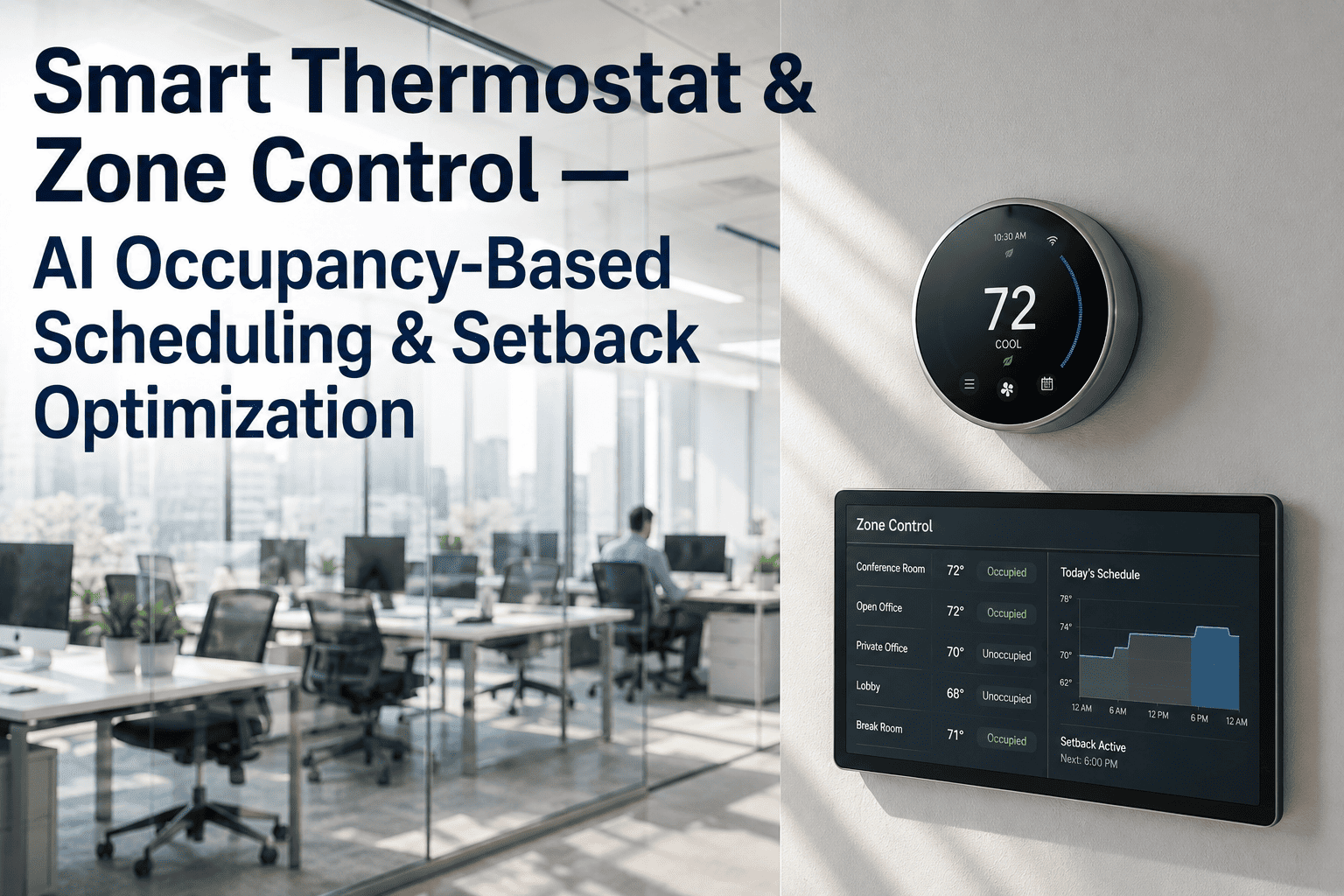
A conference room on the third floor holds its 72-degree setpoint from 6 AM to 9 PM every single day, whether the room is booked back-to-back or sits empty for eleven of those fifteen hours. Multiply that pattern across every zone in a mid-size commercial building and the waste stops looking like a rounding error and starts looking like a line item worth fixing. The fix is not a smarter thermostat sitting alone on a wall, it is a zone control layer that actually knows who is in the room, and you can see how that layer gets built by choosing to book a demo with our team.
Your HVAC Schedule Was Built for a Building That No Longer Exists
Fixed setback schedules made sense when occupancy was predictable, five days a week, nine to five, every zone filled at the same time. Hybrid attendance, irregular meeting patterns, and seasonal occupancy swings broke that assumption years ago, and most buildings never rebuilt their control logic to match. iFactory helps facility and process teams replace fixed schedules with AI occupancy-based zone control that follows how the building is actually used.
The Gap Between a Programmed Schedule and Real Occupancy
Most building automation systems already have a scheduling function, and most facility teams already use it. The problem is not the absence of scheduling, it is the coarseness of it. A typical BAS schedule treats an entire floor, or at best a handful of zones, as a single block that turns on and off at fixed clock times. Real occupancy does not move in blocks. It moves in a scattered, unpredictable pattern that changes by day of week, by department, and by season, and a fixed schedule has no way to see any of that.
The cost shows up as HVAC systems conditioning rooms nobody is using, and it shows up on the other side too, as systems failing to pre-condition a zone before a meeting starts because the schedule did not anticipate an unbooked room suddenly filling up. Both directions of the mismatch are common, and both are invisible on an energy bill until someone breaks the number down by zone and time of day.
Process engineers evaluating zone control upgrades consistently find the same root cause: the control logic was never given occupancy data granular enough to act on. Adding AI-driven scheduling does not mean replacing the BAS, it means feeding it a signal it never had, real-time and predicted occupancy at the zone level, so the existing setback and setup logic finally has something accurate to respond to.
It is worth being precise about what "occupancy-based" actually means in practice, because the term gets applied loosely across the industry. A genuinely occupancy-based system adjusts setpoints continuously in response to changing conditions in each zone, not just at the start and end of a scheduled block. A schedule with more time blocks is still a fixed schedule, it is simply a finer-grained one, and it still cannot respond to the unbooked meeting that fills a room at 2 PM or the recurring weekly session that got cancelled without anyone updating the BAS calendar.
Three Ways to Know a Room Is Occupied, and Where Each One Falls Short Alone
No single occupancy signal is reliable enough to drive zone control on its own. Motion sensors miss people sitting still at a desk. Calendar data misses walk-in meetings and misses meetings that get cancelled but never removed from the room booking system. CO2-based detection lags behind actual occupancy changes by several minutes because gas concentration takes time to build or clear. A control system built around any single signal inherits that signal's blind spot.
The more resilient approach layers signals together and lets the zone controller weigh them against each other, so a false reading from one source gets corrected by agreement, or disagreement, from another. This is where AI adds real value over a simple rules engine: it can learn which signal is most trustworthy for a given zone type and time of day, rather than treating every sensor input with equal weight everywhere in the building.
A small huddle room and a large open training space, for example, need different weighting even if they use identical sensor hardware, since motion detection in a wide-open space can miss a single seated occupant far more easily than it would in a small enclosed room. Rather than hand-tuning sensitivity settings zone by zone, a learning model can absorb this difference automatically from months of accumulated occupancy history, adjusting how much weight each signal receives per zone without a facility engineer manually recalibrating every sensor.
| Detection Method | Strength | Limitation |
|---|---|---|
| Passive Infrared Motion | Fast response, low cost, works in most room types | Misses stationary occupants after a short timeout |
| CO2 Concentration | Detects people even when perfectly still | Slow to respond, needs several minutes to register a change |
| Calendar and Badge Data | Predictive, can pre-condition before arrival | Inaccurate when bookings do not match actual attendance |
| Combined AI Fusion Model | Corrects individual signal blind spots against each other | Requires integration work across multiple data sources |
See What Your Zones Are Actually Conditioning Right Now
iFactory maps real occupancy patterns against your current HVAC schedule so you can see, zone by zone, where the mismatch is costing energy today.
The Difference Between an Aggressive Setback and a Setback That Costs You Recovery Time
Setback strategy is where a lot of well-intentioned energy programs quietly backfire. Push the unoccupied setpoint too far in either direction and the system needs a long, energy-intensive recovery period to bring the zone back to comfort before occupants arrive, sometimes consuming more energy in recovery than the setback saved in the first place. The right setback range depends on the building's thermal mass, the outdoor conditions, and how much lead time the control system has before the next occupied period begins.
This is exactly the calculation that benefits from a predictive occupancy signal rather than a purely reactive one. A zone controller that knows a meeting is booked forty minutes from now can begin recovery at the optimal moment, neither too early, which wastes energy holding comfort conditions before anyone arrives, nor too late, which leaves the room uncomfortable when the meeting starts. Reactive-only systems, working off motion detection alone, cannot make this calculation because they only know occupancy has begun after someone has already walked in.
Buildings with a high thermal mass, thick concrete floors and masonry construction, hold temperature longer and need a longer recovery lead time than a lightweight steel-and-glass structure, which is why a single fixed recovery offset applied uniformly across a building tends to either overshoot lightweight zones or undershoot heavy ones. An AI model that has observed enough recovery cycles for a specific zone learns its actual thermal response rather than relying on a generic assumption borrowed from an engineering handbook, which is part of why prediction accuracy tends to improve zone by zone the longer the system runs.
No occupancy signal detected, setback engages toward the wide unoccupied deadband.
Calendar or pattern data flags an upcoming occupied period for the zone.
System calculates recovery duration from current conditions and thermal mass.
Setpoint reaches target exactly as occupancy begins, no early waste, no late discomfort.
Ventilation Rates Should Follow People, Not the Clock
Ventilation is frequently the largest single energy cost tied to occupancy, since conditioning outdoor air to match indoor setpoints is expensive, and most systems ventilate at a fixed design rate regardless of how many people are actually in the space. Demand-controlled ventilation ties fresh air delivery to real-time occupancy or CO2 levels instead of a static design assumption, and when paired with the same occupancy data driving zone-level HVAC scheduling, the two systems reinforce each other rather than operating on separate logic.
The engineering case for demand-controlled ventilation is strongest in spaces with genuinely variable occupancy, classrooms, conference rooms, and open-plan areas that fill and empty throughout the day, and weakest in spaces with consistently high or consistently low occupancy where a fixed rate is already close to correct. Process engineers evaluating where to prioritize DCV rollout should start with the zones showing the widest occupancy variance, since that is where the fixed-rate assumption is furthest from reality.
Retrofit priority should also account for how a zone is used, not just how variable its occupancy is. A boardroom used for two hours a week has a wide occupancy gap but limited total energy exposure, while an open-plan department with moderate but sustained occupancy variance can represent a far larger absolute energy opportunity even though its percentage swing looks smaller on paper. Ranking candidate zones by total energy exposure alongside occupancy variance, rather than variance alone, tends to produce a more accurate priority list for where DCV delivers the fastest payback.
What a Phased Deployment Actually Looks Like on an Existing Building
Facility and process teams evaluating AI occupancy scheduling often assume the project requires ripping out existing controllers and starting from a blank BAS. That assumption is usually wrong, and it is one of the biggest reasons promising zone control projects never make it past the budgeting stage. Most commercial buildings already have zone-level thermostats or VAV controllers capable of receiving new setpoint instructions, and the missing piece is almost always the occupancy intelligence feeding those instructions, not the hardware executing them.
A phased rollout typically starts with a small set of high-variance zones, the conference rooms and training spaces where the gap between scheduled hours and actual use is largest, since these zones deliver the fastest, most visible savings and give the project a clear proof point before wider investment. Sensor and data integration for this first phase can usually be completed in weeks rather than months, because it is layering intelligence onto existing infrastructure rather than replacing it.
Once the first phase demonstrates measurable savings, and just as importantly, demonstrates that comfort complaints have not increased, the same integration pattern extends to additional floors or zone types. This staged approach also gives the AI model more historical occupancy data to learn from before it is asked to manage a larger portion of the building, which tends to produce more accurate predictions once the rollout reaches full scale.
One detail that catches process engineers off guard the first time: the value of occupancy-based control compounds as more zones come online, because the system starts recognizing cross-zone patterns, like an entire floor's occupancy dropping on Fridays, that would never be visible from a single zone's data in isolation. A one-zone pilot proves the concept, but the real efficiency gains tend to show up once enough zones are reporting that the AI model can see building-wide patterns rather than isolated ones.
Energy Savings Alone Is the Wrong Way to Judge a Zone Control Project
It is tempting to evaluate an occupancy-based zone control rollout purely on the utility bill reduction it produces, and while that number matters, judging the project on energy alone misses two other outcomes that determine whether the system stays trusted and stays turned on. The first is comfort complaint volume, since an aggressive setback strategy that saves energy but leaves rooms too cold or too warm at arrival will get overridden by facility staff within weeks, quietly erasing the savings it was supposed to deliver. The second is override frequency itself, a rising trend of manual thermostat overrides is an early signal that the occupancy model is not matching reality closely enough in a specific zone, and it is a far earlier warning sign than a slow drift in the energy bill would be.
Process engineers building the business case for this kind of project should track all three metrics together from day one: energy consumption by zone, comfort complaint volume, and override frequency. A project that improves energy numbers while comfort complaints or overrides climb is not actually succeeding, it has simply moved the cost from the utility bill to occupant satisfaction, and that tradeoff tends to surface as a reversal of the whole program a few months later once complaints accumulate.
Questions Process Engineers Ask About AI Zone Control
Stop Scheduling for a Building That Doesn't Match Reality
iFactory helps process and facility teams turn occupancy data into zone-level HVAC decisions that actually reflect how the building is used, day by day, room by room.