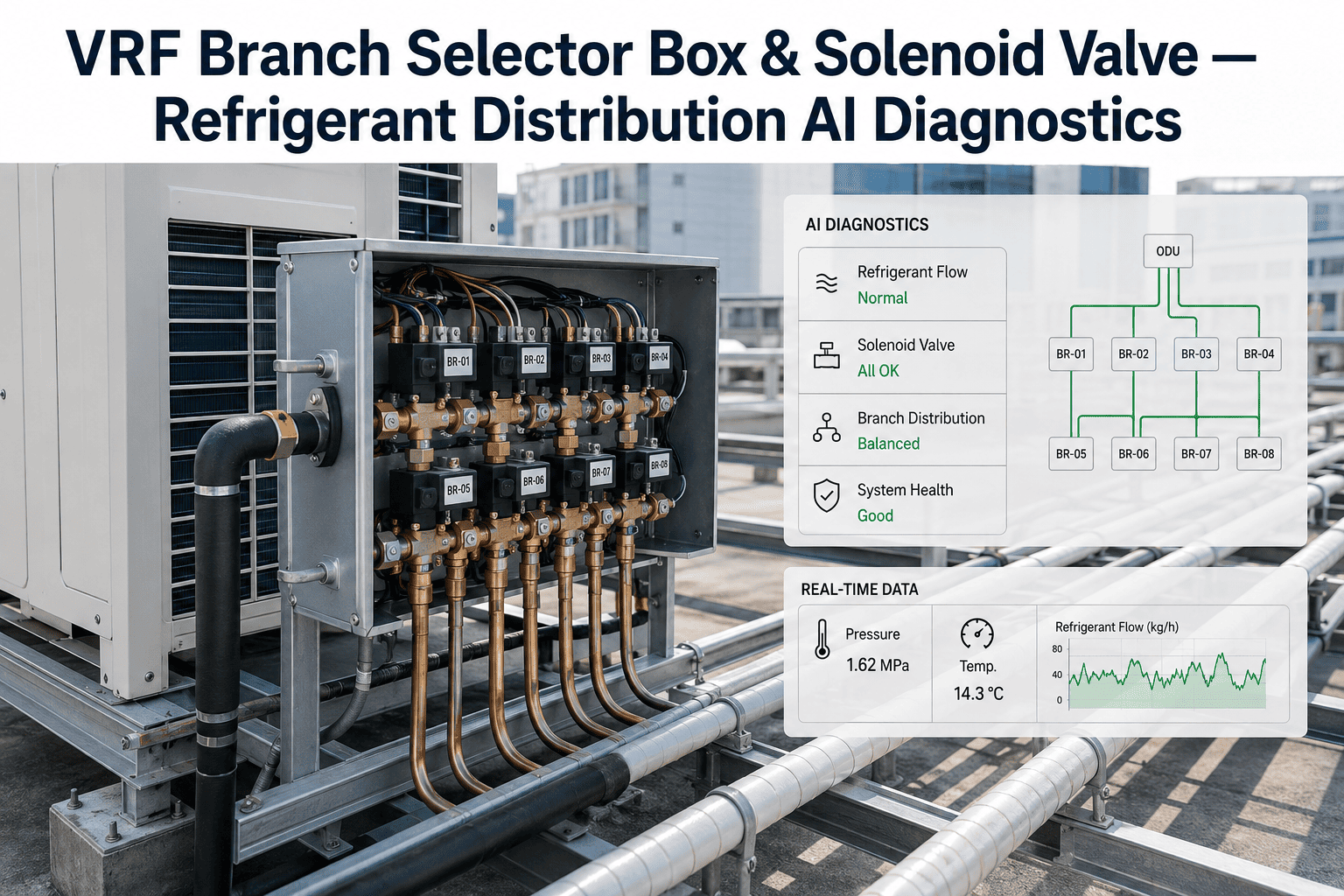
A single stuck solenoid valve inside a VRF branch selector box can quietly ruin comfort across an entire floor while every gauge at the outdoor unit still reads normal, because the refrigerant simply routes around the blockage instead of triggering an obvious fault. Maintenance teams typically find these failures only after tenants complain for weeks about one zone running warm or cold no matter what the thermostat says, at which point a technician has to physically open branch selector boxes one at a time to isolate the problem. Control board failures behave the same way, sending intermittent or corrupted signals that produce inconsistent zone behavior nobody can reliably reproduce during a scheduled service visit. AI refrigerant distribution diagnostics watch valve position, pressure differential and control board response continuously, catching the pattern of a failing component days before it becomes a comfort complaint. Book a demo to see branch selector diagnostics running on your building's VRF network.
Refrigerant Distribution AI Diagnostics
Find the Stuck Valve Before Tenants Find It First
iFactory monitors every branch selector box on your VRF network for valve sticking, control board drift and piping restrictions, flagging the exact component and location before a comfort complaint ever reaches your desk.
5-14 days
Average early-warning lead time before failure
70%
Fewer truck rolls for undiagnosed comfort calls
1 box
Pinpointed location instead of floor-wide guesswork
Why Branch Selector Failures Are So Hard to Catch Manually
Branch selector boxes route refrigerant between two-pipe and three-pipe zones using a bank of solenoid valves that open and close dozens of times a day, and any single valve that begins sticking partway open still allows enough flow that the zone appears to function, just poorly. See how partial valve sticking differs from a full failure in your data. Control boards inside these boxes translate outdoor unit commands into valve positions, and a board with a failing relay or a corroded connection can drop commands intermittently without ever throwing a fault code the building management system recognizes, leaving technicians chasing a problem that looks different every time they check it.
Common Branch Selector Failure Modes and What AI Diagnostics Catch
Valve Sticking
Solenoid Valve Partial Open or Closed
Detected through gradually widening pressure differential across the valve compared to its historical baseline, well before the zone shows a noticeable comfort problem.
Control Board Drift
Intermittent Command Response
Flagged when valve response time to routing commands becomes inconsistent across cycles, a pattern that precedes most full control board failures by one to two weeks.
Piping Restriction
Uneven Zone Cooling or Heating
Identified when a zone's actual capacity delivery falls below what its valve position and outdoor unit output should be producing, pointing to a restriction rather than a control fault.
Sensor Drift
Thermistor or Pressure Sensor Error
Caught when a branch selector's reported temperature or pressure diverges from the pattern of neighboring boxes on the same refrigerant loop under identical conditions.
Manual Troubleshooting vs. AI-Guided Diagnostics
Diagnosing a branch selector issue manually means opening boxes, checking valve continuity and cross-referencing complaint history, often across several visits before the failing component is confirmed. Compare your current troubleshooting workflow against AI-guided diagnostics.
| Diagnostic Step |
Manual Troubleshooting |
iFactory AI Diagnostics |
| Failure Detection |
Reactive, after a tenant comfort complaint is logged |
Proactive, 5-14 days before symptoms are noticeable |
| Component Location |
Technician opens multiple boxes to isolate the fault |
Exact branch selector box and valve identified in advance |
| Failure Type |
Determined on-site through physical inspection |
Classified automatically as valve, board or piping issue |
| Truck Rolls |
Often two to three visits per confirmed diagnosis |
One scheduled visit with the failure already identified |
| Parts Ordering |
Ordered after on-site confirmation, extending downtime |
Ordered ahead of the scheduled repair visit |
Stop Chasing Comfort Complaints Floor by Floor
iFactory pinpoints the exact branch selector box and component behind every zone issue, before tenants notice and before a technician opens a single panel.
How Diagnostic Monitoring Deploys Across Your VRF Network
1
Branch Selector Inventory
Every branch selector box, valve bank and control board on the refrigerant network is catalogued along with its zone assignment.
2
Baseline Behavior Capture
Two to three weeks of normal valve response, pressure differential and control board timing establish a healthy baseline per box.
3
Anomaly Detection Activation
The model begins flagging deviations from baseline as early-warning alerts, classified by likely failure type and severity.
4
Maintenance Team Integration
Alerts route directly into existing maintenance ticketing workflows with the specific box, valve and recommended part attached.
Results From Buildings Running AI Distribution Diagnostics
Commercial Office Portfolio
A property manager overseeing twelve VRF-equipped buildings reduced comfort-complaint truck rolls by 68% after AI diagnostics began flagging valve sticking issues an average of nine days before tenants noticed temperature problems.
68% fewer reactive truck rolls
Mixed-Use High-Rise
Recurring intermittent complaints on three floors that had defeated two prior service visits were traced to a single drifting control board within four days of monitoring activation, resolved in one scheduled repair.
4 days to root cause identification
Frequently Asked Questions
Can this diagnose issues without opening branch selector boxes?
Yes. The diagnostics rely on existing pressure, temperature and valve position data already available from the branch selector's control interface, so no additional sensors or physical inspection are needed to detect a developing fault. Technicians still open the box for the actual repair, but only after the specific component has already been identified.
How early does the system typically catch a failing valve?
Most valve sticking and control board drift issues are flagged five to fourteen days before they produce a noticeable comfort complaint, giving maintenance teams time to schedule a repair during normal hours rather than responding to an emergency call. Lead time varies with how gradually a component is failing, since a sudden electrical fault produces a much shorter warning window than mechanical wear.
Does this work on older VRF systems without modern BMS integration?
Diagnostics can run on most VRF branch selector networks that expose standard telemetry through the manufacturer's gateway, regardless of building age, though the exact data available depends on your specific equipment generation.
Ask support to confirm compatibility with your system.
How does the system distinguish a valve problem from a piping restriction?
Valve issues show up as abnormal pressure differential directly across the valve itself, while piping restrictions show up as a mismatch between commanded valve position and actual delivered capacity downstream, a distinct signature the model has been trained to separate. This classification is what allows a technician to arrive with the correct replacement part rather than guessing between two very different repairs.
Can alerts integrate with our existing maintenance ticketing system?
Yes, alerts can route into most standard maintenance ticketing and CMMS platforms with the branch selector box location, likely component and severity attached automatically.
Book a demo to see the alert format mapped to your team's existing workflow.
Stop Guessing Which Branch Selector Box Is Failing
iFactory flags valve sticking, control board drift and piping restrictions days before tenants notice, with the exact box and component identified.
5-14 day early-warning lead time
70% fewer reactive truck rolls
Exact box and valve pinpointed automatically
No new sensors or hardware required