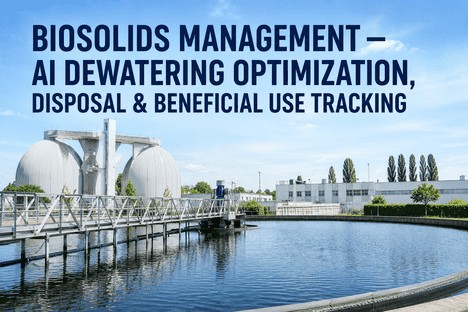
Biosolids Management — AI Dewatering Optimization, Disposal & Beneficial Use Tracking
By Grace on June 20, 2026
A process engineer watching the dewatering control panel sees the same pattern every shift. The polymer dose is set at a fixed rate. The feed solids fluctuate as upstream digestion conditions change. The centrate quality drifts. The cake solids drop. The operator walks over, adjusts the polymer pump manually based on a visual check of the floc, and the cycle repeats. The polymer budget absorbs the inefficiency — an extra 10 to 40% above the theoretical optimum because the dewatering system is always running in safety margin, compensating for feed variability with overdosing. Below the polymer cost lies a deeper layer of unmanaged expense: the energy consumed by centrifuges and presses operating outside their optimal torque range, the trucking cost of hauling wet cake that carries more water than biosolids, the incineration fuel burned to evaporate water that should have been removed in the dewatering step, and the compliance risk that follows when biosolids quality data is compiled manually and submitted late. AI dewatering optimization addresses all of these simultaneously — not by replacing the dewatering equipment, but by replacing the manual control logic with a continuous, closed-loop system that adjusts polymer dose, centrifuge torque, and belt press settings in real time against the actual feed conditions entering the machine.
AI Dewatering Control · Polymer Dose Optimization · Cake Solids Maximization · EPA 503 Compliance
Every Ton of Biosolids You Haul Contains Water You Already Paid to Treat. AI Dewatering Optimization Removes the Water Before It Leaves the Plant — and the Cost Before It Reaches the Budget.
iFactory's AI dewatering optimization platform integrates with existing centrifuges, belt presses, and polymer systems to deliver real-time closed-loop control — reducing polymer consumption, maximising cake solids, lowering energy use, and maintaining an auditable compliance record for every batch of biosolids produced.
The Three Cost Centers That Define Biosolids Management — and the Single Lever That Controls All of Them
Biosolids treatment is a chain of interdependent processes where the output of each stage determines the cost and performance of the next. The economics of the entire chain are set at the dewatering step — the point where sludge is transformed from a liquid stream into a solid material that can be hauled, incinerated, or land applied. Dewatering performance determines polymer consumption, energy demand, disposal volume, and compliance classification. And dewatering performance is determined by a single variable: how well the control system adjusts to what the sludge actually is at any given moment rather than what the operator expected it to be.
C1
Polymer Cost — The Variable That Moves With Every Feed Change
Polymer represents 30 to 60% of the variable operating cost in dewatering, and most plants operate at 10 to 40% above optimum dose because the control system is manual and the operator is making decisions on visual inspection. Every fluctuation in feed solids, sludge temperature, or upstream process condition triggers an offset between the actual optimum dose and the fixed or manually adjusted dose the operator applies. AI closed-loop control eliminates this offset by measuring the actual dewatering response — cake solids, filtrate quality, floc condition — and adjusting the polymer pump continuously. Documented savings range from 10 to 40% reduction in polymer consumption without reducing cake solids.
AI impact: 10-40% polymer reduction at same cake solids
C2
Disposal Cost — Where Moisture Content Drives Every Truck and Every Ton
Increasing cake solids from 18% to 22% reduces the volume of biosolids hauled by 18% — every truck carries more solids and less water. For a plant producing 10,000 dry tons per year, that difference can represent hundreds of truck trips eliminated and tens of thousands of dollars in hauling cost avoided annually. Every one percentage point increase in cake solids reduces disposal volume significantly, and the energy or fuel required for subsequent thermal drying or incineration drops by a corresponding margin. AI dewatering optimization targets the maximum sustainable cake solids for the specific sludge characteristics and equipment configuration, continuously verified against the actual dryer or incinerator performance.
Compliance Risk — Where Manual Data Chains Break Under Audit Scrutiny
EPA 40 CFR Part 503 requires comprehensive recordkeeping for land application, surface disposal, or incineration of biosolids — pollutant concentrations, pathogen reduction classification, vector attraction reduction methods, and application site records, all retained for five years. Facilities that rely on manual data compilation face the risk of missing monitoring frequencies, calculation errors in cumulative pollutant loading rates, and incomplete annual reports. The annual biosolids report is due by February 19 each year, and EPA has established specific violation codes for noncompliance. AI-driven compliance tracking automates the data chain from dewatering through final disposition, generating audit-ready records for every batch without manual data entry.
AI impact: Automated EPA 503 recordkeeping for every batch
10-40%
Polymer savings achievable with AI closed-loop control — documented by ANDRITZ RheoScan and Jacobs ML optimisation programmes at full-scale installations
+1%
Increase in cake dry solids can save up to EUR 100,000 per year in transport costs alone — every percentage point compounds across hauling, energy, and disposal
$208k
Annual savings from AI dewatering control at a single regional sludge treatment centre — polymer down 40%, antifoam down 75%, payback under 2 months
5 years
EPA 40 CFR Part 503 record retention requirement — AI compliance tracking automatically maintains the pollutant, pathogen, and application data chain
The Dewatering Control Problem — Why Manual and Fixed-Setpoint Control Cannot Keep Up With Feed Variability
The fundamental challenge of dewatering control is that sludge feed characteristics change constantly and unpredictably. Feed solids concentration from anaerobic digesters varies with digester draw cycles, temperature, and mixing efficiency. Primary and waste activated sludge ratios shift with the biological treatment process. Polymer demand fluctuates with sludge temperature, particle size distribution, and the ionic character of the feed. A fixed polymer dose that works optimally at 10:00 AM is producing underdosed or overdosed floc by 2:00 PM — and the operator cannot be at the centrifuge or belt press every hour of every shift to make the adjustment. The result is a control strategy driven by safety margin: dose high enough to avoid the underdose condition, because the cost of underdosing (poor capture rate, dirty centrate, overloaded return stream) is more immediately visible than the cost of overdosing (wasted polymer, lower cake solids, higher disposal volume). The AI solution is not to eliminate the operator from the loop — it is to close the loop automatically so that the operator manages the system by exception rather than by manual adjustment.
Manual Dewatering Control vs. AI Closed-Loop Control — The Operating Difference
Manual Control
Operator sets polymer dose at shift start based on visual floc assessment
Feed solids change due to digester draw — dose no longer matches actual demand
Cake solids decline as underdosed floc breaks apart in the centrifuge
Operator increases dose reactively — often above optimum to avoid recurrence
Net result: polymer consumption 10-40% above optimum, inconsistent cake solids
AI Closed-Loop Control
Continuous sensors measure feed solids, polymer concentration, and floc condition
AI model predicts optimum polymer dose for current feed conditions in real time
Polymer pump adjusts automatically — dose changes with every feed fluctuation
Cake solids and centrate quality monitored as feedback for continuous model refinement
Net result: polymer at optimum for every feed condition, cake solids maximised consistently
The Six Optimization Levers That AI Controls Simultaneously
A process engineer managing a dewatering operation manually can realistically monitor and adjust two or three variables at once — typically polymer dose and feed flow rate. An AI control system has no such limitation. It continuously monitors and optimises across six interdependent levers, finding the combination that delivers the lowest total cost per dry ton at every moment rather than optimising any single variable at the expense of the others.
01
Polymer Dose Rate
Grams of active polymer per dry kg of feed solids — adjusted continuously against feed concentration and floc response
02
Centrifuge Torque or Bowl Speed
Differential speed and torque settings that determine solids retention time and cake compaction — optimised for feed solids and polymer type
03
Belt Press Feed Rate and Belt Speed
Hydraulic loading rate and belt travel speed that determine drainage time and cake thickness — adjusted to prevent overspill and maximise capture
04
Polymer Concentration and Make-Down Ratio
Active polymer to dilution water ratio — make-down quality directly affects floc formation and dose efficiency
05
Feed Sludge Blend Ratio
Ratio of primary to waste activated sludge in the feed — variability here is the largest single driver of polymer demand fluctuation
06
Downstream Disposition Requirements
Cake solids target varies by end use — land application, incineration, composting, or thermal drying each have optimal moisture ranges
What the Biosolids Optimisation Dashboard Shows the Process Engineer
The process engineer view in iFactory's biosolids management platform is not a SCADA replica — it is a decision-support layer that sits above the control system and answers the specific questions that determine whether the dewatering operation is running at optimum total cost: what is the current polymer efficiency in grams per dry kg, what is the cake solids trend over the last 24 hours compared to the target, which shift is achieving the lowest cost per dry ton, and is the compliance record complete for the current batch?
Process View 01
Real-Time Dewatering Performance — Polymer Efficiency and Cake Solids at a Glance
The primary process view displays current dewatering performance for each operating centrifuge or belt press — feed solids concentration, polymer dose in g/kg DS, cake solids percentage, centrate suspended solids, and polymer cost per dry ton. Trend lines over the last 24 hours and 7 days show whether performance is improving, stable, or degrading. If cake solids have dropped by 2 percentage points over the last 4 hours, the dashboard flags it before the operator would normally notice it on the next hourly round. The AI model simultaneously searches for the cause — feed solids change, polymer make-down drift, torque setting shift — and displays the probable root cause alongside the alert.
Process action: Identify and correct dewatering drift before it compounds into off-spec cake.
Process View 02
Polymer Optimisation Analytics — Dose-Response Curves and Savings Tracking
The polymer optimisation view shows the relationship between polymer dose and cake solids for the current sludge blend, continuously updated from the AI model's operating data. The dose-response curve reveals whether the system is operating at the knee of the curve — the point where additional polymer produces diminishing returns in cake solids. Operators can see in real time whether they are in the underdose zone, the optimum zone, or the overdose zone. The polymer savings tracker compares actual consumption against the baseline before AI control was deployed, providing a running total of polymer cost avoided. For plants spending $500,000 to $1 million annually on polymer, a 20% reduction represents a measurable contribution to the operating budget.
Process action: Shift polymer dose to the optimum zone on the dose-response curve continuously.
Process View 03
EPA Part 503 Compliance Record — Batch-Level Documentation Chain
The compliance view links every batch of biosolids produced to its laboratory analytical results — pollutant concentrations, pathogen classification (Class A or B), vector attraction reduction method, and the dewatering operating conditions at the time of production. The record is structured to meet 40 CFR Part 503 Subpart B, C, and E requirements, including cumulative pollutant loading rate tracking for land application sites. When the annual report is due each February, the compliance record for the full calendar year is exportable with a single action — no manual data compilation from LIMS, SCADA, and hauling records across three separate systems. The audit trail shows every batch, every parameter, and the timestamped data chain from production through disposition.
Process action: Export complete annual compliance record from a single batch-level view.
Process View 04
Beneficial Use Tracking — Land Application and Resource Recovery Log
For facilities that land apply biosolids, the beneficial use tracking view records every load sent to each application site — volume, pollutant concentrations, application date, site restrictions compliance, and cumulative loading against the site's permitted capacity. For facilities pursuing resource recovery through thermal drying, composting, or biogas enhancement, the tracking view records the product quality data, the offtake agreement compliance, and the revenue or cost offset attributable to each end use. The data chain from dewatering to final disposition is complete, auditable, and structured to support both EPA compliance reporting and the utility's resource recovery performance reporting to stakeholders.
Process action: Track beneficial use programme performance against compliance and revenue targets.
"
We were spending $720,000 a year on polymer at our 28 MGD plant. The operators were doing their best with visual floc inspection and manual pump adjustments, but the feed from our digesters was inconsistent — primary to WAS ratio could shift 30% within a single shift. We deployed an AI optimisation model that took in feed solids, centrifuge torque, and polymer flow data and output a recommended dose every 15 minutes. The operators followed the recommendations. Within six months, polymer consumption dropped by 17% while cake solids held steady at 26-28%. That is $122,000 a year in polymer cost avoided — and we achieved it using the same centrifuge, the same polymer, and the same operators. The only thing that changed was the control logic.
— Process Engineer, Municipal Wastewater Treatment Plant — 28 MGD Capacity, Centrifuge Dewatering, Incineration Disposal
AI Dewatering Control · Polymer Optimisation · EPA 503 Compliance · Beneficial Use Tracking
The Polymer Dose That Was Right This Morning Is Wrong Right Now. AI Adjusts It Before the Operator Finishes the Hourly Round — and Before the Cost Compounds Across 10,000 Dry Tons.
Real-time AI closed-loop dewatering control that adjusts to every feed fluctuation, every shift, and every blend change — with polymer savings, cake solids optimisation, and compliance records generated automatically from the data your SCADA already collects.
Biosolids management is the segment of wastewater treatment where operational decisions translate most directly into financial outcomes — every percentage point of cake solids gained or lost changes disposal costs by thousands of dollars per year, every gram of polymer overdosed accumulates into a six-figure annual expense, and every compliance record missed or delayed carries regulatory exposure that no treatment plant can afford in the current enforcement environment. The common thread across all three cost centers — polymer, disposal, compliance — is that the control system operating the dewatering equipment determines the outcome. When that control system is manual, reactive, and calibrated to the feed conditions of last week, the plant absorbs the inefficiency as normal operating cost. When the control system is AI-driven, continuous, and adjusted to the feed conditions of this minute, the waste is eliminated before it appears in the monthly cost report.
The evidence from full-scale dewatering installations is no longer hypothetical. Polymer reductions of 10 to 40% have been documented by multiple independent implementations — ANDRITZ RheoScan, Jacobs ML optimisation at Vancouver, Valmet SDO, and others. Cake solids improvements of 1 to 3 percentage points are routinely achieved when AI control replaces manual adjustment. Annual savings in the range of $100,000 to $200,000 per plant are reported, with payback periods measured in months rather than years. EPA Part 503 compliance automation eliminates the manual data compilation burden that consumes weeks of staff time every year and replaces it with a continuous, audit-ready record that covers every batch from dewatering through final disposition.
iFactory's AI dewatering optimisation and biosolids management platform is purpose-built for process engineers who need to lower polymer consumption, maximise cake solids, reduce disposal costs, and maintain EPA 503 compliance — without replacing dewatering equipment or adding operator headcount. Book a Demo to see the platform configured for your dewatering equipment and biosolids disposal route, or talk to an expert about a free dewatering optimisation assessment for your plant.
Frequently Asked Questions
The AI platform integrates with existing dewatering equipment from all major manufacturers — centrifuge, belt filter press, gravity belt table, and screw press types from ANDRITZ, Alfa Laval, GEA, Huber, and others. The primary data inputs are feed flow rate and solids concentration, polymer flow rate and concentration, centrifuge torque and differential speed or belt speed and hydraulic loading, cake solids measurement, and centrate or filtrate suspended solids. Many plants already have these measurements available through existing SCADA systems and online solids analysers. If specific measurements are missing, the platform can operate with reduced input data while identifying the most valuable additional sensor investments. The AI model is trained on the plant's own historical data — typically 6 to 12 months of paired feed, dose, and cake solids records — and begins generating optimisation recommendations within two to four weeks of deployment. Talk to an expert about a data readiness assessment for your dewatering equipment configuration.
Feed sludge blend variability is the single largest driver of polymer demand fluctuation in most dewatering operations, and it is the primary reason why fixed-dose control produces such high levels of inefficiency. The AI model detects blend changes in real time through the combined signature of feed solids concentration, the dose-response relationship at the current polymer setting, and the resulting cake solids and centrate quality. When the blend shifts — for example, from a 60:40 primary-to-WAS ratio to a 40:60 ratio — the model recognises the change in dewatering behaviour and adjusts the polymer dose target accordingly. Over time, the model learns the specific dose-response curve for each blend condition and can predict the optimum dose for a given blend combination even before the full effect is measured in the cake solids output. This capability is what enables the 10 to 40% polymer savings reported by installations that have deployed AI control on variable-feed dewatering operations. Book a Demo to see the blend-adaptive dose prediction model configured for your sludge profile.
The compliance module accepts analytical data from any LIMS or laboratory system through standard data interfaces — CSV import, API connection, or manual entry for smaller facilities. Each batch of biosolids is linked to its laboratory results for the pollutants listed in 40 CFR Part 503 Tables 1 through 4 (arsenic, cadmium, copper, lead, mercury, molybdenum, nickel, selenium, zinc, and others). Pathogen classification results and vector attraction reduction method are recorded per batch. The platform tracks cumulative pollutant loading rates for each land application site and generates automated alerts when loading approaches 90% of the permitted cumulative limit. For the annual report due each February 19, the platform compiles the calendar year's data into the EPA-required format with batch-level traceability. The compliance record is retained for the five-year period required by 503.17. For facilities that incinerate biosolids, Subpart E compliance tracking for total hydrocarbons, carbon monoxide, and other incinerator emission parameters is integrated into the same record structure. Talk to an expert about configuring the compliance module for your state's biosolids programme requirements.
Total cost per dry ton is calculated by the platform as the sum of polymer cost, energy cost, disposal or hauling cost, and any incremental treatment cost — divided by the dry tons of biosolids produced in the same period. The model does not optimise for maximum cake solids at any cost. It optimises for the point where the marginal cost of additional polymer or energy to gain one more percentage point of cake solids equals the marginal saving in hauling, disposal, or incineration fuel. This is the economic optimum, and it is different for every plant depending on polymer price, hauling distance, disposal method, and energy cost. A plant that land applies biosolids locally may find the optimum at 22% cake solids, while a plant that incinerates biosolids with high natural gas costs may optimise at 28% cake solids because the fuel saving from drier cake justifies higher polymer spend. The platform calculates this dynamically based on the plant's actual cost inputs and updates the optimisation target as costs change. Book a Demo to see the total cost model calibrated for your polymer price and disposal route economics.
The Polymer Dose Is Not the Problem. The Control Logic Behind It Is. AI Closes the Loop Between Feed Variability and Optimum Dose — Every Shift, Every Blend, Every Ton.
iFactory's AI dewatering optimisation and biosolids management platform — real-time closed-loop polymer control, EPA 503 compliance automation, beneficial use tracking, and total cost optimisation from the feed line through final disposition.