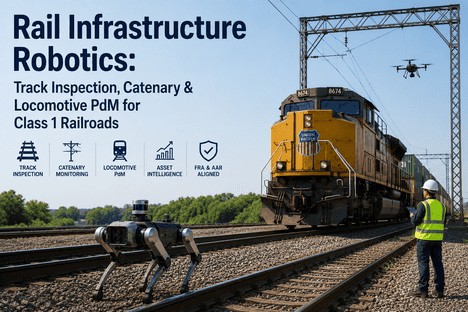
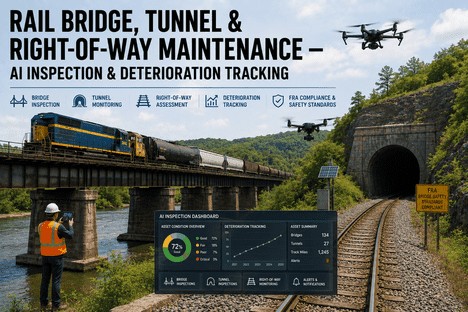
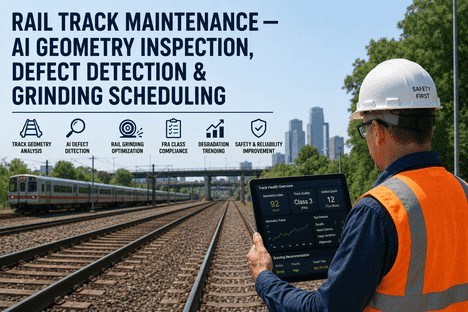
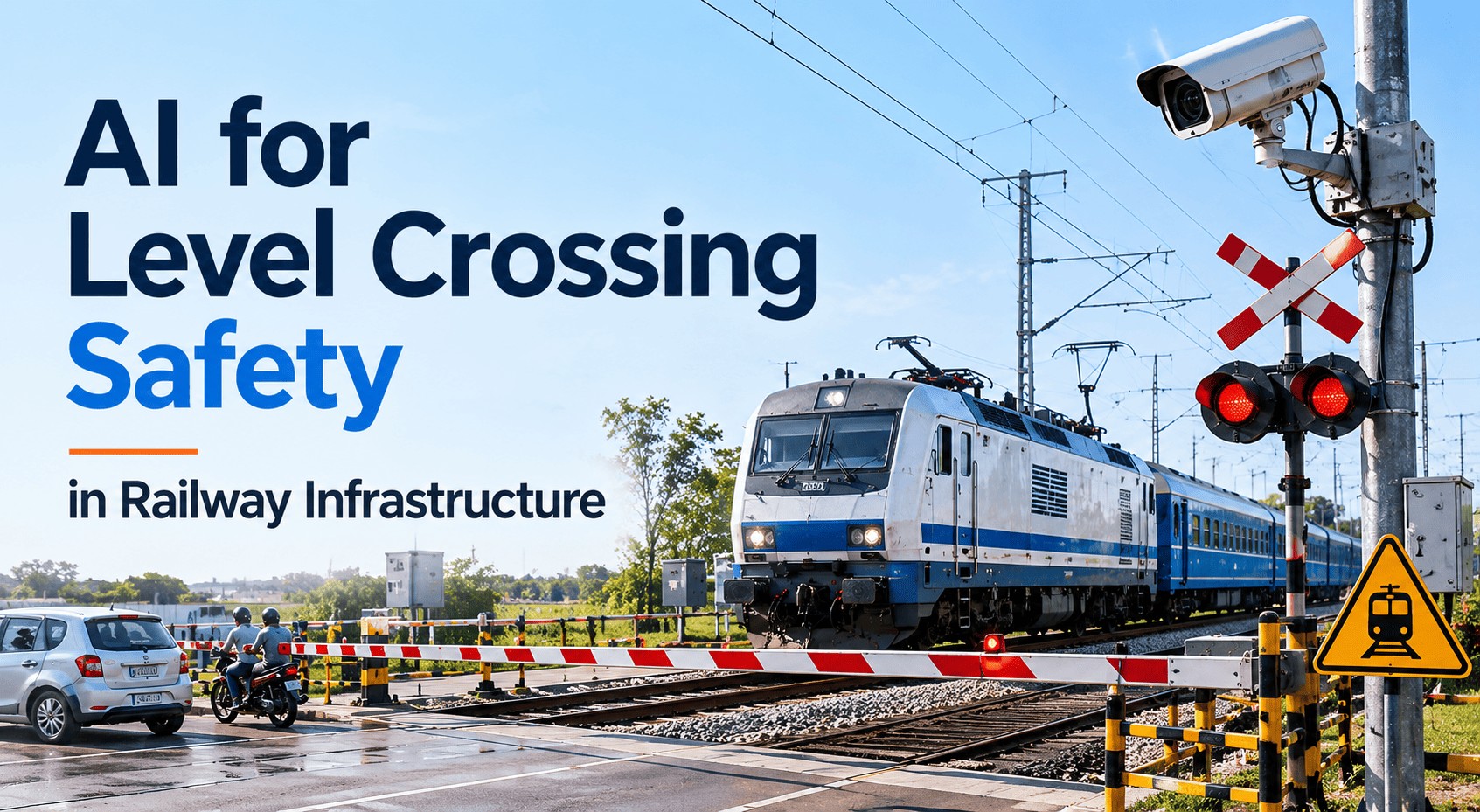
A single Class 1 railroad operates 32,500 miles of track across 28 states. That track is supported by 100,000 bridges, 200,000 grade crossings, 1.5 million railcar wheels monitored in motion, and thousands of miles of overhead catenary wire carrying 25 kV to electric locomotives. The inspection task is not a walk — it is a continuous survey of a linear asset that crosses deserts, mountains, urban corridors, and river gorges, subjected to 286,000-pound freight loads passing at 70 mph every few minutes, 24 hours a day, 365 days a year. For over a century, that inspection was done the same way: track inspectors walking the ballast, crews climbing catenary poles with portable meters, and locomotives pulled from service when something broke. That model is being transformed by a new generation of rail-specific robotics and AI. Autonomous track geometry cars mounted on revenue locomotives, quadruped robots navigating ballast and bridges, AI vision systems inspecting catenary wire at speed, and predictive maintenance platforms analysing billions of sensor readings per day — all deployed by Union Pacific, BNSF, CSX, and Norfolk Southern, and all approved by the Federal Railroad Administration for automated inspection trials. This is the technical guide to how rail infrastructure robotics for track inspection, catenary monitoring, and locomotive predictive maintenance actually works, and why the Class 1 railroads deploying it are achieving inspection coverage, defect detection accuracy, and equipment reliability that manual methods cannot match.
RAIL ASSET INTELLIGENCE PLATFORM
See How iFactory Connects Rail Robotics, Track AI, and Locomotive PdM Into One Railroad Maintenance Workflow
One platform fuses autonomous track inspection data, catenary defect detection, locomotive predictive maintenance, and CMMS integration. FRA-aligned. No rip-and-replace. Value from your first revenue service pass.
644K
Track miles inspected by Union Pacific AI geometry systems in 2025 — 100B+ spatial measurements captured
35M
Wayside detector readings processed daily by BNSF AI algorithms for predictive maintenance
90%+
Catenary defect recognition accuracy — AI vision on Shuohuang Railway maintenance robot
80%
Reliability improvement on Union Pacific locomotives after Wabtec AI-driven modernisation programme
THE THREE RAIL ASSET DOMAINS
Track, Catenary, and Locomotive — Each Needs a Different Robotic Approach
A railroad is not one monolithic asset. It is three interconnected systems that fail at different rates, require different sensing modalities, and demand different maintenance responses. Track degrades under cyclic loading — gauge spreads, surface deteriorates, and fasteners loosen over millions of wheel passes. Catenary wire wears from continuous pantograph contact and suffers fatigue from wind and ice loading. Locomotives accumulate mechanical wear on traction motors, bearings, and diesel engines that must be predicted before failure. An effective rail automation strategy must address all three domains with the appropriate robotics, sensors, and AI models for each.
T
Track Infrastructure
Rail, ties, ballast, switches, crossings, bridges
Primary Methods
Autonomous geometry cars (BNSF ODIN, UP Machine Vision)
Quadruped robots for ballast, bridge, and tunnel patrol (B2, Go2)
Drone AI inspection for switches and joint bars (CSX FlytBase)
3D laser rail profiling at 120 km/h (Pavemetrics LRAIL)
Detection Capabilities
Gauge, cross-level, alignment, surface profile — measured every foot at 70 mph in revenue service
Switch point gaps as small as 1/8 inch detected from 100 ft altitude via drone ML
Tie condition, fastener loss, ballast fouling, joint bar cracks — AI-graded in a single pass
Change detection across repeat runs — identifies developing defects weeks before critical
C
Catenary and Overhead Line
Contact wire, droppers, insulators, cantilevers, registration arms
Primary Methods
Catenary-mounted inspection robots running on convergence bars (Shenhao OCLIS1000)
Multi-arm robot platforms for autonomous maintenance (Shuohuang Railway)
LiDAR point cloud recognition with deep learning (RobotNet, 99.65% wire accuracy)
Event-based vision for continuous oscillation and component monitoring (Prophesee)
Detection Capabilities
Contact wire wear, stagger, height, deflection angle — high-precision 3D measurement
Insulator cracks, missing droppers, loose cantilevers — UAV imagery with 82.53 F1-score
Millimetre-width surface defects on contact wire — identified via deep learning algorithms
Oscillation behaviour tracking — detects developing instability between scheduled inspections
L
Locomotive Fleet
Traction motors, bearings, diesel engines, wheels, braking systems
Primary Methods
Onboard sensor telemetry with AI predictive failure models (BNSF, UP)
Wayside thermal and machine vision detectors — 2M+ images processed daily (BNSF)
Acoustic bearing detectors and wheel impact load detectors
Wabtec Modular Control Architecture with next-gen diagnostics (UP $1.2B programme)
Detection Capabilities
Engine performance telemetry compared against historical failure patterns — predicts failures weeks in advance
Wheel surface crack detection via machine vision — 1.5M wheels monitored in motion
Overheating brakes and bearing faults detected via thermal sensors at trackside
Fuel efficiency optimisation via AI Trip Optimizer — GPS, grade, traffic, and weather aware
HOW CLASS 1 RAILROADS ARE DEPLOYING AI
Real Rail Automation Programs Running Today
The following programmes represent the current operational frontier — systems deployed by North America's largest freight railroads and global rail operators, with measurable outcomes in inspection coverage, defect detection, and maintenance efficiency.
BNSF ODIN and THOR
United States
TrackGeometry
BNSF deploys two complementary AI inspection systems across its 32,500-mile network. ODIN — Onboard Defect Identification and Notification — is a track geometry measurement system mounted on revenue locomotive undersides. Housed in an aluminium box the size of a microwave oven, ODIN uses angled lasers to measure gauge, cross-level, alignment, and surface profile every foot at 70 mph during normal freight service. Over 30 units inspected 150,000+ miles in 2025; BNSF will expand to 60+ locomotives by 2027, inspecting over 1 million track miles annually. THOR — mounted on geometry cars — uses high-speed optical cameras to detect non-geometry defects at 70 mph, with onboard GPU machine vision processing and data transmission within minutes. BNSF also processes 35 million wayside detector readings daily through AI algorithms, and monitors 1.5 million wheels in motion via thermal sensors and machine vision processing 2 million images per day.
Union Pacific AI Machine Vision
United States
TrackLocomotive
Union Pacific's AI-powered machine vision programme inspected over 644,000 track miles in 2025, generating 100 billion spatial measurements — creating a high-fidelity digital twin of the rail network. The system combines high-resolution sensor arrays, optical cameras, and deep learning models to detect microscopic degradation trends invisible to human inspectors, predicting conditions requiring attention months in advance. On the locomotive side, Union Pacific signed a $1.2 billion agreement with Wabtec to modernise its AC4400 fleet with Modular Control Architecture, unlocking next-generation data, diagnostics, and AI-driven predictive maintenance — delivering 5% fuel reduction, 14% tractive effort increase, and 80% reliability improvement. The railroad also deploys Trip Optimizer for AI-optimised throttle and braking, and over 250 certified drone operators for bridge and infrastructure surveys.
CSX Autonomous Drone Inspection
United States
TrackDrone
CSX Transportation deployed autonomous drone inspection systems across 13 sites covering 10 locations on its 20,000-mile eastern US network. DJI Matrice 350 RTK drones equipped with Phase One 100MP cameras operate from weatherproof Hextronics Atlas docks with automatic battery swapping — enabling continuous operation without human intervention. Drones fly predetermined routes 100 ft above tracks, capturing images processed by machine learning models that detect defects as small as 1/8 inch — including switch point gaps, joint bar issues (missing bolts, cracks), rail gaps exceeding 2 inches, and track gauge problems. Results stream to maintenance crew tablets in real time. CSX has identified approximately 30 total use cases for the technology and plans significant expansion, including cross-level measurement, sun kink detection, and line-of-road applications across the full network.
Shuohuang Railway Catenary Robot
China
CatenaryRobot
China's first intelligent catenary maintenance robot platform entered trial operation in March 2025 on the Shuohuang heavy-haul railway. The platform integrates a six-degree-of-freedom robot group with 3D digital twin technology, AI defect recognition, and autonomous decision-making. Key achievements: defect recognition accuracy exceeding 90%, millimetre-level positioning of wire wear and stagger issues, multi-arm cooperative control for bolt fastening and height calibration, replacement of 40% of manual maintenance tasks, reduction of single operation personnel from 10 to 5, and 90% reduction in safety incidents from falls and arc burns. During trial operations, the system completed 12 catenary maintenance runs with 100% qualification rate and doubled single-operation efficiency.
JR East Autonomous Track Robot
Japan
TrackRobot
East Japan Railway Company announced development of an autonomous track inspection robot in partnership with Preferred Robotics, targeting commercialisation by fall 2026. The battery-powered robot travels at up to 15 km/h on standard narrow-gauge tracks (1067 mm), equipped with visible-light camera, LiDAR (30m range, +/-2cm accuracy), and GNSS. Data is transmitted in real time via LTE to a remote office where human operators make final judgments. The robot can detect obstacles, decelerate 12m before contact, and stop 7m before an obstacle. Future plans include 3D point cloud data for facility management and drone takeoff/landing integration for enhanced trackside surveying.
AUTOMATE YOUR RAIL INSPECTION WORKFLOW
Your Railroad Has Track Geometry, Wayside Detectors, and Drone Feeds. Connect Them to the Right Work Orders.
iFactory fuses autonomous track inspection, catenary AI, locomotive PdM, and CMMS routing into one rail asset intelligence platform. Works with existing FRA-aligned inspection programmes and TOS systems.
OUTCOMES AND DATA
Measurable Results From Rail Infrastructure Robotics
1M+
Track miles inspected annually by BNSF ODIN (planned 2026)
30+ units on revenue locomotives — expanding to 60+ by 2027
100B
Spatial measurements captured across UP network in 2025
AI machine vision — 644,000 track miles surveyed
1/8 in
Minimum defect size detected by CSX drone ML from 100 ft
Autonomous drone inspection — validated by maintenance crews
90%
Catenary defect recognition accuracy (Shuohuang robot)
AI vision + 6-DOF robot group — 40% manual task replacement
80%
Locomotive reliability improvement (UP Wabtec programme)
Modular Control Architecture + AI predictive diagnostics
99.65%
Catenary wire recognition accuracy (RobotNet LiDAR)
Lightweight deep learning model — deployed on embedded devices
FREQUENTLY ASKED QUESTIONS
What Rail Operators Ask About Robotics and AI
How does autonomous track geometry inspection differ from traditional geometry cars?▼
Traditional geometry cars are dedicated railcars that require separate train movements, dedicated track windows, and specialised crews. BNSF's ODIN system eliminates these constraints by mounting geometry measurement sensors directly on revenue-service locomotives — the inspection happens during normal freight operations at 70 mph, covering track that is already being used for revenue service. This increases inspection frequency from annual or biennial geometry car runs to continuous monitoring of every mile the locomotive traverses. BNSF plans to inspect over 1 million track miles in 2026 with ODIN, compared to 500,000 miles previously covered with geometry cars. Union Pacific's equivalent programme inspected 644,000 miles in 2025 and captured 100 billion individual spatial measurements. The key technical difference is that revenue-service mounting exposes sensors to real operating conditions — vibration, dynamic loading, and weather — which the ODIN system was specifically designed to handle during two years of pilot testing before full deployment.
What is the regulatory status of automated rail inspection under the FRA?▼
The Federal Railroad Administration granted a temporary waiver in December 2025 allowing railroads to test automated inspection systems alongside traditional visual inspections. The waiver does not authorise widespread replacement of manual inspection but creates regulatory space for data gathering and performance validation. Tetra Tech's RailAI system operates under the FRA's Automated Track Inspection Program (ATIP) and is in revenue service with North American Class 1 railroads. The FRA has emphasised that automated inspection should assist trained inspectors rather than replace them, and the waiver requires that traditional inspections remain in place during the evaluation period. Labour groups have been engaged throughout the process. The regulatory trajectory points toward gradual integration of automated inspection data as supplementary evidence for condition-based maintenance decisions, with full acceptance dependent on demonstrated safety performance across diverse operating conditions.
Can quadruped robots operate effectively on ballast and uneven rail terrain?▼
Yes — modern quadruped robots are specifically designed for rail environments. The B2 quadruped, available through Belvoir Rail and other integrators, is IP67-rated for dust and water ingress, operates from -20 to 55 degrees Celsius, and is built for loose ballast, embankments, and 45-degree inclines. It can jump up to 1.6 metres to clear track gaps and obstacles, and carries up to 120 kg of payload while stationary or 40 kg while walking — sufficient for multiple sensors including LiDAR, thermal cameras, gas detectors, and high-res optical cameras. The Go2 platform offers a lighter, more cost-effective option for routine localised inspections with up to 4-hour battery life. Both platforms use AI-driven LiDAR and stereo cameras for real-time 3D mapping and autonomous navigation in tunnels, underpasses, and remote track sections without GPS coverage. JR East's track inspection robot, developed with Preferred Robotics, takes a different approach — a wheeled platform operating directly on rails at 15 km/h with LiDAR obstacle detection and LTE data transmission.
How is AI used for locomotive predictive maintenance in freight rail?▼
AI-driven locomotive predictive maintenance operates across three data layers. The first layer is onboard telemetry — sensors on traction motors, bearings, diesel engines, and braking systems stream performance data to centralised analytics teams. AI compares this real-time data against historical failure records to predict component failures weeks in advance. The second layer is wayside detection — BNSF's network of thermal sensors and machine vision cameras monitors 1.5 million wheels in motion, processing 2 million images daily for cracks and defects, while acoustic bearing detectors identify incipient bearing failures by their sound signature. The third layer is operational analytics — Union Pacific's Trip Optimizer uses GPS, grade data, traffic conditions, and weather to optimise throttle and braking in real time, reducing fuel consumption by 5% while minimising mechanical stress. The $1.2 billion Union Pacific-Wabtec modernisation programme delivers an 80% reliability improvement by equipping locomotives with Modular Control Architecture that enables these AI capabilities across the entire fleet.
How does iFactory integrate with existing railroad inspection and maintenance systems?▼
iFactory provides the middleware layer that connects autonomous inspection data — from track geometry systems (BNSF ODIN, UP Machine Vision, Pavemetrics LRAIL), drone feeds (CSX FlytBase), quadruped patrols, and wayside detectors — with existing railroad CMMS and asset management platforms. The integration pipeline works as follows: inspection data is processed at the edge (or onboard the locomotive/drone/quadruped), transmitting only detection metadata (defect type, severity, GPS milepost, timestamp, annotated image). The iFactory platform cross-references against track and asset inventory, applies severity scoring based on FRA defect thresholds, groups findings by territory for efficient maintenance routing, and auto-generates work orders in the railroad's existing CMMS — Maximo, SAP PM, or equivalent. The platform also supports FRA-aligned inspection record keeping and NTSB-compliant audit trails. Typical integration timeline for existing Class 1 railroad systems is 30-60 days.
RAIL ASSET INTELLIGENCE PLATFORM
Class 1 Railroads Are Already Deploying AI. Is Your Network Next?
iFactory connects your autonomous track inspection, catenary AI, locomotive PdM, and maintenance management into one unified rail intelligence platform. FRA-aligned. Works with your existing inspection programme. Results from your first revenue service pass.