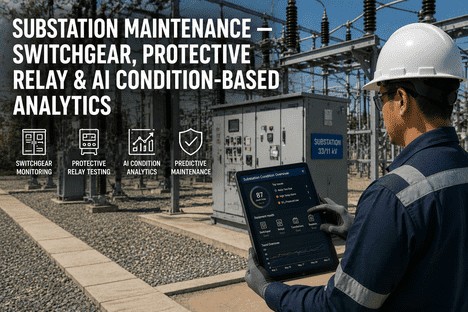
Substation Maintenance — Switchgear, Protective Relay & AI Condition-Based Analytics
By Grace on June 22, 2026
Substations are the critical interconnection points of every power grid — the nodes where transmission meets distribution, where voltage is transformed, and where the protection systems that prevent cascading outages live. Yet most utility managers will tell you the same truth: they know their substation equipment is aging, but they do not know which circuit breaker is approaching mechanical failure, which protective relay has drifted out of calibration, or which switchgear compartment has developing partial discharge. The global substation maintenance market was valued at $42.9 billion in 2025 and is projected to reach $84.9 billion by 2034 at 7.9% CAGR. The switchgear monitoring system market alone is forecast to grow from $2.2 billion to $4.5 billion over the same period. The industry is investing heavily in keeping substations reliable. But the dominant approach remains calendar-based — inspect every breaker every twelve months, test every relay every two years, replace components when they reach a prescribed age. The utilities that are outperforming this pattern have shifted from time-based to condition-based maintenance, applying AI-driven analytics to the continuous data streams that modern substations generate, and they are cutting unplanned outage costs by up to 40% while extending equipment life by years. iFactory's Substation Intelligence module was purpose-built to make this shift possible at network scale.
Stop Maintaining Substations on a Calendar Schedule. iFactory Tells You Which Equipment Needs Attention and When.
iFactory's Substation Intelligence module gives utility maintenance managers real-time visibility into switchgear condition, protective relay health, and substation equipment degradation across every station in the network — with AI-powered analytics that replace time-based inspections with condition-based interventions.
Projected global substation maintenance market by 2034 at 7.9% CAGR — utilities investing in AI-driven condition monitoring will capture disproportionate reliability gains
30%
Of switchgear failures attributed to mechanical wear — detectable months before failure through continuous condition monitoring of breaker mechanisms and drive systems
70%
Of U.S. power grid infrastructure above 30 years old — aging substation assets demand predictive analytics, not uniform calendar-based maintenance schedules
37%
Of switchgear units worldwide equipped with any form of digital monitoring — the remaining 63% still managed with manual inspections and time-based maintenance intervals
The Real Problem With Substation Maintenance Is Not the Equipment Age — It Is the Blindness
Most utilities know their substation assets are aging. What they do not know is which circuit breaker has accumulated critical wear, which protective relay has a calibration drift that will cause a misoperation, or which switchgear compartment has partial discharge activity that will escalate to a flashover within the next six months. The operational challenge of managing a multi-substation network is not that equipment fails — it is that the failure is usually preceded by warning signs that nobody was monitoring. And in a network where maintenance data is scattered across paper inspection forms, disconnected test set outputs, and the memory of senior engineers approaching retirement, the inability to see degradation before it becomes an outage is not a technology gap. It is a data integration gap that iFactory was designed to close.
How Calendar-Based Substation Maintenance Fails — and What the Pattern Looks Like
The Interval Fallacy
A twelve-month inspection interval assumes every breaker degrades at the same rate. They do not.
Calendar-based maintenance treats all equipment of the same type identically. But a circuit breaker operating in a high-moisture coastal substation with frequent switching operations wears faster than an identical unit in a climate-controlled indoor installation with minimal through-current. The twelve-month interval over-inspects the healthy unit and under-inspects the stressed one. The result is wasted maintenance labour on equipment that does not need attention and missed warning signs on equipment that is approaching failure. In a network with dozens or hundreds of substations, the compounding effect of this misallocation is substantial — both in unnecessary maintenance cost and in preventable failures.
Wasted Labour + Preventable Failures
The Relay Reliability Paradox
Protective relays may only operate once in decades — and that single operation must be correct.
A protective relay may sit in standby mode for twenty years without ever being called upon to operate. When a fault finally occurs, the relay has one opportunity to perform correctly. If it fails to trip, or trips when it should not, the consequences can include equipment damage, extended outage duration, and cascading grid events. Traditional testing at two-year intervals creates a long gap between verification cycles, during which component drift, environmental stress, or firmware issues can develop undetected. Continuous relay monitoring — tracking relay health parameters, event log consistency, and self-diagnostic outputs — closes this gap by providing continuous assurance that the protection system is ready to operate when required.
Undetected Drift + Fault Misoperation Risk
The Data Fragmentation Problem
Partial discharge data on one spreadsheet. Breaker operation counts in another. Relay event logs in a third.
In a typical multi-substation utility, condition data is generated by different systems for different equipment types: online PD monitors for switchgear, SCADA for breaker operations, relay test sets for protection calibration, dissolved gas analysers for transformers, thermography for bus connections. Each data stream lives in its own application, reviewed by its own specialist, on its own schedule. The cross-correlation that reveals a pattern — for example, that three breakers from the same manufacturing batch across different substations are showing elevated mechanical wear — is invisible because the data was never combined. Without a centralised platform that aggregates and analyses all substation condition data in one place, the network-level view of asset health does not exist.
Siloed Data + No Cross-Correlation
The Compliance Documentation Burden
Every inspection generates a paper form. Every test produces a PDF report. Proving compliance means finding the right file.
Utilities operate under regulatory frameworks — NERC, IEC, IEEE, and national grid codes — that require documented evidence of substation maintenance and relay testing at prescribed intervals. When a regulator asks for proof that a specific breaker at a specific substation was inspected on schedule, the answer should be available in seconds, not days. In most utilities, retrieving the documentation requires searching through filing cabinets, network drives, and email archives. A centralised substation intelligence platform that captures every inspection, test, and maintenance event with timestamped records, linked to the specific asset, transforms compliance from a quarterly filing exercise into a continuously auditable data stream that can be queried in real time.
Managing Each Substation Separately Is Not Asset Management. It Is a Collection of Silos. iFactory Unifies the View.
A single platform view of every substation's switchgear condition, protective relay status, partial discharge trends, and equipment degradation trajectory — updated continuously, without manual compilation, without the quarterly data consolidation exercise that consumes your engineering team's time.
What iFactory's Substation Intelligence Module Actually Does
iFactory is not a reporting layer bolted on top of disconnected monitoring systems. It is a unified substation asset intelligence platform where every breaker, every relay, every switchgear compartment, and every maintenance event is registered, tracked, and analysed in a single data environment — with role-based access that gives network managers the cross-substation visibility they need and gives field engineers the diagnostic insights that match their maintenance workflow.
Capability 01
AI-Powered Switchgear Condition Monitoring — Detect Partial Discharge, Mechanical Wear and Thermal Anomalies in Real Time
Real-Time Equipment Intelligence
iFactory integrates with online switchgear monitoring sensors — partial discharge couplers, UHF sensors for GIS, temperature sensors at critical bus connections, breaker mechanism travel sensors, and SF6 gas density monitors. The platform aggregates sensor data from every switchgear assembly across every substation into a single condition monitoring view. AI models analyse the combined data streams to identify patterns that indicate developing faults: an upward trend in partial discharge activity at a specific bus section, a change in breaker closing time that signals mechanism wear, or a gas pressure trend that indicates a slow leak. When a parameter crosses a configurable threshold, the system alerts the responsible engineer with the specific equipment identification, the nature of the anomaly, and a severity rating that enables maintenance prioritisation across the network. This eliminates the dependence on periodic manual inspections and replaces it with continuous, data-driven condition awareness.
Multi-sensor data integration
AI-based anomaly detection
Threshold-based severity alerting
Capability 02
Intelligent Protective Relay Testing and Analytics — Ensure Every Relay Operates Correctly Before the Fault Happens
Protection System Assurance
iFactory centralises protective relay data across the entire substation network — capturing relay settings, firmware versions, event logs, oscillography records, and self-diagnostic outputs from every microprocessor-based relay. The platform tracks calibration test history for each relay, maintaining a trending database that reveals drift patterns before they cross tolerance limits. When a relay test is performed, results are uploaded directly to the platform, compared against previous test cycles for the same relay, and flagged if any parameter shows a statistically significant change. The system also maintains a complete relay settings database with version control, enabling engineers to verify that every relay in the network is running the correct settings group for its protection application. For compliance reporting, a NERC or IEC standard audit query returns every relay test record, calibration result, and settings change across the entire network in seconds — rather than the days or weeks typically required to assemble this documentation manually.
Centralised relay settings management
Trend-based calibration drift tracking
Compliance audit readiness in seconds
Capability 03
Predictive Substation Equipment Degradation Analytics — Replace Components Based on Condition, Not Calendar Schedule
Predictive Lifecycle Management
iFactory's degradation analytics engine fuses data from multiple monitoring sources — partial discharge trends, breaker operation counts and timing, contact resistance measurements, SF6 gas density trends, transformer DGA results, and load history — to produce a per-asset condition score and remaining useful life estimate. The AI models are calibrated to equipment-type-specific failure modes: the degradation pattern of a vacuum interrupter differs fundamentally from that of an SF6 puffer breaker, and the platform applies the correct model to each asset class. The output is a prioritised maintenance and replacement list sorted by predicted failure probability, enabling maintenance managers to allocate capital budgets to the breakers, switchgear compartments, and relays that need intervention most urgently — not those that happen to have reached a calendar milestone.
Equipment-specific degradation models
Multi-variate condition scoring
Risk-prioritised intervention lists
Capability 04
Network-Wide Substation Health Dashboard — Every Breaker, Every Relay, Every Substation, One Unified View
Unified Network Visibility
iFactory aggregates condition data from every substation in the network into a single geospatial dashboard. Every asset — circuit breaker, switchgear compartment, protective relay, transformer — is displayed with its current condition score, last inspection date, active alerts, and predicted remaining life. Network managers can filter by asset type, manufacturer, installation year, condition severity, or geographic region to identify patterns that would be invisible in substation-by-substation reporting. The dashboard supports what-if analysis for capital planning — modelling the reliability and budget impact of replacing specific breaker populations or upgrading specific relay types across the network. This transforms the annual substation maintenance planning process from a subjective discussion based on individual engineer judgement into an objective, data-driven investment framework that can be presented to regulators, financial stakeholders, and board-level decision makers with confidence.
Geospatial asset condition map
Cross-substation cohort analysis
Replacement scenario modelling
Managing a Mixed Substation Network — Why Different Equipment Types Require Different Condition Monitoring Approaches in the Same Platform
One of the underappreciated challenges of substation asset management is that different equipment types do not just require different maintenance tasks — they require fundamentally different condition monitoring methodologies and degradation models. A gas-insulated switchgear compartment has different partial discharge characteristics and failure mechanisms than an air-insulated switchgear section. A microprocessor-based relay produces entirely different diagnostic data than an electromechanical relay. Managing all of them in a single intelligence platform requires a system that can apply equipment-type-specific monitoring logic without forcing a common denominator approach on all substation assets.
How iFactory Handles Equipment-Type Monitoring Differences Within a Single Multi-Substation Network
Equipment Type
Primary Failure Mode
How iFactory Configures Monitoring for This Type
Gas-Insulated Switchgear (GIS)
SF6 gas leakage, partial discharge in epoxy insulators, mechanical wear in operating mechanisms, moisture ingress
Continuous SF6 density monitoring with leak rate trending, UHF partial discharge sensor integration, breaker mechanism travel analysis, moisture content tracking, gas compartment pressure alerts with automated leak classification
Air-Insulated Switchgear (AIS)
Insulation degradation from contamination and moisture, contact erosion, bus connection overheating, mechanical wear
Online partial discharge monitoring via capacitive couplers and HFCT sensors, infrared temperature monitoring at critical bus joints, contact resistance trending, breaker mechanism travel analysis with contact wear estimation
Protective Relays (Microprocessor)
Calibration drift, firmware anomalies, component ageing on critical circuit boards, communication degradation
Continuous self-diagnostics monitoring via relay health reports, calibration test trending with drift analysis, firmware version control across all relays in the network, settings change tracking with version history, event log analysis for pattern anomalies
DGA trending with AI-driven fault gas interpretation, bushing power factor monitoring, tap changer operation count and wear tracking, winding temperature correlation with load profiles, on-line insulation resistance monitoring where installed
"
We were managing forty-three substations with a mix of GIS, AIS, electromechanical relays, and microprocessor-based protection — each with its own maintenance schedule, its own inspection form, its own spreadsheet for tracking test results. Our quarterly network health assessment required two full-time engineers spending a week compiling data from seven different sources. The first month on iFactory, the platform identified that a batch of breakers installed across four different substations during a 2018 upgrade programme were showing a common mechanical wear pattern. None of the individual substation teams had flagged it because the trend was only visible when the data from all four substations was combined. We coordinated a root cause investigation and implemented corrective maintenance before any of them failed in service. That cohort-level visibility alone justified the entire platform investment.
— Director of Substation Maintenance Operations, Regional Transmission Utility — 28 Years Power Systems
Conclusion
The substation maintenance market is heading toward $84.9 billion by 2034 at 7.9% CAGR, the switchgear monitoring market is projected to reach $4.5 billion over the same period, and more than 70% of power grid infrastructure now exceeds thirty years of service. The substation automation market alone is forecast to grow from $44.3 billion in 2026 to $78.9 billion by 2036 at 5.9% CAGR — reflecting the industry's accelerating investment in digital transformation of grid operations. The defining challenge of substation maintenance in this decade is not whether equipment will degrade — it is whether your organisation will know which components are degrading fastest and intervene before they fail.
The utilities that solve this challenge with AI-driven condition monitoring and centralised substation intelligence will outperform those running calendar-based programmes on every metric that matters: unplanned outage frequency, maintenance cost per asset, equipment lifespan, capital replacement efficiency, regulatory compliance confidence, and the grid reliability that determines both customer satisfaction and regulatory standing. The condition data already exists across every substation. What has been missing is the management layer that connects it into a single, actionable view of network-wide substation health.
iFactory's Substation Intelligence module connects every switchgear assembly, every protective relay, and every substation into a single real-time network view — with AI-powered condition monitoring, intelligent relay analytics, degradation prediction, and the network dashboard that gives maintenance managers the information they need to maintain the right equipment at the right time, regardless of calendar schedule. Book a Demo to see how the platform maps to your network's specific substation types and equipment mix, or talk to an expert to begin your substation intelligence configuration and get your first network-wide asset health dashboard live within thirty days.
Frequently Asked Questions
iFactory supports integration with a wide range of substation monitoring and diagnostic systems, including online partial discharge monitors, SF6 density monitoring systems, breaker analytics platforms, relay test sets from major manufacturers, transformer DGA analysers, and SCADA systems. Data can be ingested through automated file parsing, direct instrument connectivity, API integration, or OPC-UA gateway connections. In the initial deployment phase, iFactory operates alongside your existing systems — field teams continue using their current test equipment and monitoring tools, and data flows into the platform for centralised analysis and trending. The full condition-based maintenance workflow becomes operational as the data model populates with your asset register and monitoring streams. Talk to an expert to review your current monitoring infrastructure and integration requirements.
Yes. iFactory's asset intelligence architecture is manufacturer-agnostic and technology-generation-independent. The platform supports equipment from any manufacturer and any vintage — from 1960s electromechanical relays to the latest IEC 61850 digital substation protection systems. Each asset type is modelled with its specific monitoring parameters, degradation characteristics, and maintenance requirements. The platform normalises data from diverse sources into a consistent condition assessment framework, so a 1970s oil circuit breaker with manual inspection records and a 2020s SF6 puffer breaker with continuous online monitoring both produce comparable condition scores and trend data. The system tracks methodology provenance alongside condition data, enabling engineers to assess whether condition changes reflect actual degradation or changes in monitoring method. Book a Demo to walk through the multi-substation, multi-vendor configuration for your specific network composition.
iFactory's AI models are trained on equipment-type-specific degradation curves that establish a baseline expected aging trajectory for each asset class — taking into account factors such as manufacturer, installation environment, switching frequency, load profile, and years in service. The platform continuously compares each asset's observed condition trend against its expected degradation curve. When the observed trend diverges from the expected trajectory beyond a configurable confidence interval, the system flags the asset for review and escalates the anomaly with a severity rating based on the rate of divergence. This approach enables the platform to distinguish between normal age-related deterioration and accelerated degradation caused by specific defect mechanisms — a partial discharge hotspot, a mechanism lubrication failure, a contact erosion acceleration — that require intervention. The model self-calibrates over time as more condition data is collected from each asset population. Talk to an expert to discuss how the degradation models would be calibrated for your specific equipment fleet and operating conditions.
For a utility network managing multiple substations with mixed equipment types, iFactory's standard implementation sequence covers: weeks one to two for network architecture configuration and asset register population from existing GIS, CMMS, and maintenance databases; weeks three to five for monitoring system integration and data ingestion pipeline setup — connecting online PD monitors, relay test sets, DGA analysers, and SCADA data streams; weeks six to eight for condition model calibration and AI degradation baseline establishment using available historical maintenance and test data; and weeks nine to twelve for dashboard configuration, threshold setting, alert workflow design, and engineering team training. The first network-wide substation health dashboard is typically available for management review within the first thirty days, with the AI condition monitoring engine producing prioritised maintenance recommendations once the initial data model has been populated and baseline trends established. Full transition from calendar-based to condition-based maintenance planning is phased over the first six to twelve months as the platform accumulates sufficient trend data to support confident decision-making. Book a Demo to build the implementation plan specific to your network's substation count, equipment mix, and current monitoring infrastructure.
Maintaining Every Substation on the Same Calendar Schedule Is Not a Strategy. Knowing Which Asset Needs Attention and When Is.
iFactory's Substation Intelligence module — AI-powered switchgear condition monitoring, intelligent relay analytics, degradation prediction, network-wide asset health dashboard. The single platform your substation network has been missing.