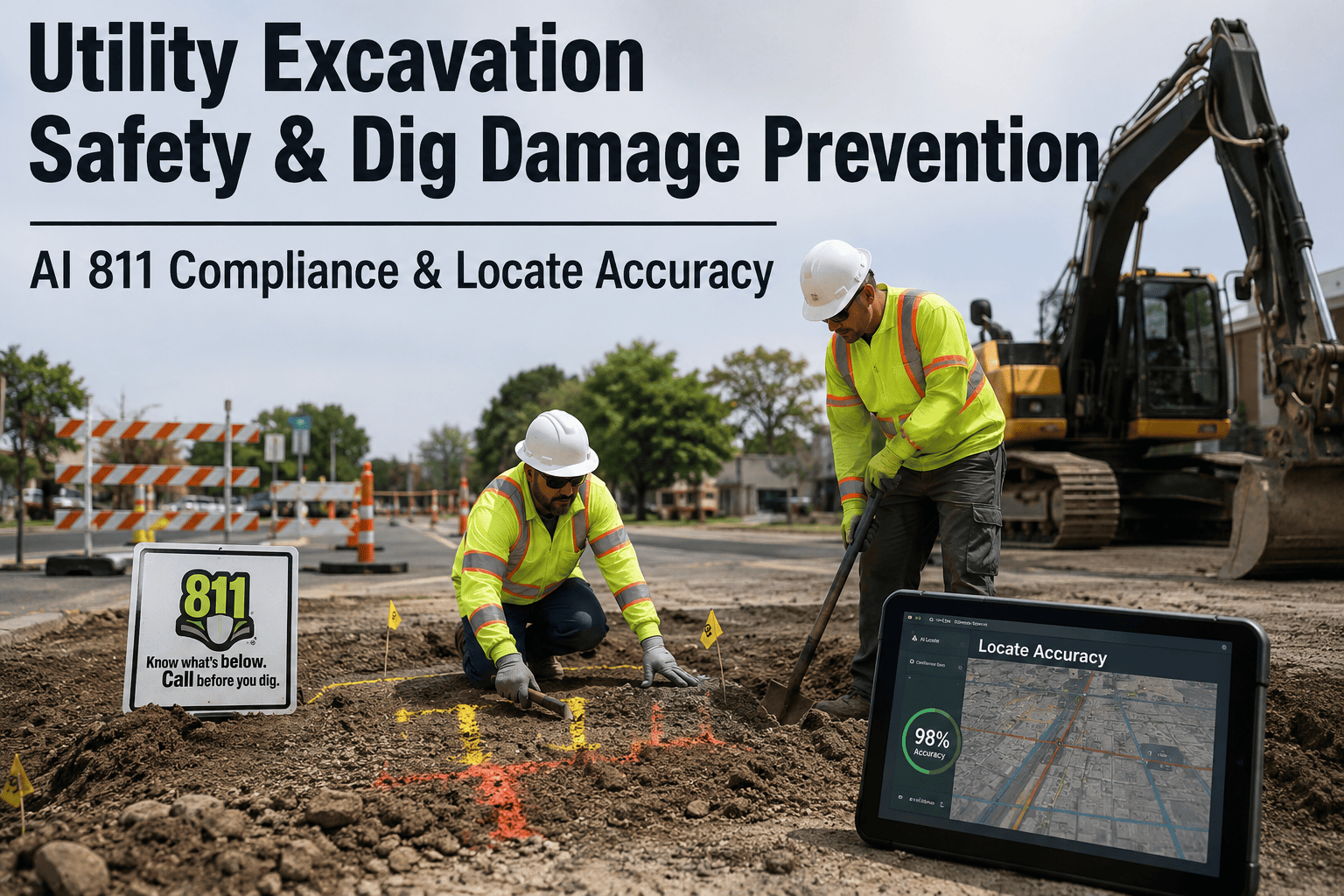
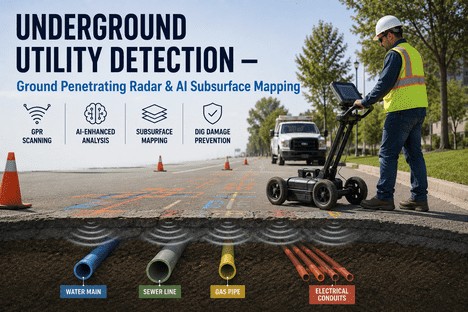
Every year in the United States, underground utility strikes damage buried water, sewer, gas, and electric infrastructure at a rate of roughly one incident every two minutes. For EHS managers overseeing excavation programs across multiple sites or contracted crews, these numbers are not abstract statistics — they represent reportable incidents, regulatory scrutiny, crew evacuations, service disruptions, and in the worst cases, fatalities. The 811 one-call system was designed to prevent exactly this outcome, yet the gap between calling 811 and actually preventing damage remains wide because locate accuracy, verification, and real-time compliance tracking still rely heavily on manual processes that break down under operational pressure. AI-powered excavation safety systems are closing that gap by turning locate tickets, paint marks, and pothole results into verifiable, auditable data that EHS teams can act on before the bucket touches the ground. Talk to iFactory support about deploying AI-driven dig damage prevention across your excavation program.
Excavation Safety · Dig Damage Prevention · AI 811 Compliance
Utility Excavation Safety and Dig Damage Prevention With AI-Powered 811 Compliance and Locate Accuracy
Stop relying on paper tickets and visual guesswork. AI vision systems verify locate marks, track 811 compliance in real time, and give EHS managers documented proof that every excavation followed the damage prevention process before a single shovel broke ground.
700,000+
Underground utility strikes reported annually in the United States, costing an estimated $30 billion in direct and indirect damages
38%
Of all damage incidents occur on work sites where a 811 ticket was never submitted or was submitted after excavation had already begun
72 Hrs
Minimum legal notice period in most states between 811 ticket submission and lawful excavation start — yet compliance tracking is almost entirely manual
The Damage Problem
Why Utility Strikes Keep Happening Despite Decades of 811 Enforcement
The one-call system has been operational since the 1970s, and every state now has a mandatory 811 statute with penalties for non-compliance. Yet damage rates have not declined meaningfully in over a decade. The reason is not that excavators do not know about 811 — it is that the process between calling 811 and safely excavating contains multiple failure points where human error, miscommunication, and lack of verification converge. EHS managers inherit the consequences of every one of these failures, but historically have had no way to intervene before damage occurs because the verification steps happen on the ground, away from any centralized oversight.
01
Ticket Never Submitted
Crews or subcontractors begin work without filing a 811 request, either because of schedule pressure, unfamiliarity with the site, or the mistaken belief that no utilities are present in the work area. This accounts for over a third of all strikes and is entirely a compliance failure that EHS teams cannot detect without real-time tracking.
02
Insufficient Wait Time
Excavation begins before the legal notice period has elapsed. In many states, the law requires 48 to 72 hours of advance notice, excluding weekends and holidays. Crews working under deadline pressure frequently start early, and without automated ticket-to-excavation tracking, EHS managers have no visibility into whether the wait period was actually observed at each site.
03
Locate Marks Missing or Inaccurate
The utility locator arrives but marks the wrong location, misses a utility, or places marks that are ambiguous or illegible. Excavators then follow incorrect paint lines into buried infrastructure. This failure mode is particularly dangerous because the crew believes they are in compliance — the marks are visible, they appear to be following the process — but the data they are acting on is wrong.
04
Marks Degraded or Obscured
Weather, traffic, or subsequent ground activity erases or obscures paint marks between the locate date and the excavation date. Crews arrive at a site where the locate was performed days earlier but the marks are no longer visible or interpretable. Without photographic documentation of the original mark placement, there is no way to reconstruct what the locator intended.
811 Process Map
The 811 Excavation Workflow and Where AI Verification Inserts Safeguards at Every Failure Point
The standard 811 excavation process contains eight discrete steps between project planning and safe excavation. In a traditional workflow, steps three through seven operate with minimal documentation and no real-time oversight. AI vision and tracking systems insert verification checkpoints at each of these steps, creating an auditable chain of evidence that the damage prevention process was followed correctly.
1
Plan Excavation
Site survey and work area definition
Manual
2
Submit 811 Ticket
One-call center notification with dig site coordinates and date
AI Tracked
3
Wait Period Begins
Legal notice countdown starts — 48 to 72 hours in most jurisdictions
AI Tracked
4
Locator Arrives
Utility locate technician marks buried infrastructure with paint and flags
AI Verified
5
Mark Documentation
AI vision captures and archives locate mark positions, colors, and legibility
AI Verified
6
Pre-Excavation Check
Verify ticket active, wait period complete, marks present and legible
AI Verified
7
Safe Excavation Begins
Work proceeds within verified and documented locate boundaries
AI Tracked
8
Close Ticket
Excavation complete — full compliance record archived
Manual
Locate Accuracy
AI Vision for Locate Mark Verification — What the System Actually Detects and Documents
The core capability that makes AI-powered excavation safety effective is computer vision applied to locate mark documentation. When a utility locator finishes marking a dig site, an AI vision system — deployed on a mobile device, edge camera, or drone — captures images of the marked area and automatically analyzes them against a verification checklist that would take a human inspector ten to fifteen minutes to complete manually. The system does not replace the locator. It verifies that the locate was performed completely and documents the result in a format that EHS teams, regulatory auditors, and legal teams can rely on.
Mark Presence
The vision system confirms that locate marks are visible within the defined dig area boundary. If no marks are detected, the system flags the site as non-compliant and alerts the EHS manager before any excavation equipment is mobilized. This prevents the most common failure mode: crews arriving at a site assuming locates were completed when they were not.
Color Code Compliance
APWA uniform color codes assign specific colors to specific utility types — red for electric, yellow for gas, orange for communications, blue for water, green for sewer, and pink for temporary survey markings. The AI system verifies that the correct colors are present for the utility types listed on the 811 ticket. A missing color for a known utility is flagged as a potential incomplete locate.
Mark Continuity
Locate marks should form continuous lines showing the path of buried utilities through the dig area. Gaps, breaks, or discontinuous paint lines indicate areas where the locator may have lost signal, encountered interference, or simply stopped marking. The vision system detects continuity breaks and flags them for manual review before excavation proceeds through the gap area.
Mark Legibility
Weather degradation, traffic wear, poor paint application, or ground surface conditions can render marks unreadable. The system assesses mark clarity and contrast against the ground surface, flagging marks that fall below a legibility threshold. This is particularly critical for sites where the locate occurs days before excavation is scheduled to begin.
Spatial Accuracy Check
When GPS or survey reference points are available at the dig site, the vision system can compare the location of painted marks against the known utility corridor coordinates from the one-call ticket. Significant deviations between expected and actual mark positions are flagged as potential locate accuracy issues that require potholing or additional verification before excavation.
Temporal Documentation
Every verification image is timestamped and geotagged, creating an immutable record of what the locate marks looked like at a specific date and time. This documentation is critical for resolving disputes, responding to regulatory inquiries, and defending against liability claims when damage occurs despite apparent compliance with the 811 process.
Process Comparison
Traditional 811 Compliance Management Versus AI-Powered Dig Damage Prevention
Compliance Dimension
Traditional Manual Process
AI-Powered Verification
Ticket Submission Tracking
Crews self-report ticket submission on paper forms or spreadsheets that are completed after the fact and cannot be independently verified
Digital ticket ingestion with automated timestamp verification against planned excavation start dates
Wait Period Enforcement
No automated mechanism to prevent early excavation — relies entirely on crew discipline and supervisor awareness
System automatically calculates legal wait period and flags or blocks excavation start if minimum notice has not elapsed
Locate Mark Verification
Visual inspection by crew foreman, if performed at all — no photographic record and no standardized verification criteria
AI vision system captures, analyzes, and archives locate marks against APWA color code and continuity standards
Mark Degradation Monitoring
No tracking between locate date and excavation date — marks may be gone by the time crews arrive
Comparison of original locate documentation against current site conditions at excavation start
Compliance Audit Trail
Paper tickets, handwritten notes, and verbal confirmations that are difficult to locate, organize, and present during audits
Complete digital chain of evidence from ticket submission through excavation completion with timestamps and images
Multi-Site Oversight
EHS manager must physically visit each site or rely on phone reports — impossible to maintain real-time visibility across more than a few active excavations
Centralized dashboard showing compliance status, verification results, and flagged issues across all active excavation sites simultaneously
Subcontractor Accountability
Contractor self-certification with no independent verification — damage liability disputes are common and poorly documented
System-enforced compliance checkpoints create objective documentation of contractor adherence to damage prevention requirements
Risk Quantification
The Real Cost of a Single Utility Strike — What EHS Managers Report After an Incident
Most organizations dramatically underestimate the total cost of a utility strike because they account for the immediate repair expense but not the cascading consequences. The following breakdown represents the composite cost structure that EHS managers who have been through strike incidents consistently report. These are not theoretical — they are the actual cost categories that appear on incident reports, insurance claims, and regulatory filings after a significant underground utility damage event.
Immediate Costs
Emergency Utility Repair
Crew dispatch, materials, and emergency repair labor — typically $5,000 to $50,000 depending on utility type and damage severity
Service Disruption Liability
Costs charged by the utility for service interruption to downstream customers — can exceed $100,000 for gas or electric outages affecting multiple properties
Site Evacuation and Stand-Down
Crew evacuation, area封锁, and lost productive hours while the incident is stabilized — typically 4 to 24 hours of fully loaded crew and equipment cost
Secondary Costs
Regulatory Investigation
OSHA, state utility commission, or pipeline safety administration investigation — requires legal counsel, document production, and management time over weeks or months
Contractual Penalties
Liquidated damages or contract default clauses triggered by utility damage — particularly severe on government, military, or infrastructure owner projects
Insurance Premium Impact
Reportable strikes affect experience modification rates and can increase general liability and professional liability premiums for three to five years
Catastrophic Risk
Gas Explosion or Electrocution
Damage to high-pressure gas lines or energized electric conduits can cause immediate fatalities, criminal negligence charges, and enterprise-threatening litigation
Environmental Contamination
Sewer or fuel line strikes releasing hazardous materials trigger EPA reporting requirements, remediation obligations, and potential Superfund designation
Community Impact and Reputation
Extended service outages affecting residential areas, hospitals, or schools generate media coverage, community outrage, and lasting reputational damage to the organization
Deployment Case
Municipal Infrastructure Contractor Reduced Utility Strikes by 84% Across 340 Annual Excavation Sites
A municipal infrastructure contractor performing water main replacements, sewer rehabilitation, and street reconstruction across a metropolitan area was averaging 22 reportable utility strikes per year across approximately 340 excavation sites. Their 811 compliance rate — measured by ticket submission — was 94%, but their damage rate was nearly triple the industry average for their compliance level, indicating that the problem was not tickets but what happened after the ticket was filed. Investigation revealed three systemic failures: crews frequently began excavation before the 72-hour wait period elapsed because supervisors could not track ticket submission times across multiple active sites; locate marks were not systematically verified before excavation, meaning crews often worked with incomplete or degraded markings; and subcontractor crews had no standardized pre-excavation verification process, creating accountability gaps when damage occurred. The contractor deployed an AI-powered excavation safety platform that integrated with the state one-call system to automatically ingest and track all 811 tickets, enforced wait period compliance through automated alerts, and used mobile AI vision to capture and verify locate marks at each site before excavation was authorized. In the first twelve months after deployment, reportable utility strikes dropped from 22 to 3. The three remaining strikes all occurred on subcontractor sites where the AI system had flagged incomplete locates but excavation had been authorized by a project manager who overrode the system alert — a human decision, not a system failure.
84%
Reduction in reportable utility strikes in the first year of deployment
340 Sites
Annual excavation sites managed through the AI compliance platform
100%
Of remaining strikes traced to manual system overrides, not platform failures
$410K
Estimated first-year savings from avoided strike costs, repairs, and penalties
Every Unverified Locate Mark Is a Potential Strike. AI Vision Turns Paint Lines Into Documented Compliance Evidence Before the Bucket Goes Down.
iFactory deploys AI-powered excavation safety systems that track 811 compliance, verify locate accuracy, and create auditable damage prevention records across every active dig site in your program — giving EHS managers real-time visibility they have never had before.
Tracked Metrics
What EHS Teams Measure After Deploying AI-Powered Dig Damage Prevention Systems
811 Ticket Coverage
Percentage of excavation sites with verified, time-stamped 811 ticket submission before any ground disturbance
This is the foundational compliance metric. Before AI tracking, most organizations estimate their ticket coverage rate based on self-reported data. After deployment, they discover the actual rate is 5 to 15 points lower than they believed, because unreported no-ticket excavations become visible for the first time.
Wait Period Compliance
Percentage of excavations where the legal notice period fully elapsed before ground disturbance began
Even organizations with high ticket coverage rates frequently have wait period violations because the time between ticket submission and planned excavation is not automatically calculated. AI systems enforce this by comparing ticket timestamps against excavation authorization timestamps and flagging any gap below the legal minimum.
Locate Verification Rate
Percentage of sites where AI vision confirmed that locate marks matching the ticket were present, legible, and color-code compliant before excavation
This metric reveals the true completeness of the locate process. Many organizations discover that 15 to 25 percent of their excavations proceed with at least one missing or non-compliant locate mark — a condition that was invisible under manual verification processes.
Strike Rate Per 1,000 Excavations
The definitive outcome metric — reportable utility damage incidents normalized by excavation volume
This is the metric that matters most to executive leadership, insurance carriers, and regulatory agencies. Organizations deploying AI-powered prevention typically see a 60 to 85 percent reduction in strike rate within the first twelve months, with continued improvement as the system accumulates data and refines detection models.
Regulatory Landscape
811 Compliance Requirements That EHS Managers Are Directly Accountable For Across Key Jurisdictions
While 811 is federally mandated through the Pipeline Safety Improvement Act, implementation and enforcement vary significantly by state. EHS managers operating across multiple jurisdictions face a patchwork of notice periods, penalty structures, and documentation requirements that are nearly impossible to manage consistently through manual processes. The following overview covers the compliance variables that most commonly create exposure for multi-state excavation programs.
Notice Period Variance
State-mandated advance notice ranges from 48 hours (Texas, Florida) to 72 hours (California, New York) to 10 full working days (Alaska). Some states exclude weekends and holidays from the calculation, others count calendar days. Multi-state programs that apply a single standard notice period are inevitably non-compliant in some jurisdictions. AI tracking systems apply jurisdiction-specific rules automatically based on dig site location.
Penalty Structures
Per-incident civil penalties for 811 violations range from $1,000 in some states to $50,000 or more in others, with enhanced penalties for damage to critical infrastructure. Several states now impose per-day penalties for ongoing non-compliance. Criminal penalties are possible in cases involving gas line damage with injury or fatality. AI compliance documentation provides the primary defense against these penalties by demonstrating good-faith process adherence.
Documentation Requirements
An increasing number of states require excavators to maintain written documentation of 811 compliance at the job site during active excavation. Some states specify what the documentation must include — ticket number, submission time, response status, and locate verification. AI systems generate this documentation automatically in the required format, eliminating the risk of incomplete or missing site records during a regulatory inspection.
Positive Response Requirements
Most states operate under a positive response system where utilities must either mark their lines or provide an all-clear response within the notice period. If no response is received, excavators in some jurisdictions may proceed with caution, while others require a second contact attempt. AI systems track utility response status and alert EHS managers when the notice period expires without a confirmed response from all ticketed utilities.
Frequently Asked Questions
Excavation Safety and AI-Powered 811 Compliance — What EHS Managers Ask First
Does the AI system replace the utility locator or the 811 one-call process?
No. The AI system does not perform locates and does not replace the 811 notification process. Utility locates are still performed by trained technicians employed by the utility companies or their contracted locate service providers. The 811 ticket is still submitted through the existing one-call center. What the AI system does is verify and document the output of that process — confirming that locates were completed, marks are present and correct, wait periods were observed, and the pre-excavation checklist was satisfied before work begins. It adds a verification and documentation layer on top of the existing process without changing any of the underlying stakeholder responsibilities or workflows.
Contact support to discuss how the AI layer integrates with your current 811 workflow.
How does the system handle excavations where locates are marked with flags instead of paint?
The AI vision system is trained to detect both paint marks and flag placements, including the color-coded flags that correspond to the same APWA color standards used for paint. Flag detection uses a different detection model than paint mark analysis because flags present in three dimensions, can be displaced by wind or traffic, and may be positioned at offset distances from the actual utility path. The system documents flag presence, color, and approximate position, but flags inherently provide lower spatial precision than paint lines, so the verification confidence score reflects this difference. Sites flagged with low confidence due to flag-only marking are automatically escalated for manual verification or potholing before excavation proceeds.
Book a Demo to see flag detection in action.
What happens when the AI system flags a potential locate inaccuracy but the utility company has provided an all-clear response?
This scenario — where the utility has responded to the 811 ticket with a no-facility or all-clear response but the AI system detects what appears to be unmarked utility infrastructure — is one of the most valuable use cases for the technology. The system does not block excavation in this situation, but it generates a high-priority alert that requires EHS or field supervisor review before the dig proceeds. In practice, these alerts frequently identify utilities that were missed by the locator, facilities that were installed after the utility records were last updated, or unregistered infrastructure that does not appear in the one-call database. Organizations using the system report that these false all-clear detections prevent some of the most dangerous strikes because they catch the exact situation where the crew would otherwise have the highest false confidence that the area is clear.
Contact support to discuss alert configuration for your program.
Can the system integrate with our existing one-call ticket management platform or do we need to change our current 811 workflow?
The platform integrates with major one-call ticket management systems through available APIs and data export formats, including ITIC ticket data standards used by most state one-call centers. In most deployments, the integration is configured to automatically ingest new tickets submitted under your company name or associated contractor names, pull ticket status updates on a scheduled basis, and cross-reference ticket data with site excavation schedules. Your crews and subcontractors continue to submit 811 tickets through whatever method they currently use — phone, web portal, or mobile app. The AI system receives the ticket data from the one-call center, not from the excavator, which means the verification is independent of the submission method and cannot be circumvented by the field crew.
Book a Demo to review integration options for your one-call platform.
How do we deploy this across subcontractor crews who do not work directly for our organization?
Subcontractor deployment is the highest-impact use case for most organizations because subcontractor crews typically have the lowest 811 compliance rates and the least standardized pre-excavation processes. The deployment model for subcontractors is designed to minimize adoption friction: the AI verification step is performed by a single designated person on each subcontractor crew using a mobile device with the verification app installed. The app guides the user through the capture process — photographing locate marks from defined angles, scanning the work area boundary, and confirming ticket information. The entire verification process takes three to five minutes per site. Subcontractors do not need training on AI or computer vision — they follow a simple guided capture workflow. Contractually, the verification requirement is added as a pre-excavation checkpoint in the subcontractor agreement, and compliance is tracked through the centralized dashboard. Organizations that have deployed this model report that subcontractor adoption exceeds 95 percent within the first month because the process is simpler than the paper checklists it replaces.
Contact support to discuss subcontractor deployment for your program.
Your Excavation Crews Are Making Compliance Decisions Every Day With No Documentation and No Oversight. AI Changes That.
Deploy AI-powered 811 compliance tracking and locate verification across your excavation program — turn every dig site into a documented, verified, and auditable compliance event that protects your crews, your organization, and the underground infrastructure you work around every day.