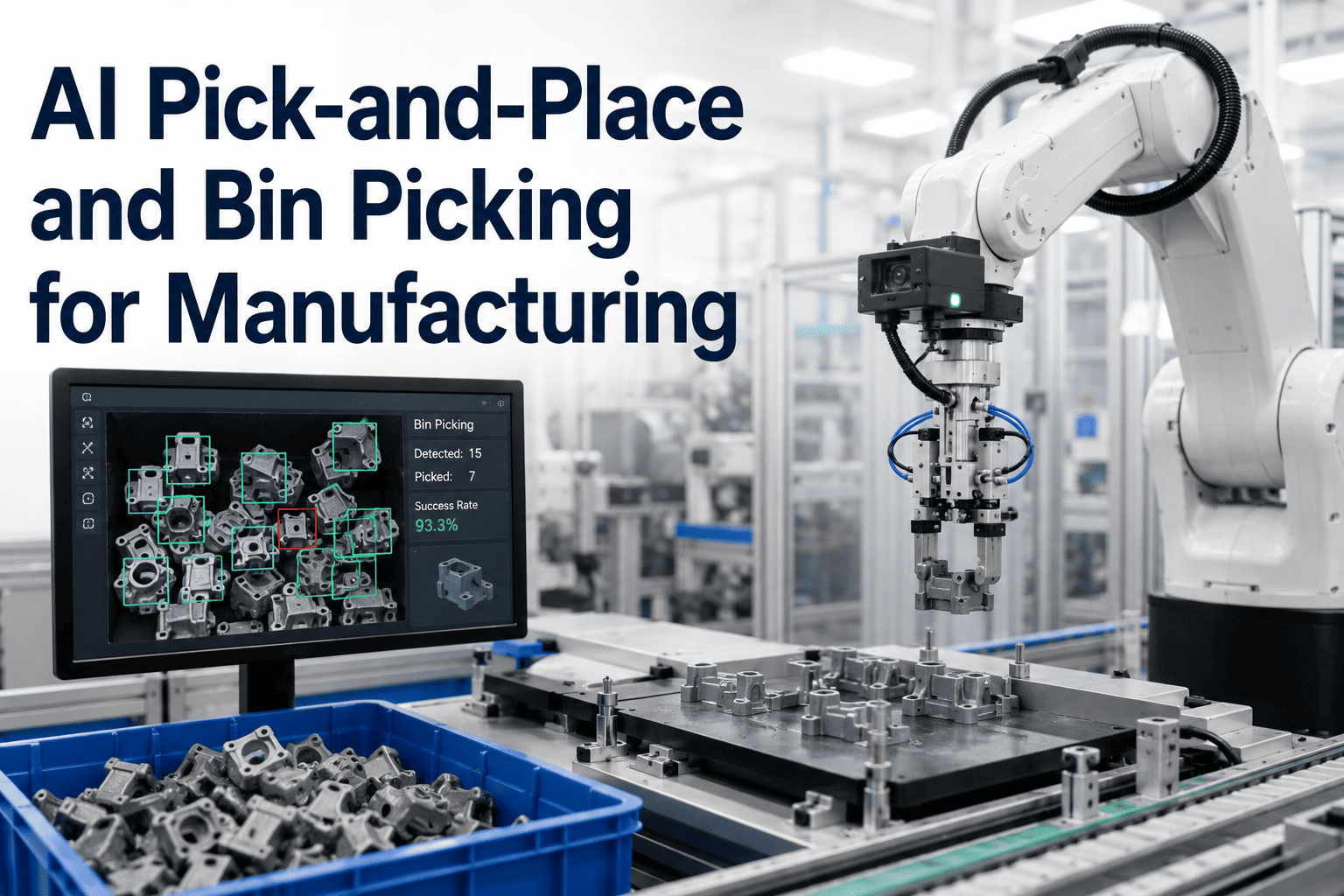
Random bin picking was considered one of the hardest unsolved problems in industrial robotics for well over a decade. A robot could place a part with sub-millimeter precision once it arrived in a known orientation, but the moment that same part landed randomly angled and overlapping inside a bin, most automation programs simply routed the job back to a person. That gap between structured pick-and-place and true random bin picking is closing fast, with AI vision and grasp-planning models now letting robots identify, localize, and lift parts they were never explicitly programmed to recognize, across mixed product runs and unattended shifts. Robotics and automation teams evaluating where to deploy this next can book a demo to see how iFactory AI monitors and optimizes pick-and-place cells already running on the floor.
Turn Every Pick-and-Place Cell Into a Monitored, Optimized Production Asset
iFactory AI layers continuous grasp success tracking, cycle time analytics, and gripper health monitoring on top of your existing bin picking and pick-and-place robots — so engineering teams see drift, wear, and changeover friction before they cost a shift.
Why Random Bin Picking Stayed Unsolved for So Long — and What Finally Changed
Traditional pick-and-place automation matches a scanned part against a known CAD model, which works well for a single part type arriving in a predictable orientation. That approach breaks down the moment parts vary in size, arrive mixed together, or land randomly oriented and overlapping in a bin — the exact conditions most incoming parts, castings, and fasteners actually show up in. Reflective surfaces confuse conventional 3D sensors, transparent materials scatter light unpredictably, and dense clutter forces a gripper to plan a path around neighboring parts without knocking them loose. For years, the economics only worked if a plant could afford to singulate parts onto trays or belts before a robot ever touched them, which meant paying a person to do the sorting a robot was supposed to eliminate.
What changed is the shift from matching a fixed model to learning a grasp strategy from data. Modern systems detect randomly oriented parts in dense clutter, estimate a precise six-degree-of-freedom pose, and plan a collision-free grasp on parts they were never explicitly trained on — then adapt in real time if the first attempt slips. That generalization is what turns bin picking from a specialty integration project into a repeatable production capability.
Inside the AI Grasp Cycle — From Cluttered Bin to Placed Part
Every AI-guided pick is really five decisions made in rapid sequence, each one a potential failure point that iFactory AI tracks independently so an engineering team knows exactly which stage of the cycle is degrading rather than just seeing an aggregate success rate drop.
Perceive
3D and 2D imaging captures the bin contents under current lighting, handling reflective, dark, or transparent materials.
Localize
The model estimates a precise six-degree-of-freedom pose for each candidate part in the clutter, not just its rough location.
Plan Grasp
A collision-free grasp is planned against neighboring parts and the bin wall, selecting the approach angle least likely to fail.
Execute
The gripper commits to the pick, with adaptive retries if resistance or slip is detected mid-motion instead of a hard fault.
Verify
In-hand localization confirms part orientation before placement, and the outcome is logged for trend analysis.
Where Manufacturers Are Putting AI Pick-and-Place to Work Across the Plant
Bin picking earns its keep wherever removing part randomness has been the actual bottleneck to automation, rather than the robot's speed or reach. The application areas below are ranked by how commonly plants deploy them today and how quickly the business case tends to close.
Machine Tending and CNC Parts Feeding
Operators loading raw castings or blanks from bins into CNC fixtures or feeders is one of the most common manual tasks left on a machining floor. AI bin picking automates the handoff, particularly for unattended second and third shifts, letting a single cell keep multiple machines fed without a dedicated loader.
Fastest ROI CategoryKitting and Assembly Staging
Mixed small parts are picked directly from bulk bins and staged into kits for downstream assembly stations, replacing manual kitting labor.
Mixed-SKU Order Fulfillment
Cells handle dozens of SKUs in the same shift, switching between learned grasp models instead of requiring a changeover reprogram.
Depalletizing Incoming Totes
Bulk-delivered components are unloaded from totes and pallets directly into production flow without a manual unpack step.
Lights-Out Production Coverage
Unattended shifts run with confidence when adaptive retries and drift alerts replace a supervisor watching for jams.
Matching Gripper Type and Vision Approach to Your Part Mix
The single biggest driver of pick success and cycle time is not the robot arm — it is whether the gripper and vision approach actually match the part geometry and surface finish coming down the line. The table below reflects the general fit patterns iFactory AI's analytics team sees most often when assessing a new cell.
| Part Characteristic | Recommended Gripper | Vision Approach | Typical Cycle Impact |
|---|---|---|---|
| Flat, smooth, rigid parts | Vacuum cup | 2D plus 3D depth | Fastest cycle, 4-5 sec |
| Irregular or porous parts | Adaptive finger gripper | Full 3D pose estimation | +1-2 sec vs. vacuum |
| Small ferrous parts | Magnetic end-effector | 2D with depth assist | Fast, low grasp planning load |
| Reflective or transparent parts | Multi-modal gripper | 3D plus polarization imaging | +2-3 sec vs. baseline |
| Deep, heavily cluttered bins | Extended-reach or dual-arm | Continuous re-scan between picks | +2-4 sec vs. shallow bins |
From Manual Sorting and Fixed Programs to Adaptive, Monitored Picking
What Robotics and Automation Leaders See After Deploying AI Bin Picking
Automation engineers who move a cell from fixed programming to AI-guided picking consistently describe the same turning point: the moment the cell stops being a black box that either runs or stalls, and starts producing data the team can actually act on before a stall happens.
We run three bin picking cells feeding CNC machining centers on our third shift, where we have no operator on the floor between 11pm and 6am. Before AI-guided picking, that shift only worked if incoming castings arrived pre-sorted, which meant a day-shift operator spent close to two hours every afternoon staging bins for the night run. When a cell jammed at 2am, the machines it fed simply sat idle until morning. Since we moved to AI-guided grasp models, the cells pick directly from the same random bins the supplier ships in, and the pre-staging labor is gone entirely. iFactory's monitoring layer also caught a slow decline in one cell's pick success rate over about ten days before it ever became a visible stoppage — a worn gripper finger that we replaced during a scheduled changeover instead of losing a night shift to it.
AI Pick-and-Place and Bin Picking — Frequently Asked Questions
What is AI pick-and-place and how is it different from traditional robotic pick and place?
Traditional pick-and-place matches a part against a fixed CAD model and expects it to arrive in a known, consistent orientation, which is why it works well on a conveyor but fails inside a randomly filled bin. AI pick-and-place instead learns to recognize part geometry and plan grasps from data, so it generalizes to parts it was never explicitly programmed for, including mixed SKUs, novel orientations, and dense clutter. Manufacturing teams weighing whether an existing cell can be upgraded rather than replaced can book a demo to review their current setup against what AI-guided grasping can add.
How accurate is AI-guided bin picking in real production, not lab conditions?
Production accuracy depends heavily on part geometry, surface finish, and bin configuration, but well-matched deployments now report first-pick success rates from the mid-90s to above 99 percent, a substantial jump from the 74 to 85 percent range typical of earlier rules-based approaches. The gap between lab-tested and real-world performance is usually explained by lighting variation, reflective or transparent materials, and bin depth, which is exactly why continuous monitoring of pick success by part type matters more than a single headline accuracy figure. Teams can contact support to discuss expected performance for a specific part catalog.
What is the ROI timeline for deploying AI bin picking on an existing robotic cell?
Most plants see the fastest payback where bin picking removes a manual sorting or fixturing step entirely, since that labor cost disappears from day one of stable operation. Machine tending and unattended shift coverage tend to close the business case quickest because the alternative is either idle machines or a dedicated night-shift operator. iFactory AI's role in the ROI case is reducing the ongoing cost of keeping a cell running at its designed success rate, since gripper wear and vision drift are caught before they cause a stoppage. Reach out to book a demo with a specific part mix for a realistic payback estimate.
Can AI pick-and-place handle mixed SKUs without reprogramming for each one?
Yes, this is one of the clearest advantages over rules-based automation. Because the grasp model learns general part characteristics rather than matching one fixed CAD file, many new SKUs can be onboarded with a short calibration pass rather than a full reprogramming cycle, often reducing changeover time from weeks to hours. How quickly a new SKU is production-ready still depends on how different it is from parts the model has already seen, which is why iFactory AI tracks per-SKU success rates rather than assuming uniform performance. Contact support for guidance on onboarding a specific new product line.
How does iFactory AI fit into a pick-and-place deployment that already uses a vision and grasp-planning vendor?
iFactory AI is not a replacement for the vision or grasp-planning system already running your robot — it is the operational analytics layer that sits above it, tracking grasp success rate, cycle time, gripper wear indicators, and changeover performance in one dashboard across every cell on the floor. This is particularly valuable in plants running multiple cells from different integrators, where performance data would otherwise live in separate, incompatible systems. Manufacturing teams can book a demo to see how existing cells connect into iFactory's monitoring platform without disrupting the underlying robot program.
See Your Pick-and-Place Cells Through iFactory AI's Monitoring Layer
From grasp success tracking to gripper wear prediction and mixed-SKU changeover analytics, iFactory AI gives robotics teams the operational visibility that a robot controller alone was never built to provide.

.png)