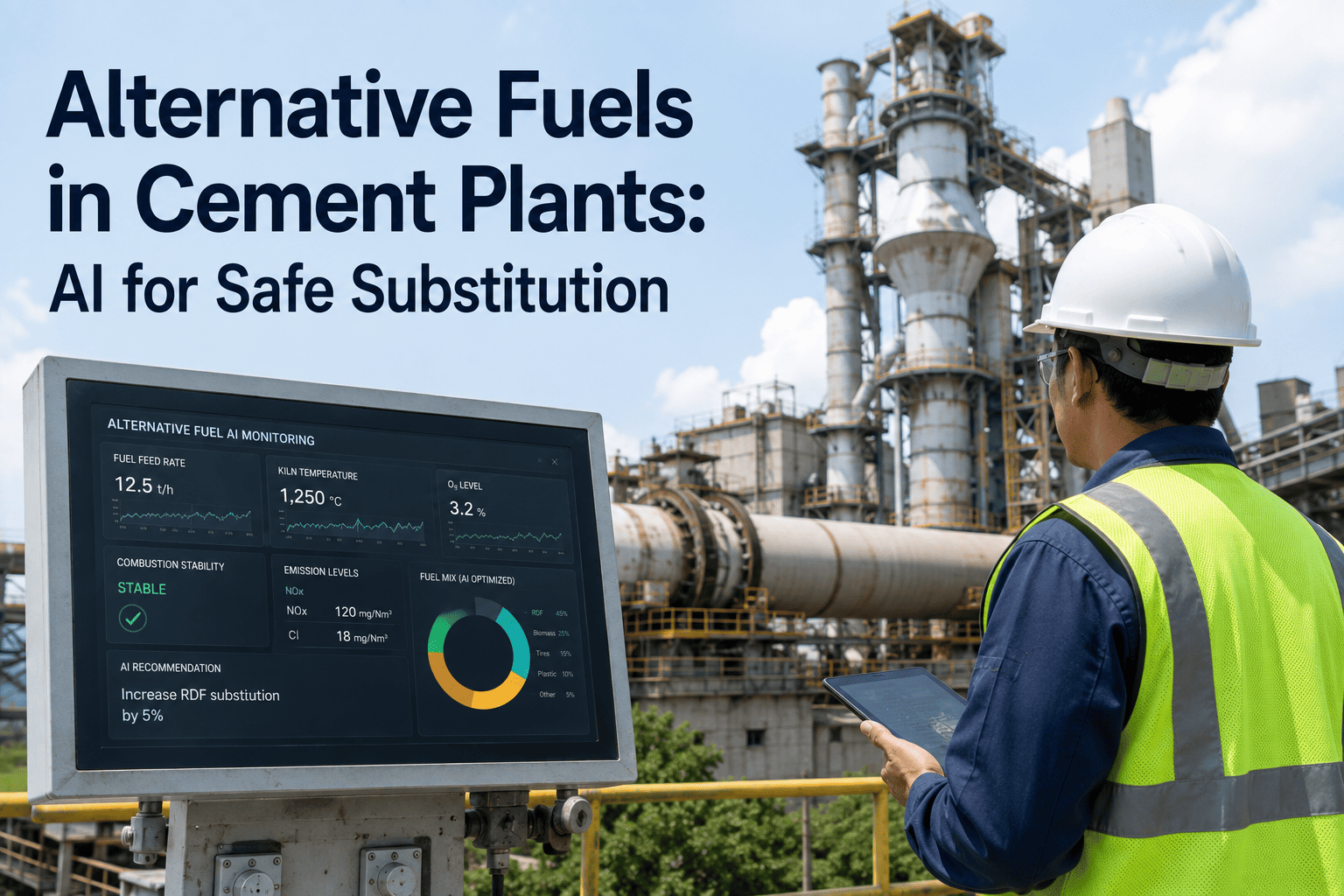
A cement plant commits to a 25 percent thermal substitution target using agricultural biomass, has the fuel supply secured, and still ends up stuck at 11 to 13 percent six months later. This is not a rare story, it is close to the median outcome when a plant tries to raise alternative fuel use with manual control alone. Biomass moisture swings from 12 to 28 percent between deliveries, free lime spikes when the mix runs too rich, and operators respond the only way they safely can, by pulling back and citing quality concerns. The fuel was never the constraint. The intelligence needed to use it safely was. Cement operations leads ready to see what a higher, stable substitution rate looks like on their own kiln can book a demo.
You Have the Alternative Fuel Supply. You Don't Have the Control System to Use It.
AI-driven combustion control that adapts to calorific value and moisture swings in real time, unlocking 20 to 40 percent higher thermal substitution than manual operation can safely sustain.
Where Global Cement Plants Actually Stand on Substitution
The gap between what is technically possible and what most plants actually achieve is enormous, and it is almost entirely a control problem rather than a fuel availability problem. India generates 62 million tonnes of agricultural waste annually, yet Indian cement plants average just 3 to 5 percent thermal substitution against global benchmarks of 15 to 20 percent and European plants running 30 to 40 percent. Leading global producers have already crossed the 30 percent TSR threshold, and one plant in Catalonia reached 100 percent alternative fuel use alongside a 37 percent increase in clinker production, proof that the ceiling is far higher than most plants are currently operating against.
Conservative Manual Cap
15-25%
Europe, Leading Plants
30-40%
AI-Enabled Substitution
40-60%
Why Manual Control Hits a Ceiling Around 15 to 25 Percent
Every alternative fuel introduces a form of variability that fossil fuel never had. Refuse-derived fuel arrives at different moisture levels between trucks, tire-derived fuel carries variable sulfur loads, and biomass shifts in calorific value with the seasons. Volumetric dosing holds feed rate constant while the real heat input shifts underneath it, and above roughly 50 percent thermal substitution, flame shape can degrade and create reducing conditions that a manual operator has no fast way to correct. The result is that plant managers cap TSR at a level they can control by feel, not at the level the fuel supply or the kiln could actually sustain.
Calorific Value Swing
20-40% between deliveries
The same tonnage of fuel can deliver very different heat input depending on the batch, destabilizing burning zone temperature if not compensated.
Moisture Variability
5-45% depending on source
High-moisture RDF or biomass cools the flame and produces weakly burned clinker if fuel feed isn't adjusted to compensate.
Combustion Characteristics
Varies by ignition point and ash
Different fuels ignite and burn differently, affecting flame shape and secondary air requirements at each substitution level.
Refractory and Coating Wear
Accelerated by high sulfur and alkali
Aggressive alternative fuel chemistry speeds up refractory wear and coating buildup if not tracked and managed proactively.
How AI Removes the Ceiling Without Removing the Safety Margin
01
Real-Time Fuel Characterization
AI models characterize each incoming fuel blend's calorific value and combustion profile as it arrives, rather than assuming the same properties batch after batch.
02
Dynamic Coal-AFR Ratio Adjustment
The system adjusts the coal to alternative fuel ratio roughly every 5 minutes to maintain constant thermal input despite fuel variability, instead of holding a fixed volumetric setpoint.
03
Predictive Quality Modeling
Free lime and clinker quality impact of the current fuel mix is modeled ahead of time, proving to operators that a higher TSR maintains quality before they commit to it.
04
Refractory and Coating Monitoring
Refractory temperature and coating thickness are tracked continuously, so the AFR mix is optimized to maximize TSR while keeping equipment wear inside acceptable limits.
Your Kiln Can Handle More Alternative Fuel Than Your Control System Currently Allows
The Fuel Mix Math No Operator Can Solve By Hand
With three to four fuel types in play at once, such as coal, biomass, RDF, and petcoke, the optimal blend at any given moment has well over 10,000 possible combinations once you account for the calorific value, moisture, chlorine, and sulfur profile of each stream. A human operator managing this manually is not failing due to lack of skill, they are solving a combinatorial problem in real time with a two-hour lab confirmation lag and no way to simulate the outcome before committing fuel to the kiln. This is precisely the class of problem AI optimization is suited for: continuously scoring thousands of possible blend ratios against thermal input, quality impact, and equipment wear, then selecting the mix that maximizes substitution without crossing any of those limits.
| Approach | Typical TSR Ceiling | Quality Risk |
| No AFR program |
0% |
None, but zero cost or carbon benefit |
| Manual AFR, conservative |
5-8% |
Low, but savings left entirely on the table |
| Manual AFR, aggressive |
15-25%, unstable |
High, frequent free lime excursions |
| AI-optimized AFR |
40-60% |
Low, quality validated before each increase |
What Each Fuel Stream Demands From Your Control System
Refuse-derived fuel, tire-derived fuel, and biomass are often discussed as if they behave the same way once they're fed into the kiln, but each introduces a distinct control challenge that a one-size-fits-all setpoint cannot handle. Understanding what each stream actually demands is the difference between a fuel mix that raises TSR safely and one that forces the operator back to a conservative cap the first time a batch behaves unexpectedly.
Refuse-Derived Fuel
Up to 80-100% TSR in calciner
Achieves the highest substitution ceiling in the calciner, but moisture swings above 20-30% in winter cool the flame and require compensating fuel feed adjustments.
Tire-Derived Fuel
Variable sulfur loads
Delivers high, consistent calorific value but carries sulfur content that must be tracked against clinker sulfate balance and emissions limits batch by batch.
Agricultural Biomass
Moisture: 12-28% seasonal swing
Calorific value shifts with harvest season and storage conditions, the single largest cause of plants getting stuck well below their committed TSR target.
Sewage Sludge and Solvents
Dual fuel and raw material role
Functions as both an energy source and a raw material contributor in some kiln configurations, requiring mineralogy tracking alongside combustion control.
Emissions and Compliance Data From the Same System Driving TSR Up
Raising thermal substitution is as much a compliance question as a cost question, since every alternative fuel decision has a direct emissions consequence that regulators and auditors expect documented. Every fuel substitution decision made by the AI model is logged with its corresponding CO2, NOx, and SO2 impact, which means your emissions record is generated automatically as a byproduct of the same optimization driving TSR higher, not as a separate manual reporting exercise bolted on afterward. This matters because the industry's own trajectory depends on this being solved well: global cement could meet up to 60 percent of kiln energy needs from alternative fuels by 2050, with biomass contributing roughly 40 percent of that figure, and the fuel-related CO2 reduction tied to reaching that level of substitution is estimated at approximately 27 percent industry-wide. Every plant that safely raises its own TSR now is closer to that trajectory than one still capped by manual control.
Raising TSR the Way Leading Producers Actually Did It
Build the Fuel Registry
Create a digital registry of every incoming AFR stream, RDF, tire-derived fuel, and biomass types, mapped against calorific value, moisture, and chemical profile including chlorine, alkalis, and sulfur.
Validate at Current TSR
Run predictive quality modeling against the existing substitution rate to establish a confident baseline of what the current fuel mix is doing to clinker chemistry.
Increase Gradually With Live Validation
Raise TSR in controlled steps, with the AI model continuously confirming free lime and quality stay within target range before the next increase is approved.
Automate the Coal-AFR Ratio
Move from manual ratio adjustments to closed-loop control that rebalances coal and alternative fuel automatically as fuel properties shift through the day.
Frequently Asked Questions
Why do most cement plants stay stuck at 5 to 8 percent thermal substitution?
Plant managers understandably fear that alternative fuel variability will compromise clinker quality, so the conservative default is to cap TSR at a level low enough that manual control can hold steady, even though this leaves most of the available cost savings and carbon reduction unrealized. The fear is rational given the tools available. Without real-time fuel characterization and predictive quality modeling, an operator genuinely cannot see a free lime excursion coming until the lab confirms it hours later, so caution is the only safe strategy.
Book a demo to see how predictive modeling changes that calculation.
How does AI keep clinker quality stable while raising alternative fuel use?
The system characterizes each incoming fuel batch's calorific value and combustion profile as it arrives, then adjusts the coal to alternative fuel ratio roughly every five minutes to maintain constant thermal input despite that variability. Predictive quality modeling runs ahead of each substitution increase, confirming the projected free lime and clinker chemistry impact before the change is made rather than discovering the impact after the fact through a lab sample.
Will higher TSR accelerate refractory wear and coating buildup?
Aggressive alternative fuel chemistry with high sulfur or alkali content can accelerate refractory wear and coating buildup if left unmanaged, which is why plants historically limited TSR partly to protect equipment. AI optimization tracks refractory temperature and coating thickness continuously and factors equipment wear into the optimal AFR mix, maximizing substitution while keeping wear inside acceptable limits rather than treating fuel mix and equipment protection as separate decisions.
What thermal substitution rate is realistically achievable for our plant?
It depends heavily on kiln configuration, calciner design, and available fuel streams, but the global pattern is consistent: plants using AI-optimized combustion control sustain substitution rates 20 to 40 percent higher than what manual control achieves safely. Preheater or precalciner kilns attempting substitution above 15 percent see the clearest benefit from a unified analytics platform.
Contact our support team for an assessment specific to your kiln and fuel supply.
Do we need to switch fuel suppliers or fuel types to raise TSR with AI?
No, in most cases the constraint has been the control system rather than fuel availability. Plants that were stuck at 11 to 13 percent TSR despite having sufficient biomass supply typically had the fuel the whole time, they lacked the real-time intelligence to blend and burn it consistently. Deployment starts by building a digital registry of your existing fuel streams and characterizing what you are already receiving, rather than requiring a change in fuel sourcing before you can begin.
Stop Leaving Thermal Substitution on the Table Out of Caution
See how iFactory's AI combustion control raises your TSR safely, with quality validated before every increase.