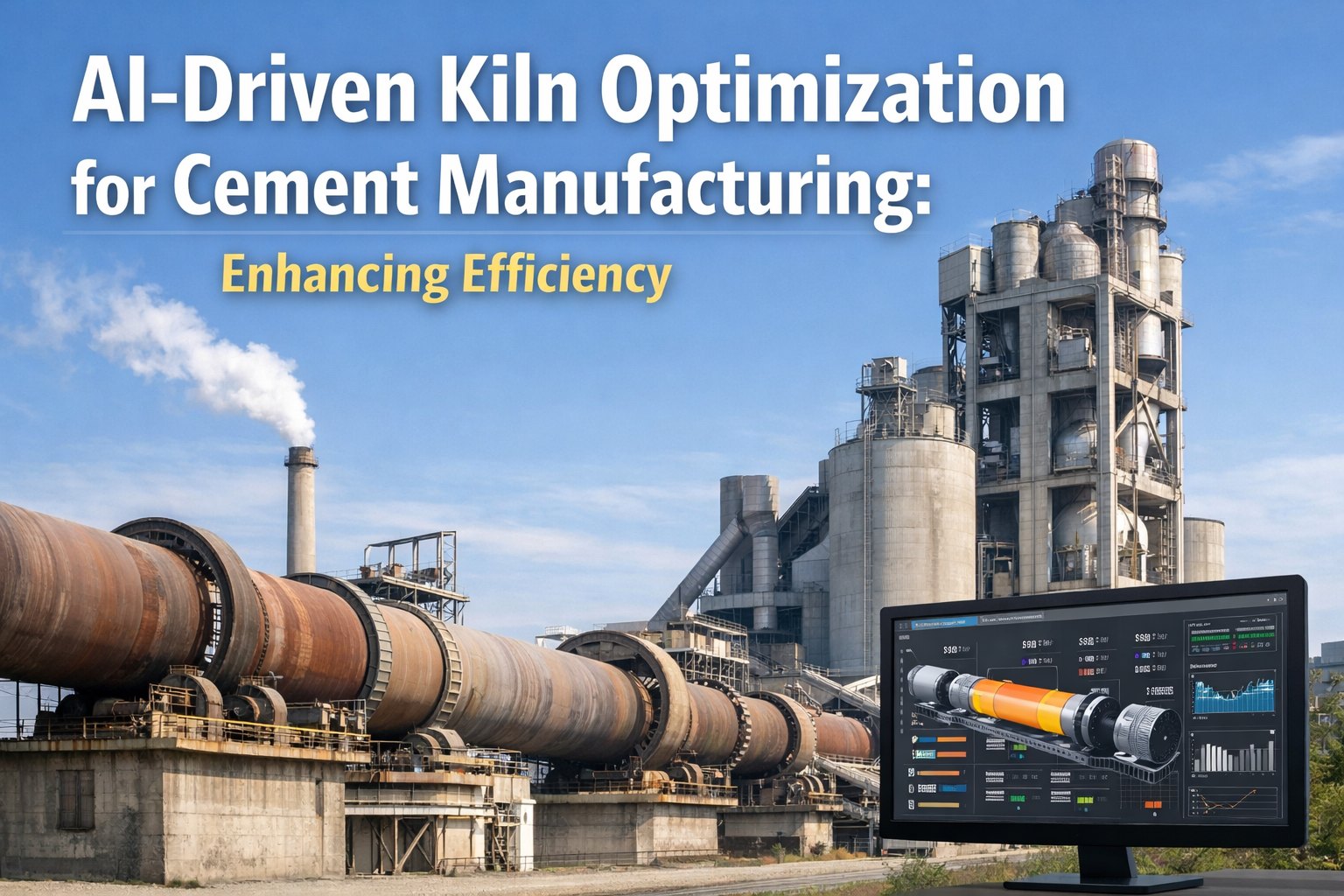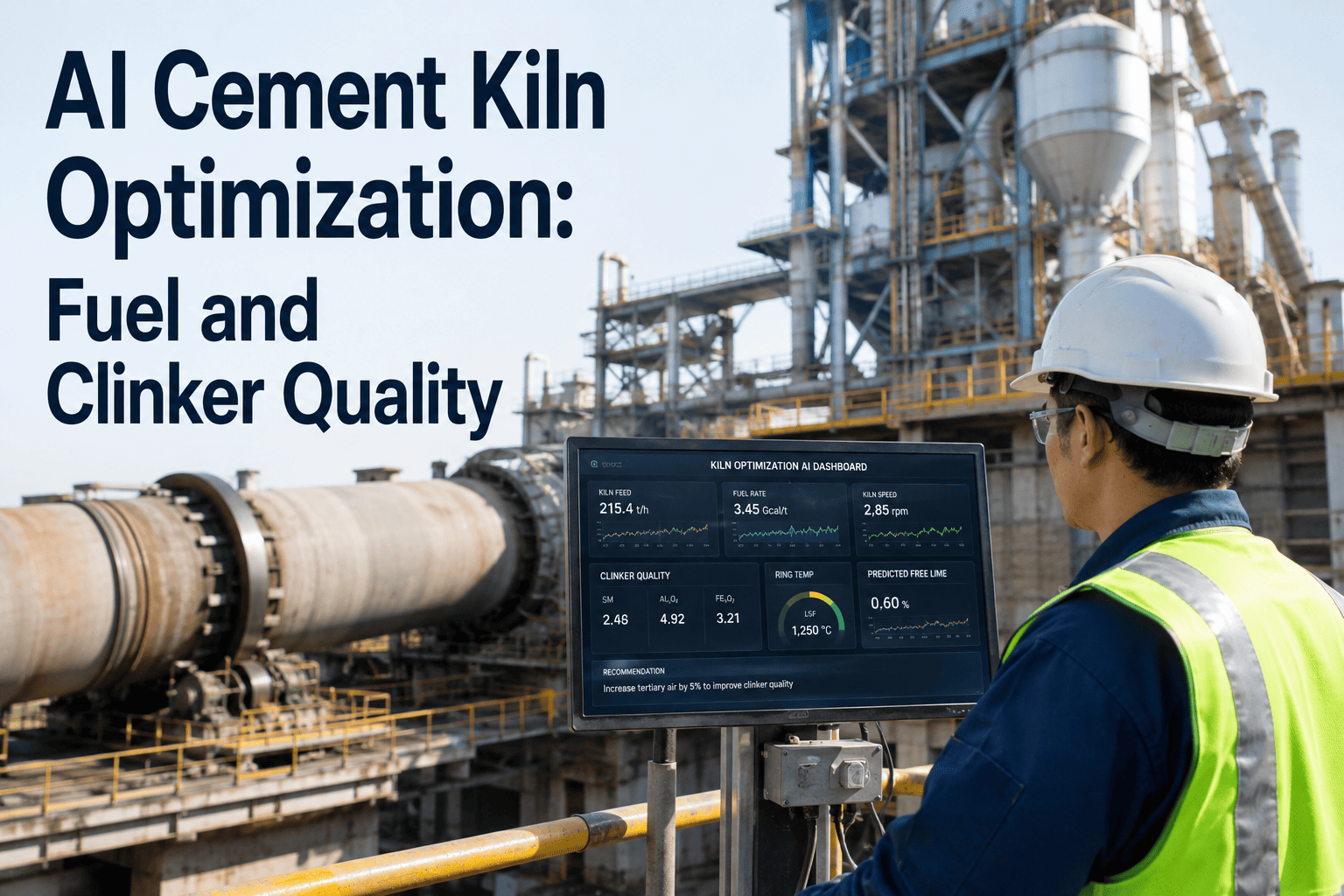
Your kiln operators are managing a chemical reactor with over 200 interacting variables, and they are doing it with lab results that arrive two to six hours after the sample was taken. By the time a free lime reading confirms the burning zone drifted, several hundred tonnes of clinker have already left the cooler, either overburned and wasting fuel or underburned and risking a quality claim. Most plants respond to this lag the only way they can, by adding an insurance margin to the free lime target and burning hotter than the process actually requires. That margin is quietly the single largest source of thermal waste in the plant. Cement plant managers who want to see real-time free lime prediction running against their own kiln configuration can book a demo.
The Two-Hour Blind Spot Every Kiln Operator Manages
Free lime content must stay in a narrow band, typically 0.5 to 1.5 percent, to hit cement strength targets without wasting energy. Too high and the clinker is under-burned and weak; too low and you've burned more fuel than the chemistry required. The problem is that traditional quality control depends on lab samples pulled every two to six hours, so the operator is always reacting to where the kiln was two hours ago, not where it is right now. Raw mix chemistry drifts as the quarry face changes, feed moisture rises after a rainstorm, and fuel quality shifts between deliveries, and none of it shows up on the operator's screen until the lab confirms it after the fact.
What AI Optimizes Across Your Pyroprocessing Line
A kiln is not four separate pieces of equipment, it is one thermal system where a decision at the preheater changes conditions at the cooler. AI models built for cement manufacturing treat it that way, coordinating hundreds of micro-adjustments per hour across the full line rather than tuning each zone in isolation.
Verified Result: 3,000 TPD Kiln Line, 60 Days After Deployment
The numbers below are not projections, they are a documented outcome from a 3,000 tonne-per-day kiln line that deployed AI pyroprocessing optimization on a trial basis. Thermal energy consumption dropped from 780 kcal per kilogram of clinker to 738 kcal per kilogram, a 5.4 percent reduction, translating to roughly 2.07 million dollars in annual fuel savings from that single kiln line. What makes the result notable is what did not happen: clinker quality did not degrade to achieve it. Free lime actually improved, moving from an average of 1.8 percent down to 1.4 percent, and NOx emissions came in 12 percent lower than the pre-AI baseline.
Manual Control vs AI Control: Response Time Is Everything
| Control Action | Manual Response | AI Response |
|---|---|---|
| Free lime deviation detected | 2-6 hours, after lab confirmation | 15-30 minutes ahead of tap |
| Combustion parameter adjustment | Minutes, operator-initiated | Every few seconds, automatic |
| Fuel-air ratio tuning | Static setpoint, rarely revisited | Continuous, closed-loop |
| Cooler grate and airflow | Fixed schedule, manual override | Optimized to bed depth in real time |
| Insurance margin on free lime target | Built in as standard practice | Removed as prediction confidence rises |
Catching Mechanical Failures the Same Way You Catch Chemistry Drift
A kiln does not only fail chemically, it fails mechanically, and the two are often connected. Vibration, temperature, and acoustic sensors mounted on the kiln drive, girth gear, support rollers, and mill bearings detect degradation weeks before failure, the same early-warning principle applied to combustion is applied to the equipment carrying the load. An emergency kiln shutdown from a mechanical failure typically costs 50,000 to 200,000 dollars per incident once you count lost production, emergency repair labor, and the refractory damage that often follows an uncontrolled stop. Thinner refractory from accumulated wear increases shell heat loss, and a 50 percent reduction in lining thickness can increase shell radiation loss by 30 to 40 percent in that zone alone, which means refractory condition is not just a mechanical concern, it is a silent, ongoing fuel drain that compounds every day it goes unaddressed.
Emissions Compliance Comes Along for the Ride
Tighter combustion control does not just save fuel, it produces a cleaner burn, and that shows up directly in your emissions profile. Real-time tracking of CO2, NOx, and SO2 correlated against the same energy parameters the AI is already optimizing gives you continuous compliance data for EPA, EU ETS, and regional reporting requirements, rather than relying on periodic stack testing to confirm you are within limits. Because overburning is a major driver of excess NOx formation, the same model that eliminates insurance clinker also tends to lower NOx output as a direct byproduct, which is exactly what shows up in documented deployments alongside the fuel savings. For plants tracking carbon intensity as part of ESG reporting or preparing for carbon trading obligations, this same data stream becomes the foundation for that reporting rather than a separate system to build and maintain.
Deployment: Advisory Mode First, Autonomous Control Later
No credible AI deployment for a live kiln starts with the model making unsupervised decisions. Most deployments start in advisory mode where the AI recommends adjustments and the operator approves every change, which lets your team validate the model's judgment against their own process knowledge before any autonomy is extended. AI is not there to replace the operator, it is there to handle the hundreds of micro-adjustments per hour that no human can track simultaneously, freeing the team to focus on exception handling, strategic decisions, and the process oversight that still requires human judgment. Once the model's advisory recommendations consistently match or beat manual outcomes across a full range of feed and fuel conditions, plants typically extend closed-loop authority to combustion and cooler control first, since these respond fastest and provide the clearest before-and-after comparison.