Boiler and Steam System Safety and analytics Checklist
By Hannah Baker on June 1, 2026
Boilers and steam systems power critical processes across U.S. manufacturing—from food processing and chemical production to pharmaceuticals, textiles, and automotive assembly. Yet they remain among the most hazardous and energy-intensive assets on any plant floor. The U.S. Department of Energy estimates that industrial boilers consume roughly 37% of total U.S. industrial energy, and the National Board of Boiler and Pressure Vessel Inspectors reports thousands of incidents annually—many attributable to deferred maintenance, inadequate water treatment, and missed inspection intervals.
This checklist is built for U.S. manufacturing maintenance engineers, reliability teams, and plant managers who need a systematic, field-ready framework to evaluate every critical component of their boiler and steam system—from combustion and water chemistry to steam traps, distribution, and ASME/OSHA compliance documentation.
Boiler & Steam System Safety Checklist
Prevent Failures Before They Happen. Start With a Systematic Boiler Audit.
A complete, field-tested checklist covering combustion systems, water treatment, steam traps, pressure vessels, distribution piping, and compliance documentation—designed for U.S. industrial facilities targeting zero unplanned downtime and full regulatory compliance.
Why Boiler and Steam System Audits Are Critical in 2026
Boiler failures are not gradual—they are sudden, expensive, and potentially catastrophic. A single unplanned boiler outage in a continuous-process manufacturing facility can cost $50,000–$500,000 in lost production, emergency repairs, and regulatory penalties. Beyond economics, OSHA 29 CFR 1910.169 and the ASME Boiler and Pressure Vessel Code (BPVC) impose mandatory inspection and record-keeping requirements that carry serious liability exposure if ignored.
37%
Of total U.S. industrial energy consumed by boilers
15–30%
Energy savings achievable via steam trap repair and insulation
$50K+
Typical cost of a single unplanned boiler shutdown
3–5 yr
Typical ROI payback on boiler efficiency upgrades
A rigorous audit addresses six core areas: combustion and burner systems, boiler vessel integrity, water treatment and chemistry, steam distribution and traps, ancillary equipment, and documentation and compliance. Each section below provides actionable checkpoints you can execute in the field with standard maintenance instrumentation.
Section 1: Combustion System and Burner Inspection
The combustion system is the primary driver of boiler efficiency and emissions compliance. Poor burner tuning, fouled heat transfer surfaces, or incorrect air-to-fuel ratios directly inflate fuel consumption and stack emissions—and can push a facility out of EPA Title V permit compliance. This section should be completed with the boiler online at normal operating load.
Combustion & Burner — Pre-Inspection Steps
Pro Tip: iFactory AI's Preventive Maintenance Scheduling module automates burner tune-up work orders triggered by runtime hours or combustion efficiency thresholds—eliminating the manual tracking that leads to missed intervals. Book a Demo to see how it works in a live plant environment.
Section 2: Boiler Vessel Integrity and Pressure Safety
The pressure vessel itself is the highest-risk component in any steam system. ASME BPVC Section I governs construction; the National Board Inspection Code (NBIC) governs in-service inspection. Most U.S. jurisdictions require boilers to be inspected annually by a commissioned inspector—but internal maintenance inspections between third-party visits are equally important for identifying developing defects before they become failure events.
Pressure Vessel & Safety Devices
Section 3: Boiler Water Treatment and Chemistry
Water chemistry is the single most controllable variable in boiler reliability and efficiency. Scale deposits as thin as 1/32 inch on heat transfer surfaces increase fuel consumption by 2–4%. Oxygen pitting, caustic embrittlement, and chloride stress corrosion cracking are all preventable through consistent water treatment and monitoring. This section is the most frequently neglected in facilities without a dedicated water treatment program.
Water Treatment & Chemistry Monitoring
Boiler Water Chemistry Target Ranges — Low-Pressure Steam Systems (<150 psig)
Parameter
Target Range
Action Threshold
Risk if Ignored
Priority
pH (Boiler Water)
10.5 – 11.5
<10.0 or >12.0
Corrosion / caustic embrittlement
Critical
Dissolved Oxygen
<0.007 ppm
>0.020 ppm
Oxygen pitting corrosion
Critical
Total Hardness (Feedwater)
0 ppm
Any detection
Scale formation, overheating
High
TDS / Conductivity
Per program spec
+20% above set point
Foaming, carryover, scaling
High
Phosphate Residual
20 – 40 ppm
<10 ppm
Scale on heat transfer surfaces
Medium
Sulfite Residual
20 – 60 ppm
<10 ppm
Oxygen corrosion risk
Medium
Section 4: Steam Trap Inspection and Distribution System
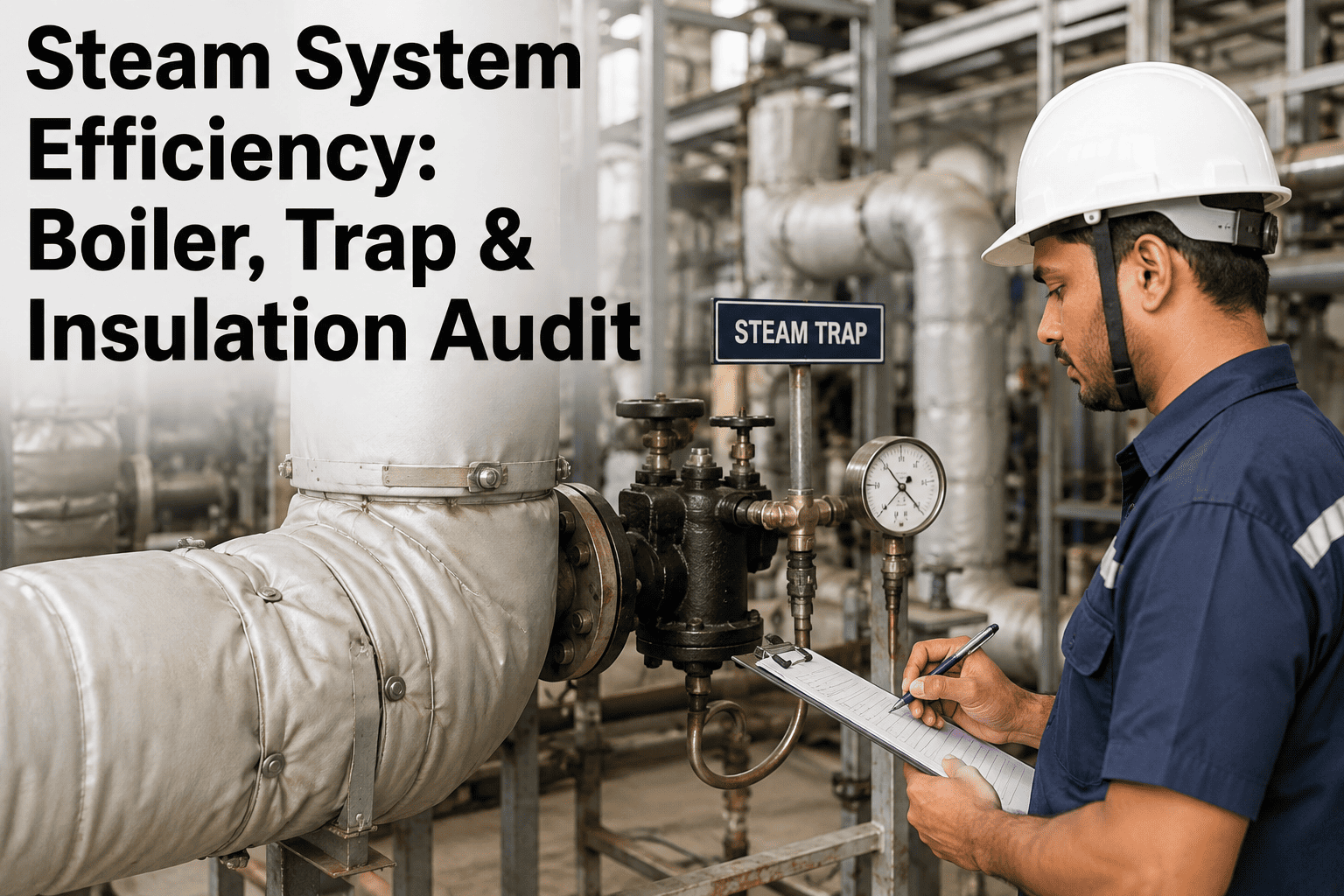
Steam traps are among the most failure-prone components in any steam system—and the most overlooked. A single failed-open steam trap wastes 15–40 lbs of steam per hour continuously. In a plant with 200 traps, even a 10% failure rate can represent $50,000–$150,000 in annual steam losses. Systematic steam trap surveys using ultrasonic and infrared technology are essential for facilities serious about energy performance.
Steam Trap Survey & Distribution Piping
Automate Your Boiler Preventive Maintenance with iFactory AI
iFactory AI's Preventive Maintenance Scheduling module automates steam trap surveys, water chemistry logs, burner tune-up work orders, and compliance inspection reminders—turning manual checklists into closed-loop digital workflows with full audit trails.
Section 5: Compliance, Documentation, and CMMS Integration
For U.S. manufacturers, boiler compliance is non-negotiable. ASME BPVC, the National Board Inspection Code, OSHA 29 CFR 1910.169, and state boiler laws collectively require specific inspection intervals, record retention, and safety device certification. Non-compliance carries civil penalties, forced outages during inspections, and potential criminal liability following incidents. This section ensures your documentation is audit-ready at all times.
Compliance, Records & CMMS Setup
Audit Findings Prioritization Workflow
After completing the field inspection, use this prioritization framework to sequence corrective actions based on safety impact, regulatory exposure, and energy value. Focus resources where the risk and ROI are highest—not simply where the work is easiest.
01
Classify All Findings
Categorize each finding: Safety/Code Violation, Compliance Gap, Energy Loss (Critical/High/Medium/Low), Reliability Risk, or Documentation Deficiency. Safety and compliance items go first, regardless of cost.
02
Quantify Energy and Financial Losses
Estimate annual dollar value of each energy finding—steam trap failures, insulation gaps, combustion inefficiency, and blowdown losses. Prioritize any finding with annual cost above $1,000 for immediate scheduling.
03
Generate Work Orders in CMMS
Create corrective maintenance work orders in iFactory AI for all findings—linking each to the asset, location, estimated cost, assigned technician, and target completion date. Safety items get same-day or next-shift assignment.
04
Execute, Document, and Verify
Complete repairs with full documentation in CMMS. For energy repairs, re-measure before and after to confirm improvement. For safety device repairs, test function immediately after completion and document test result.
05
Calculate Realized Savings and Update Baseline
Compare post-repair energy consumption against pre-audit baseline. Track cumulative savings monthly. Most boiler audit programs recover their full cost within 60–120 days through steam trap repair and combustion optimization alone.
Want iFactory AI to turn your boiler audit findings into tracked, closed-loop corrective actions automatically? Book a Demo and see how audit-to-work-order workflows operate in a live plant environment.
Expert Review: What Certified Boiler Inspectors and Energy Auditors Look For
Expert Perspective: Boiler & Steam System Assessment
Based on National Board Inspection Code (NBIC), ASME BPVC, DOE Steam Best Practices & Certified Energy Auditor (CEA) Methodology
National Board-commissioned inspectors and DOE-trained steam system specialists consistently identify the same blind spot in U.S. manufacturing facilities: boiler compliance inspections are performed on schedule, but day-to-day operational monitoring is treated as optional. Most plants pass their annual jurisdictional inspection—then operate for 11 months with deferred water treatment, unchecked combustion drift, and failed steam traps that nobody has surveyed since the last major outage.
According to the DOE's Steam System Assessment Tool (SSAT) methodology, a typical unaudited industrial steam system has 10–20% of its traps failed, combustion efficiency 3–5 percentage points below optimum, and insulation deficiencies on 5–15% of steam piping. In aggregate, that represents 15–30% of total boiler fuel cost as avoidable waste—an enormous opportunity that requires no capital investment to address, only a systematic survey and a functional PM program.
The minimum instrumentation for a credible boiler audit includes: a calibrated combustion analyzer (for O₂, CO, and efficiency), an ultrasonic steam trap tester, an infrared thermometer or thermal camera, a calibrated pressure gauge set, a conductivity/pH meter for water chemistry, and a data logger for 24–72 hour load profiling. Inspectors who work from memory and spot checks miss the transient operational conditions—cold startups, peak demand events, and weekend off-shift operation—that drive the largest loss categories.
10–20% of steam traps are typically failed in unaudited industrial plants
Every 1% improvement in boiler efficiency reduces fuel cost proportionally
1/32" scale on heat transfer surfaces increases fuel consumption by 2–4%
Water chemistry failures are the leading cause of premature boiler tube replacement
Conclusion: Build Boiler Safety Into Your Continuous Improvement Program
A boiler and steam system audit is one of the most high-impact activities a manufacturing maintenance or energy team can execute. The combination of combustion optimization, steam trap repair, water chemistry correction, and insulation improvements consistently delivers payback periods under 12 months—and often under 90 days for steam trap programs alone.
But the facilities that truly lead on boiler reliability and energy efficiency are not the ones that complete an annual audit and wait. They are the ones running continuous preventive maintenance programs—where every burner tune-up, water chemistry test, trap survey, and safety device check is scheduled, tracked, and verified in a CMMS like iFactory AI. Every finding becomes a work order. Every repair gets measured for verified savings. Every compliance record is one click away during an audit.
iFactory AI's Preventive Maintenance Scheduling module was built for exactly this operating model—connecting your boiler assets, sensors, PM schedules, and maintenance teams in a single platform that eliminates the paper logs, missed intervals, and deferred maintenance that cause boiler failures in the first place. Book a Demo with iFactory AI to see how your facility can get there.
Frequently Asked Questions
QHow often should a boiler and steam system audit be performed?
A comprehensive boiler and steam system audit should be conducted at minimum annually, aligned with—but separate from—the required jurisdictional external inspection. Steam trap surveys should be conducted semi-annually in high-pressure or continuous-process environments, as trap failure rates can climb quickly. Water chemistry monitoring should be performed daily by the boiler operator and reviewed formally on a monthly basis. Facilities participating in ENERGY STAR for Industry or ISO 50001 programs will have additional monitoring frequency requirements tied to their EnMS baseline targets.
QWhat OSHA and ASME regulations apply to industrial boilers in U.S. manufacturing?
Key federal and standards-body requirements include: OSHA 29 CFR 1910.169 (air receivers and boiler systems—safety relief valve, water gauge, and pressure limit requirements); ASME Boiler and Pressure Vessel Code Section I (power boilers construction standards) and Section IV (heating boilers); and the National Board Inspection Code (NBIC) for in-service inspection. At the state level, virtually every U.S. state has a Boiler and Pressure Vessel Act that requires registration, periodic third-party inspection by a licensed inspector, and in many states, licensed boiler operator certification. Requirements vary by state—consult your state's Department of Labor or equivalent agency for specific intervals and licensing requirements.
QWhat is the most cost-effective first step for reducing boiler energy costs?
A systematic steam trap survey and repair program is consistently the highest-ROI first step in any steam system energy reduction program. In most unaudited facilities, 10–20% of traps are failed, and repairing them typically returns $20,000–$100,000 in annual fuel savings with an investment of $3,000–$10,000 for the survey and repair labor. Combustion optimization is the second-highest-priority action—a properly tuned burner running at 84% efficiency instead of 79% on natural gas saves approximately $8,400 per year per 10,000 lbs/hr of steam output at $5.00/MMBtu fuel cost. Neither intervention requires capital equipment—just systematic field inspection and maintenance execution.
QHow does a CMMS improve boiler preventive maintenance and compliance management?
A CMMS like iFactory AI centralizes all boiler and steam system assets with their PM schedules, maintenance history, compliance records, and spare parts inventory. It automatically generates work orders at the correct runtime or calendar intervals—daily operator rounds, monthly chemistry tests, quarterly combustion checks, and annual internal inspections—and routes them to the right technician with instructions and documentation requirements. For compliance, it maintains a complete audit trail of inspection dates, findings, corrective actions, and technician sign-offs that can be produced immediately during a jurisdictional audit or insurance review. For energy management, it tracks steam trap failure rates, boiler efficiency trends, and water chemistry compliance over time—turning raw maintenance data into actionable performance metrics.
QWhat are the most common causes of unplanned boiler shutdowns in manufacturing plants?
Based on National Board incident data and DOE steam system assessments, the most frequent causes of unplanned boiler shutdowns are: (1) low-water conditions caused by feedwater pump failures, failed LWCO devices, or condensate return system failures; (2) scale-induced overheating from inadequate water treatment allowing hardness to deposit on heat transfer surfaces; (3) safety relief valve failures caused by deferred testing and maintenance; (4) burner and combustion control failures from fouled sensors, worn ignition electrodes, or flame scanner degradation; and (5) tube failures from oxygen pitting corrosion due to deaerator or chemical treatment program deficiencies. The common thread in nearly all incidents is deferred preventive maintenance—which is precisely what a functioning CMMS-driven PM program is designed to prevent.
Ready to Automate Your Boiler and Steam System Maintenance?
iFactory AI's Preventive Maintenance Scheduling turns your boiler safety checklist into a continuous digital monitoring program—with automated PM work orders, compliance tracking, water chemistry logs, and closed-loop corrective action management for every finding.