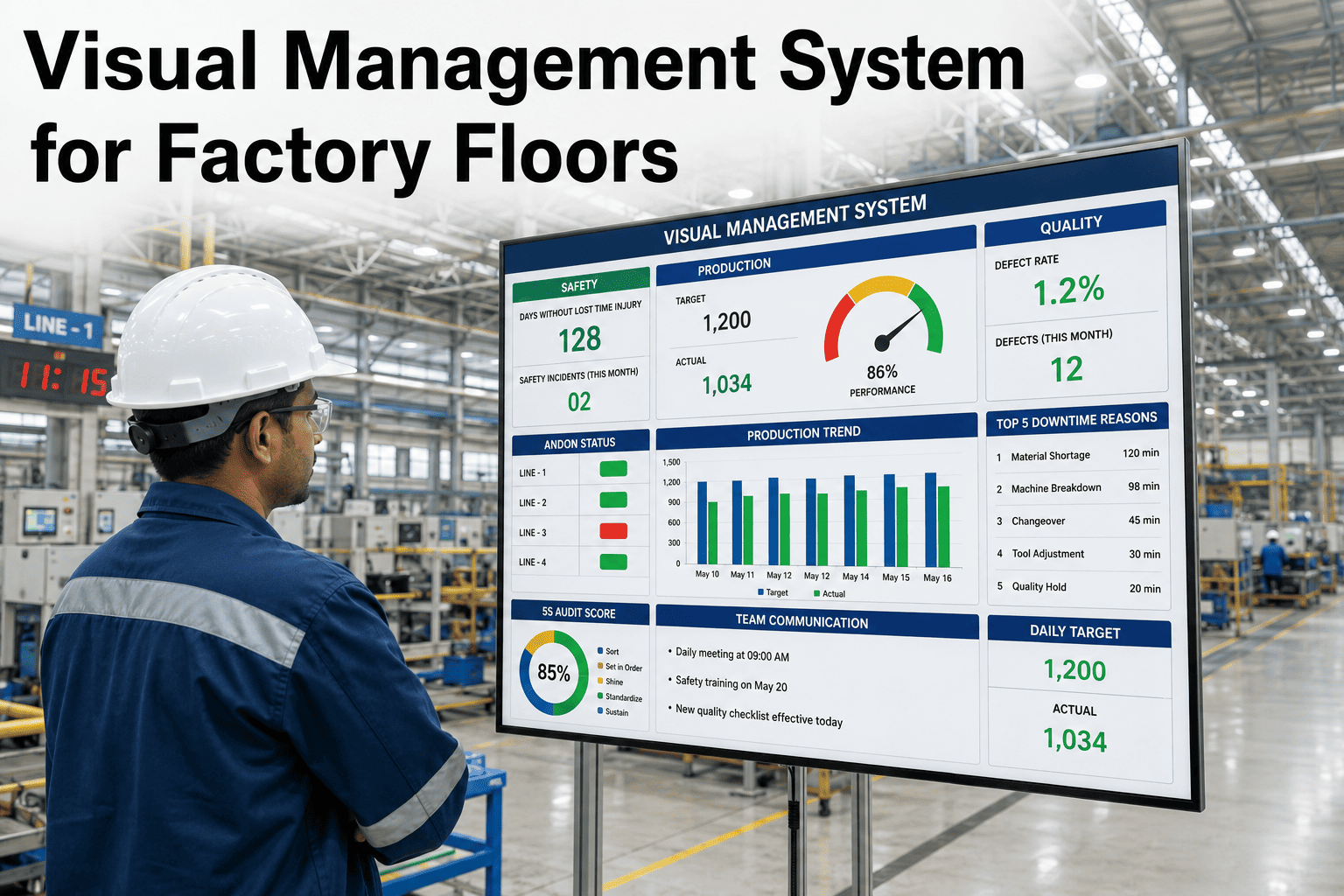
Most plants already hold daily meetings — a shift huddle here, a production review there — but very few connect those meetings into a system that actually moves problems to the people who can fix them. A tiered daily management system changes that by defining exactly what gets discussed at the line, what escalates to the department, and what only plant leadership needs to see. Without this structure, the same downtime cause gets rediscovered on three different shifts because nobody connected the dots between them. Book a session with the iFactory team to see how a tiered structure fits your current meeting cadence.
Lean & CI · Daily Management
Daily Management System: Building a Tier 1-2-3 Meeting Structure That Actually Closes Issues
A working tiered cadence moves a shop-floor problem to the person who can authorize a fix within hours instead of weeks — turning three isolated shift logs into one coordinated countermeasure.
The Escalation Ladder
Tier 1
Line, 10 minutes, shift start
Tier 2
Area, 15 minutes, unresolved items
Tier 3
Plant, 20 minutes, resource decisions
Why Most Daily Meetings Don't Function As a System
Meetings Without Tiers Just Document Problems — They Don't Resolve Them
A shift huddle that has no defined path upward is a reporting exercise, not a management system. The operator who flags a recurring jam at 6 AM has no mechanism to reach the maintenance planner who could see the same pattern across two other lines, so the issue gets re-logged, re-discussed, and re-forgotten on every shift until it eventually causes a stoppage severe enough to force attention.
No Defined Escalation Path
Without a rule for what leaves the Tier 1 board and moves to Tier 2, supervisors decide case by case, which means identical problems get escalated by one shift and buried by another.
Meetings Run Long and Lose Discipline
A Tier 1 huddle without a strict agenda and time box drifts into open-ended discussion, and attendance and punctuality erode within weeks once the meeting stops respecting people's time.
Cross-Line Patterns Stay Invisible
A fault that shows up on Line 2 today and Line 5 next week looks unrelated at the Tier 1 level, and only becomes visible when someone above the line level is looking at both boards together.
Action Items Never Get Closed
Issues get written down, assigned an owner, and never revisited, because no tier above the originating meeting is tracking whether the commitment made yesterday was actually completed today.
The Three Levels
What Belongs at Each Tier — and What Gets Escalated
01
Tier 1 — The Line, at Shift Start
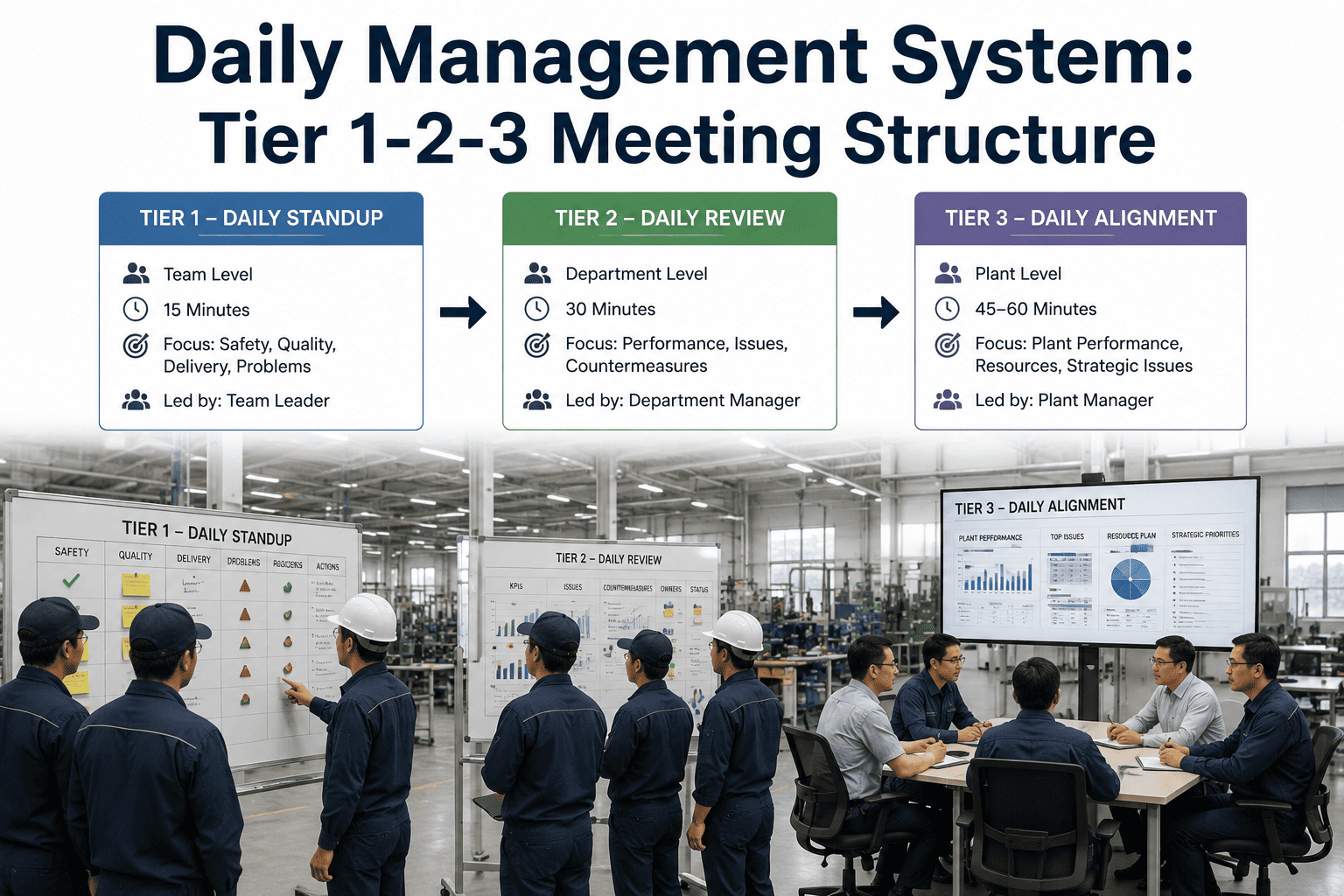
Team leaders and operators review the previous 24 hours against safety, quality, delivery, and equipment targets, confirm the plan for the coming shift, and log anything that needs help. This meeting stays under 10 to 12 minutes, is held standing at the line, and covers only what happened and what today's plan is — not open-ended troubleshooting.
02
Tier 2 — The Area, Right After Tier 1
Area managers, maintenance, quality, and planning representatives meet for 15 minutes to review only the items Tier 1 could not resolve. This is where cross-line patterns surface, because one area lead sees every Tier 1 board in their zone at once, and where support functions commit resources with a named owner and a target time.
03
Tier 3 — Plant Leadership, Site-Wide
Plant leadership hears summarized, already-triaged issues that need a resource decision, a cross-department priority call, or budget authority only that level can grant. A well-run Tier 3 meeting is short precisely because Tier 1 and Tier 2 already filtered out everything that did not need to reach this level.
See a Tiered Board Built From Your Own Shift Data
iFactory Connects Tier 1 Boards to Tier 2 and Tier 3 Automatically
A digital tier board carries the flagged issue and its notes up to the next level automatically, so leadership sees full context without a separate handoff conversation or an email chain nobody reads before the meeting starts.
Side by Side
Comparing the Three Tiers on Duration, Attendance, and Purpose
| Attribute | Tier 1 | Tier 2 | Tier 3 |
|---|---|---|---|
| Frequency | Every shift start | Daily, after Tier 1 | Daily or several times weekly |
| Duration | 10–12 minutes | 15 minutes | 15–20 minutes |
| Typical attendees | Operators, team leader | Area managers, maintenance, quality, planning | Plant manager, department heads |
| Primary focus | Last shift review, today's plan | Unresolved Tier 1 items, resource commitments | Cross-department decisions, resource authorization |
| Location | At the line | Area board | Plant war room or virtual |
The rule that keeps this working: nothing skips a level, and nothing that Tier 1 can resolve on its own is allowed to reach Tier 2.
Measuring the System
Four Metrics That Tell You Whether Your Tier Structure Is Actually Working
Escalation-to-Resolution Time
Target: under 48 hours
Elapsed time from when an issue leaves Tier 1 to when it is marked closed at whichever tier owns it. A rising trend signals the tiers are meeting, but not resolving.
Tier 1 On-Time Start Rate
Target: >95%
Percentage of shifts where the huddle started within the scheduled minute. Discipline at Tier 1 predicts discipline at every level above it.
Repeat Issue Rate
Target: decreasing
Share of logged issues that are recurrences of something already closed in the prior 30 days, which exposes countermeasures that were logged but never actually implemented.
Action Item Aging
Target: <5% over 14 days
Percentage of open action items past their committed due date, tracked at the tier that owns them, which is the clearest early warning that follow-up discipline is slipping.
From the Plant Floor
The plants that get the most out of a tiered structure are the ones that resist the temptation to make every meeting a status update. Tier 1 should feel almost boring — the same four questions, the same board, the same ten minutes, every single shift. The value is not in any one meeting; it is in the discipline of never letting an unresolved item die quietly at the level where nobody has the authority to fix it. The moment a plant lets Tier 2 turn into a second Tier 1, or lets Tier 3 relitigate decisions Tier 2 already made, the whole system starts to lose the trust of the people standing at the board every morning, and trust is the entire mechanism that makes a tiered system work in the first place.
Odalys Feinberg-Achterberg
Learning & Development Director · Manufacturing Training Systems Specialist · 18 years designing operator training and daily management programmes across automotive and heavy industrial manufacturing
Getting Started
Rolling Out a Tiered System Without Overwhelming a Plant That Has Never Run One
W1
Pilot Tier 1 in One Area Only
Pick a single line or department, define a strict 10 to 12 minute agenda, and hold it standing at the board at the same time every shift. Resist the urge to roll out plant-wide immediately — a pilot that runs cleanly for two weeks gives you a template worth copying, while a plant-wide launch with no working example just multiplies the same early mistakes across every area at once.
W2
Add Tier 2 Once Tier 1 Is Stable
Introduce a 15-minute area huddle directly after Tier 1 ends, attended only by area leads and support functions, and restrict it to items Tier 1 genuinely could not resolve. If Tier 2 starts turning into a second full production review, that is the signal to tighten the escalation rule, not to extend the meeting.
W3
Expand Tier 1 to Remaining Areas
Use the pilot area's board, agenda, and escalation rule as the template for every other line or department, adjusting only for area-specific KPIs. Consistency across areas is what makes Tier 2 useful — a Tier 2 lead comparing five differently structured boards cannot spot cross-line patterns nearly as fast as one comparing five identical ones.
W4
Connect Tier 3 and Start Tracking the System's Own KPIs
Bring plant leadership into a short site-level meeting fed entirely by Tier 2 summaries, and begin tracking escalation-to-resolution time and action item aging from day one. A tiered system that isn't measuring its own performance tends to quietly decay back into informal, undocumented problem-solving within a few months.
Common Questions
Tier 1-2-3 Meeting Structure — Frequently Asked
How do we decide what actually escalates from Tier 1 to Tier 2 instead of leaving it to the supervisor's judgment on the day?
The most reliable approach is a written escalation rule tied to whether the issue can be resolved with resources already available at the line — if the fix requires a part not in stock, a decision outside the team leader's authority, or coordination with another line, it escalates by default rather than by discretion. Teams that leave this to daily judgment see wide variance between shifts, where one supervisor escalates readily and another tries to solve everything locally and quietly lets problems compound. Writing the rule down and reviewing it periodically against what actually got escalated closes that gap. Talk to our support team about setting up escalation rules inside a digital tier board.
Our Tier 1 meetings keep running 20 to 25 minutes instead of the 10 we planned — how do we get the discipline back?
Meeting length creep almost always comes from allowing troubleshooting discussion to happen inside the huddle itself, rather than parking the item for a smaller follow-up conversation after the meeting ends. A fixed four-question agenda — safety, quality, delivery, equipment, in that order, with a hard stop — keeps the meeting to its time box, and any item that needs more than sixty seconds of discussion gets assigned an owner and moved off the floor. Standing at the board rather than sitting also naturally shortens meetings, since nobody wants to stand around for twenty-five minutes.
Do we need software to run a tiered daily management system, or can this work with physical boards and markers?
Tiered meetings absolutely can and historically have run on physical whiteboards, and a disciplined team can sustain that for a single line or department indefinitely. The practical limit shows up as the organization scales past a handful of tiers — keeping visibility, escalation, and follow-up consistent across many Tier 1 boards feeding into fewer Tier 2 and Tier 3 meetings becomes significantly harder without a digital layer that automatically carries an item's context upward. Most plants running four or more Tier 1 boards find a digital board pays for itself in the handoff time alone. Book a demo to see how a digital board handles the handoff between tiers.
How is a tiered daily management system different from just holding a daily production meeting?
A single daily production meeting tries to cover everything from shift-level operational detail to plant-level resource decisions in one room, which means either the meeting runs far too long or the detail gets skipped entirely in favor of a high-level summary. A tiered structure deliberately separates those concerns by level, so each meeting stays short and each audience only hears what is relevant to the decisions they can actually make, with structured escalation carrying the right level of detail to the right room instead of forcing one meeting to do three jobs at once.
What is the biggest reason tiered meeting systems fail after an initial successful rollout?
The most common failure mode is escalation without resolution — items get correctly identified and moved up the ladder, but nobody at the receiving tier is held accountable for closing them, so the board fills with aging, unresolved actions and the frontline team stops trusting that raising an issue accomplishes anything. Once that trust erodes, Tier 1 participation becomes performative rather than genuine, and the entire system quietly reverts to documenting problems instead of solving them. Assigning a named owner and a due date to every escalated item, and reviewing aging items explicitly at the next tier, is the single highest-leverage habit that prevents this.
Every Shift Deserves a Path From Problem to Resolution
Build a Tier 1-2-3 System That Closes the Loop, Not Just Logs It
iFactory connects your Tier 1 shop-floor boards to Tier 2 area reviews and Tier 3 plant leadership automatically, tracking escalation time, action item aging, and repeat issue rate so you can see whether your daily management system is actually working — not just meeting.