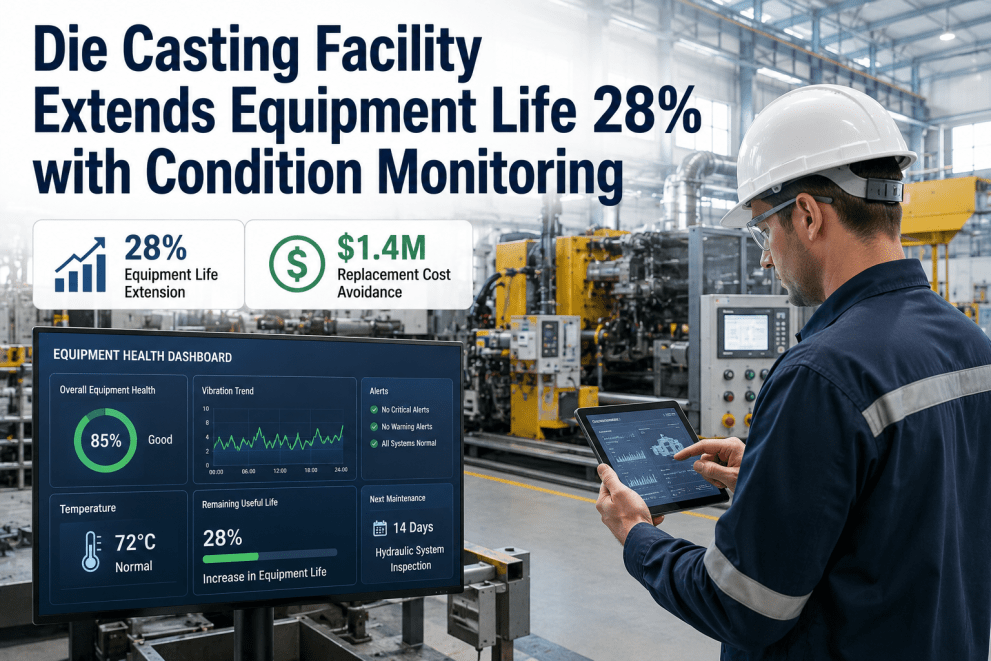
Die casting facilities operate at the intersection of extreme thermal stress, high-pressure hydraulics, and continuous mechanical cycling — an environment where equipment degradation is not a question of if, but when. Shot sleeves experience thermal shock with every injection cycle. Hydraulic pumps degrade under sustained 2,000+ PSI loads. Dies crack from the relentless expansion and contraction of molten aluminum at 1,200°F. Traditional calendar-based maintenance programs miss the early indicators of these failures because they do not measure what matters: real-time equipment condition. The gap between the first detectable anomaly and catastrophic breakdown in die casting equipment is often measured in hours, not weeks. Facilities that Book a Demo of iFactory's AI-powered condition monitoring platform are discovering how continuous vibration analysis, thermal tracking, and hydraulic pressure curve monitoring extend equipment life by 28% while avoiding millions in unplanned replacement costs.
Six Failure Modes That Shorten Die Casting Equipment Life and Disrupt Production
Die casting equipment operates under conditions that accelerate wear across every major subsystem. Without continuous condition monitoring, these six degradation mechanisms remain invisible until they cause unplanned downtime, scrapped production, or catastrophic asset failure.
How iFactory Compares to Generic Condition Monitoring and Threshold-Based Tools
Most industrial analytics vendors offer vibration trend dashboards, fixed-threshold alert engines, or OEM-bundled condition monitoring tools that apply generic models to your assets. iFactory is built differently — training asset-specific ML models on your plant's own historical operating data, so predictions reflect your unique cast cycle parameters, die configurations, and failure history rather than a generic industry average.
| Capability | Generic PdM / Condition Monitoring Tools | iFactory Platform |
|---|---|---|
| Model Training Approach | Generic industry models applied across all plants. No training on site-specific die configurations, alloy types, or cast cycle profiles. | ML models trained on your facility's shot end data, hydraulic pressure histories, die thermal profiles, and confirmed failure events. Predictions reflect your unique cast cell signatures. |
| Failure Window Forecasting | Reactive alerts after threshold breach. No probabilistic failure window modelling calibrated to your shot cycle speeds or alloy-specific thermal loads. | Time-series forecasting models predict failure probability per asset over 1, 2, and 4-week windows. Alerts include urgency tiers, confidence scores, and recommended intervention timelines. |
| Multi-Parameter Correlation | Single-sensor or dual-parameter vibration monitoring. No cross-asset correlation across shot end, hydraulic, and die sensor streams simultaneously. | Multi-stream anomaly detection correlates vibration, thermal, pressure, and electrical parameters simultaneously — identifying compound failure signatures invisible to single-parameter systems. |
| CMMS Integration | Standalone dashboards or manual alert exports. No native work order generation or parts procurement triggers. | Native OPC-UA, Modbus TCP, and REST connectors for SAP PM, Maximo, and Infor EAM. Auto-generates prioritised work orders with failure probability and recommended actions on alert. |
| Continuous Model Improvement | Static models with periodic vendor updates. No learning loop from confirmed failure events or false positive feedback. | Every maintenance event and failure confirmation feeds back into the ML training pipeline — increasing prediction accuracy by an average of 12% per 6-month retraining cycle. |
| False Positive Rate | High false positive rates from generic threshold triggers. Maintenance teams develop alert fatigue and begin bypassing notifications. | Under 3.5% false positive rate through multi-parameter cross-validation and adaptive baseline modelling tuned per asset during the 2-week pilot phase. |
| Deployment Timeline | 6–18 months for model configuration, sensor integration, and pilot validation. High engineering overhead and open-ended implementation scope. | 5-week fixed deployment: sensor installation in week 1, pilot model in week 3, plant-wide rollout by week 5. CMMS integration and reliability team training included. |
Strategic Architecture: Four Deployment Tiers for Die Casting Condition Monitoring
Die casting facilities can scale their condition monitoring journey from critical asset protection to fully autonomous operations using iFactory's phased framework. Every sensor deployment has a direct path to ROI in extended equipment life and avoided replacement costs. Maintenance and engineering leads often choose to Book a Demo to align their hardware roadmap with these phases.
Measurable Results: Equipment Life Extension Across Five Asset Classes
iFactory's AI-powered condition monitoring platform delivers measurable reliability and cost improvements within the first 60 days of full production rollout. The following KPIs reflect aggregated performance data across shot end systems, hydraulic power units, dies, furnaces, and automation at a production die casting facility.
What Die Casting Maintenance Professionals Say About iFactory
The following testimonial is from a maintenance director at a facility currently running iFactory's AI-powered condition monitoring platform in the United States.
Financial Impact and Cost Avoidance by Asset Class
Beyond maintenance cost reduction, iFactory's condition monitoring platform directly protects production revenue and eliminates the compounding costs of reactive asset management — quantified below by asset class from live die casting facility deployments.
Conclusion: Condition Monitoring Is Not a Maintenance Tool — It Is a Capital Preservation Strategy
The die casting facility in this case study was not in crisis. It was producing quality castings, maintaining acceptable uptime, and meeting customer delivery schedules. What it was doing — systematically and at a cost buried in the maintenance budget — was accepting premature equipment replacement as a normal operating expense. Shot sleeves were replaced at 18 months because that is when they had always failed. Hydraulic pumps were overhauled every 4 years because that was the OEM recommendation. Dies were retired at 120,000 cycles because nobody had data to justify running them longer. The assumption that these lifespans were fixed represented millions in avoidable capital expenditure.
iFactory's AI-powered condition monitoring platform disproved that assumption. By measuring the actual degradation trajectory of each asset rather than relying on calendar-based estimates, the facility extended shot sleeve life by 33%, hydraulic pump life by 30%, and die life by 33% — achieving a weighted average equipment life extension of 28% across all monitored asset classes. The $1.4 million in avoided replacement costs in the first 18 months represented a 4.8x return on the platform investment. The data that was previously invisible — vibration trends, temperature profiles, pressure curves — is now the foundation of a capital planning process that no longer accepts premature replacement as inevitable.