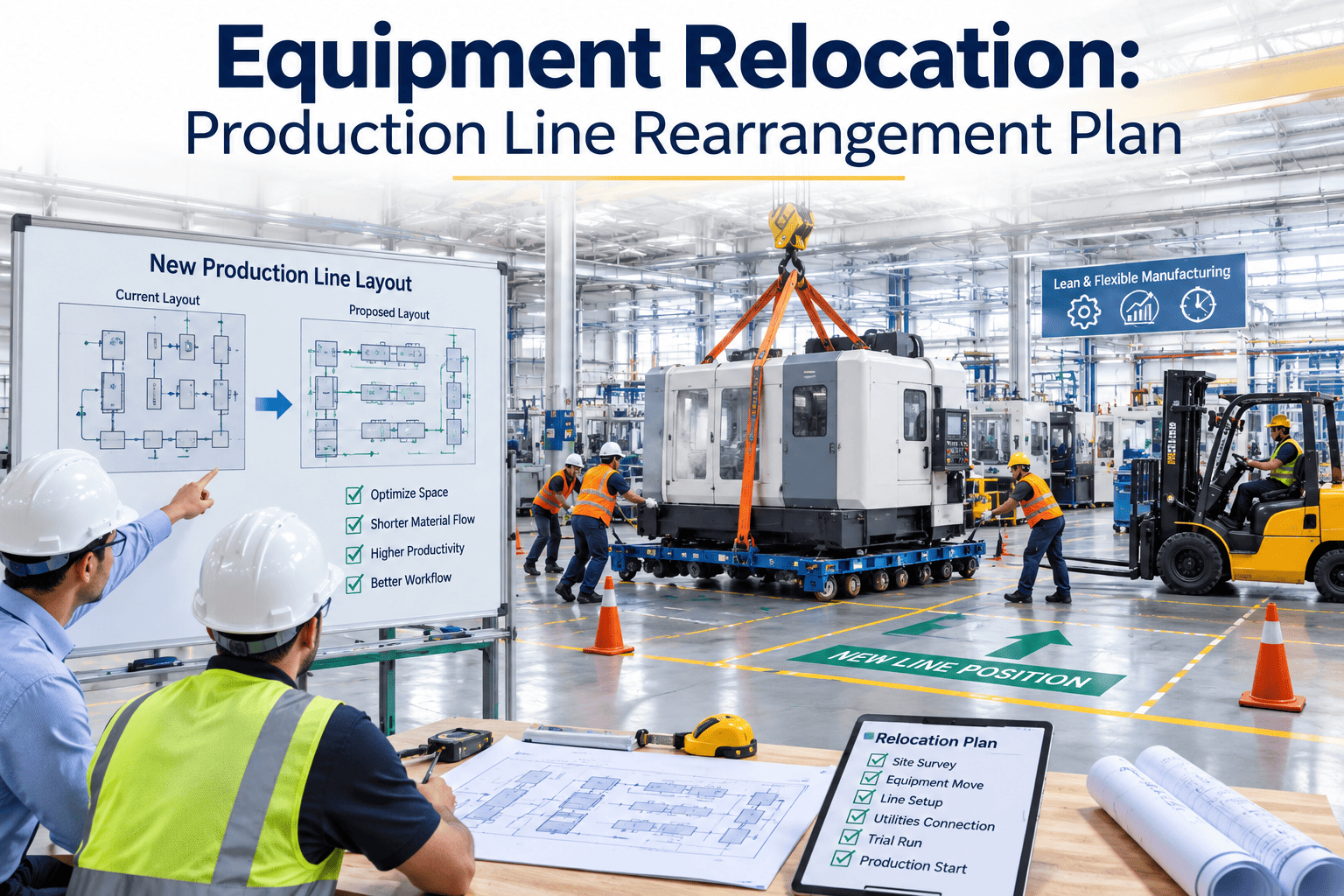
Moving a machine sounds simple until you count everything connected to it. Power, compressed air, coolant lines, dust extraction, network cabling, safety interlocks, and foundation anchoring all have to be disconnected, relocated, and recommissioned in the correct sequence, and every hour the machine is disconnected is an hour of lost production. Equipment relocation projects fail budgets and schedules far more often from poor sequencing and utility coordination than from the physical move itself. A structured rearrangement plan treats the move as a project with its own risk register, not a weekend task squeezed between shifts, and our team can help build that plan around your specific equipment and utility requirements.
Plant Layout & Bottlenecks
Equipment Relocation: A Production Line Rearrangement Plan That Protects Uptime
A phased relocation plan sequences disconnection, physical move, reconnection, and recommissioning to minimize the window of lost production, with every utility and safety system accounted for before the first bolt comes loose.
The Four Phases of a Controlled Relocation
Equipment moves that stay on schedule follow a consistent phase structure, with clear exit criteria at each stage before the next phase begins. Skipping a phase, or compressing recommissioning to save time, is the single most common cause of extended downtime after a move.
Phase 1
Pre-Move Engineering
Utility mapping, foundation assessment at the new location, rigging plan, and a documented lockout/tagout sequence for every connected system, reviewed before any physical work begins.
Phase 2
Disconnection & Preparation
Utilities disconnected in the sequence defined during engineering, with photos and labels documenting every connection point to eliminate guesswork during reconnection.
Phase 3
Physical Move & Placement
Rigging, transport, and precision placement against the new foundation or anchor points, with alignment and leveling verified before any utility reconnection starts.
Phase 4
Reconnection & Recommissioning
Utilities reconnected and tested individually, followed by a full functional test, safety interlock verification, and a supervised first-piece production run before handoff to normal operation.
Where Relocation Projects Lose the Most Time
Analysis of equipment relocation projects across manufacturing facilities consistently points to the same handful of causes for schedule overruns. Planning around these specific risks in advance is what separates a move that finishes on schedule from one that stretches an extra shift or an extra week.
A relocation plan built around utility mapping, sequenced trades, and recommissioning checkpoints keeps your move on schedule and your downtime predictable.
Utility Reconnection Checklist
Every utility connected to a piece of equipment needs its own verification step before production resumes. This checklist covers the systems most frequently underestimated during relocation planning.
ElectricalCircuit continuity, voltage verification, and grounding confirmed before power-on, with breaker labeling updated to reflect the new location.
Compressed AirLine pressure tested at the new connection point, with leak checks performed at every fitting disturbed during the move.
Coolant & FluidsSystems flushed and refilled to specification, with flow rate and temperature verified against baseline before first production run.
Dust & Fume ExtractionDuctwork reconnected and airflow tested to confirm capture velocity meets the original design specification at the new position.
Network & ControlsPLC and network connections re-established, with control logic verified against the pre-move configuration backup.
Safety SystemsLight curtains, interlocks, and emergency stops individually function-tested against the original safety validation record.
Who Needs to Be at the Table Before the Move
Relocation projects that stay on schedule involve the right roles from the pre-move engineering phase onward, not just on move day itself. Missing a stakeholder until late in planning is a common source of surprise delays.
Maintenance & Electrical
Owns the utility disconnection and reconnection sequence, and validates that the new location's power and controls infrastructure matches equipment requirements.
Production Planning
Coordinates the downtime window against the master schedule and arranges temporary routing or buffer stock for any dependent downstream stations.
EHS & Safety
Signs off on the lockout/tagout plan, rigging safety review, and post-move safety system re-validation before the machine returns to production.
Facilities & Rigging
Confirms foundation readiness at the new location and manages the physical transport, lifting, and precision placement of the equipment.
What Drives the Real Cost of a Relocation Project
Relocation budgets are frequently underestimated because the visible cost, rigging and transport, is only one line item among several that determine the true project cost.
Rigging & TransportCrane, forklift, and specialized transport equipment costs, which scale with machine weight, dimensions, and distance moved.
Foundation WorkNew anchor points, leveling, or concrete work at the destination, which can require lead time well before the move date.
Utility ReconnectionElectrical, compressed air, coolant, and network reconnection labor, often underestimated when utility routing at the new location differs from the original.
Lost ProductionThe largest and most frequently underestimated cost, calculated as downtime hours multiplied by the value of lost output during the disconnection-to-recommissioning window.
Frequently Asked Questions
How much downtime should we budget for a single machine relocation?
Downtime varies significantly by equipment complexity, but a well-planned relocation of a standalone machine with standard utilities typically runs one to three days including recommissioning and a supervised first-piece run. Equipment with extensive automation integration, custom tooling, or complex safety systems can require a week or more. The single biggest lever for reducing this window is completing utility mapping and foundation preparation before the move date rather than during it.
Book a demo to scope a downtime estimate for your equipment.
Should relocation happen during a planned shutdown or a live production window?
Planned shutdowns are strongly preferred whenever available, since they remove the schedule pressure that leads to skipped verification steps. When a shutdown window is not available, the move should still follow the same phased sequence, with disconnection and reconnection work scheduled around off-shift hours to minimize impact on adjacent lines that may share utilities or floor space with the equipment being moved.
Do we need to re-validate safety systems after every relocation?
Yes. Any equipment move that disturbs safety interlocks, light curtains, or emergency stop wiring requires individual function testing against the original safety validation record before the machine returns to production. This is not optional documentation, it is the step most likely to be compressed under schedule pressure, and it is also the step most likely to cause an incident if skipped.
Contact support for a safety re-validation checklist template.
What documentation should be captured before disconnecting a machine?
Photograph every connection point before disconnection, label cables and lines with their destination, record current control system configuration and parameter settings, and capture baseline performance data such as cycle time and output quality so recommissioning can be verified against a known-good state. This documentation is what turns reconnection from a guessing exercise into a checklist, and it is the single most effective way to compress recommissioning time.
How do we sequence a multi-machine line rearrangement without stopping the whole line?
Multi-machine rearrangements are typically sequenced one station at a time, with temporary buffer inventory or a bypass path allowing the rest of the line to keep running while each station is relocated in turn. This requires more detailed pre-move planning than a single machine move, since the sequence and temporary routing has to be worked out for every stage of the transition, but it avoids a full line shutdown for the duration of the project.
Book a demo to plan a phased multi-station rearrangement.
Move Equipment Without Losing Control of Your Schedule
Get a relocation plan that sequences every utility, trade, and safety check so your line comes back online on schedule.