U.S. fire departments respond to somewhere around 37,000 fires at industrial and manufacturing properties every year, which works out to roughly a hundred fires a day across the country, and the direct property damage from those fires runs well past a billion dollars annually. The long-term trend is genuinely encouraging, industrial and manufacturing fires have fallen by roughly two thirds since 1980 as codes, suppression technology, and inspection discipline have all improved. But the properties still losing that fight are rarely the ones without a sprinkler system, they are the ones where a system exists on paper and quietly stops matching the hazard it was designed around as the plant's processes, equipment, and material storage change underneath it. Facilities building a fire protection program that keeps pace with those changes can book a demo to see how monitoring supports the process.
SAFETY & EHS · FIRE PROTECTION · 2026
Fire Protection That Keeps Pace With What's Actually on the Floor
A risk assessment matched to real hazards, detection tuned for a plant's specific environment, and suppression design verified against current occupancy turn fire protection from a static permit requirement into a program that actually holds up.
The Scale of the Problem Industrial Fire Protection Is Solving
Industrial and manufacturing fires have fallen substantially over the past four decades, from well over 100,000 fires a year in 1980 to under 40,000 today, largely on the strength of better codes, better suppression technology, and more consistent inspection programs. That progress is real, but the properties that still lose this fight tend to share a pattern, a fire protection system that was correctly designed once and never fully re-verified against how the space is actually used today. A sprinkler layout sized for general storage does not automatically stay adequate once that same area starts holding flammable coatings, and a detection system tuned for a low, tight space struggles in a high-bay area where smoke has to travel much further before it reaches a sensor. The gap rarely shows up until an insurer's survey or a real event exposes it. Vehicle fires deserve a specific mention here, since they account for a meaningful share of industrial fires and a disproportionate share of the resulting civilian deaths, particularly in facilities where forklifts or loaders operate indoors alongside combustible material storage.
~37,000
fires occur annually at U.S. industrial and manufacturing properties, according to NFPA estimates.
$1B+
in direct property damage results from these fires each year, before accounting for downtime and lost production.
$260K/hr
is a commonly cited average cost of unplanned downtime for manufacturing firms, a cost any fire-related shutdown adds directly to.
66%
decline in industrial and manufacturing fires since 1980, showing the scale of improvement consistent fire protection programs can produce.
Where Industrial Fire Risk Actually Originates
Manufacturing environments carry hazard types most other occupancies never have to plan around, and a generic commercial fire risk assessment routinely misses several of them. A useful risk assessment walks the plant hazard by hazard rather than applying a template built for an office building.
Combustible Dust
Fine particulate from grinding, sanding, or material handling can create an explosion hazard invisible to a standard inspection.
Electrical & Equipment
Overloaded circuits and aging equipment remain among the most common ignition sources in manufacturing fires.
Hot Work
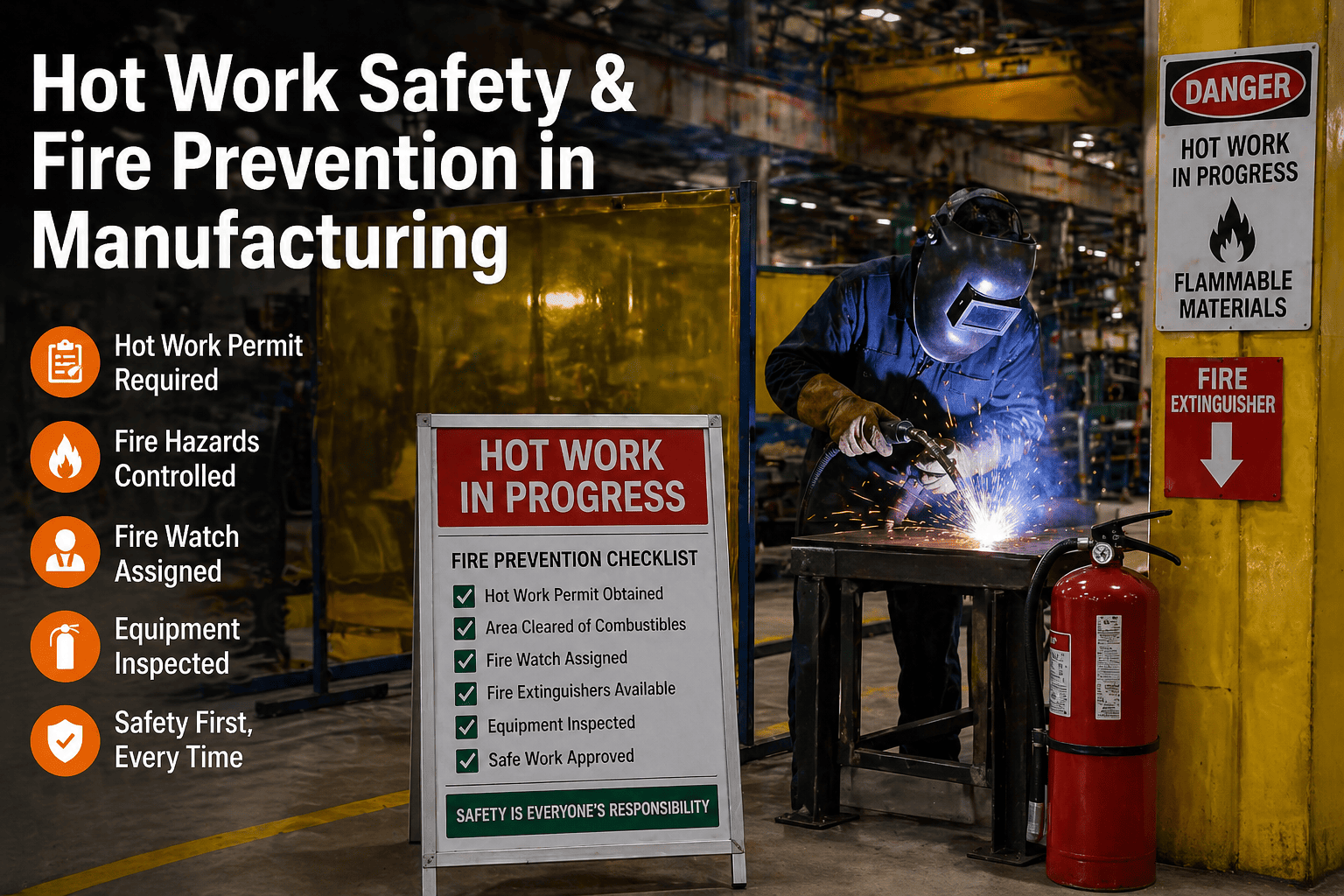
Welding, cutting, and grinding operations require a permit process that many facilities apply inconsistently across shifts.
Flammable Storage
Solvents, coatings, and fuel storage areas need suppression matched to the specific material, not the building's general system.
CONTINUOUS FIRE SYSTEM MONITORING
Know a System Is Ready Before You Need It, Not After
See how live tracking of inspection, testing, and maintenance schedules supports your fire protection program.
Building Layers of Protection Instead of One Single System
The facilities with the strongest fire outcomes rarely rely on one system. They layer detection, suppression, and routine maintenance so that a gap in one layer, a detector that drifts out of calibration, a valve left closed after maintenance, does not become the single point of failure for the whole plant.
Detection Layer
Smoke, heat, flame, and gas detection matched to the specific hazard and ceiling height of each area.
Suppression Layer
Sprinklers, clean agent, or foam systems matched to what would actually be damaged by water in that space.
Egress & Response Layer
Alarm monitoring, clear egress routes, and a documented emergency response plan that matches current floor layout.
Maintenance Layer
Routine inspection, testing, and preventive maintenance that catches a deficiency before the system is ever called on.
The Inspection & Testing Cadence Most Systems Actually Need
WEEKLY
Visual Walkthroughs
Sprinkler heads, extinguisher access, and egress routes checked for obstructions or obvious damage.
QUARTERLY
Alarm & Detector Testing
Detection devices tested and calibration verified, particularly in high-ceiling or remote areas prone to delayed smoke reach.
ANNUALLY
Fire Pump & Main Drain Testing
Full-flow testing confirms the system can deliver the pressure and volume it was originally designed to deliver.
ON CHANGE
Re-Verification After Process Change
New equipment, new storage, or a layout change triggers a re-check that suppression design still matches the hazard present.
What Plant Safety Leaders Are Saying
Our suppression system was designed correctly for the plant we had ten years ago. Nobody had gone back to check whether it still matched the plant we had today, until an insurer's inspection flagged that a storage area had shifted from general stock to flammable coatings without anyone updating the suppression design for that zone.
Plant Safety Director, Discrete Manufacturing Facility
Frequently Asked Questions
What causes most industrial and manufacturing fires?
Electrical malfunctions, equipment overheating, combustible dust, hot work operations, and chemical ignition sources are among the most frequently cited causes across industrial and manufacturing fires. Vehicles used inside or around a facility also account for a meaningful share of fires, particularly in facilities with heavy material handling equipment. The common thread across most of these causes is that they involve a hazard the facility already knew about, which is why a current and thorough risk assessment tends to matter more than any single piece of equipment.
Why can't one fire suppression system protect an entire plant equally well?
Different areas of a manufacturing facility present genuinely different hazards, and a water-based sprinkler system that is exactly right for general combustible storage can be the wrong choice near sensitive electronics, where a clean agent system avoids the water damage a sprinkler would cause. Flammable liquid storage typically needs foam suppression specifically sized for that hazard, and combustible dust areas often need explosion venting and isolation on top of standard suppression. Facilities weighing system selection for a specific area can review options through
support.
How often should fire protection systems be inspected and tested?
Most systems need a layered cadence rather than a single annual check, weekly visual walkthroughs of sprinkler heads and egress routes, quarterly testing of alarms and detection devices, and annual full-flow testing of fire pumps and main drains. Beyond the standing calendar, any process change, new equipment installation, or storage change should trigger a re-verification that the existing suppression design still matches the hazard now present in that area. Facilities that only inspect on a fixed calendar without re-checking after change are the ones most likely to be running a system quietly mismatched to their current floor.
What is a dust hazard analysis and when is one required?
A dust hazard analysis is a systematic evaluation of a facility's combustible dust hazards, identifying where fine particulate accumulates and what explosion protection or housekeeping controls are needed to manage it. Facilities with grinding, sanding, cutting, or other processes that generate fine particulate from combustible materials are the ones most likely to need one, and the analysis typically drives decisions about explosion venting, isolation, and suppression system sizing in those specific areas. Skipping this analysis is a common reason a suppression system that looks adequate on paper turns out to be undersized for the actual dust hazard present.
How does downtime cost factor into fire protection decisions?
Beyond the direct property damage a fire causes, the production downtime that follows is often the larger cost, with manufacturing downtime commonly estimated in the hundreds of thousands of dollars per hour depending on the facility and product line. That downtime cost is a strong argument for layered protection that limits a fire's spread and severity, since a contained incident that trips a suppression system in one zone is a very different recovery timeline than one that spreads across multiple production lines. Plants can
book a demo to see how tracking system readiness supports faster, more confident recovery planning.
SAFETY & EHS · FIRE PROTECTION
Move From a Static Permit File to a Tracked Fire Protection Program
See how live inspection, testing, and hazard-change tracking fit into your plant's current fire protection program.