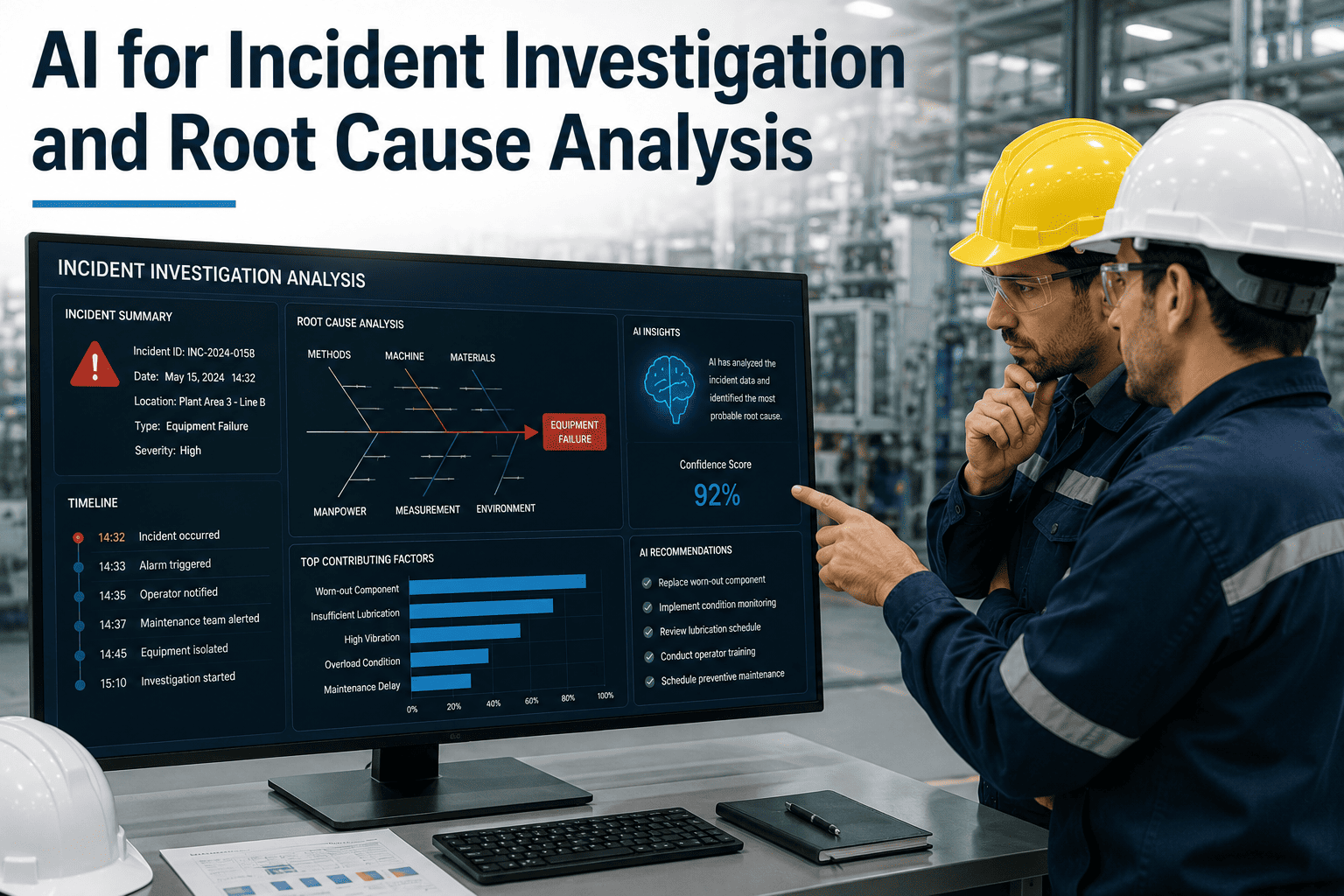
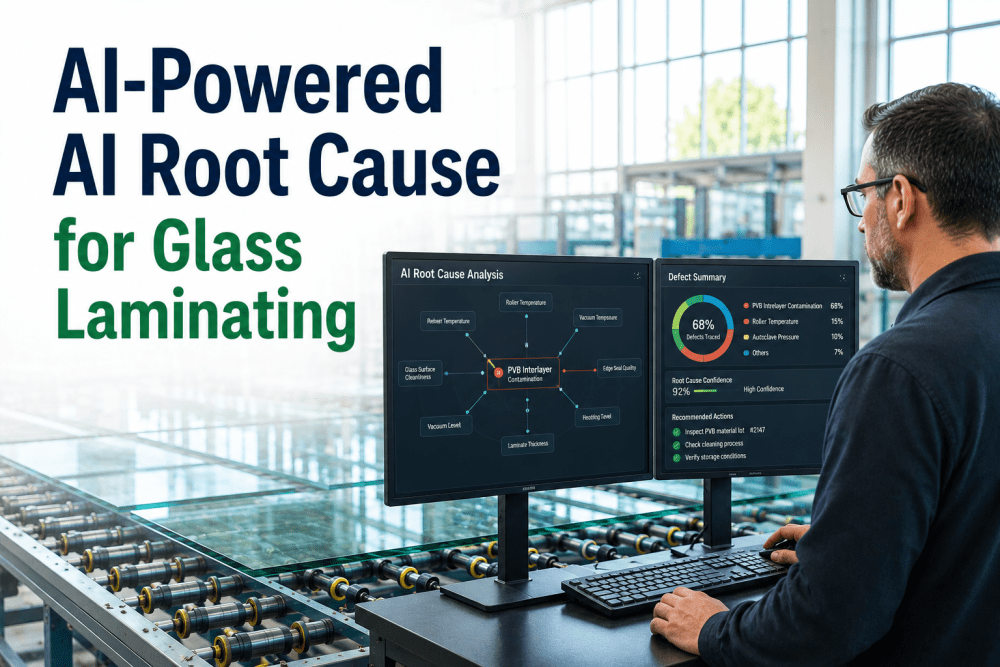
Most manufacturing plants already require that recordable injuries get investigated, but the events that actually predict where the next injury will happen almost never reach a paper trail. A worker notices a guard has worked loose, catches it before anyone gets hurt, and moves on without filling out a form, and the exact same hazard sits there just as dangerous as it was five minutes earlier. Decades of accident-triangle research point to the same pattern, hundreds of near-misses sit underneath every serious injury, and a plant that only investigates after someone gets hurt is working from the smallest, least useful slice of its own safety data. Building a near-miss reporting system and an investigation methodology that people actually use, rather than one that quietly gets ignored after the first quarter, is where that gap starts to close. Plants ready to structure this data can book a demo to see how monitoring supports the process.
SAFETY & EHS · INCIDENT INVESTIGATION · 2026
Turn Near-Miss Reports Into the Investigation Data That Actually Prevents Injuries
A structured intake process, a consistent root-cause methodology, and a classification taxonomy that holds up across shifts turn near-miss reporting from a compliance checkbox into a genuine leading indicator.
Why Near-Misses Are the Cheapest Safety Data a Plant Will Ever Collect
Herbert Heinrich's original research into industrial accidents, and the larger studies that followed it decades later, converge on a ratio that looks roughly like a triangle rather than a straight line. For every serious or fatal injury, there are dozens of minor injuries, and hundreds of near-misses, unsafe conditions caught before they became anything worse. The exact numbers move depending on which study a plant cites, but the shape of the triangle does not change: near-misses happen far more often than injuries, they carry almost none of the cost or the paperwork burden of a recordable incident, and they describe the same underlying hazards that eventually produce the injuries a plant is desperate to prevent.
That makes near-miss data the cheapest, fastest leading indicator a safety team has access to. A control system fault, a housekeeping lapse, a procedure that gets skipped under time pressure, all of these show up in near-miss reports long before they show up in an OSHA 300 log. The plants that treat near-miss volume as a sign of reporting health, rather than a sign of an unsafe floor, are usually the ones with the strongest injury trends five years later. A site logging fifty near-misses a month with zero injuries is very often safer than a site logging two near-misses and one injury, because the first site is catching the conditions the second site is quietly ignoring.
Near-Misses & Unsafe Conditions
~300 events
Minor & First-Aid Incidents
~29 events
Serious or Recordable Injury
1 event
These figures come from the accident-triangle literature built up since Heinrich's original 1931 study and refined by later researchers, and they are directional rather than a fixed law a plant should expect to reproduce exactly. What every version of the triangle agrees on is the underlying lesson: the base is where the useful data lives, and a program that only reacts once something reaches the top of the triangle has already missed the cheapest opportunity to intervene.
The Real Bottleneck Isn't Report Volume, It's Participation and Follow-Through
Most plants that stand up a near-miss program do not fail because workers refuse to report hazards. They fail because the reporting rate quietly collapses a few months in, usually right after someone who filed a report gets questioned about why they were doing the task in the first place. Once that happens once, word travels across a shift faster than any safety bulletin, and the near-miss numbers that follow look clean on paper for exactly the wrong reason, nobody is telling the company anything anymore. Contract and temporary workers are usually the first group to stop reporting, since they have the least job security and the least reason to believe a report will not follow them, which means a plant that leans heavily on contract labor needs to track participation for that group separately rather than folding it into a single plant-wide number.
50-70%
of employees submitting at least one near-miss report a year is a common participation target in mature programs.
70-90%
of reports submitted within 72 hours is generally treated as a sign the reporting and response process is actually working.
10:1+
near-miss-to-recordable ratio is typical of healthy programs, with low ratios usually flagging under-reporting rather than a safer floor.
2.6x
higher turnover intention has been associated in published research with workers who felt their near-miss reports got no company response at all.
The programs that keep their participation and timeliness numbers healthy share a common trait, they separate the report from the worker's performance record and they close the loop visibly, so the person who filed a report can see what happened as a result. Continuous monitoring of participation, timeliness, and closure by shift and by line gives a safety team an early warning when a program starts to drift, well before the annual audit surfaces the same gap the hard way.
From Immediate Cause to Root Cause: A Classification Taxonomy That Holds Up
An investigation that stops at the immediate cause, the loose guard, the worker who bypassed a lockout step, the wet floor with no sign, fixes exactly one instance of the hazard and leaves the system that produced it untouched. A taxonomy that separates immediate causes from contributing factors and root causes gives investigators a consistent place to stop digging only once they have reached something a corrective action can actually change.
CONTINUOUS INVESTIGATION TRACKING
Stop Losing Near-Miss Data to a Clipboard Nobody Reviews
See how live tracking of reports, root cause categories, and corrective action closure supports a stronger safety program.
Choosing an Investigation Methodology That Fits the Event
No single root-cause method is right for every incident. A near-miss with one obvious contributing factor does not need the same rigor as a serious injury with multiple systemic gaps, and forcing every event through a heavyweight process is one of the fastest ways to burn out an investigation team and slow reporting down. Matching the method to the incident's complexity keeps investigations fast enough that they actually get finished.
5-Whys
Iterative questioning that works well for simpler near-misses with a single clear causal chain and a small investigation team.
Fishbone / Ishikawa
Categorizes causes across people, equipment, procedure, environment, and management, useful when several factors likely combined.
SCAT
Systematic Cause Analysis links substandard acts and conditions back through basic causes, a solid middle-weight option for recordable injuries.
TapRooT / Decision-Tree Methods
Standardized root-cause trees suited to serious events or organizations that want comparable data across many sites over time.
The value of standardizing on even one or two of these methods compounds over time. When every investigator uses the same categories, patterns become visible across a plant, or across a whole company, that a single one-off investigation could never reveal. A recurring pattern of procedure-related root causes across unrelated departments points to a training or documentation gap that no individual investigation would have surfaced on its own.
Investigation Mistakes That Quietly Undermine the Corrective Action
Most investigation programs do not fail because nobody knows a methodology. They fail because a handful of avoidable mistakes creep into how the methodology gets applied under time pressure, and each one shows up again the next time a similar event happens.
Blame-First Interviews
Interviews framed around who made a mistake shut down the honest detail an investigator actually needs to reach a root cause.
Stopping at the Immediate Cause
Closing the file once the unsafe act is identified leaves the system condition that produced it completely untouched.
Corrective Actions With No Owner
An action assigned to a department instead of a named person with a due date is an action that rarely gets closed.
No Effectiveness Verification
Marking an action closed once it is done is not the same as confirming it actually prevented the hazard from recurring.
What a Near-Miss Investigation Actually Looks Like, Start to Finish
STEP 1
Intake & Triage
Every report gets logged and screened within hours, with severity potential, not actual outcome, deciding how deep the investigation needs to go.
STEP 2
Evidence & Scene Preservation
Photographs, equipment settings, and physical conditions are captured before the area gets cleaned up or production resumes.
STEP 3
Interviews
Open-ended, non-leading interviews with everyone involved, focused on what the system allowed rather than who is to blame.
STEP 4
Root Cause Analysis
The chosen methodology is applied consistently until the investigation reaches a cause the plant can actually change, not just describe.
STEP 5
Corrective Action & Verification
Actions are assigned with an owner and a due date, then verified as genuinely effective rather than simply closed on schedule.
What Safety Leaders Are Saying
We had a near-miss program on paper for two years before anyone told me the reporting rate had quietly dropped to almost nothing. Once we started tracking participation and closure by shift instead of just counting total reports, we found out our best line was reporting the least, not because it was safest, but because a supervisor had been quietly discouraging it.
Safety Manager, Discrete Manufacturing Plant
Frequently Asked Questions
What is the difference between a near-miss and a recordable incident?
A near-miss is an unplanned event that had the potential to cause injury, illness, or damage but did not, either by chance or because someone intervened in time. A recordable incident is an event that did result in injury, illness, or property damage that meets a regulatory reporting threshold. Both should be investigated, but the classification determines which reporting obligations apply and how urgently the investigation needs to start. Plants that only investigate recordables are working from a much smaller and later slice of their own safety data.
Which root-cause methodology should a plant standardize on?
There is no single correct answer, and most mature programs keep more than one method available depending on event severity. A simpler near-miss with one clear causal chain is usually well served by a 5-Whys analysis, while a serious injury with several contributing systems benefits from a more structured method such as SCAT or a decision-tree approach. What matters more than which method is picked is that the same investigators apply it consistently, since that consistency is what makes root cause patterns visible across the plant over time. A plant does not need to pick one method for every event either, a lightweight 5-Whys for a minor near-miss and a fuller decision-tree method reserved for anything with serious injury potential is a common and reasonable split. Teams weighing options can review current practice through
support.
How many near-misses should a plant expect to see reported?
There is no universal target number, because reporting volume depends heavily on plant size, hazard profile, and how much trust workers have in the reporting process. What matters more than the raw count is the ratio of near-misses to recordable incidents, with healthy programs commonly seeing a ratio well above ten to one, and the participation rate across the workforce, with fifty to seventy percent of employees submitting at least one report annually being a common benchmark in mature programs. A ratio that looks unusually low is far more often a sign of under-reporting than a sign of a genuinely safer floor.
Does near-miss reporting replace formal incident investigation?
No, near-miss reporting and formal incident investigation serve different purposes and both are necessary parts of a complete safety program. Near-miss reporting is the intake mechanism that surfaces hazards early, while investigation is the structured process that determines why the hazard existed and what needs to change to prevent recurrence. A near-miss program without consistent investigation behind it produces a large volume of reports that never actually reduce risk, since nothing gets fixed. Plants can
book a demo to see how the two connect in practice.
How should near-miss and investigation data be tracked over time?
Most mature programs track a handful of metrics consistently, participation rate by shift and department, timeliness of reporting, near-miss-to-recordable ratio, and closure rate on corrective actions with verified effectiveness rather than just a closed date. Segmenting these numbers by site, shift, and job type makes it possible to catch a site with an unusually low near-miss rate but a normal or high recordable rate, which is a strong signal of under-reporting rather than genuine safety performance. Trending this data monthly with a rolling average helps separate a real shift in safety performance from ordinary month-to-month noise.
SAFETY & EHS · INCIDENT INVESTIGATION
Move From a Clipboard Program to a Tracked Investigation System
See how live near-miss and investigation tracking fits into your plant's current safety program.