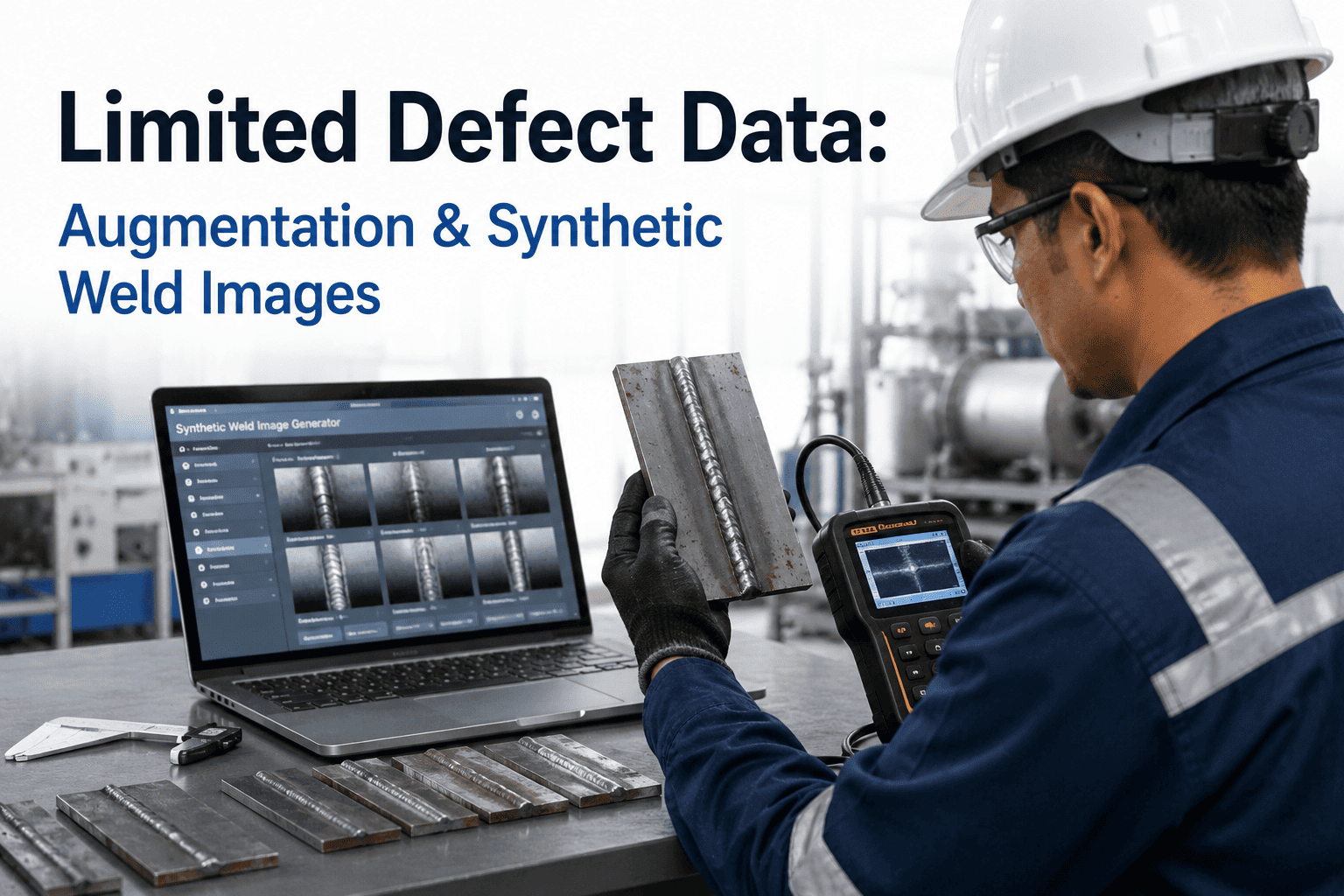
Every AI weld inspection project runs into the same wall eventually: porosity, undercut, and lack-of-fusion defects are rare by design, because a well-run weld line produces mostly good welds. That is great for production and terrible for training a computer vision model, which needs hundreds of examples of each defect type to learn what one actually looks like. Teams that try to solve this by manually photographing every possible flaw spend months chasing a dataset that is still imbalanced when it is done. Data augmentation and synthetic image generation exist precisely to break that bottleneck, turning a handful of real defect photos into a training set large and varied enough to build a model that holds up on the production line, which is the exact problem iFactory's AI vision team solves for weld quality programs stuck at the data collection stage.
AI WELD QUALITY INSPECTION · SYNTHETIC DATA · 2026
Limited Defect Data: How Augmentation and Synthetic Weld Images Solve the Training Data Shortage
Most weld defect datasets start with fewer than fifty real examples per defect class. See how geometric augmentation, GAN-based synthesis, and diffusion models turn that shortage into a training set that actually generalizes to the plant floor.
The Core Problem
Why Weld Defect Data Is Almost Always Too Small and Too Imbalanced
A model trained on lopsided data learns a lopsided lesson. When a classifier sees a thousand good welds for every ten porosity examples, it optimizes toward predicting "good" by default, which is exactly the false-negative risk a quality team cannot afford to ship.
Before: Real Data Only
Good weld images2,000+
Porosity examples12–30
Undercut examples8–20
Lack-of-fusion examples5–15
→
After: Real + Synthetic Data
Good weld images2,000+
Porosity examples500+
Undercut examples500+
Lack-of-fusion examples500+
The Techniques
The Augmentation Spectrum: From Simple Transforms to Generative Synthesis
Not every augmentation technique solves the same problem. Simple transformations stretch what you already have, while generative methods create genuinely new defect patterns the model has never seen before.
Tier 1
Geometric Transformations
Rotation, flipping, cropping, and scaling reframe existing defect images from new angles. Fast and free, but they only present the same defect differently, they never invent a new pattern.
Tier 2
Photometric Transformations
Brightness, contrast, and color jitter simulate different lighting and camera conditions across weld stations, helping a model generalize across cameras rather than one specific setup.
Tier 3
GAN-Based Synthesis
Generative adversarial networks learn the visual distribution of real defects and compose new, plausible defect foregrounds onto clean weld backgrounds, expanding true pattern diversity.
Tier 4
Diffusion-Based Generation
Diffusion models offer more stable training than GANs and can generate photorealistic defect images from as few as three to five real examples per class, the current state of the art for scarce data.
Turn a Handful of Defect Photos Into a Production-Ready Model
iFactory's AI vision pipeline generates balanced, validated synthetic defect data from your existing weld images, cutting model training timelines from months to days.
Choosing a Method
Which Augmentation Method Fits Your Defect Data Situation
Weld Defect Augmentation Method Comparison — 2026
The Pipeline
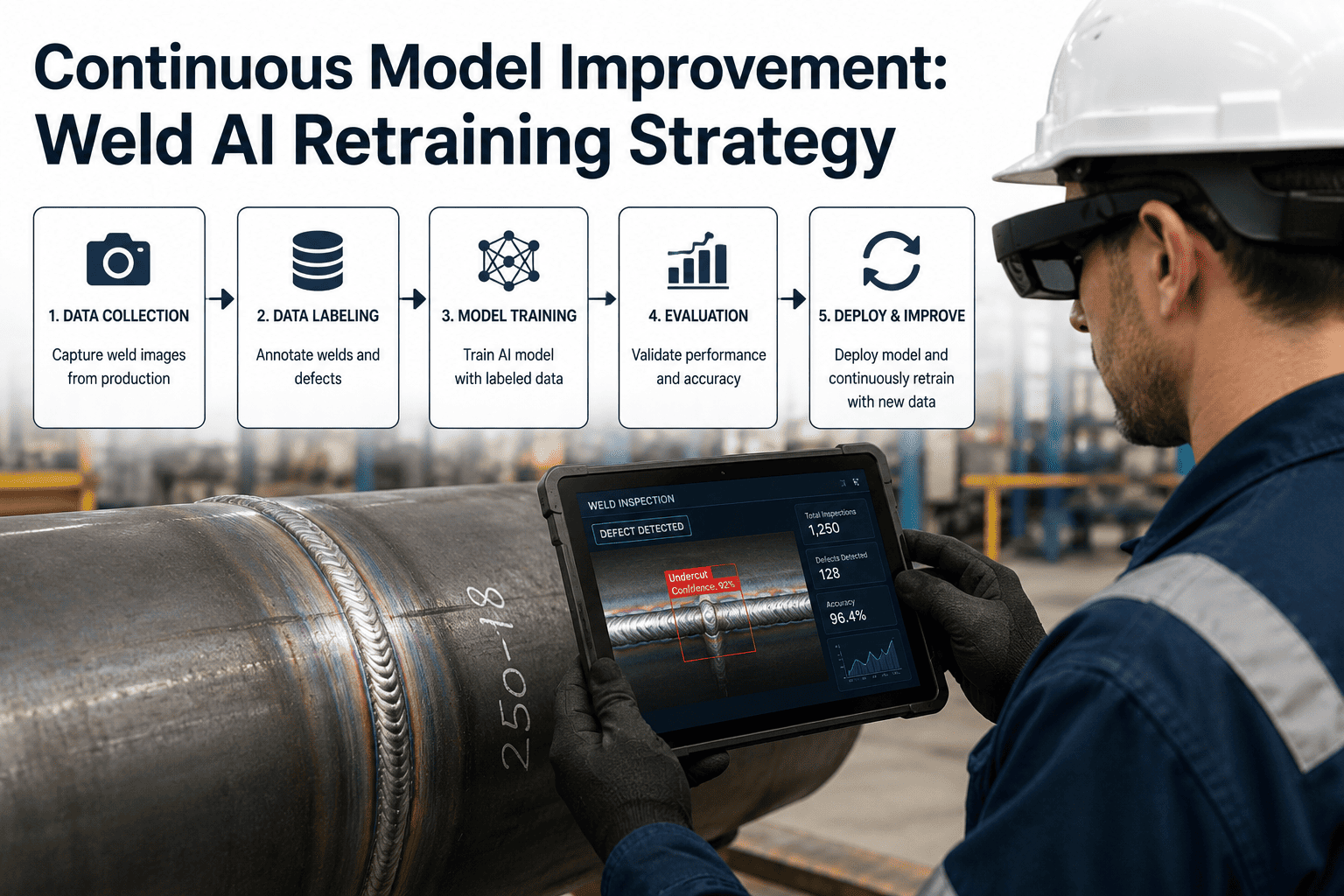
How a Synthetic Weld Defect Pipeline Actually Runs
Generating synthetic images is only one step in a larger pipeline. Skipping the validation step at the end is the single most common reason synthetic data hurts model performance instead of helping it.
1
Collect Seed Defects
Gather every available real example of each defect class, even a handful, as the foundation the generative model will learn from.
2
Train or Fine-Tune the Generator
A GAN or diffusion model learns the visual characteristics of each defect type from the seed images and the clean weld background.
3
Generate a Balanced Synthetic Set
The model produces hundreds of new, labeled defect images per class, composed onto realistic weld backgrounds and surface conditions.
4
Blend With Real Data
Synthetic images are mixed with real ones at a tested ratio, since 100% synthetic training data typically underperforms a real-and-synthetic blend.
5
Validate Against Held-Out Real Images
The trained model is tested only against real, never-seen weld images to confirm synthetic training actually improved production accuracy.
What to Watch For
Where Synthetic Data Projects Go Wrong
Treating Geometric Augmentation as Enough
Rotating and cropping the same twelve porosity images only ever shows the model the same twelve defects from different angles, which limits real-world generalization no matter how many augmented copies exist.
Skipping Validation on Real Images
A model can score well on a synthetic-heavy test set while failing on the production line, since synthetic images can share subtle generation artifacts the model learns to key on instead of the actual defect.
Ignoring GAN Training Instability
GAN-based generators are sensitive to hyperparameter choices and can collapse into producing repetitive, low-diversity images if training is not monitored closely, undermining the diversity the method is meant to provide.
Using an All-Synthetic Training Set
Removing real examples entirely tends to degrade performance, since even a small anchor of real data keeps the model tied to the true visual distribution rather than the generator's approximation of it.
What the Research Shows
Results Manufacturers Are Seeing From Synthetic Defect Data
3–5
real defect images can be enough to seed a diffusion-based generator for a new defect class
~6%
typical mIoU improvement on surface defect segmentation when synthetic images are blended into training
Months → Hours
typical reduction in data collection timelines when generative synthesis replaces manual defect photography
Minority classes
gain the largest accuracy improvement, since rare defect types benefit most from synthetic class balancing
Frequently Asked Questions
Synthetic Weld Defect Data — Common Questions
How many real defect images do we actually need to start generating synthetic data?
Modern diffusion-based methods can begin generating usable synthetic defect images from as few as three to five real examples per class, though GAN-based approaches typically perform better with a few dozen real examples to learn from. Starting with whatever real data exists today is enough to begin the process.
Will a model trained on synthetic data actually work on the real production line?
Yes, when the synthetic images are blended with real data at a validated ratio and tested exclusively against held-out real images rather than synthetic ones. Skipping that validation step is the most common reason synthetic-trained models underperform once deployed, not a flaw in synthetic data itself.
Is GAN-based or diffusion-based synthesis better for weld defect images?
Diffusion models generally offer more stable training and higher photorealism from very limited seed data, making them the stronger default for new or rare defect types. GANs can still be effective and faster to run once a defect class already has a moderate number of real examples to learn from.
Can iFactory build a synthetic data pipeline around our existing weld inspection cameras?
Yes,
iFactory's AI vision team works directly with your existing camera setup and historical defect images to build a generation and validation pipeline suited to your weld types, materials, and defect classes without requiring new hardware.
Does synthetic data replace the need to keep collecting real defect images?
No, synthetic data accelerates model readiness while real data collection continues in the background, and new real examples should periodically retrain the generator itself so synthetic output keeps reflecting the current production process and materials rather than drifting out of date.
AI WELD QUALITY INSPECTION · SYNTHETIC DATA · 2026
Stop Waiting Months for Defect Data That May Never Arrive
iFactory turns your limited real defect images into a balanced, validated training set, so your weld inspection model ships in days instead of quarters.