A plant manager pitching smart factory investment usually leads with productivity gains and operational metrics; a CFO evaluating the same request wants NPV, payback period, and a risk-adjusted case next to every other capital request competing for the same budget. Most smart factory proposals stall not because the technology case is weak, but because the financial case was built in operational language instead of the language finance actually approves capital in. This framework translates productivity, quality, energy, and labor impact into the investment analysis a CFO can actually sign off on.
Digital Transformation ROI · 2026
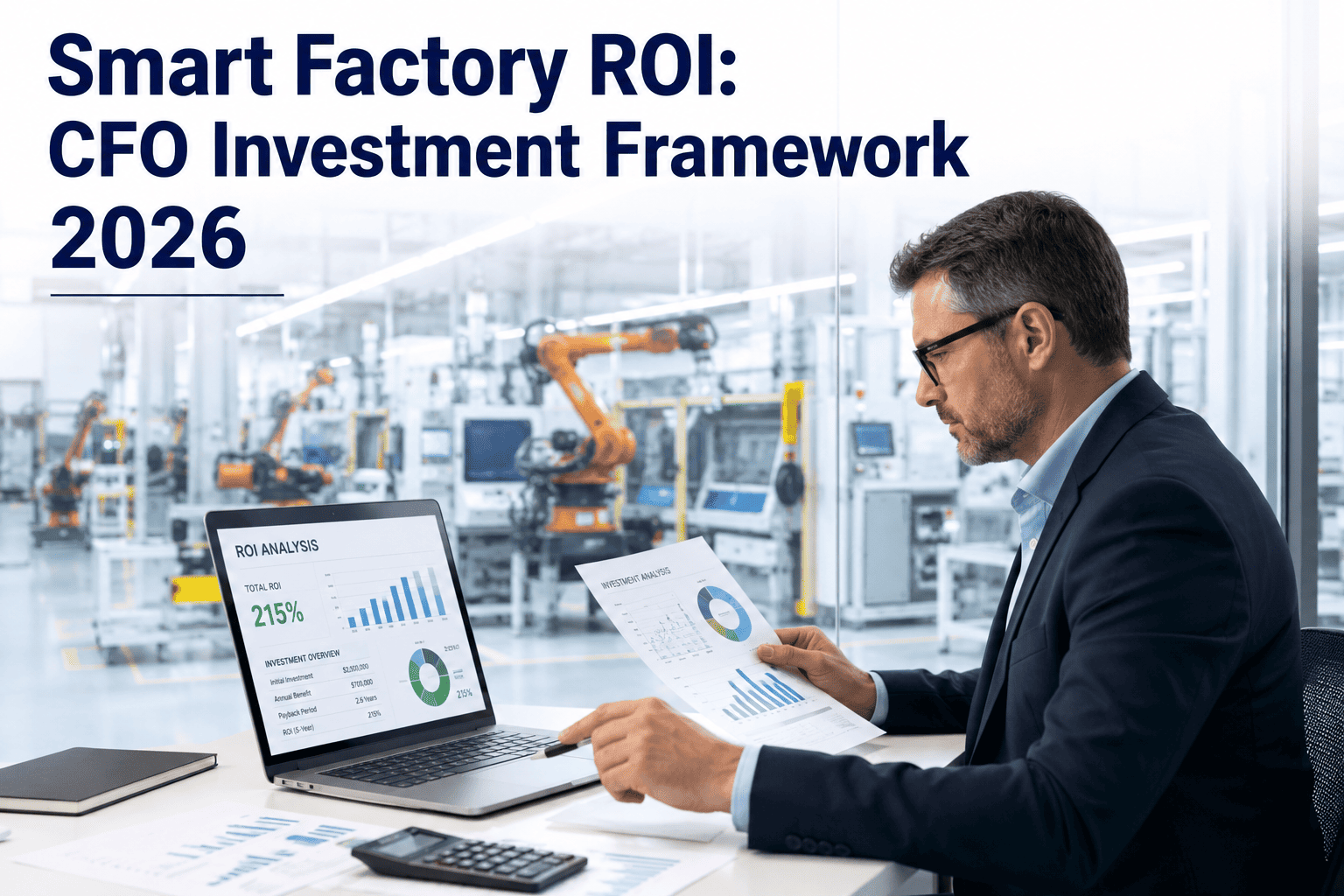
Smart Factory ROI: Building the Investment Case Your CFO Will Approve
NPV, IRR, and payback analysis that translates productivity, quality, energy, and labor savings into the financial case capital committees actually evaluate.
Foundations
Why Operational Metrics Alone Don't Clear Capital Committee
Productivity gains, quality improvements, and downtime reduction are real, but a capital committee needs them expressed as cash flow impact over a defined time horizon, discounted against the cost of capital, and compared against the alternative uses of the same budget. A proposal built around "20 percent fewer defects" gets debated on definitions; a proposal built around the same fact translated into dollars saved per year, net present value, and payback period gets evaluated against every other project competing for approval on the same terms. The translation step — from operational impact to financial model — is what separates smart factory proposals that get funded from ones that get tabled for "more data."
Financial Reference
The Metrics a Capital Committee Actually Evaluates
| Metric | What It Answers | Why Finance Weighs It |
|---|---|---|
| Net Present Value (NPV) | Is the project worth more than its cost, today | Accounts for the time value of money across the full horizon |
| Internal Rate of Return (IRR) | What return rate does this project generate | Directly comparable against other capital projects |
| Payback Period | How long until the investment is recovered | A simple risk proxy finance leans on early in review |
| Sensitivity Range | How the case holds under conservative assumptions | Tests whether the case survives if benefits underperform |
Building the Case
Five Steps to a CFO-Ready Smart Factory Business Case
1
Quantify Every Benefit Category in Dollars
Translate productivity, quality, energy, and labor impact into annual dollar figures using your plant's own cost data, not industry averages, since finance will discount generic benchmarks heavily.
2
Build a Conservative and a Base Case
Present a conservative scenario alongside the base case rather than only the optimistic number, since a case that only survives under best-case assumptions signals higher risk to reviewers.
3
Calculate NPV and IRR Against Your Cost of Capital
Use your organization's actual discount rate rather than a generic figure, and present both metrics since some committees weight one more heavily than the other.
4
Show the Payback Timeline Explicitly
Chart cumulative cash flow against investment over time so the payback point is visually obvious rather than buried in a spreadsheet appendix.
5
Address the Risk Section Directly
Name implementation risk, adoption risk, and benefit-realization risk explicitly with mitigation steps, since an unaddressed risk section reads as an unconsidered one to experienced reviewers.
Turn Operational Gains Into a Financial Case
Get Your Smart Factory Investment Case Modeled Properly
Our team helps translate your plant's productivity, quality, and energy data into NPV, IRR, and payback analysis structured the way your capital committee reviews it.
Case Comparison
Operational Pitch vs Financial Case
Operational Pitch
Leads with percentage improvements in OEE, defect rate, or downtime, framed as operational wins without translation into cash flow, discount rate, or comparison against other capital projects competing for the same budget.
Financial Case
Leads with annual dollar impact, NPV and IRR against actual cost of capital, an explicit payback timeline, and a named risk section with mitigation — structured in the exact format capital committees use to compare every proposal.
Applied Example
A Proposal That Stalled, Then Cleared
A tier-one automotive supplier's plant team submitted a smart factory monitoring proposal built around a projected 15 percent reduction in unplanned downtime, and the request sat unapproved for two budget cycles despite strong operational support from plant leadership. Reworking the same proposal into a financial case — translating downtime reduction into dollar-per-hour production value, calculating NPV against the company's actual cost of capital, and presenting a conservative case alongside the base case — cleared capital committee review within a single cycle. Nothing about the underlying operational improvement changed between the two submissions; what changed was whether the benefit was expressed in the language the committee evaluates capital requests in.
"
The proposals that get approved fastest aren't necessarily the ones with the biggest projected savings — they're the ones that show their work in a format finance already trusts. A conservative case with clear assumptions beats an aggressive case with hand-waved ones almost every time, because reviewers are pattern-matching for rigor as much as for magnitude.
Corinne Adeyemi-Waskiewicz
Manufacturing Finance Consultant · 13 years in capital planning and digital transformation business cases
Benefit Classification
Hard Savings vs Soft Savings
Hard Savings
Directly measurable reductions in cost or increases in output — lower scrap dollars, reduced overtime hours, avoided downtime — that translate cleanly into cash flow and carry the most weight in a capital committee review.
Soft Savings
Harder-to-quantify benefits like improved visibility, better decision-making speed, or employee experience, which are real but should be presented separately from hard savings rather than blended into the primary financial case.
Realization Timeline
Typical Benefit Categories and When They Show Up
| Benefit Category | Typical Realization Window | Measurement Approach |
|---|---|---|
| Downtime Reduction | Often visible within the first two quarters | Dollar-per-hour of production value recovered |
| Quality Improvement | Typically six months to a year | Cost per defect avoided, scrap and rework reduction |
| Energy Savings | Visible in utility billing within one to two quarters | Direct utility cost comparison, pre and post |
| Labor Reallocation | Varies, often a year or more to fully realize | Headcount or overtime hours redeployed or reduced |
Presenting the Case
Steps to Present the Case to a Capital Committee
1
Open With the Financial Summary, Not the Technology
Lead the presentation with NPV, IRR, and payback so reviewers immediately see the financial shape of the request before technical details.
2
Walk Through Assumptions Transparently
Show the source of every key assumption rather than presenting only final figures, since reviewers trust a case they can trace back to its inputs.
3
Anticipate the Questions Finance Will Ask
Prepare answers for sensitivity, risk, and comparison against alternative capital uses in advance, rather than fielding them live without preparation.
4
Propose a Post-Implementation Review
Committing to measure actual results against the projected case after implementation builds credibility for this and future proposals.
Objection Handling
Common Objections and How to Address Them
| Objection | How It's Typically Addressed |
|---|---|
| "Benefits seem optimistic" | Present the conservative scenario alongside the base case with sourced assumptions |
| "Payback is too long" | Break out phased implementation so early wins generate cash flow sooner |
| "Similar projects underdelivered before" | Reference the post-implementation review commitment and named risk mitigations |
| "Why this over other capital requests" | Show IRR and NPV directly comparable against the committee's other active proposals |
Smart Factory ROI Questions
Frequently Asked
What discount rate should I use for a smart factory NPV calculation?
Use your organization's actual weighted average cost of capital rather than a generic industry figure, since capital committees will immediately question a discount rate that doesn't match the number they use to evaluate every other project. Finance can typically provide this figure directly. Book a call to work through the calculation together.
How do I quantify quality improvement in dollar terms?
Multiply the projected reduction in defect rate by your plant's actual cost per defect, including scrap, rework labor, and warranty exposure where applicable, using your own historical cost data rather than industry benchmarks that reviewers tend to discount. Contact support for help structuring this calculation.
Should the business case include a conservative scenario even if it looks less impressive?
Yes — a conservative scenario alongside the base case signals that the projections have been stress-tested, which tends to increase reviewer confidence even though the headline number is smaller, and it protects the case if actual results come in below the optimistic projection. Book an ROI modeling call to build both scenarios properly.
What payback period is typically expected for smart factory investments?
Expectations vary significantly by company and industry, but presenting the payback timeline clearly and comparing it against your organization's typical capital project thresholds is more important than hitting any universal benchmark, since committees evaluate against their own internal standards. Talk to our team to benchmark against comparable projects.
How should implementation risk be addressed in the business case?
Name specific risks — integration complexity, workforce adoption, data quality — explicitly rather than omitting a risk section, and pair each with a concrete mitigation step, since reviewers read an absent risk discussion as a sign the risks weren't considered rather than that they don't exist. Book a call to structure a risk section that holds up under review.
Get the Financial Case Finance Will Approve
Build Your Smart Factory ROI Model the Way Capital Committees Evaluate It
iFactory helps translate operational impact into NPV, IRR, and payback analysis structured for capital review — not just an operational pitch.