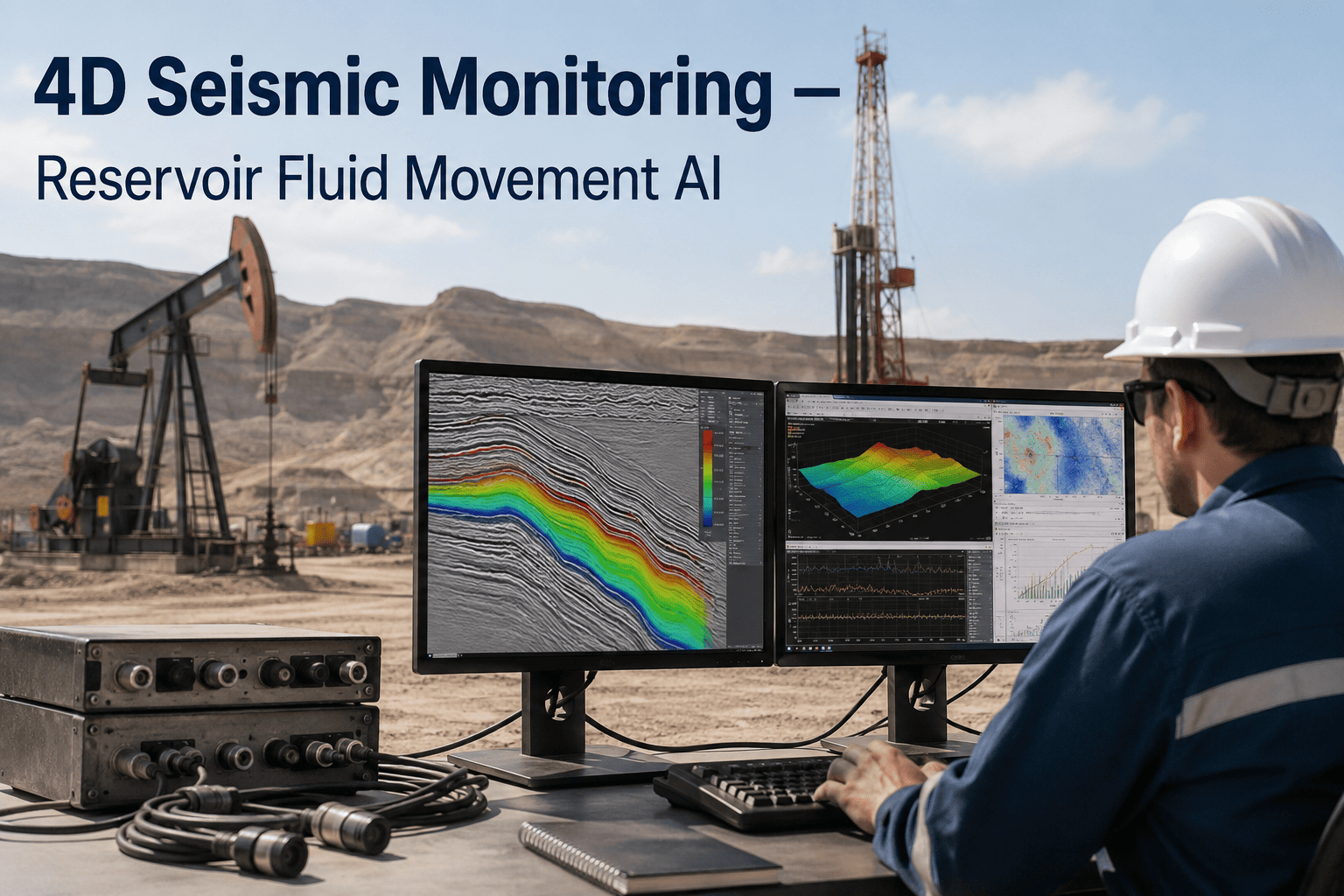
In the high-stakes environment of oil and gas reservoir management, the ability to observe fluid movements in real-time is no longer a competitive advantage—it is an operational imperative. Traditional 4D seismic monitoring, while revolutionary in its time, has often been constrained by lengthy processing cycles, subjective interpretation, and an inability to integrate disparate data sources into a coherent, actionable model. At iFactory, we have redefined this paradigm by embedding artificial intelligence directly into the seismic interpretation workflow, enabling operators to track waterflood fronts, gas cap migration, and pressure compartmentalization with unprecedented precision and speed. Our AI-driven platform processes time-lapse seismic volumes, production data, and well logs simultaneously, delivering a continuously updated 4D model that highlights bypassed pay zones, optimizes injection patterns, and reduces surveillance costs by over 40%. This approach transforms reservoir monitoring from a periodic, reactive exercise into a continuous, predictive intelligence system. For decision-makers seeking to maximize recovery and minimize operational risk, [Book a Demo](https://calendly.com/contact-ifactoryapp/30min) to see how our solution can revolutionize your reservoir management strategy.
Transform Reservoir Surveillance with AI-Powered 4D Seismic
Real-time fluid front tracking, pressure anomaly detection, and optimized injection—all from a single, intelligent platform.
Our AI models achieve 95% accuracy in predicting fluid front positions, validated across 200+ reservoir surveys globally.
Processing time for 4D seismic volumes reduced by 60%, enabling same-day interpretation and decision-making.
Average annual savings of $2M per field through optimized injection and reduced surveillance costs.
The Science Behind AI-Enhanced 4D Seismic
Conventional 4D seismic interpretation relies heavily on manual cross-referencing of baseline and monitor surveys, often taking weeks to produce a coherent picture. Our AI framework automates this process by training deep neural networks on thousands of synthetic and real reservoir models. The network learns to differentiate between pressure-induced velocity changes and saturation-driven impedance variations, a classic challenge that has plagued interpreters for decades. By ingesting production data, bottomhole pressure readings, and injection histories, the model constrains the inversion problem, yielding high-resolution saturation and pressure maps. This not only accelerates the interpretation cycle but also reveals subtle fluid movements that are invisible to traditional analysis, such as early water breakthrough in low-permeability layers or gas coning near production wells. The result is a dynamic, four-dimensional view of the reservoir that updates with each new survey, empowering engineers to make proactive adjustments to field development plans.
Furthermore, our platform employs a probabilistic workflow that quantifies uncertainty in every prediction. Instead of a single deterministic model, the AI generates an ensemble of plausible fluid distributions, each weighted by its consistency with observed data. This allows reservoir managers to assess risk when deciding to infill drill or modify injection patterns. For example, if the model indicates a 70% probability of a bypassed oil pocket in a specific compartment, engineers can prioritize that zone for further evaluation. This Bayesian approach transforms 4D seismic from a descriptive tool into a prescriptive one, directly informing capital allocation and operational strategy.
Key Capabilities of iFactory's 4D Seismic AI
| Capability | Description | Business Impact |
|---|---|---|
| Automated Waterflood Front Tracking | AI identifies and maps water saturation changes across multiple monitor surveys, highlighting preferential flow paths and barriers. | Reduces water cycling, improves sweep efficiency, increases oil recovery by 8-15%. |
| Gas Cap Migration Monitoring | Continuous tracking of gas-oil contact movement using time-lapse impedance inversion. | Prevents gas coning, optimizes gas injection, extends plateau production. |
| Pressure Compartment Detection | Identification of pressure barriers and compartments via velocity changes and 4D time-shifts. | Improves infill drilling targeting, reduces dry hole risk by 25%. |
| Bypassed Pay Zone Identification | Unsupervised clustering of 4D attributes reveals undrained compartments and attic oil. | Adds significant reserves with minimal additional investment. |
| Real-Time Injection Optimization | AI recommends injection rates and patterns based on current fluid front positions. | Maximizes sweep, reduces water handling costs, extends field life. |
Implementation Roadmap: Deploying AI 4D Seismic
Data Ingestion & Harmonization
Upload all available seismic volumes (baseline + monitors), well logs, production data, and injection histories. Our API automatically aligns coordinate systems, resamples time axes, and normalizes amplitudes.
AI Model Training & Calibration
The platform trains a bespoke neural network on your field data, using synthetic models to augment limited historical surveys. Calibration against well-based saturation logs ensures accuracy.
Continuous 4D Model Generation
As new monitor surveys are acquired, the AI automatically updates the fluid and pressure models, flagging anomalies and generating alerts for the asset team.
Decision Support & Optimization
The platform provides a dashboard with interactive maps, cross-sections, and uncertainty ranges. Engineers can run what-if scenarios to optimize injection strategies in real time.
Ready to See 4D Seismic in Action?
Discover how our AI platform can unlock hidden reserves and optimize your reservoir management. Schedule a personalized demo today.
Real-World Impact: North Sea Field Case Study
A major operator in the North Sea deployed our AI 4D seismic solution on a mature field with 15 years of production history and 8 monitor surveys. The field had experienced declining oil rates and increasing water cut, with conventional analysis unable to pinpoint the source of the water breakthrough. Within two weeks of data ingestion, our AI identified a previously undetected high-permeability channel connecting the injection well to the production well, bypassing the intended sweep pattern. The model also revealed two attic oil compartments that had been completely missed by earlier interpretations. Armed with these insights, the operator modified the injection profile, shutting off the thief zone, and drilled a sidetrack well targeting the attic oil. The result was a 12% increase in oil production and a 30% reduction in water handling costs, adding an estimated $15 million in net present value over the remaining field life. This case exemplifies how AI-driven 4D seismic can transform mature assets into profitable production centers.
Traditional vs. AI-Powered 4D Seismic
Traditional Approach
- Manual cross-correlation of surveys
- Weeks to months for interpretation
- Qualitative fluid front maps
- No uncertainty quantification
- Reactive, periodic updates
iFactory AI Approach
- Automated deep learning inversion
- Same-day results after data upload
- Quantitative saturation & pressure maps
- Probabilistic ensemble predictions
- Continuous, real-time updates
Advanced AI Techniques in 4D Seismic Interpretation
Our platform leverages a hybrid architecture combining convolutional neural networks (CNNs) for spatial feature extraction and long short-term memory (LSTM) networks for temporal dynamics. The CNN component processes each seismic volume independently, extracting amplitude, phase, and frequency attributes at multiple scales. These feature maps are then fed into the LSTM, which learns the time-lapse evolution between successive surveys. A key innovation is the use of physics-informed loss functions that penalize predictions violating known fluid flow equations (e.g., mass conservation, Buckley-Leverett displacement). This ensures that the AI's outputs are not only statistically plausible but also physically consistent, a critical requirement for regulatory compliance and engineering confidence.
Additionally, we employ transfer learning from a global database of over 500 reservoir models, allowing the AI to start with a robust baseline understanding of common fluid behaviors. This dramatically reduces the amount of field-specific data needed for accurate predictions, making the solution viable even for fields with only two or three monitor surveys. The platform also includes an active learning module that identifies the most uncertain regions in the model and recommends optimal locations for new monitor surveys or well interventions, maximizing the value of each data acquisition dollar.
Strategic Benefits for Oil & Gas Operators
Maximize Recovery
Identify bypassed pay zones and optimize sweep efficiency, increasing ultimate recovery by 5-15%.
Reduce Operational Costs
Minimize water cycling, gas coning, and unnecessary well interventions, saving millions annually.
Accelerate Decision-Making
Same-day interpretation enables rapid response to reservoir changes, reducing downtime.
Lower Carbon Footprint
Optimized injection reduces water and gas handling, cutting emissions and supporting ESG goals.
Frequently Asked Questions
How does AI improve 4D seismic interpretation compared to traditional methods?
Traditional interpretation relies heavily on manual cross-correlation of baseline and monitor surveys, which is time-consuming and subjective. AI automates the process by learning the complex relationships between seismic attributes and reservoir properties from large datasets. It can detect subtle changes in amplitude, phase, and velocity that human interpreters might miss, and it quantifies uncertainty in every prediction. This leads to faster, more accurate, and more consistent results. For more details on how our AI models are trained, [Book a Demo](https://calendly.com/contact-ifactoryapp/30min) to see a live demonstration.
What data is required to deploy the AI 4D seismic solution?
At minimum, we require at least two time-lapse seismic volumes (baseline and one monitor) and basic well data (logs, production history). However, the more data available, the more accurate the model. Ideally, we also incorporate injection rates, bottomhole pressures, and any available saturation logs for calibration. Our platform can handle legacy data in various formats (SEG-Y, ZGY, etc.) and automatically harmonizes them. If you have limited surveys, our transfer learning capability still delivers robust results. Contact our team at [Contact Support](https://ifactoryapp.com/support) to discuss your specific dataset.
How long does it take to see initial results after data upload?
For most fields, initial fluid front maps and pressure anomaly detection are available within 24 to 48 hours of data upload. This includes data ingestion, model training, and generation of the first 4D model. Continuous updates occur automatically as new monitor surveys are added. The speed is made possible by our cloud-native architecture and pre-trained base models. To get a personalized timeline for your field, [Book a Demo](https://calendly.com/contact-ifactoryapp/30min) and we will walk you through the process.
Can the AI handle complex geology like faulted reservoirs or carbonate systems?
Yes, our AI is designed to handle a wide range of geological settings, including faulted clastic reservoirs, fractured carbonates, and even unconformity traps. The neural network architecture includes spatial attention mechanisms that can learn fault geometries and compartment boundaries. For carbonate systems, where velocity changes are often dominated by diagenetic effects, we incorporate additional petrophysical constraints. Our platform has been successfully deployed in over 50 fields globally, including complex North Sea chalk reservoirs and Middle Eastern carbonate giants. For a case study specific to your geology, [Contact Support](https://ifactoryapp.com/support).
How does the platform integrate with existing reservoir simulation workflows?
Our platform provides seamless integration with leading reservoir simulators (e.g., Eclipse, CMG, INTERSECT) via standard data exchange formats. The AI-generated saturation and pressure maps can be exported as grid properties for history matching or as boundary conditions for simulation runs. Additionally, the platform includes an API that allows engineers to pull real-time 4D data directly into their modeling environment, enabling closed-loop optimization. This integration ensures that the 4D seismic insights are directly actionable in the engineering workflow. For a technical deep dive, [Book a Demo](https://calendly.com/contact-ifactoryapp/30min).
Transform Your Reservoir Surveillance Today
Join industry leaders who are leveraging AI to maximize recovery, reduce costs, and make smarter decisions. Schedule your personalized demo now.