A coke drum running two hours past its optimal switch point does not announce itself with an alarm. It shows up months later as a bulged shell, a stuck unheading valve, or a liquid yield that quietly drifted below where the unit's design case said it should sit. Delayed cokers are the only semi-batch process in a modern refinery, and that structure — one heater feeding two drums that trade places every 16 to 18 hours — is exactly why conventional control keeps losing ground on both fronts at once. Getting heater outlet temperature, drum pressure, and switching sequence right, shift after shift, is what separates top-quartile coker performance from average, and it is the problem iFactory's process AI platform was built to close.
DELAYED COKING · REFINERY AI · DRUM SWITCHING LOGIC
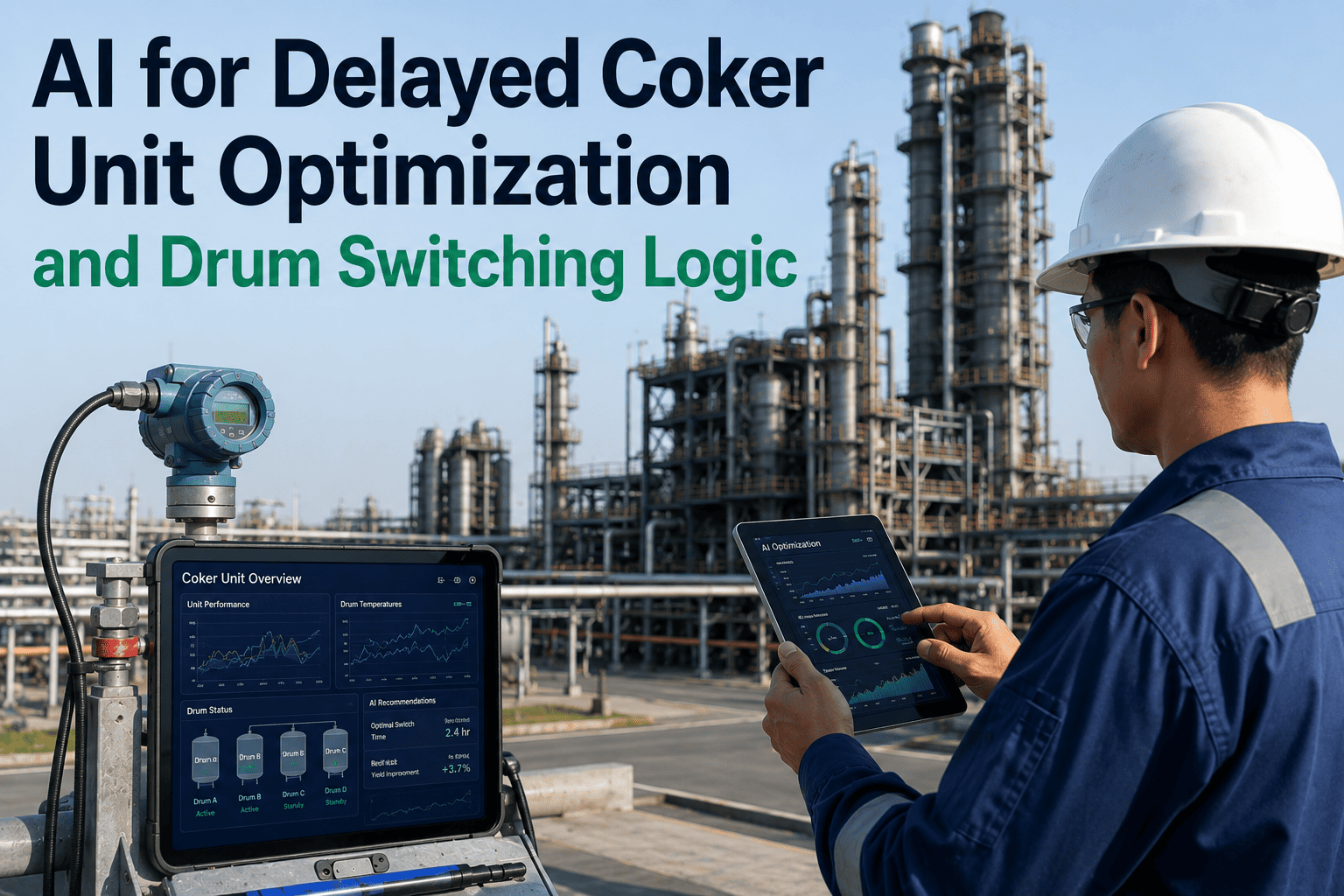
AI for Delayed Coker Unit Optimization and Drum Switching Logic
Heater outlet temperature, coke drum fill level, and switching sequence decide how much liquid a coker recovers from every barrel of resid. See how AI models coordinate those variables continuously, without trading away drum life for yield.
Why a Coker Is the Hardest Unit in the Refinery to Tune
Most refinery units run continuously, and a linear or model-predictive controller built around steady-state assumptions handles them well. A delayed coker never reaches true steady state. Feed is switched between two drums on a rolling cycle, and every switch sends a pressure and temperature disturbance straight through the fractionator, the heater, and the downstream gas plant at once. A controller tuned for the "quiet" middle of a fill cycle is fighting the wrong dynamics during the ten or fifteen minutes around a switch, which is precisely when foaming, over-pressure, and carryover risk are highest.
Operators compensate by running conservatively — a wider pressure margin, a lower heater outlet setpoint than the metallurgy technically allows, a cycle time padded past the point that maximizes throughput. Each of those margins is a small, permanent tax on liquid yield. Individually they look minor. Stacked across a 30,000 to 60,000 barrel per day coker, running weeks or months at a time, they add up to real margin left on the table, and it is margin that shows up nowhere on a single day's report because it is the absence of an optimization no one is actively running.
There is also a staffing reality behind the conservatism. A coker cycle plays out over roughly a day, which means the same switch is handled by three or four different shift teams over the course of a week, each with its own read on how tight the margins can safely run. Without a shared, continuously updated model of where the unit actually sits relative to its limits, the unit ends up operating to whichever shift's judgment is most cautious, not to the tightest margin the equipment and chemistry could actually support. That is a coordination problem as much as a control problem, and it is one AI is particularly well suited to close because a model does not have shift-to-shift variability — it applies the same learned relationships every single cycle, day or night.
What Coker Optimization Is Actually Worth
$0.50–$1.00
per barrel margin recoverable through better coker value-chain optimization at a mid-size refinery
16–18 hrs
typical drum cycle time — stretching from 16 to 18 hours drops relative unit capacity to roughly 89 percent
2 Drums
operating in parallel on every cycle, one filling online while the other is stripped, cooled, decoked, and warmed up
Double-Digit
gas oil yield improvement achievable by lowering oil partial pressure under the right operating conditions
Four Variables That Actually Move Liquid Yield
Delayed coker yield is not controlled by one setpoint — it is the combined outcome of four variables that interact continuously, and that interaction is exactly what a rules-based controller struggles to track. AI models trained on site-specific cycle history learn how these four levers move together on a given unit, rather than applying a generic relationship pulled from a textbook correlation.
Lever 01
Heater Outlet Temperature
Coil outlet temperature sets the severity of thermal cracking before feed ever reaches the drum. Push it too high and coke yield climbs along with fouling risk in the heater tubes; hold it too conservatively and liquid conversion is left unrealized. AI models track fouling trends in near real time and adjust the target within safe metallurgical limits instead of holding a fixed setpoint for the whole run length.
Lever 02
Coke Drum Operating Pressure
Lower drum pressure consistently improves liquid yield at a given recycle ratio and CCR content, but pushing pressure down raises the risk of foaming and overhead line carryover during a switch. AI optimization narrows the pressure band dynamically around each switch event rather than carrying one static margin through the entire cycle.
Lever 03
Overhead Quench Rate
Quench oil injected into the vapor line prevents coke formation and keeps the line wetted, but overquenching promotes recycle back into the drum and quietly erodes liquid yield. Monitoring the delta-T between the drum top and the downstream vapor line lets an AI model hold quench at the minimum rate that still protects the line.
Lever 04
Recycle Ratio
The ratio of recycle to fresh feed directly sets coke yield for a given CCR content. Cutting recycle raises liquid yield but shifts more conversion duty onto the heater and drum, so this lever cannot be adjusted in isolation — it has to move in coordination with outlet temperature and drum pressure, which is where a model that sees all four variables together earns its keep, rather than treating recycle as a fixed ratio set once at the start of a run and left untouched.
None of these four levers behaves the same way twice, because feed quality is never quite constant. A shift in vacuum residue API gravity or CCR content changes how the same heater outlet temperature and recycle ratio translate into coke versus liquid yield, which is why a static lookup table or a fixed correlation loses accuracy over time. Models trained continuously on live feed assay data and cycle outcomes keep adjusting the relationship between these four levers as feed quality drifts, instead of requiring an engineer to manually re-tune the control strategy every time crude slate or resid quality shifts.
See What AI-Coordinated Drum Switching Looks Like on Your Unit
iFactory models heater outlet temperature, drum pressure, quench rate, and recycle ratio together, continuously, so switching decisions are made with the full picture instead of one variable at a time.
Inside an AI-Coordinated Drum Switch, Step by Step
A drum switch is the single riskiest ten to fifteen minutes of a coker cycle. Feed moves from a full, hot drum to an empty, warmed drum, and every downstream system feels the disturbance at once. The sequence below shows where AI models add coordination that a fixed-logic switch controller cannot.
1
Fill Level and Foam Front Tracking
Nuclear or guided-wave level instruments track the coke bed and foam front inside the online drum. AI models trained on prior cycles predict how close the fill level is to the switch trigger, factoring in feed rate and recycle ratio changes made earlier in the cycle rather than reading the instrument in isolation, which gives the board operator a more reliable heads-up window before the actual switch decision has to be made.
2
Standby Drum Warm-Up Coordination
The offline drum is steam-warmed ahead of switch time so it can accept hot feed without a thermal shock. Timing the warm-up against the predicted fill point — instead of a fixed clock schedule — keeps the standby drum ready exactly when needed without holding steam flow longer than necessary.
3
Pressure Equalization Before Switch
Equalizing pressure between the filling and standby drums before feed transfer reduces the shock the fractionator sees at switch time. AI-coordinated sequencing adjusts the equalization rate based on current overhead pressure and quench conditions rather than a single fixed ramp rate applied to every switch regardless of conditions.
4
Feed Transfer and Heater Compensation
As feed moves to the new drum, the heater outlet temperature is compensated in real time to hold conversion severity steady through the transition, offsetting the momentary drop in coil velocity that a switch naturally creates.
5
Full Drum Steam-Strip and Cooling Handoff
The now-full drum begins steam stripping and water cooling on a schedule the model adjusts based on observed fouling severity from the completed cycle, rather than a flat duration applied to every batch of coke regardless of how the cycle actually ran.
Conventional Control vs. AI-Coordinated Optimization
The table below reflects the practical gap between fixed-logic coker control and AI models trained continuously on site-specific cycle data, based on documented coker optimization deployments across mid-size and large delayed coking units. The differences look incremental variable by variable, but because a coker cycle repeats hundreds of times a year, small per-cycle improvements compound into a substantial annual swing in both yield and drum reliability metrics.
Delayed Coker Control Approach Comparison
| Operating Variable | Conventional Control | AI-Coordinated Control |
|---|---|---|
| Response to fouling progression | Fixed setpoint held until manual review | Continuous adaptation as fouling trend changes |
| Drum switch coordination | Single fixed sequence and timing | Sequence adjusted to real-time fill and pressure data |
| Pressure margin | Static margin held for full cycle | Margin narrowed dynamically outside switch windows |
| Cycle time consistency | Varies by operator and shift | Held consistent against a model-predicted optimum |
| Yield visibility | Reviewed after the fact, batch by batch | Predicted and tracked continuously through the cycle |
What Goes Wrong When Switching Logic Runs on Fixed Rules
Most coker reliability incidents trace back to one of a small number of recurring switch-related failure modes. Understanding why they happen makes it clearer why coordinated, continuously adapting control closes the gap that a fixed-logic sequence cannot.
Failure 01
Foam-Over and Overhead Carryover
When the foam front inside the online drum is misjudged, feed continues past the safe fill point and foam carries into the overhead line, fouling the fractionator and forcing an unplanned shutdown for cleanout. Fixed-logic switch triggers rely on a single level reading rather than a trend, so they tend to catch this only after it has already started.
Failure 02
Cold Feed Shock to the Standby Drum
If the offline drum has not been warmed sufficiently before the switch, hot feed hitting cold steel creates thermal shock that accelerates fatigue cracking over repeated cycles. A fixed warm-up timer does not account for how long the previous cooling cycle actually ran, so it can hand off a drum that is not truly ready.
Failure 03
Pressure Spikes at Switch Initiation
Switching feed between drums without adequate pressure equalization sends a sharp pressure spike through the fractionator, which can trip relief devices and upset downstream gas plant operation. Fixed sequences apply the same equalization ramp regardless of the actual pressure differential at the moment of switch.
Failure 04
Conversion Dip Through the Transition
Heater coil velocity drops momentarily during a switch, and if outlet temperature is not compensated for that change, conversion severity dips for several minutes, quietly lowering the average liquid yield for that entire cycle without ever tripping an alarm.
Where the Yield and Reliability Gains Actually Come From
The gains below are not one-time step changes captured during a commissioning honeymoon period. They come from the model continuing to tighten its predictions cycle after cycle as it accumulates more operating history, which is why sites typically see the strongest incremental improvement in the first two to three months after go-live before results settle into a stable, sustained baseline.
Liquid Yield Recovery
Coordinated pressure, quench, and recycle management captures the liquid yield that static margins otherwise leave behind, without requiring capital changes to vapor line sizing or drum metallurgy.
Reduced Thermal Fatigue on Drums
Consistent, model-guided quench and warm-up timing reduces the aggressive quenching cycles that accelerate thermal fatigue and shorten drum inspection intervals.
Cycle Time Consistency Across Shifts
Switch timing tied to model-predicted fill state rather than operator judgment closes the variability gap between shifts, so cycle length stops depending on who is on the board.
Fewer Foaming and Carryover Events
Predictive tracking of the foam front and pressure equalization ahead of a switch reduces the overhead carryover events that force conservative pressure operation in the first place.
What a Coker AI Deployment Needs From Your Site
Coker optimization AI performs only as well as the data and process context it is trained on. These are the readiness items that determine whether a deployment starts delivering yield gains in weeks or stalls waiting on missing instrumentation. Teams that walk through this checklist before committing budget consistently reach first-value milestones faster than teams that discover the gaps mid-deployment.
Historical Cycle Data Depth
Models trained on a full range of feed qualities, seasons, and fouling states generalize far better than models built on a few clean cycles. At least several months of continuous historian data gives the model enough variation to learn from.
Reliable Drum Level Instrumentation
Fill level and foam front tracking accuracy directly limits switch timing accuracy. Nuclear or guided-wave level gauges in good calibration are a prerequisite, not a nice-to-have.
Heater Fouling and Metallurgy Limits Documented
The model needs explicit upper bounds on coil outlet temperature and tube skin temperature so optimization never operates outside the limits your inspection and metallurgy teams have already set.
Operations Sign-Off on Switch Authority
Decide up front how much switch-timing authority the model has versus the board operator, and where the handoff between advisory recommendations and closed-loop action sits for your unit. Documenting this authority split before go-live avoids ambiguity during the first few live switches, when trust between the operations team and the model is still being established.
Downstream Fractionator and Gas Plant Constraints
Yield gains at the coker have to respect downstream capacity limits in the fractionator and gas plant, so those constraints need to be modeled alongside the coker itself, not treated as a separate exercise. A yield increase that overwhelms a downstream bottleneck simply shifts the constraint elsewhere in the unit rather than delivering the margin improvement it was meant to capture.
A Named Process Owner for the Model
Deployments that sustain their gains have one process engineer accountable for reviewing model recommendations, flagging drift, and feeding operating changes back into retraining.
AI for Delayed Coker Optimization — Common Questions
Does AI optimization replace the coker's existing DCS or APC layer?
No. AI optimization sits on top of the existing distributed control system and advanced process control layer, providing setpoint recommendations or supervisory adjustments rather than replacing the underlying regulatory control. The DCS continues to execute safety interlocks and base-layer control exactly as it does today, while the AI layer coordinates the higher-level decisions around heater temperature, drum pressure, and switch timing that traditional APC treats as separate, disconnected loops. This layered approach also means the existing control system's safety case does not need to be re-validated from scratch, since the interlocks and trip logic that operations and process safety teams already trust remain untouched.
How much liquid yield improvement is realistic for a typical coker?
Documented coker optimization programs report meaningful margin recovery in the range of $0.50 to $1.00 per barrel for a mid-size refinery, driven primarily by reduced pressure and quench margins and more consistent cycle timing. The exact figure depends heavily on how conservatively the unit currently operates — a coker already running tight margins will see smaller gains than one carrying wide safety buffers built up over years of shift-to-shift variability. A site-specific baseline assessment against your own historian data is generally the most reliable way to size the opportunity before committing to a full deployment.
What data does the model need before it can generate useful recommendations?
At minimum, continuous historian data covering heater outlet temperature, drum pressure, level instrumentation, quench flow, and recycle ratio across a representative range of feed qualities and seasons. The more cycle-to-cycle variation the training data captures, the better the model generalizes to conditions it has not seen in exactly that combination before. Teams that are unsure what data they already have available can work through that assessment directly with iFactory's support team before committing to a deployment timeline.
Can this be deployed on an older coker without new instrumentation?
Many older cokers already have the core instrumentation needed — level gauges, pressure transmitters, and heater thermocouples — even without a modern APC layer sitting on top of them. Gaps typically show up around foam front detection or vapor line delta-T monitoring rather than the base measurements, and those gaps can usually be closed with targeted instrumentation upgrades rather than a full control system replacement. A short instrumentation audit at the start of the project is usually enough to scope exactly what needs to be added before any modeling work begins, which keeps the overall project timeline predictable.
How long does it take to see results after go-live?
Most deployments run an initial advisory period of several weeks where the model's recommendations are compared against operator decisions before any closed-loop authority is granted. Measurable yield and consistency gains typically become visible within one to two months once the model has observed enough live cycles to refine its predictions against real operating conditions on that specific unit. The advisory period also gives the operations team time to build trust in the recommendations before any switch-timing authority moves from the board operator to the model, which tends to make the eventual transition to closed-loop operation much smoother.
DELAYED COKING · YIELD OPTIMIZATION · DRUM RELIABILITY
Coordinate Every Coker Variable, Every Cycle
iFactory brings heater temperature, drum pressure, switching sequence, and quench management into one continuously learning model, so liquid yield gains don't depend on which shift is on the board.