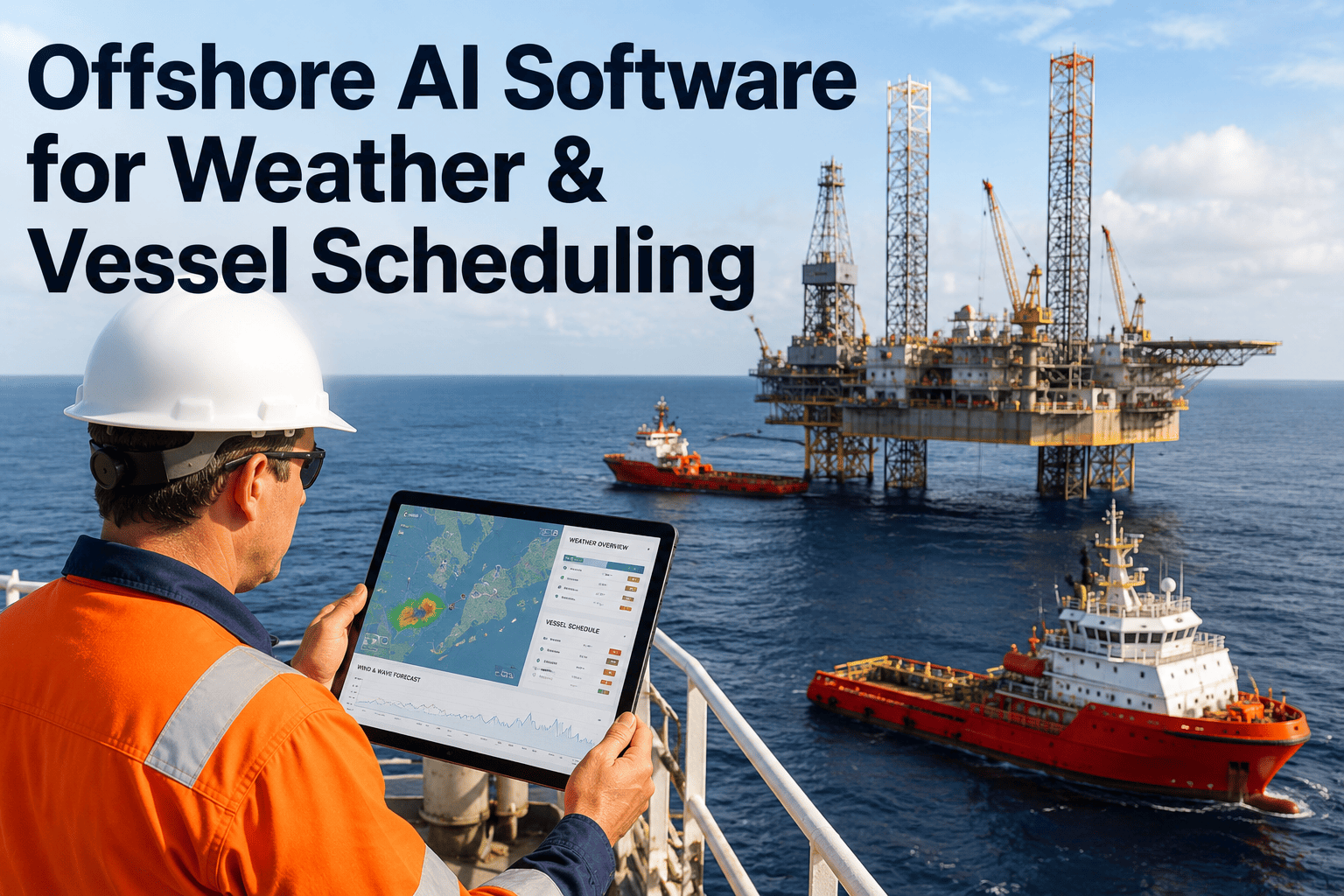
A single day of weather-related downtime on an offshore vessel can cost $500,000 or more, and that number climbs fast when a marginal call turns into a missed window and a full crew standing by with nothing to do. Every offshore operation, crane lifts, diving, helicopter transfers, cargo transfers, carries its own weather sensitivity, and a sea state that's perfectly fine for one task can shut down another entirely. Most offshore schedules are still built around a single forecast review each morning, a judgment call made against a wave height number that may already be stale by the time the crew mobilizes. AI software built for offshore weather window optimization closes that gap by continuously modeling forecast uncertainty against each specific operation's actual limits, not just a single significant wave height threshold. Operators can see how that maps to their own vessel schedule by reaching out to iFactory support.
Every Operation Has a Different Weather Limit. Most Schedules Only Track One.
iFactory's AI models forecast uncertainty against the specific Hs, wind, and current limits for each planned operation, crane lifts, diving, helicopter flights, cargo transfers, so vessel schedules get built around real, defensible weather windows instead of a single morning forecast check.
Four Operations, Four Different Weather Tolerances
A single "go/no-go" weather call treats every task on the vessel schedule the same way, but crane lifts, diving, helicopter flights, and cargo transfers each have their own limiting sea state and wind parameters, and planning against only one of them either wastes safe working time or risks pushing another operation past its actual limit.
Crane Lifts
Governed primarily by significant wave height and wave peak period, with the limit shifting sharply depending on payload, sling arrangement, and whether the crane uses heave compensation.
Diving Operations
Sensitive to swell height, current speed, and underwater visibility, often with tighter tolerances than surface operations since diver safety margins are narrower.
Helicopter Flights
Driven by wind speed, gusts, visibility, and deck motion limits on the receiving platform, independent of the sea state limits governing marine lifts happening at the same time.
Cargo and Supply Transfers
Constrained by relative vessel motion during ship-to-ship or ship-to-platform transfer, which depends on wave direction and period as much as raw wave height.
How a Real Weather Window Gets Calculated
A workable weather window isn't just "the forecast looks fine right now." Marine operations standards require the forecast to hold below the operational limit for a full reference period, and a contingency factor is applied to account for forecast uncertainty.
| Concept | What It Means | Why It Matters for Scheduling |
|---|---|---|
| Reference Period | Weather must hold within limits for roughly three times the planned operation duration | A short calm spell isn't a valid window if it doesn't cover the full margin required |
| Alpha Factor | A contingency multiplier, typically 0.51 to 0.85, applied to the design wave height based on forecast lead time and operation duration | Longer operations and longer lead times require a more conservative operating limit |
| Wave Period Limits | Avoiding resonance between wave period and the crane or vessel system's natural period | A low Hs reading can still be unsafe if the wave period matches the equipment's resonant frequency |
See Your Vessel Schedule Modeled Against Real Weather Window Math
iFactory can walk through how your planned lifts, dives, and transfers map to alpha-factor-adjusted weather windows before your team commits to a rollout.
Morning Forecast Check vs. Continuous AI Window Modeling
| Capability | Single Daily Forecast Review | AI-Driven Continuous Modeling |
|---|---|---|
| Operation-specific limits | Usually one go/no-go call applied across all tasks | Separate limits modeled per operation type against live forecast data |
| Forecast uncertainty | Rarely quantified beyond a general confidence statement | Alpha factor and reference period applied systematically to every window |
| Schedule adjustment speed | Reassessed once per shift or once per day | Updated continuously as new forecast data arrives |
| Vessel utilization | Conservative, standby time absorbs uncertainty | Optimized against the actual, quantified window rather than a worst-case guess |
What the AI Model Actually Tracks for Your Fleet
Per-Operation Limit Modeling
Crane, diving, helicopter, and cargo limits are tracked as distinct thresholds, so one operation's go call doesn't get treated as blanket clearance for another.
Forecast Uncertainty Quantification
Alpha factors and reference periods are applied automatically based on operation duration and forecast lead time, rather than relying on a single point-in-time reading.
Multi-Vessel Schedule Optimization
Predicted windows across the fleet are sequenced to minimize standby time, prioritizing operations against the windows most likely to hold.
Continuous Window Re-Evaluation
As new forecast data arrives, predicted windows update automatically, flagging when a planned operation's margin is shrinking before the crew mobilizes.
A Composite Scenario: The Lift That Didn't Wait an Extra Day
An offshore operator had a subsea crane lift scheduled during a stretch of marginal North Sea weather, with a morning forecast review showing Hs hovering right around the uncompensated 1.5m limit, historically enough to call off the operation and hold the vessel on standby for a clearer day. After connecting live forecast data, wave period, and the crane's heave-compensated rating to a predictive model, the system identified a 14-hour window later that day where Hs was expected to stay within the compensated 2.5m limit for the full required reference period.
The lift proceeded that afternoon instead of the following day, and the vessel avoided a full standby day at its contracted day rate. The forecast held within the predicted window's alpha-factor margin for the entire operation, and the lift was completed roughly a full day earlier than the conservative single-forecast approach would have allowed.
Rolling AI Weather Window Modeling Out Across a Fleet
Define Limits for Each Operation Type
Hs, wind, current, and wave period limits are documented for crane lifts, diving, helicopter operations, and cargo transfers specific to the equipment and vessels in use.
Connect Forecast and Vessel Motion Data
Live weather forecast feeds and vessel motion sensor data become the model's continuous input, updating as new forecast cycles arrive.
Validate Predicted Windows Against Real Operations
Predicted go/no-go windows are checked against actual outcomes for a set of real lifts and transfers before the schedule relies on them fully.
Expand to Fleet-Wide Schedule Optimization
Once validated, the model sequences operations across every vessel in the fleet to minimize standby time and maximize workable window use.
Common Mistakes Offshore Operators Make With Weather Scheduling
Applying One Weather Call to Every Operation
Treating a single go/no-go decision as blanket clearance ignores that diving, helicopter, and crane operations each have different limiting conditions.
Ignoring Wave Period in Favor of Height Alone
A low significant wave height reading can still be unsafe if the wave period resonates with the crane or vessel system's natural frequency.
Skipping the Reference Period Requirement
A brief calm spell that doesn't cover the full required reference period isn't a valid window, even if conditions look fine at the moment the operation starts.
Reassessing Weather Only Once Per Shift
Forecasts update multiple times a day, and a schedule built on a single morning check can miss both closing windows and newly opened ones.
Frequently Asked Questions
What determines the weather limit for an offshore crane lift?
Crane lift limits are typically set by significant wave height and wave peak period, with the specific threshold depending on crane capacity margin, payload weight, sling arrangement, and whether heave compensation is used. Uncompensated subsea lifts commonly operate within an Hs limit of roughly 1.0 to 1.5 meters, while a heave-compensated lift can often proceed up to 2.5 to 3.5 meters under the same conditions. A team can review how these limits apply to their specific crane and vessel configuration by contacting iFactory support.
What is a weather window, and why isn't it just "the forecast looks calm today"?
A weather window is a continuous period during which sea conditions stay within an operation's defined limits for long enough to complete the work safely, typically requiring the forecast to hold for roughly three times the planned operation duration. Marine operations standards also apply an alpha factor, a contingency multiplier that adjusts the design wave height downward to account for forecast uncertainty, with more conservative factors used for longer operations and longer forecast lead times. A single calm reading doesn't confirm a valid window unless it holds for the full required duration with that margin applied.
Why can diving or helicopter operations be cancelled even when a crane lift is cleared to proceed?
Each operation type has its own limiting parameters that don't move together. Diving is governed largely by swell, current, and visibility, helicopter flights depend on wind speed, gusts, and deck motion, and crane lifts depend primarily on wave height and period. A sea state that clears one operation's threshold can easily exceed another's, which is why a single blanket weather call across a vessel schedule tends to either overly restrict some operations or under-protect others.
Do we need new forecasting or vessel sensor hardware to use this kind of scheduling model?
Most offshore operations already receive weather forecast feeds and collect vessel motion data through existing systems, and that data is what the predictive model uses as its primary input. The model applies operation-specific limits and uncertainty factors on top of existing forecast and motion data rather than requiring new instrumentation. Book a demo to see how a rollout maps to your current forecast and vessel data sources.
How much does weather-related standby time actually cost an offshore operation?
Vessel day rates of $500,000 or more are common in offshore heavy-lift and marine operations, which means every unnecessary standby day represents a substantial direct cost on top of any schedule delay to the broader project. Because the decision to proceed on a marginal weather window is one of the harder judgment calls in offshore planning, having a systematic, quantified way to evaluate that window matters as much for cost control as it does for safety.
Stop Making a $500,000-a-Day Decision Off One Morning Forecast Check
iFactory models weather windows for every operation on your vessel schedule, crane lifts, diving, helicopter flights, and cargo transfers, so scheduling decisions are backed by continuously updated, quantified data.