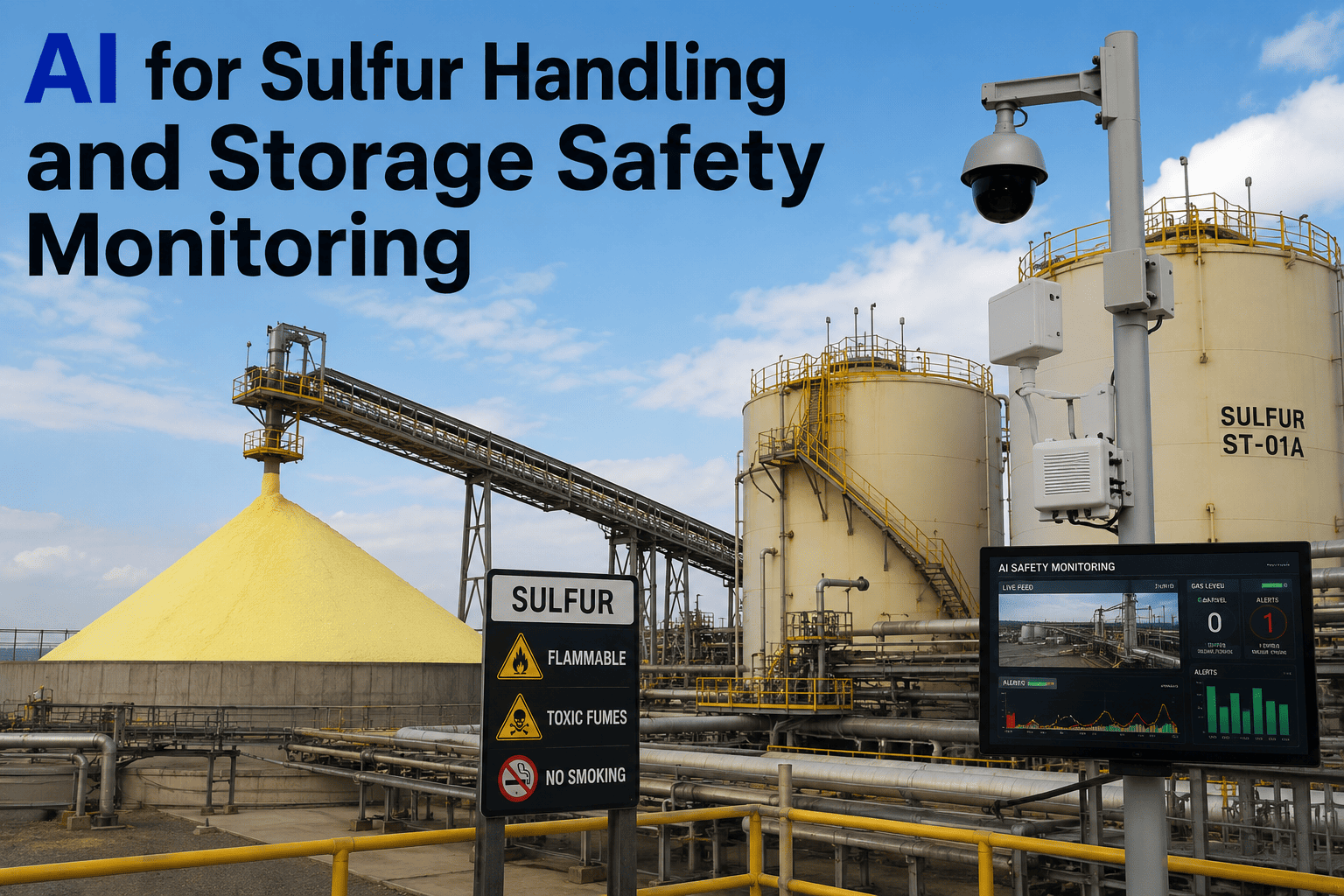
Molten sulfur looks harmless in a storage pit — a dull yellow liquid sitting quietly at a controlled temperature. It is also the source of one of the more overlooked hazard chains in a gas plant: let it cool unevenly, let ventilation lapse, or let a degassing unit drift out of spec, and hydrogen sulfide can accumulate in spaces workers walk through every shift. iFactory's sulfur handling safety monitoring watches every variable in that chain continuously, so a slow drift never becomes the incident report nobody saw coming.
The Hazard in a Sulfur Pit Isn't the Sulfur. It's the Gas You Can't See Coming Off It.
Molten sulfur storage, degassing, and solidification each carry a distinct H2S and SO2 release pathway — and each one is preventable with continuous monitoring instead of a periodic gas check.
Three Hazard Pathways, One Storage Pit
Sulfur handling safety is not a single risk with a single alarm setpoint. It is three overlapping hazard pathways that each need their own monitoring logic, and a plant that only watches one of them is only partially protected.
Molten Sulfur Temperature Control
Sulfur held outside its narrow liquid-phase temperature band either solidifies unpredictably, creating handling and pumping hazards, or overheats toward the temperature range where H2S generation accelerates inside the melt itself.
Degassing Unit Performance
Degassing units exist specifically to strip dissolved H2S from molten sulfur before it reaches storage or transport. A degassing unit running below its design efficiency sends under-treated sulfur downstream, where the dissolved gas releases later, somewhere less controlled.
Pit Ventilation & SO2 Off-Gas
Sulfur pit ventilation systems are the last line of defense for both H2S and SO2 concentrations in the workspace above and around storage. A ventilation system running below design airflow may show no immediate alarm while concentrations climb toward the exposure limit.
How Continuous Monitoring Closes the Gap a Periodic Check Leaves Open
The standard approach to sulfur pit safety is a combination of fixed-point gas detectors and periodic manual surveys — a technician walking the pit perimeter with a handheld meter on a set schedule. Both are necessary, and neither is sufficient on its own. A fixed detector only sees its own location; a manual survey only sees the moment it happens to occur. A slow ventilation degradation between two scheduled surveys, or a degassing unit drifting off spec between two manual checks, can develop for hours without triggering either safeguard.
Continuous multi-point gas monitoring
H2S and SO2 sensor readings across the pit, degassing unit, and surrounding work areas are tracked continuously rather than sampled, so a rising trend is visible in the minutes it starts, not the hours it takes to become an alarm event.
Temperature and level correlation
Molten sulfur temperature and pit level are correlated against gas concentration trends, so the model can distinguish a normal transient from a developing condition that needs intervention before concentration alone would flag it.
Degassing efficiency tracking
Inlet and outlet dissolved H2S measurements around the degassing unit are tracked against design efficiency targets, surfacing gradual performance decline long before under-treated sulfur reaches storage in volume.
Ventilation performance verification
Airflow rate and pattern across the pit ventilation system are checked against design specification continuously, catching fan degradation, ducting obstruction, or damper drift before it shows up as a concentration alarm.
Early warning to the right team
A developing condition triggers a graduated alert — informational at the earliest drift, escalating as the trend continues — routed to operations and safety teams before it reaches a level requiring evacuation or emergency response.
| Monitored Variable | What a Slow Drift Looks Like | What It Precedes If Missed |
|---|---|---|
| Molten sulfur temperature | Gradual rise above optimal liquid-phase band | Accelerated H2S generation within the melt |
| Degassing unit outlet H2S | Slow decline in stripping efficiency | Under-treated sulfur reaching storage or transport |
| Pit ventilation airflow | Fan or damper performance degrading | H2S/SO2 accumulation in occupied work areas |
| Pit ambient H2S concentration | Slow baseline creep between scheduled surveys | Exposure limit exceedance during routine work |
| Solidification event indicators | Unplanned temperature drop in a pit zone | Trapped gas release during re-melt or handling |
A Sulfur Pit Incident Is Never the First Data Point — It's the Last One Nobody Caught
iFactory correlates temperature, degassing performance, and gas concentration continuously, so a developing hazard is flagged while it's still a maintenance item, not an evacuation.
A Composite Scenario: Catching a Degassing Drift Before It Reaches Storage
Consider a gas plant where the sulfur degassing unit has been running slightly below its commissioned efficiency for several weeks — nothing dramatic, no alarm triggered, just a slow decline that a monthly performance review would eventually catch on a trend chart, weeks after it started. Under a periodic-check regime, this drift is invisible until either the monthly report flags it or, less fortunately, a downstream H2S release event during sulfur transport forces an investigation that traces back to the degassing unit.
Under continuous monitoring, the model correlates degassing outlet H2S against design targets every shift rather than every month. It flags the efficiency decline within days, well before under-treated sulfur has accumulated in meaningful volume downstream, and routes the finding to the process team with the specific trend data attached — not a generic "check the degasser" alert, but the actual efficiency curve showing exactly when the decline started and how fast it's progressing. The unit gets attention during a planned maintenance window, on the team's schedule, instead of during an incident response, on nobody's schedule.
Building Sulfur Safety Around Leading Indicators, Not Lagging Ones
Most sulfur handling safety programs are built around lagging indicators by default — an alarm that trips once concentration crosses a threshold, an incident report filed after an exposure event, a near-miss log reviewed monthly. These are necessary, but they are all downstream of the actual hazard developing. A leading-indicator program watches the variables that predict concentration before concentration itself moves: temperature trend, degassing efficiency trend, ventilation performance trend. By the time a lagging indicator fires, the leading indicators have usually been signaling for hours or days.
Who Should Own the Monitoring Program
Sulfur safety monitoring works best as a shared responsibility between process operations, who understand degassing and temperature control, and EHS, who own exposure limits and incident response protocols. Neither group alone has full visibility into both the process chemistry and the safety threshold context.
Realistic Alert Review Cadence
Early-stage drift alerts should be reviewed same-shift, not batched into a weekly safety meeting — the entire value of a leading indicator is lost if it sits in a queue as long as the lagging indicator it was meant to preempt.
Common Mistake: Treating Fixed Detectors as Sufficient
Fixed-point gas detectors remain essential, but relying on them alone means the plant only learns about a problem once concentration has already risen at that specific location — the correlation with temperature and degassing performance is what provides the earlier warning.
Common Mistake: Siloing Degassing Data From Ventilation Data
Degassing performance and pit ventilation are usually monitored by different systems with no shared view. Correlating them is what reveals compound risk — a slightly under-performing degasser combined with slightly reduced ventilation is a materially different risk level than either issue alone.
The Seasonal Pattern Most Programs Miss
Sulfur pit safety risk doesn't hold steady across the year. Ambient temperature swings affect molten sulfur cooling rates at the pit surface, ventilation system performance shifts with outdoor air density, and solidification events — one of the more hazardous moments in the handling chain, when trapped gas can release suddenly as sulfur crusts over — become more likely during cold-weather transitions when surface cooling accelerates unpredictably. A monitoring program built around fixed thresholds, calibrated once and left alone, doesn't account for any of this.
Correlating gas concentration, temperature, and ventilation performance against ambient weather data lets the model distinguish a seasonal pattern that warrants a standing seasonal adjustment from a genuine equipment-level drift that needs maintenance attention. A pit that shows the same early-warning signature every December, tied cleanly to ambient temperature drop, is a different situation than one showing that signature in the middle of a stable summer month — and treating both the same way either produces unnecessary alarm fatigue in winter or misses a genuine issue in summer.
Time-to-Detection Improvement
How much earlier a developing drift is flagged compared to the plant's previous detection method, typically measured in the shift from a monthly survey catch to a same-day correlation alert.
Degassing Efficiency Trend
Rolling efficiency of the degassing unit tracked against its design specification, isolating gradual performance decline from normal day-to-day feed variability.
Ventilation Performance Index
Airflow rate and pattern compared against design specification continuously, catching fan or damper degradation before it manifests as a concentration event.
Near-Miss Reduction Rate
Change in the frequency of near-miss reports specifically tied to gas exposure risk in and around the sulfur pit, tracked as the clearest outcome measure of whether early warnings are translating into fewer close calls.
What Changes When Multiple Storage Pits Share One Monitoring Framework
Larger gas plants and sulfur recovery complexes often run more than one storage pit, sometimes fed by separate degassing trains with different design vintages and different historical maintenance records. Treating each pit as an isolated monitoring problem misses the comparative signal that becomes available once all of them are watched under a shared framework — a pit whose ventilation performance sits meaningfully below its sister pits, even though it's still technically within its own individual threshold, is a different kind of finding than one evaluated purely on its own historical baseline.
Cross-pit comparison also helps distinguish equipment-specific issues from site-wide ones. If every pit at a facility shows the same seasonal ventilation dip in January, that's a site-level pattern worth addressing through a broader HVAC or ducting review. If only one pit shows it while its neighbors hold steady, that narrows the investigation to something specific to that pit's equipment — a distinction that's far harder to make from siloed, pit-by-pit monitoring alone.
Frequently Asked Questions
Does this replace our fixed gas detection and permit-required confined space program?
No — fixed detectors, permit-required confined space procedures, and manual gas surveys remain necessary safety controls and are not replaced by continuous monitoring. What the platform adds is the correlation layer between temperature, degassing performance, and gas concentration that no single fixed detector or periodic survey can provide on its own, giving your existing safety program an earlier warning before a fixed-point alarm would trigger. Visit support to see how it integrates with existing detection infrastructure.
What sensors or instrumentation do we need to add?
Most plants already have the core instrumentation — sulfur pit temperature sensors, degassing unit inlet/outlet H2S measurement, and fixed gas detectors — connected to a historian or DCS. iFactory typically works with this existing instrumentation rather than requiring new hardware, though where a critical gap exists, such as missing ventilation airflow measurement, the platform flags it as a prioritized addition rather than silently working around it.
How does the system distinguish a real developing hazard from normal process variation?
The model learns the normal operating range and correlation pattern between temperature, degassing efficiency, and gas concentration specific to your plant's equipment and typical feed variability, rather than applying a generic industry threshold. This is what allows it to flag a genuine slow drift while staying quiet during expected transients like a planned solidification or a scheduled degassing unit turndown. Book a demo to see the correlation model applied to a scenario from your operation.
Can this help with regulatory compliance reporting for H2S and SO2 exposure limits?
Continuous trend data on gas concentration, correlated with the process conditions that drove it, produces a more complete compliance record than periodic point-in-time readings alone, and can support incident investigation and regulatory reporting requirements around exposure monitoring. The platform is not a substitute for a facility's formal compliance program, but it strengthens the data available to that program considerably.
How fast is an early-warning alert delivered once a drift is detected?
Alerts are generated as soon as a correlated pattern crosses the early-warning threshold, typically well before a fixed-point concentration alarm would trip, and are routed immediately to the relevant operations or safety contact rather than queued for a later review. The exact lead time depends on how fast the underlying condition is developing, but the entire design intent is to surface the signal while it is still a maintenance item rather than an emergency response.
Every Sulfur Pit Has a Slow Drift Happening Somewhere Right Now
iFactory finds it before it becomes an evacuation, a compliance finding, or an incident report — and keeps finding the next one after that.