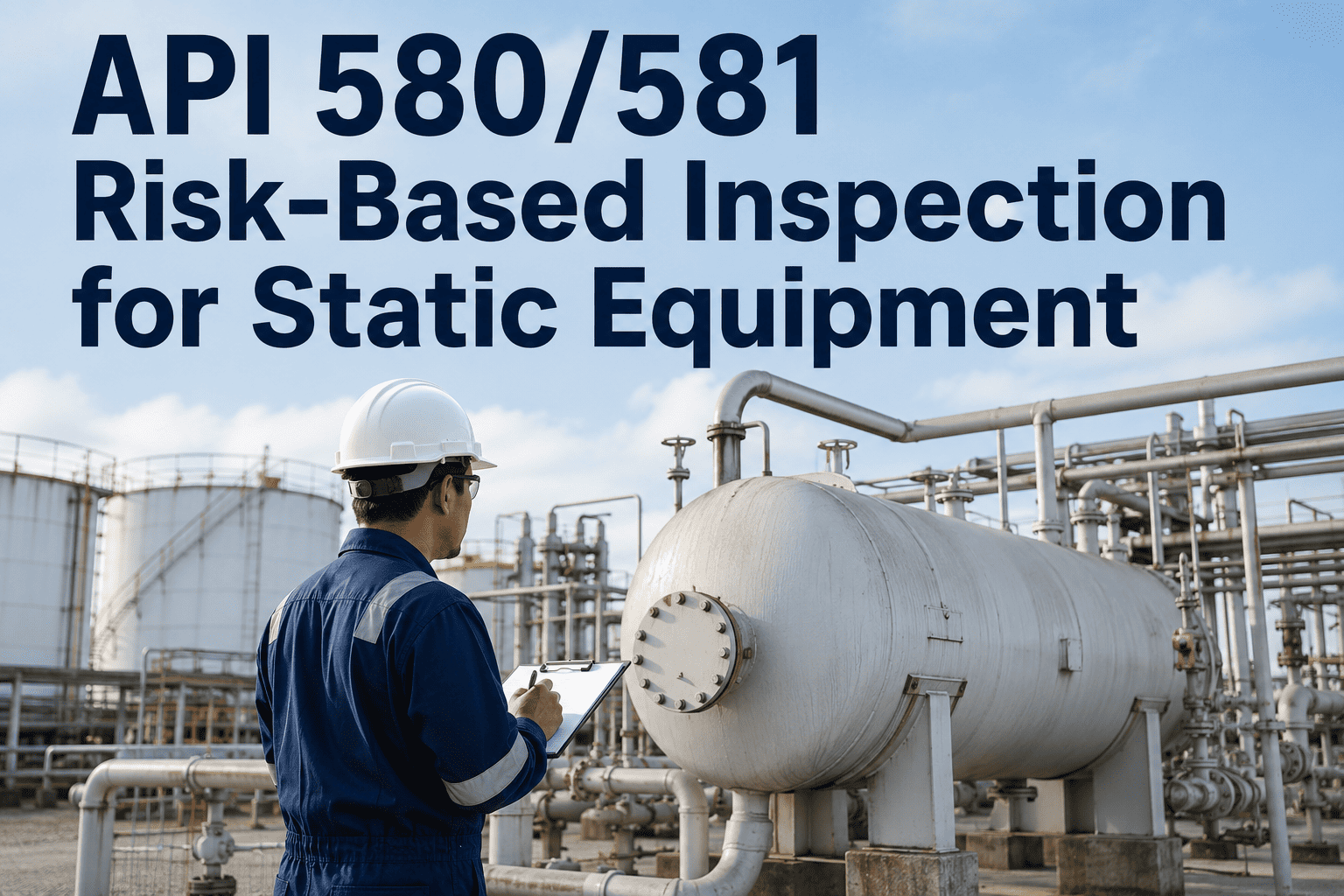
Static equipment in oil and gas facilities — pressure vessels, heat exchangers, piping systems, and storage tanks — operates under extreme conditions for decades. Traditional inspection programs assign intervals based on calendar time or regulatory minimums, which means low-risk equipment gets inspected too often while high-risk equipment may not get inspected frequently enough. API 580 and API 581 provide a risk-based inspection methodology that quantifies both the probability and consequence of failure for each piece of equipment, then uses that risk profile to set inspection intervals that are technically justified and cost-optimized. Facilities ready to move from time-based to risk-based inspection can Book a Demo to see how iFactory structures RBI data and workflows.
Calendar-Based Inspection vs Risk-Based Inspection
Most oil and gas facilities still run their static equipment inspection programs on calendar intervals — every five years for a pressure vessel, every ten years for a tank floor — regardless of what the equipment actually experiences in service. This approach treats a low-pressure nitrogen buffer vessel the same as a high-pressure sour gas separator, consuming inspection resources on equipment that does not need it while leaving high-risk equipment under-examined. Risk-based inspection replaces that uniform calendar with a risk-ranked plan where every inspection interval has a documented technical basis tied to the specific damage mechanisms and consequences associated with each piece of equipment.
Calendar-Based Inspection
Fixed intervals driven by code minimums, not actual equipment condition or operating severity
All equipment inspected on the same cycle regardless of damage mechanism activity or consequence level
No mechanism to prioritize resources toward the equipment where failure would matter most
Higher total inspection cost with no measurable improvement in failure prevention on critical equipment
Risk-Based Inspection
Intervals set by calculated risk, combining probability of failure with consequence of failure for each item
High-risk equipment inspected more frequently; low-risk equipment intervals extended with technical justification
Every inspection task tied to a specific damage mechanism with a defined detection method and effectiveness rating
Reduced total inspection volume with improved coverage on the equipment where failure has the largest impact
Understanding API 580 and API 581 and When to Use Each
API 580 and API 581 are complementary standards that serve different roles in an RBI program. API 580 is the overarching recommended practice that defines the methodology — how to categorize risk, how to manage the program, and what outputs the assessment should produce. API 581 is the base resource document that provides the detailed quantitative calculation methods for determining probability of failure and consequence of failure for specific equipment types and damage mechanisms. Understanding the distinction is critical because applying the wrong level of analysis to the wrong equipment wastes resources and delays the inspection plan.
Qualitative Risk Assessment
Defines the RBI methodology, program management requirements, and risk categorization approach. Risk is assessed using qualitative categories — High, Medium, Low — based on engineering judgment, simplified calculations, and a risk matrix. Best suited for initial RBI screening across a large equipment population, smaller facilities with limited analytical resources, or organizations building their first RBI program before committing to quantitative analysis on every item.
Quantitative Risk Assessment
Provides the detailed calculation methods for probability of failure, consequence of failure, and resulting risk using numerical values. Includes specific damage factor calculations for thinning, cracking, and high-temperature mechanisms, financial and safety consequence models, and area-of-release calculations. Required for high-risk equipment where numerical risk values are needed to satisfy regulatory expectations, corporate risk tolerance thresholds, or insurance requirements.
How Probability and Consequence Combine Into a Risk Ranking
The risk matrix is the central output of any API 580 qualitative assessment. Each piece of equipment is plotted at the intersection of its assessed probability of failure and its assessed consequence of failure. The resulting cell determines the risk category — Very High, High, Medium, Low, or Very Low — which directly drives the inspection interval and the level of analysis required. Equipment in the Very High and High cells gets the most frequent inspection and may require API 581 quantitative analysis. Equipment in the Low and Very Low cells can have intervals extended beyond standard code maximums with documented justification.
What Degrades Static Equipment and Where to Look
Every RBI assessment starts with identifying the credible damage mechanisms for each equipment item based on its process conditions, materials of construction, and operating history. Different equipment types are susceptible to different degradation modes, and the inspection plan must target the specific mechanism that is most likely to cause failure. Missing a credible damage mechanism during the assessment means the inspection plan will not detect the failure mode that matters, which defeats the purpose of the entire RBI effort.
General and localized wall thinning from corrosion or erosion
Hydrogen-induced cracking and stress-oriented HIC in sour service
Sulfide and chloride stress corrosion cracking at welds
High-temperature hydrogen attack and creep in elevated-temperature service
Tube-side erosion-corrosion and pitting from process fluid velocity
Stress corrosion cracking of tubes in chloride or caustic environments
Thermal fatigue at tube-to-tubesheet joints from cycling service
Under-deposit corrosion accelerated by fouling on the shell or tube side
Corrosion under insulation at locations where moisture penetrates the jacket
Erosion-corrosion at flow disturbances including elbows, tees, and reducers
Sulfide stress cracking and caustic stress corrosion cracking at welds
Atmospheric corrosion at supports, flanges, and low-point drainage locations
Internal bottom plate corrosion from settled water and sediment layers
Shell thinning from atmospheric exposure and product-side corrosion
Foundation settlement causing shell distortion and stress concentrations
Roof structure corrosion and structural degradation from exposure conditions
What Determines Consequence and Probability in an RBI Assessment
Risk in API 580/581 is not a single number — it is the product of two independently assessed factors, each driven by a distinct set of inputs. Understanding what feeds into each side of the risk equation is essential for interpreting the assessment results and for identifying where better data or process changes would shift the risk ranking. The consequence side captures what happens if the equipment fails. The probability side captures how likely that failure is under current conditions.
Consequence of Failure
Safety Impact
Number of personnel in the potential release zone, toxicity and flammability of the contained fluid, and the potential for fire, explosion, or toxic exposure if a leak or rupture occurs.
Environmental Release
Product type, quantity of material that could be released, proximity to environmental receptors, and the effectiveness of containment systems such as berms, dikes, and drainage controls.
Business and Financial
Duration of production loss if the equipment fails, cost of emergency repair versus planned repair, replacement lead time for long-lead components, and contractual penalties from downstream supply interruptions.
Probability of Failure
Damage Mechanism Rate
The predicted or measured rate of degradation — corrosion rate in mils per year, crack growth rate, or creep rate — that determines how quickly the equipment progresses from its current condition toward failure.
Current Equipment Condition
Remaining wall thickness relative to the minimum required thickness, known flaw sizes from previous inspections, and the amount of life consumed since the last assessment or inspection.
Inspection Effectiveness
The ability of the selected inspection technique to detect the active damage mechanism at a size small enough to allow intervention before failure, rated from Highly Effective to Ineffective per API 581 categories.
Five Phases From Data Collection to a Living Inspection Plan
Implementing an API 580/581 RBI program is a structured process that moves from data assembly through assessment to execution and continuous improvement. Each phase produces a specific output that feeds the next, and skipping a phase — particularly the damage mechanism identification step — undermines the technical credibility of the entire inspection plan.
Scope and Data Collection
Define the equipment boundary and collect design data, operating conditions, materials of construction, maintenance history, and previous inspection records for every static equipment item in the RBI scope.
Damage Mechanism Review
Evaluate each equipment item against credible damage mechanisms based on process fluid composition, operating temperature and pressure, materials, and historical failure data to build the damage mechanism register.
Probability and Consequence Assessment
Apply API 580 qualitative categories or API 581 quantitative calculations to determine the probability and consequence of failure for each damage mechanism on each equipment item in the assessment scope.
Risk Ranking and Inspection Planning
Plot each equipment-damage mechanism combination on the risk matrix, rank by risk level, and assign inspection tasks, techniques, and intervals that reduce risk to the acceptable threshold.
Execution and Reassessment
Execute the RBI-driven inspection plan, feed actual thickness readings and inspection findings back into the probability assessment, and reassess on a defined cycle when conditions change.
What Facilities Measure After Implementing API 580/581 RBI
The return on an RBI implementation is not theoretical — it shows up in inspection budgets, turnaround scopes, and failure rates within the first reassessment cycle. The metrics below represent typical outcomes reported by oil and gas facilities that have completed at least one full RBI cycle on their static equipment population and are executing against the risk-ranked inspection plan.
API 580/581 Risk-Based Inspection — Common Questions
What is the difference between API 580 and API 581, and which should our facility use?
API 580 defines the qualitative risk-based inspection methodology using category-based risk rankings, while API 581 provides the quantitative calculation methods that produce numerical probability and consequence values. Most facilities start with API 580 to screen their entire static equipment population and identify which items fall into the high-risk categories, then apply API 581 quantitative analysis to that high-risk subset where numerical values are needed for regulatory approval or corporate risk reporting. Applying API 581 to every piece of equipment is rarely necessary and consumes analytical resources that would be better spent executing the inspection plan. Teams can Book a Demo to see how iFactory manages the transition from qualitative screening to quantitative analysis within a single workflow.
How does RBI change our regulatory inspection requirements under API 510 and API 570?
RBI does not eliminate regulatory inspection requirements but changes how the inspection interval is determined. Both API 510 for pressure vessels and API 570 for piping allow inspection intervals to exceed the default maximums when a risk-based assessment provides documented technical justification for the extension. The RBI assessment becomes part of the inspection plan that the authorized inspector reviews and approves, and the extended interval must still result in a risk level that meets the facility's acceptance criteria. The critical requirement is that the RBI methodology itself must be properly documented and the assessment must be technically sound. The iFactory Support team can advise on how the platform's RBI workflows map to common regulatory frameworks.
What data do we need to have before starting an RBI assessment?
At minimum, you need equipment design data including design conditions and materials of construction, current operating data such as process fluid composition and operating temperatures and pressures, maintenance and inspection history with previous thickness readings and failure records, and a process description that supports the damage mechanism identification step. Facilities with well-maintained CMMS records and current process safety information typically have most of this data available, though gaps are common during the first RBI cycle and are addressed by assigning conservative default values where actual data is missing or by conducting targeted data collection before the assessment is finalized.
How often does an RBI assessment need to be reassessed?
API 580 recommends reassessment at least every five years or sooner if a significant change in operating conditions occurs, a process upset has potentially accelerated damage, or an inspection finding materially changes the assessed risk. In practice, most facilities align the reassessment cycle with their turnaround schedule since that is when the most current inspection data becomes available. Facilities that maintain continuous thickness monitoring programs or online condition monitoring systems may update the probability side of the assessment more frequently without conducting a full programmatic reassessment, which keeps the risk rankings current between turnaround cycles.
Can RBI be applied to equipment that has already been in service for twenty or thirty years?
Applying RBI to aging equipment often produces some of the largest benefits because the historical inspection data provides a strong empirical basis for estimating actual damage rates rather than relying on generic industry corrosion rates. The key requirement is that the probability of failure calculation must account for the actual measured condition — remaining wall thickness, known flaws, observed degradation rates — rather than assuming the equipment is in its original as-built condition. Equipment that has been in service for decades with consistent inspection records frequently ends up with a lower assessed probability of failure than generic estimates would suggest, which can justify extended intervals with a level of confidence that was not possible when the data was siloed in paper records.


-in-oil-&-gas-a-practical-guide.png)