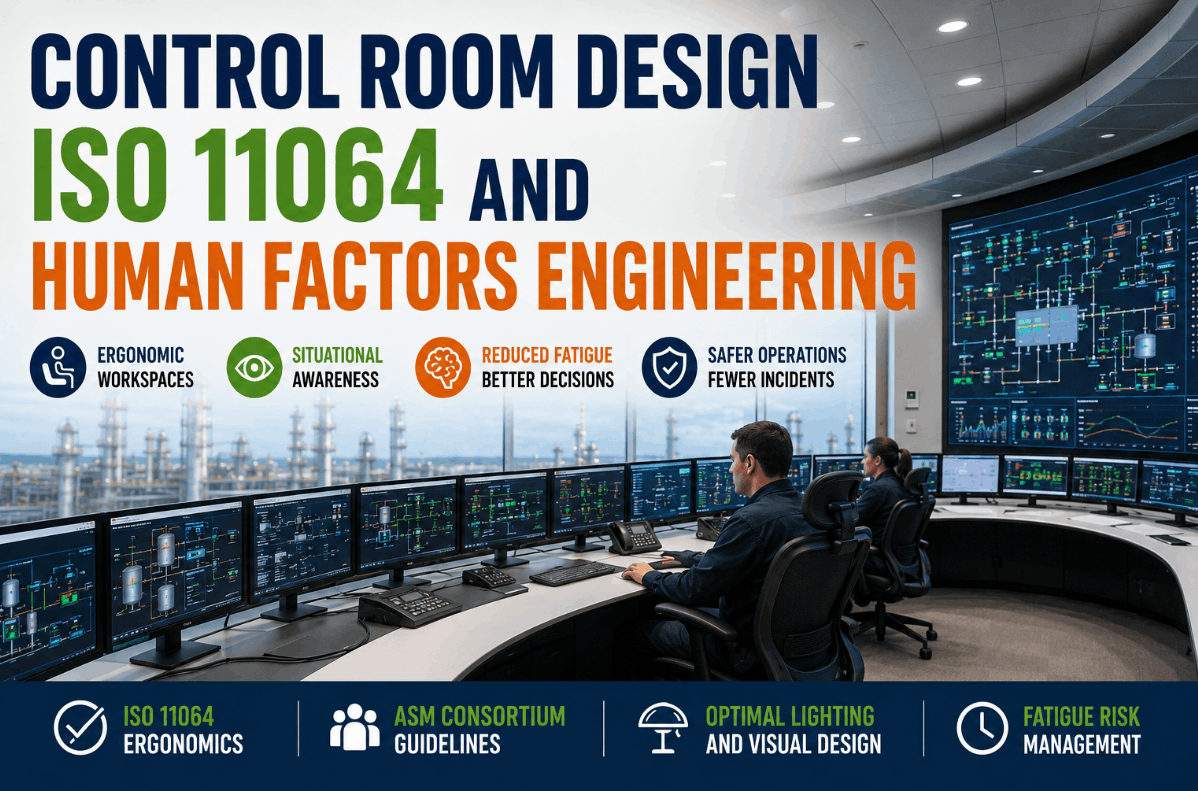
Most control room incident investigations don't find a single dramatic failure. They find an operator who missed a critical alarm buried in a flood of forty others, a shift handover where a key detail never made it from one team to the next, or a console layout that put the most safety-critical display at the edge of peripheral vision during the exact minute it mattered most. These are not failures of operator competence — they are failures of room design. ISO 11064 exists precisely because control room performance is shaped by physical layout, workstation dimensions, lighting, and sightlines as much as it is by training, and the ASM Consortium's decades of abnormal-situation research extends that same logic into how information should be displayed and how shift schedules should be structured to protect operator vigilance. iFactory AI's control room design framework treats ergonomics, alarm presentation, and fatigue management as one connected system rather than three separate projects, because in practice an operator's ability to catch the next anomaly depends on getting all three right at once.
Is Your Control Room Designed Around the Operator, or Around the Legacy Layout?
iFactory's human factors framework applies ISO 11064 ergonomics, ASM Consortium display guidelines, and shift fatigue research to control rooms that need to prevent the next incident, not just look modern.
The Physical Design Decisions That Quietly Drive Operator Error
ISO 11064 governs the ergonomic design of control centres across seven linked parts, covering everything from the overall design process down to workstation dimensions, display and control placement, and environmental conditions like lighting, acoustics, and thermal comfort. The standard exists because the consequences of an inappropriate operator action — acts of omission, commission, or simply reacting at the wrong moment — can be severe in a process plant, and a meaningful share of those actions trace back to a room that was never actually designed around the task the operator has to perform. A workstation that forces an operator to twist away from a primary display to reach a secondary control, a sightline that's blocked by a column or a support beam, or lighting that creates glare on a critical screen are not minor annoyances — they are measurable contributors to slower detection and slower response during the exact moments that matter most. Book a Demo to see how an ISO 11064 audit applies to your existing control room.
Control Suite Arrangement
ISO 11064 Part 2 governs how the control room relates to supporting spaces — break areas, equipment rooms, and adjacent offices — so operators aren't isolated from support functions during a developing situation.
Control Room Layout
Part 3 covers workstation arrangement, sightlines, and off-workstation displays within the room itself, ensuring operators retain visual and auditory access to colleagues without unnecessary interruption.
Workstation Dimensions
Part 4 specifies workstation layout and dimensions based on anthropometric data, ensuring the physical desk and display arrangement accommodates the real range of operator body sizes, not just an average.
Environmental Conditions
Parts 5 and 6 address display and control design alongside lighting, acoustics, thermal comfort, and vibration — the environmental factors proven to affect sustained attention over a long shift.
"We assumed our control room problems were a training issue until a human factors review showed half our night-shift near-misses traced back to console glare and a console layout that buried the most critical alarm panel out of the primary sightline. We rebuilt the room around ISO 11064 principles and rationalized the alarm presentation at the same time. The training hadn't been the problem — the room had been working against our operators the whole time."
Mapping ASM Consortium Principles to Operator Performance
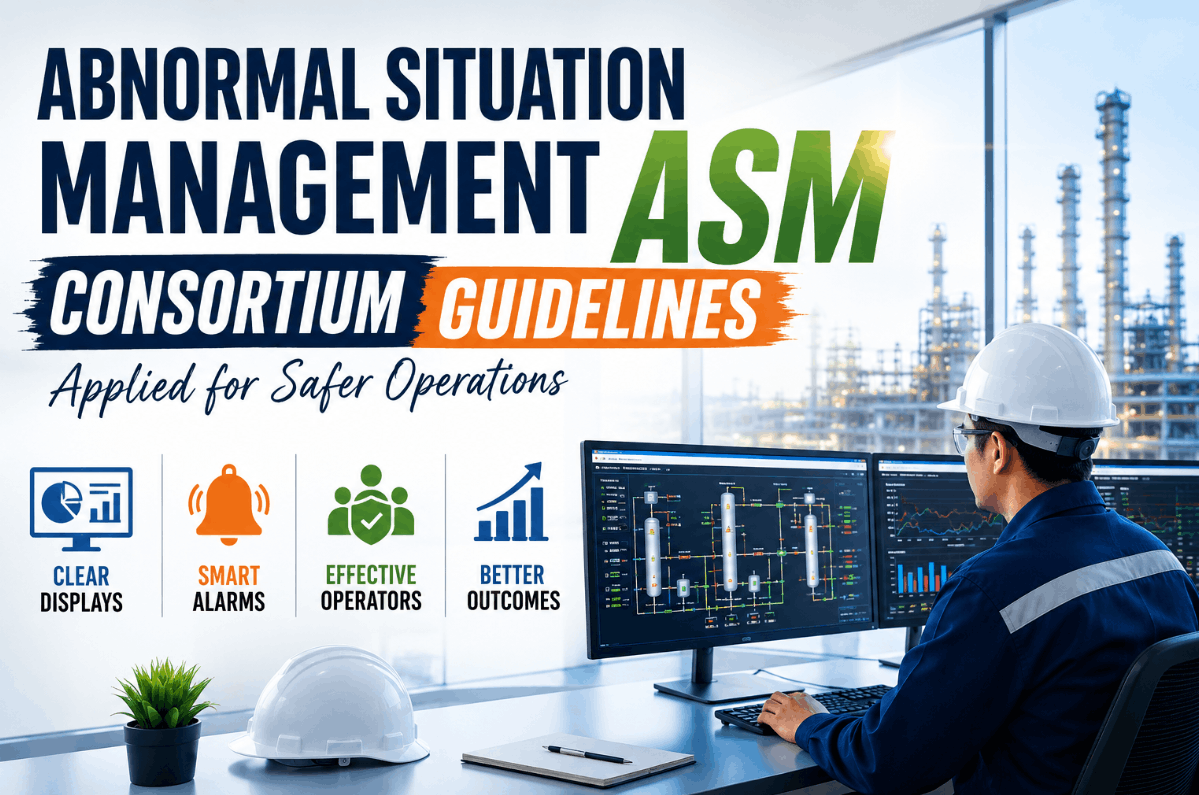
Good console layout solves where an operator sits and what they can see. The ASM Consortium's research solves a different but related problem: what should actually be on the screen, and how should it be organized so an operator under pressure can find the right information fast instead of hunting through cluttered displays. The Consortium's effective HMI design guidelines and alarm management research grew directly out of analyzing real abnormal situations where operators had the right room but the wrong information architecture. Reliability and process safety teams who schedule a review often find that pairing physical layout improvements with display rationalization delivers a bigger gain than either change made alone.
| Design Layer | Governing Framework | What It Addresses | Risk If Ignored |
|---|---|---|---|
| Room & Suite Layout | ISO 11064 Parts 1–3 | Sightlines, adjacency to support spaces, workstation arrangement | Isolated operators, blocked views, slow team coordination |
| Workstation Ergonomics | ISO 11064 Part 4 | Desk and display dimensions fitted to real operator body sizes | Physical strain, awkward reach to critical controls |
| Display & Alarm Design | ASM Consortium Guidelines | Information hierarchy, alarm presentation during abnormal situations | Alarm floods, missed critical alerts, slow diagnosis |
| Environmental Conditions | ISO 11064 Parts 5–6 | Lighting, acoustics, thermal comfort, glare control | Faster fatigue onset, reduced sustained attention |
| Shift Scheduling | API RP 755 / Fatigue Research | Work-rest scheduling, circadian-aware rotation design | Elevated error rates on night shifts and shift transitions |
Why Shift Fatigue Is a Design Problem, Not Just a Scheduling Problem
Control room design and shift scheduling are often managed by entirely separate teams, but the research is unambiguous that they affect the same outcome. Studies of petrochemical control room operators have documented measurable declines in cognitive performance — including increased omission and commission errors — by the end of both day and night shifts, with the effect most pronounced during circadian misalignment on night rotations. Sustained wakefulness beyond roughly ten hours compounds the problem further, degrading sustained attention and visual-motor performance at exactly the point in a shift when an operator is most likely to be relied upon for a critical judgment call. A control room that is ergonomically excellent but staffed on a fatigue-blind rotation schedule still inherits the same error risk a poorly designed room would create.
A Phased Approach to Human Factors Control Room Design
Redesigning a live control room is not a project that can pause production, so the work has to be sequenced carefully around assessment, design, and validation before any physical change is made. Book a Demo to walk through how this sequence applies to a room that's still in active use.
Task and Sightline Analysis
Document what each operator role actually needs to see and do during normal and abnormal situations, mapping current sightlines, reach distances, and console arrangement against those task requirements.
ISO 11064 and ASM Design Application
Apply workstation dimension standards, room layout principles, and ASM-aligned display hierarchy to a redesigned console and screen arrangement, validated against the task analysis from Phase 1.
Fatigue-Aware Schedule Integration
Align shift rotation design with the redesigned room, incorporating circadian-aware scheduling principles so the physical and human elements of the control room reinforce each other rather than working at cross purposes.
Control Room Design — Frequently Asked Questions
What does ISO 11064 actually cover?
It's a seven-part standard covering control center design principles, suite arrangement, room layout, workstation dimensions, displays and controls, environmental conditions, and evaluation methods.
Is ISO 11064 only for new control room construction?
No — it applies to new builds as well as expansions, refurbishments, and technology upgrades of existing control centres, and is commonly referenced when addressing known problems in older rooms.
What's the difference between ISO 11064 and ASM Consortium guidelines?
ISO 11064 governs the physical room, workstation, and environmental design, while ASM guidelines focus on display content and alarm presentation — the two address different but complementary parts of operator performance.
How does shift scheduling connect to control room design?
Research shows cognitive performance declines measurably by shift end and worsens with circadian misalignment on night rotations, meaning even a well-designed room needs fatigue-aware scheduling to fully protect operator performance.
Can an existing control room be evaluated without a full rebuild?
Yes — a task and sightline analysis can identify specific layout, display, or environmental gaps that may be addressed through targeted changes rather than a complete reconstruction.
Design the Control Room Around the Operator's Real Task
iFactory's human factors framework brings ISO 11064 ergonomics, ASM display principles, and fatigue-aware scheduling together into one control room design approach.