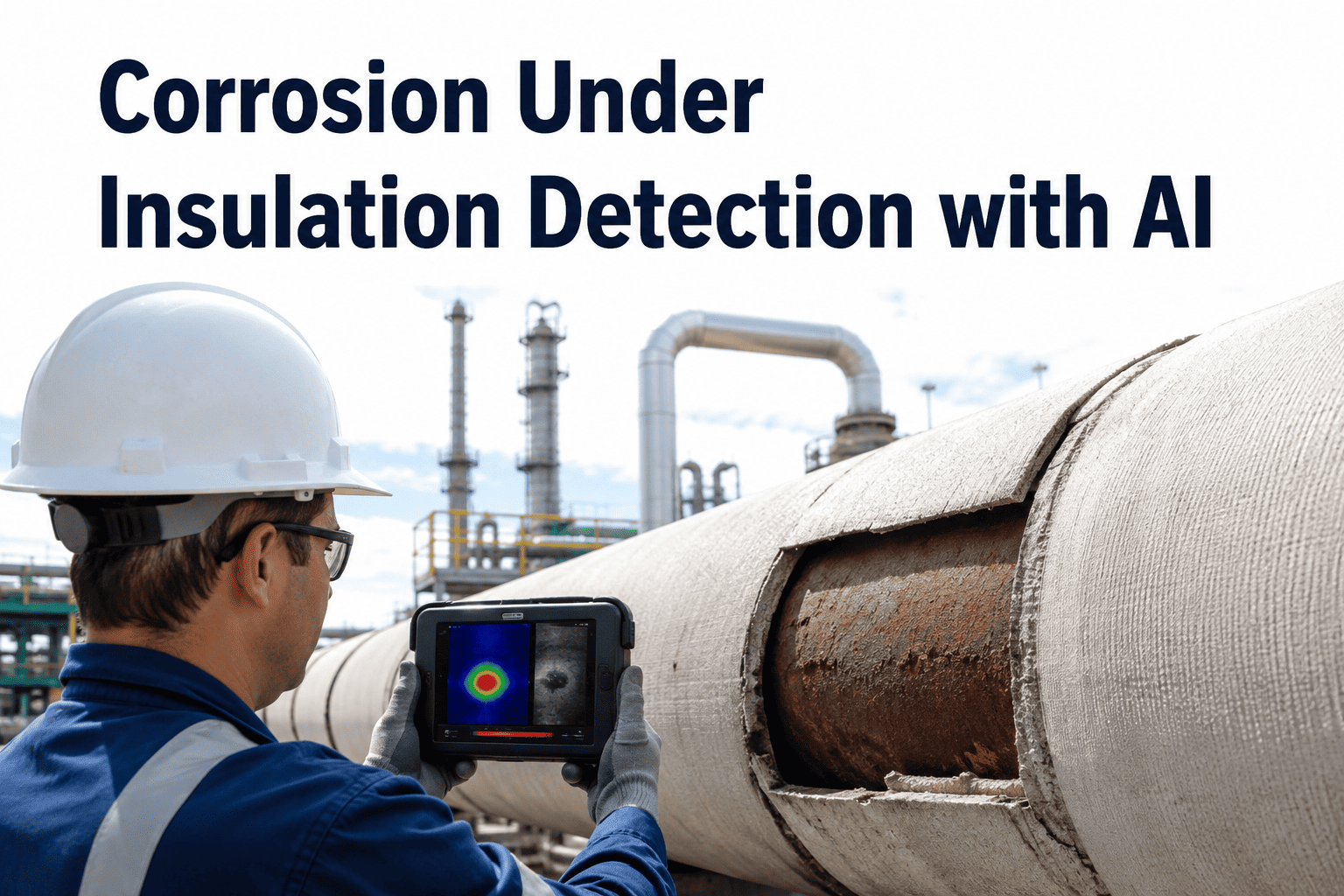
Corrosion under insulation accounts for 40–60% of piping failures in U.S. refineries and petrochemical plants — and unlike most damage mechanisms, it develops entirely out of sight beneath insulation jacketing that was installed to protect the very asset it ultimately conceals. CUI destroys carbon steel and austenitic stainless steel through a deceptively simple mechanism: water ingress through degraded jacketing contacts the pipe surface, drives localized corrosion, and compounds over years while no external indicator reaches the operator. By the time a CUI-related failure occurs — a through-wall perforation, a catastrophic rupture in a high-energy line, a hydrocarbon release — the corrosion has been progressing for years in a location that was never entered into an active monitoring program. The financial and safety exposure is compounded by the cost of the inspection itself: conventional CUI inspection requires stripping insulation, which is labor-intensive, disruptive to operations, and destructive to insulation systems that must be replaced after inspection. iFactory's CUI detection and monitoring platform gives integrity engineers a structured path out of this cycle — deploying guided wave UT, pulsed eddy current, and process-integrated risk screening to detect active CUI before insulation removal becomes the only diagnostic option. Facilities that have Book a Demo with iFactory consistently find undetected CUI in circuits classified as low-risk under conventional calendar-based inspection programs.
Why CUI Is the Damage Mechanism That Conventional Inspection Programs Miss Most Consistently
The structural weakness of conventional CUI inspection programs is not a lack of technology — it is a mismatch between inspection interval, inspection method, and the actual rate and location of CUI damage development. Calendar-based insulation stripping programs inspect a fraction of the susceptible circuit inventory each year, prioritized by age or general process classification rather than by real-time moisture ingress risk or process severity. The result is a systematic blind spot: circuits where insulation jacketing has degraded at low points, around pipe supports, at flange protrusions, or beneath cladding penetrations — exactly the locations where water accumulates and CUI initiates — go uninspected while resources are spent stripping and reinstating insulation in areas where no active corrosion is occurring.
iFactory addresses this structural weakness through risk-ranked CUI circuit screening that combines process severity factors — operating temperature range, insulation system type, jacketing age and condition assessment, historical leak history — with non-invasive screening NDE to identify circuits where active CUI is probable before insulation removal is committed. The platform maintains a live CUI risk register for every insulated circuit in the facility, updated continuously as process conditions, maintenance records, and inspection findings evolve. Facilities that Book a Demo with iFactory typically reduce total insulation stripping labor by 35–50% in the first inspection cycle by concentrating strip-and-inspect resources on circuits that screening has identified as actively corroding.
The Four Primary CUI Detection Methods: Capabilities, Limitations, and When to Deploy Each
No single NDE technology covers the full range of CUI scenarios across a complex piping inventory. The optimal CUI detection program selects methods based on pipe diameter, insulation type, operating temperature, circuit geometry, and the consequence of a missed finding. iFactory's CUI program management platform maintains a method selection matrix for each circuit in the asset register, recommending the appropriate NDE approach based on these parameters and tracking results across successive inspection cycles.
Guided Wave Ultrasonic Testing (GWUT)
Guided wave UT transmits low-frequency ultrasonic waves axially along the pipe from a single collar location, screening 50–100 meters of pipe in both directions from a single test point without insulation removal. GWUT detects cross-sectional area loss from both internal and external corrosion, making it highly effective for long straight runs of insulated piping where access is limited. Sensitivity is typically 3–9% CSA loss detection depending on frequency and pipe condition. Key limitation: signal attenuation at supports, bends, and heavily corroded sections limits range and requires multiple collar positions on complex pipe routing. iFactory manages GWUT collar position planning, signal interpretation records, and anomaly follow-up tracking within the CUI circuit record.
Pulsed Eddy Current (PEC)
Pulsed eddy current testing measures average wall thickness through insulation, cladding, and fireproofing up to 150mm thick without requiring insulation removal or direct contact with the pipe surface. PEC is particularly effective for insulated piping in the 4–24 inch diameter range, on complex geometries including elbows and reducers, and in situations where insulation removal is operationally impractical. The method measures average wall thickness over the measurement footprint (typically 50–100mm diameter) rather than point measurements — meaning it detects area-averaged corrosion reliably but may understate highly localized pitting. iFactory integrates PEC data directly into the circuit thickness record alongside conventional UT results, applying corrosion rate calculations and remaining life projections from the combined dataset.
Neutron Backscatter (NB)
Neutron backscatter detects hydrogen-containing materials — water — within the insulation annulus rather than measuring wall thickness directly. NB identifies locations where moisture is present in the insulation system, which are the locations where CUI is either active or about to initiate. NB is particularly valuable for surveying large areas of insulated piping rapidly to identify wet zones for targeted follow-up inspection, and for monitoring the performance of insulation systems after refurbishment. The method does not quantify metal loss; it identifies investigation candidates. iFactory uses NB survey results as a primary input to the CUI risk register, elevating the inspection priority of circuits where moisture ingress has been confirmed.
Radiographic Profile and Digital RT
Tangential radiography (profile RT) produces a direct image of the pipe wall profile through the insulation, providing both wall thickness measurement and a visual record of the corrosion morphology. Digital radiography and computed radiography have made this method significantly more practical than film-based RT, with immediate image availability and no film processing delay. Profile RT is the preferred follow-up method when GWUT or PEC identifies a significant anomaly requiring characterization before fitness-for-service assessment. Limitations include radiation exclusion zone requirements and the need for access to both sides of the pipe for some configurations. iFactory schedules radiographic follow-up work orders automatically when screening NDE results exceed the defined escalation threshold for a circuit.
CUI Risk Ranking: How iFactory Prioritizes the Inspection Queue Across a Complex Piping Inventory
A mid-size U.S. refinery may have 50,000–200,000 linear meters of insulated piping — far more than any inspection program can screen comprehensively in a single turnaround cycle. Effective CUI management requires a risk ranking framework that concentrates inspection resources on circuits where the combination of CUI probability and failure consequence is highest. iFactory implements API RP 583-aligned risk ranking that scores each insulated circuit on probability factors and consequence factors independently, combining them into a risk matrix that drives inspection priority, method selection, and interval assignment.
| Risk Factor | High CUI Probability Indicators | Lower CUI Probability Indicators | iFactory Data Source |
|---|---|---|---|
| Operating Temperature | Cycling between 0°C and 175°C; cold service below 0°C (ESCC risk for SS) | Continuously above 175°C (too hot for sustained moisture) | Process historian — continuous temperature monitoring |
| Insulation System Condition | Jacketing damaged or missing; sealant failed at penetrations; age >15 years | Recently refurbished; intact jacketing; sealed penetrations | Insulation inspection records + visual survey inputs |
| Location and Geometry | Pipe supports, low points, dead legs, beneath cladding penetrations | Continuously elevated straight runs with intact top-seal | Isometric drawings + pipe support register |
| Process Environment | Marine/coastal environment; cooling tower drift zone; steam tracing leaks | Indoor dry environment; no external moisture source | Site environment classification |
| Historical Leak Record | Previous CUI findings on same circuit or adjacent piping | No prior CUI findings; recent baseline inspection clean | Inspection records database — past finding integration |
| Material | Carbon steel in wet CUI range; 300-series SS in ESCC temperature range with chloride exposure | Alloy materials with demonstrated CUI resistance in service | Pipe material register |
The risk ranking output from iFactory's CUI module generates a prioritized inspection queue updated each time new data is entered — process temperature changes, new inspection findings, or insulation condition updates from field walkdowns. High-risk circuits receive condition-triggered NDE scheduling; low-risk circuits receive extended intervals with periodic visual walkdown as the primary monitoring method. Book a Demo to see how iFactory builds the CUI risk register for a piping inventory of your facility's scale.
The CUI Inspection Workflow: From Risk Screening to Fitness-for-Service to Insulation Reinstatement
An effective CUI program is not a series of individual inspections — it is a closed-loop workflow that moves from risk screening through NDE, finding characterization, remediation decision, and insulation reinstatement tracking, with every step documented in a system that accumulates inspection intelligence across successive turnaround cycles. iFactory manages the full CUI inspection workflow in a single platform accessible to inspection engineers, maintenance planners, and insulation contractors simultaneously.
Risk Register Build and Circuit Prioritization
Build or import the insulated piping circuit register with temperature range, insulation type, jacketing age, and historical finding data. Apply API 583 risk ranking to generate the prioritized inspection queue for the upcoming turnaround. Assign NDE method per circuit based on the method selection matrix.
Non-Invasive Screening NDE Execution
Execute GWUT, PEC, or neutron backscatter screening on prioritized circuits per the iFactory-generated work orders. Results entered directly into the platform from mobile field devices with GPS-tagged measurement locations. Anomalies automatically flagged against the circuit's established acceptance criteria.
Targeted Insulation Strip and Confirmatory UT
Screening anomalies generate targeted strip-and-inspect work orders at the specific GPS-located anomaly position — not blanket insulation removal across the circuit. Conventional UT thickness grids at the stripped location provide point-measurement wall thickness data for fitness-for-service assessment input.
FFS Assessment and Remediation Decision
Wall thickness findings assessed against API 579 Level 1 remaining strength criteria. Circuits with findings above the remediation threshold generate repair work orders with priority classification and target completion date. Circuits within acceptance limits receive updated corrosion rate calculations and revised reinspection intervals.
Insulation Reinstatement and System Performance Tracking
Insulation reinstatement work orders generated with specification requirements — jacketing type, sealant application at penetrations, vapor barrier continuity. Post-reinstatement condition recorded as the new baseline for the circuit. Reinstatement quality tracked against repeat CUI findings in successive cycles to identify insulation system performance patterns. Book a Demo to see the full workflow in the iFactory platform.
Expert Review: Why Most CUI Programs Generate More Insulation Work Than Defect Findings
I have been involved in CUI program design and inspection execution at U.S. refineries for 19 years, and the most consistent observation I can share is this: the facilities that have the worst CUI outcomes are not the ones with the smallest inspection budgets — they are the ones that spend the largest fraction of their budget stripping insulation on a calendar schedule without a risk-ranking framework to tell them where to look. You can strip 10,000 linear meters of insulation in a turnaround and find three significant CUI locations. Or you can use guided wave screening and pulsed eddy current to screen the same 10,000 meters for a fraction of the cost, identify the twenty locations where moisture ingress has been confirmed or where wall loss has been detected, and strip only those locations — finding the same three significant findings with 80% less insulation removal labor. The technology exists. The risk-ranking framework exists. What most facilities are missing is a platform that connects the NDE data, the process severity data, and the inspection history into a single risk register that drives the inspection queue every turnaround cycle rather than having to rebuild it from scratch each time.
Conclusion: CUI Management Requires a Platform That Knows Where to Look Before Insulation Comes Off
Corrosion under insulation is a damage mechanism that rewards programs built around risk-ranked, technology-assisted screening — and punishes programs built around calendar schedules and blanket insulation removal. The NDE technologies to detect active CUI without full insulation removal are well-established: guided wave UT for long-range pipe screening, pulsed eddy current for through-insulation wall measurement, neutron backscatter for moisture mapping. What converts those individual technologies into a high-performing CUI program is the platform that maintains the risk register, generates the NDE work orders, tracks the findings, drives the FFS assessments, and feeds the insulation reinstatement quality record back into the circuit history — so that each turnaround cycle builds on the intelligence of the last.
iFactory's CUI detection and program management platform delivers that capability for refinery and petrochemical facilities of any scale, integrating with existing inspection management systems and process historians in 4–8 weeks without requiring DCS modifications or insulation removal at deployment. To see how iFactory deploys for your insulated piping inventory, Book a Demo with our fixed equipment integrity team.
Frequently Asked Questions: CUI Detection and Inspection Programs
What is the most effective NDE method for CUI detection on large-diameter insulated piping?
Pulsed eddy current is generally the most effective method for large-diameter insulated piping — it measures average wall thickness through insulation up to 150mm thick without contact, covers complex geometries including elbows and reducers, and requires no radiation exclusion zone; iFactory combines PEC data with process severity risk scoring to prioritize follow-up strip-and-inspect at confirmed anomaly locations.
How does iFactory integrate guided wave UT results into the CUI risk register?
GWUT collar position results are entered from mobile field devices with GPS-tagged anomaly locations, automatically compared against the circuit's acceptance criteria in the iFactory risk register, and converted into targeted strip-and-inspect work orders when the defined anomaly threshold is exceeded — no manual data transfer or spreadsheet reconciliation required.
Which API standard governs CUI inspection program design and what does iFactory implement from it?
API RP 583 defines the CUI risk assessment framework, inspection method selection, and mitigation requirements; iFactory implements the API 583 risk ranking methodology in the CUI circuit register — scoring probability and consequence factors per the standard and generating inspection queues, method assignments, and interval recommendations aligned with its requirements.
Can iFactory's CUI platform connect to our existing inspection management system and process historian?
Yes — iFactory integrates with Meridium/APM, PCMS, and other inspection management systems via standard data exchange, and connects to OSIsoft PI, Aspen InfoPlus.21, and other process historians via read-only OPC-UA connectors for real-time temperature range monitoring that updates circuit risk scores continuously.
What is the typical reduction in insulation stripping scope when non-invasive CUI screening precedes strip-and-inspect?
Facilities deploying GWUT and PEC screening before committing insulation removal resources typically reduce total strip-and-inspect scope by 35–50% in the first inspection cycle — concentrating the labor-intensive removal work at the specific GPS-located anomaly positions identified by screening rather than applying blanket removal across the full circuit.