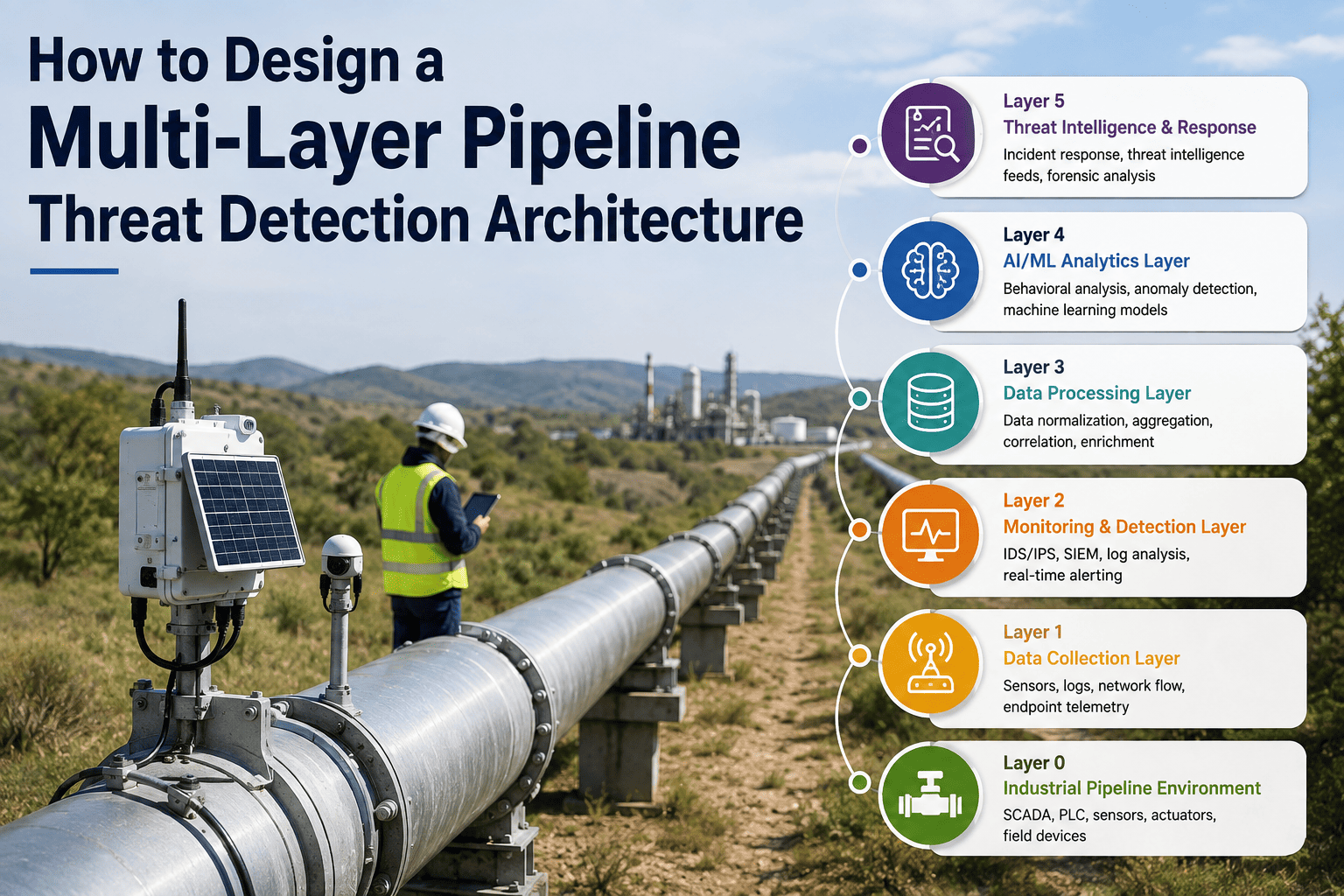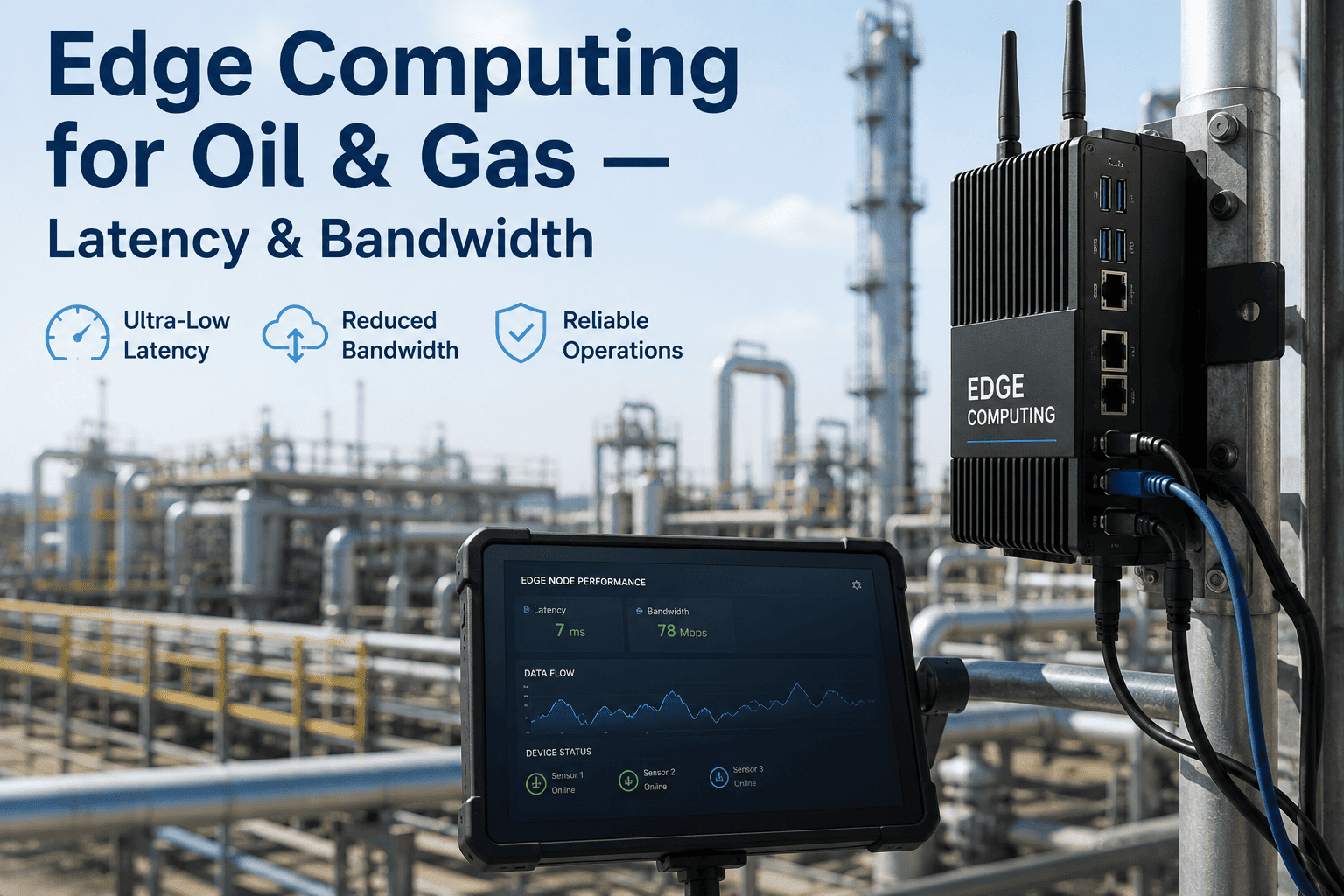
In upstream oil and gas, the sensor that catches a stuck-pipe condition or a compressor surge has milliseconds to matter, and by the time raw data crawls from a remote wellsite over a 10-100 kbps satellite or cellular link to a data center hundreds of miles away, the moment for corrective action has already passed. A single well instrumented with twenty sensors sampling once a second produces close to two million data points a day, far more than any remote link can carry and far more than a centralized system can act on in time. The industry's real answer has never been to pick edge or cloud — it has been to split the work on purpose, running inference that protects equipment and people on-premise at the edge while training, fleet-wide analytics, and enterprise reporting run in the cloud where scale and compute are cheap. Getting that split wrong is expensive in both directions: over-committing to the edge starves the models of the fleet-wide data they need to keep improving, and over-committing to the cloud means the alarm that should have fired locally now arrives after the failure. iFactory's engineering team works through this exact split with every operator before a single camera or sensor ships to site.
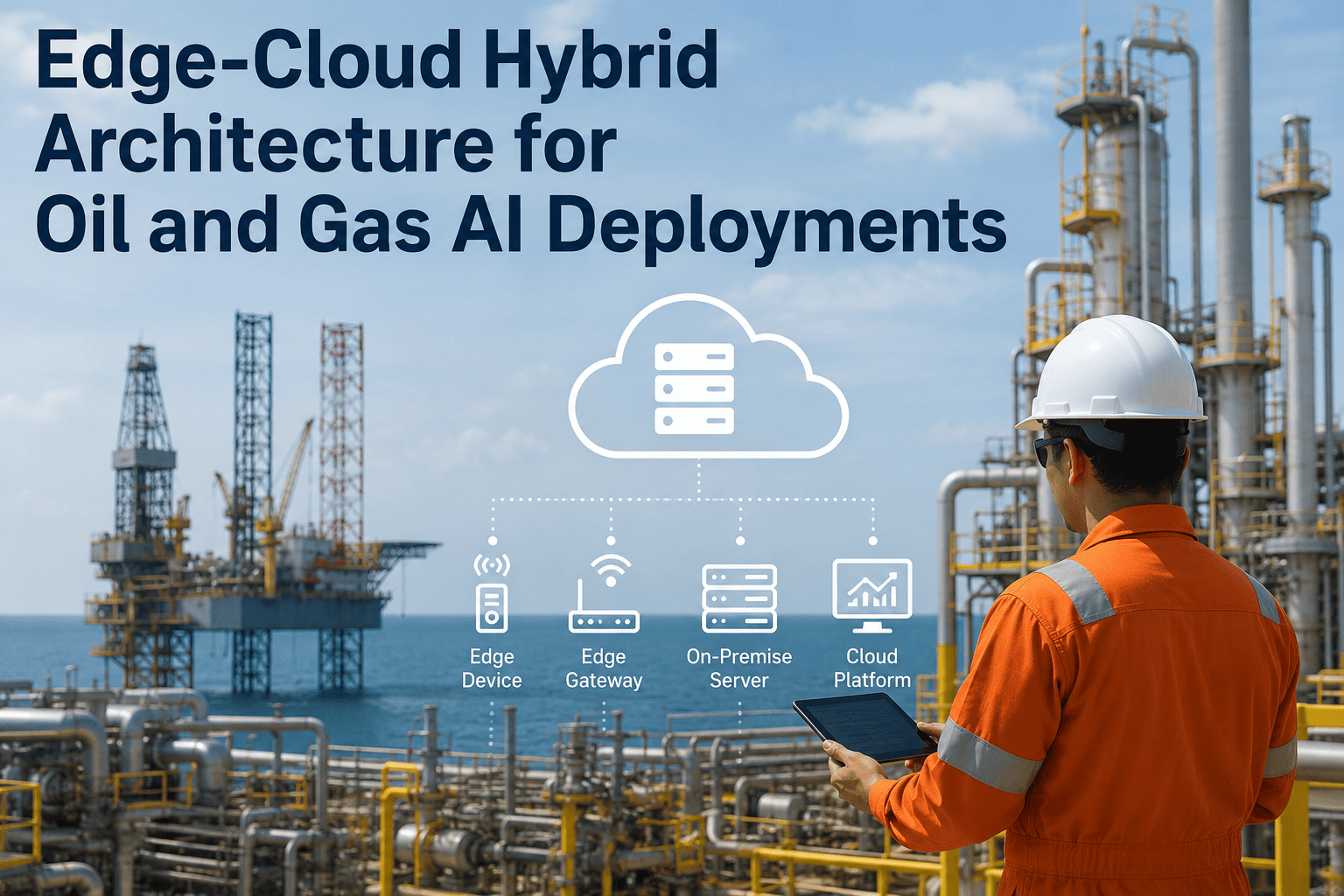
Edge-Cloud Hybrid Architecture for Oil and Gas AI Deployments
Critical inference has to happen where the sensor is, not where the servers are. Model training, fleet analytics, and enterprise reporting can wait a few minutes; a gas leak alarm cannot wait a few seconds. Designing the boundary between what runs on-site and what runs in the cloud is the single decision that determines whether an AI deployment actually protects a facility or just generates dashboards nobody trusts.
The Numbers Behind the Hybrid Decision
Operators who try to run everything through the cloud discover the connectivity ceiling almost immediately, and operators who try to run everything at the edge discover they've built a facility full of models that never learn from each other. The figures below, drawn from industry engineering literature on remote wellsite connectivity and edge deployment patterns, explain why a deliberate split between the two tiers has become the default architecture rather than an optional refinement.
What Belongs at the Edge, and What Belongs in the Cloud
The dividing line is not about which technology is more advanced — it is about which side of the network a decision can afford to wait for. A model that has to trigger a shutdown before a compressor bearing fails cannot depend on a satellite round trip, no matter how good the model is once the data eventually arrives. A model that is learning to recognize a new failure signature across four hundred wells absolutely should be trained where the compute is elastic and the data from every site can be seen at once, because no single edge device has enough local history to learn a pattern that only shows up once a year across the fleet. Most deployments that struggle were not built on bad models — they were built with the wrong workload on the wrong side of the line, and the fix is rarely a better algorithm, it is a redrawn boundary.
- Real-time gas leak and flare-stack anomaly detection from camera and sensor feeds
- Vibration and acoustic inference for rotating equipment protection interlocks
- PPE compliance and personnel-in-hazard-zone detection at wellheads and process units
- Local alarm triage so operators aren't paged for noise that self-resolves in seconds
- Store-and-forward buffering that queues data safely through connectivity dropouts
- Model training and retraining pulled from the full multi-site sensor and video history
- Fleet-wide failure-pattern analytics comparing equipment behavior across every asset
- Enterprise reporting, ESG documentation, and regulatory recordkeeping
- Long-horizon historian storage that supports root-cause investigation months later
- Cross-site benchmarking that tells a reliability team which facility is the outlier
The Architecture Decides Whether the Alert Arrives Before or After the Failure
iFactory designs the edge-cloud boundary around your actual connectivity, latency requirements, and fleet size before recommending a single piece of hardware.
From Sensor to Boardroom: The Full Data Path
A well-designed hybrid architecture is a loop, not a one-way pipe. Data flows up from the field, gets acted on locally, gets summarized and sent onward, and eventually feeds a retrained model that flows back down to the edge — closing the gap between what the field sees today and what the model knows tomorrow. Skipping any single stage in this loop is usually where an otherwise sound architecture quietly stops improving, even while it keeps functioning day to day.
Which Workloads Belong on Which Tier
This is the table most architecture conversations eventually get reduced to. Latency requirement is the dominant variable, but data volume and how often a model needs retraining both push a workload toward one tier or the other.
| Workload | Latency Requirement | Data Volume | Recommended Tier |
|---|---|---|---|
| Gas leak / flare anomaly alarm | Under 1 second | High (continuous video) | Edge |
| PPE and intrusion detection | Under 1 second | High (continuous video) | Edge |
| Rotating equipment vibration anomaly | Seconds | Medium | Edge, validated in cloud |
| Fleet-wide failure pattern analysis | Hours to days | Very high, aggregated | Cloud |
| Model training and retraining | Weekly to monthly | Very high | Cloud |
| Regulatory and ESG reporting | Days | Aggregated | Cloud |
Six Patterns That Make Hybrid Deployments Reliable
These patterns show up repeatedly across mature edge-cloud rollouts in oil and gas, and each one exists to solve a specific failure mode that a naive cloud-only or edge-only design runs into within the first few months of operation.
The Design Mistakes That Show Up Six Months In
Most hybrid architecture failures are not model failures — they are boundary failures, where a workload was placed on the wrong tier and nobody noticed until the connectivity link degraded or the fleet outgrew the original design. The pattern below repeats across enough deployments that it is worth treating as a checklist during the design phase rather than a lessons-learned document written after the first outage.
A Compressor Station, a Dropped Link, and a Model That Kept Working
A midstream operator running six compressor stations across a basin with patchy cellular coverage had built its original AI monitoring around a cloud-first design — vibration and acoustic data streamed continuously to a central platform for anomaly scoring. During a multi-day storm, three of the six stations lost their uplink entirely. The stations kept running, but the monitoring platform went dark for exactly the window when equipment stress was highest, and a bearing failure that had been trending for two days went unflagged until a technician's routine walk-down caught it well past the point of early intervention.
The redesign moved anomaly scoring onto edge devices at each station, so inference continued locally regardless of uplink status, with store-and-forward buffering queuing the exception data for sync once connectivity returned. Cloud-side training kept pulling in the aggregated exception data from all six stations to keep improving the shared model, and a scheduled sync window pushed the retrained model back down every two weeks. The next time a multi-day outage hit the same basin, the edge devices at every station kept flagging anomalies through the entire event, and the queued data synced cleanly once the link came back — no gap in coverage, no missed trend, and no dependence on a technician happening to walk past the right compressor on the right day. The total cost of the redesign was a fraction of what the original bearing failure had cost in emergency repair, lost throughput, and the unplanned three-day station shutdown that followed it, which is the calculation most operators eventually make when they compare a cloud-only architecture's upfront simplicity against what it actually costs the first time the link goes down at the wrong moment.
Frequently Asked Questions
Put Inference Where the Danger Is, and Training Where the Compute Is
iFactory designs the edge-cloud split around your actual connectivity, fleet size, and latency requirements, then deploys the hardware and model pipeline to match.