A terminal "loss" that triggers a theft investigation, a shortage claim, and a strained relationship with a custody transfer counterparty is, more often than not, a measurement problem wearing a different name. Radar and servo gauges drift out of calibration. Temperature correction factors get applied inconsistently across a tank farm. Water cut goes unmeasured until it shows up as an unexplained volume gap at reconciliation. Before anyone accuses a driver, a meter, or a counterparty of taking product that isn't there, the measurement chain itself deserves a hard look — because in most cases, the missing barrels were never actually missing. They were miscounted. iFactory's tank gauging and mass balance monitoring platform gives terminal operators the continuous, cross-referenced visibility needed to separate real loss from measurement error before it becomes a dispute.
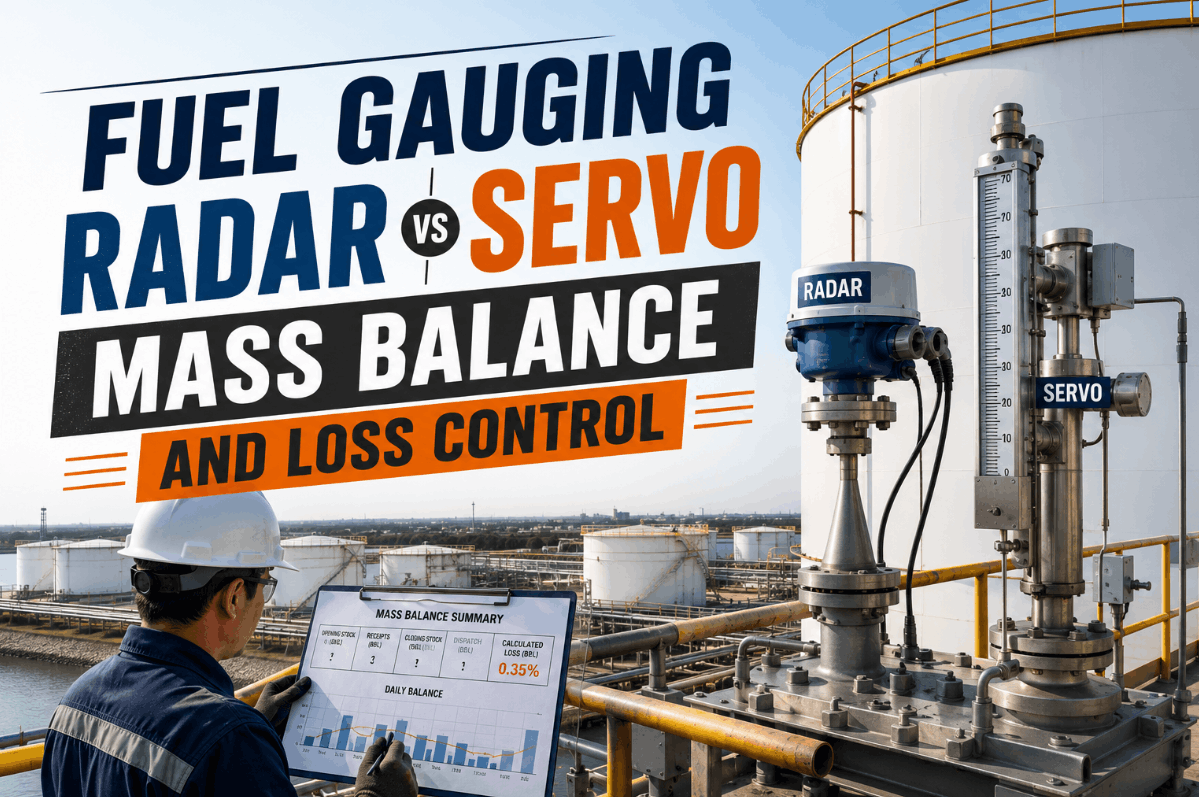
Radar vs. Servo Gauging: Two Accuracy Profiles, One Reconciliation Problem
Servo gauges measure level using a small displacer suspended on a wire, positioned and balanced by a servo motor — a mechanical approach refined for decades and capable of accuracy around plus or minus 0.4 millimeters across a full tank range. Radar gauges measure the same level using a non-contact microwave signal, typically frequency-modulated continuous wave or time-of-flight reflectometry, with no moving parts in the vapor space and accuracy often within a millimeter or better. Both technologies meet custody transfer accuracy requirements when properly installed and maintained, but they degrade differently: servo systems develop wire stretch, displacer fouling, and mechanical wear, while radar systems are vulnerable to antenna buildup, foam interference, and signal reflection issues in turbulent or vapor-dense conditions. A terminal running a mixed fleet of both technologies often has no single view of which gauges are drifting until a volume discrepancy forces a manual audit. Terminal operators managing this exposure frequently Book a Demo to see how iFactory tracks gauge-level drift continuously instead of waiting for a reconciliation failure to surface it.
- Mechanical displacer and wire system, proven for custody transfer use
- Accuracy around ±0.4 mm under proper maintenance conditions
- Vulnerable to wire stretch, displacer fouling, and mechanical wear over time
- Can provide density and interface measurement alongside level
- Non-contact microwave measurement, no moving parts in the vapor space
- Accuracy often within sub-millimeter range under stable conditions
- Vulnerable to antenna fouling, foam, and signal interference in turbulence
- Lower mechanical maintenance burden over the gauge's service life
Temperature Compensation: Where Volume Discrepancies Quietly Start
Hydrocarbon volume changes with temperature, and every custody transfer measurement has to be corrected back to a standard reference condition — typically 60°F or 15°C — using a Volume Correction Factor calculated from observed temperature and density. The VCF is a precise figure, generally expressed to five decimal places and ranging roughly from 0.90000 to 1.05000, and even small errors in the temperature reading feeding that calculation compound across every barrel measured. A gauge with a drifting temperature sensor, or a terminal applying an outdated density value to the VCF lookup, doesn't produce one obvious error — it produces a small, consistent bias across every transaction that only becomes visible once volumes are reconciled at scale.
Water Cut: The Variable Most Mass Balance Discrepancies Forget to Measure
Free water and emulsified water in stored crude or fuel oil directly affect both the measured volume and the net hydrocarbon content of a tank, yet many terminals rely on periodic manual water-cut checks rather than continuous measurement. If water content shifts between gauging events — from settling, temperature change, or a new receipt — the gauge can report an accurate total liquid level while the actual recoverable hydrocarbon volume has changed underneath it. This is one of the most common sources of an apparent "loss" that isn't a loss at all: it's water displacing product in the measured column without anyone updating the water-cut assumption used in the volume calculation. Book a Demo to see how continuous water-cut tracking feeds directly into iFactory's mass balance model instead of relying on a periodic spot check.
Building a Mass Balance That Actually Locates the Discrepancy
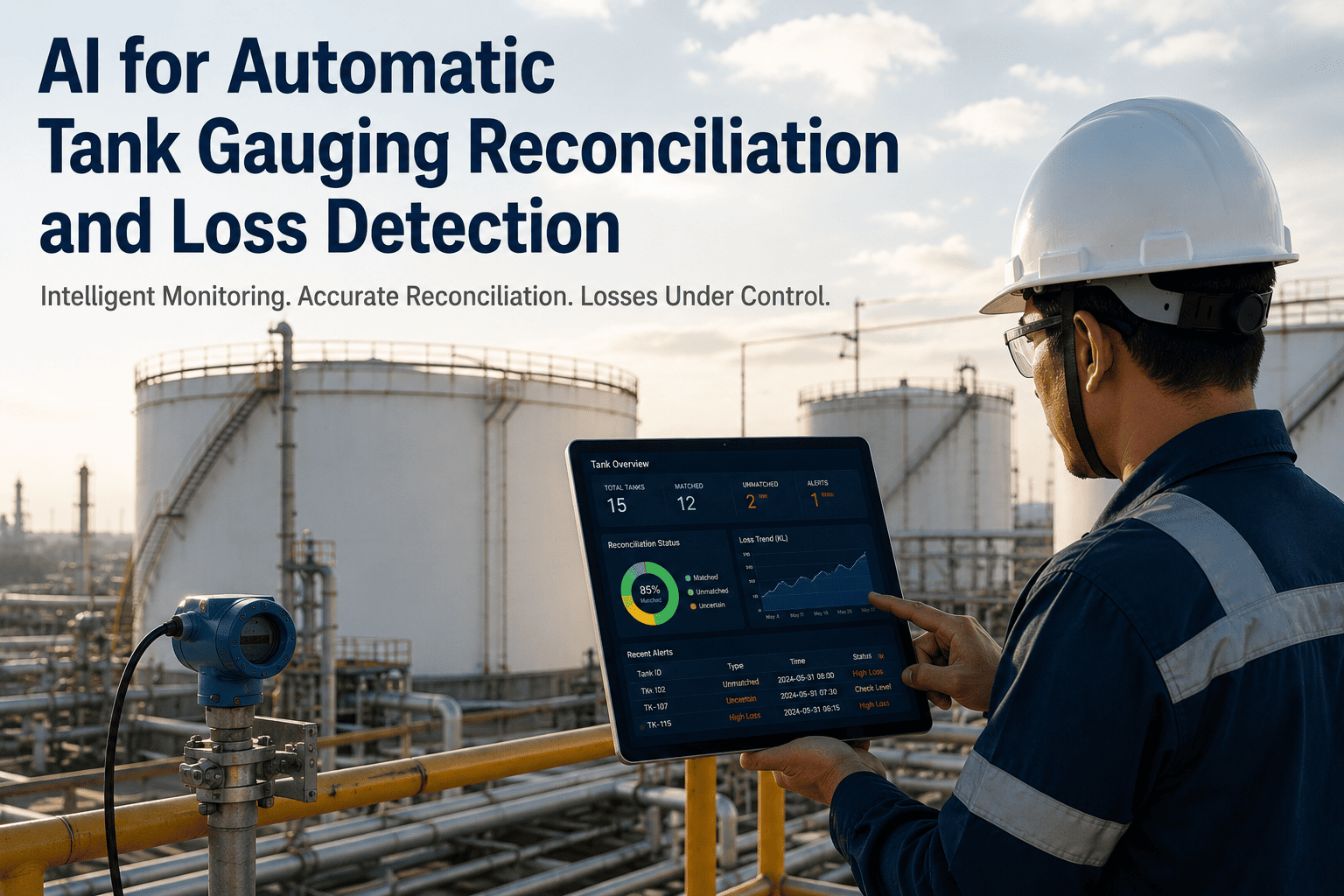
A terminal mass balance is only as useful as its ability to point to where a discrepancy originated, not just confirm that one exists. iFactory's mass balance reconciliation model cross-references gauge readings, applied VCF calculations, and water-cut data across every tank and transfer point, flagging whether a given volume gap traces back to a specific gauge's drift pattern, a temperature compensation error, or a genuine physical loss requiring further investigation.
Expert Perspective: Most "Losses" Are Found in the Measurement Chain First
Every time a shortage claim came in, our first instinct used to be to question the carrier or the counterparty's numbers. Once we started cross-referencing our own gauge drift and VCF calculations systematically, we found that the majority of our discrepancies traced back to a handful of servo gauges that needed recalibration and one tank where water cut hadn't been updated in months. We still investigate genuine losses — but now we rule out our own measurement chain first, and that's resolved more disputes than any negotiation ever did.
Conclusion: Loss Control Starts With Trusting the Measurement, Not Assuming the Worst
Hydrocarbon loss control at a terminal is as much a measurement discipline as it is a security or operational one. Radar and servo gauges each carry their own drift profile, temperature compensation errors compound silently across every barrel measured, and water cut left unmeasured between gauging events can masquerade as a physical loss that never actually happened. Building a mass balance process that checks the measurement chain itself before escalating a discrepancy as theft or shrinkage protects both the terminal's relationships with counterparties and its own operational credibility. The data needed to make that distinction is already being generated by every gauge on the tank farm — it just needs to be reconciled continuously rather than reviewed only when a number doesn't add up.
Fuel Gauging and Mass Balance Loss Control — Frequently Asked Questions
Both can meet custody transfer accuracy requirements when well maintained — servo typically achieves around ±0.4 mm, while radar can reach sub-millimeter accuracy under stable tank conditions.
Every custody transfer volume is corrected to a standard reference temperature using a VCF, so a sensor or calculation error in that correction compounds consistently across every barrel measured.
Yes. Water displacing product in a tank without an updated water-cut value can make recoverable hydrocarbon volume appear to shrink even though total liquid level stays consistent.
iFactory cross-references gauge drift trends, VCF calculation inputs, and water-cut data against the mass balance to isolate whether the source is measurement error or a genuine loss.
Yes. iFactory tracks drift patterns for both gauge types independently, since each technology degrades differently, and reconciles their data into a single mass balance view.