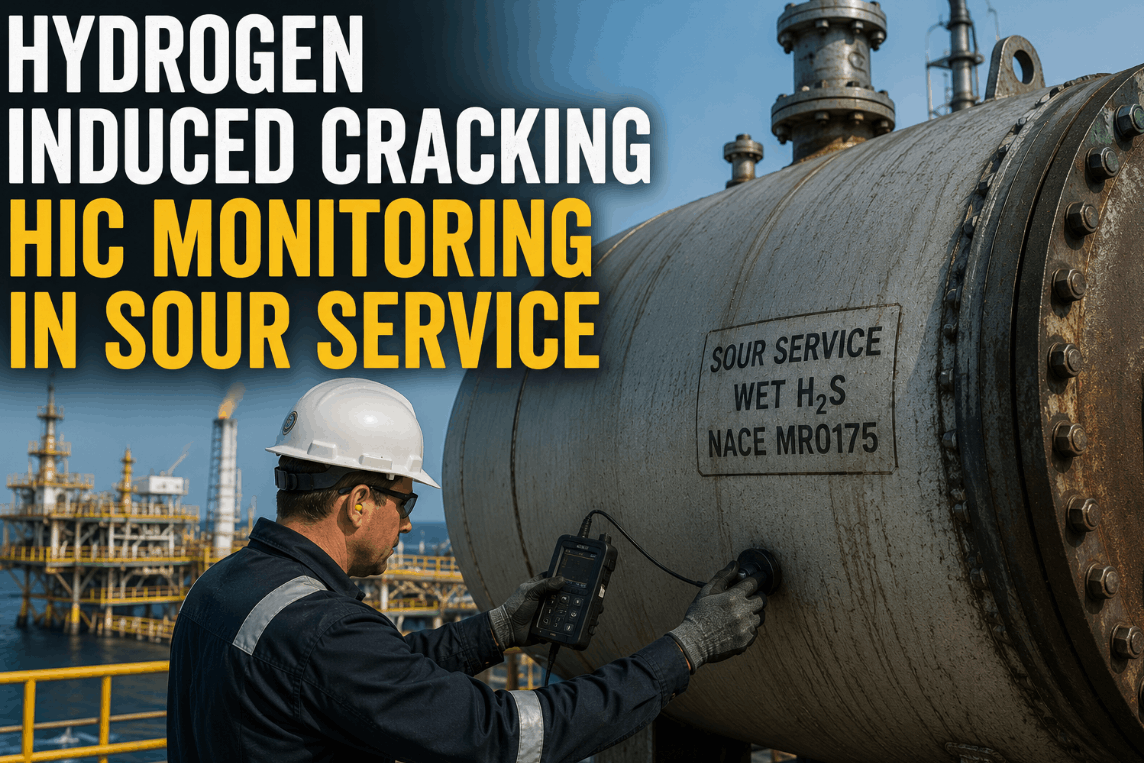
Hydrogen induced cracking is among the most insidious damage mechanisms operating in U.S. refinery and gas processing infrastructure — it progresses silently through carbon steel walls under wet H2S exposure, produces no visible surface signal, and routinely reaches critical crack dimensions before any conventional inspection program detects it. The consequence profile is severe: HIC-compromised pressure vessels, separators, and piping in sour service have failed catastrophically with no preceding warning from pressure or temperature instrumentation. NACE MR0175 and API 571 establish the material selection and inspection framework for sour service assets, but compliance with those standards alone does not constitute active monitoring — it establishes a starting point. Real-time HIC management requires continuous hydrogen flux measurement, ultrasonic thickness trending, and an analytics layer that connects process severity data to equipment damage state across every asset in the sour service inventory. iFactory's sour service integrity platform delivers exactly that capability, giving corrosion engineers and integrity teams the real-time visibility they need to manage HIC and sulfide stress cracking risk before a failure event resets the conversation.
Are Your Sour Service Assets Being Monitored or Just Inspected?
iFactory AI connects hydrogen flux probes, UT thickness data, and process severity records into a unified sour service integrity platform — delivering real-time HIC risk status across your entire asset inventory.
HIC and SSC in Wet H2S Service: How the Damage Develops and Why It Goes Undetected
Hydrogen induced cracking occurs when atomic hydrogen — generated by the cathodic reaction of wet H2S corrosion on steel surfaces — diffuses into the steel lattice and accumulates at internal defects, inclusions, and laminations. H2S acts as a recombination poison, suppressing the formation of molecular hydrogen at the surface and maximizing atomic hydrogen ingress into the metal. Once trapped at a planar inclusion, hydrogen recombines into H2 gas, generating internal pressure that initiates and propagates stepwise cracks parallel to the steel surface. The critical feature of HIC is that it requires no applied external stress — it is purely pressure- and environment-driven, which means it can develop in low-stress locations that are excluded from SSC (sulfide stress cracking) monitoring programs. Process facilities that Book a Demo with iFactory consistently find that their existing sour service monitoring covers SSC-susceptible bolting and hard HAZ zones but leaves HIC-vulnerable base metal in wet H2S separators and absorber shells largely unmonitored in real time.
Sulfide stress cracking operates through the same hydrogen charging mechanism but targets high-strength or hard microstructures — weld HAZs above 22 HRC, improperly PWHT'd connections, and cold-worked areas — under applied or residual tensile stress. SSC failure is rapid and brittle; cracks can propagate to through-wall in hours after initiation. Both mechanisms intensify with H2S partial pressure, temperature excursions below 60°C, and pH drop — the same transient conditions that occur during startup, shutdown, and process upsets that traditional fixed-interval inspection programs are structurally unable to capture.
NACE MR0175 Material Requirements and Where Compliance Gaps Create Unmonitored Risk
NACE MR0175 / ISO 15156 defines the qualification requirements for materials used in H2S-containing oil and gas production environments — establishing maximum hardness limits, heat treatment requirements, and cold-work restrictions for carbon steels, low-alloy steels, stainless steels, and nickel alloys. Compliance with MR0175 at the design and fabrication stage is necessary but not sufficient for operational integrity management. The standard governs material selection; it does not govern the ongoing monitoring of those materials under actual service severity, which varies continuously with crude slate, H2S concentration, temperature, and pH. iFactory's integrity platform maintains a digital NACE compliance register for every sour service asset — tracking material certifications, PWHT records, hardness test documentation, and weld procedure qualifications — and connects that static compliance record to the real-time process severity data that determines whether current operating conditions remain within the original material qualification envelope.
| Material Class | MR0175 Hardness Limit | HIC Susceptibility | SSC Susceptibility | iFactory Monitoring Approach |
|---|---|---|---|---|
| Carbon steel (base metal) | ≤22 HRC (200 HBW) | High — inclusion-dependent | Low at ≤22 HRC | Hydrogen flux probes + UT thickness trending + HIC coupon program |
| Carbon steel (weld HAZ) | ≤22 HRC after PWHT | Moderate | High if HAZ exceeds 22 HRC | HAZ hardness survey records + TOFD at weld seams + SSC risk scoring |
| Low-alloy steel (Cr-Mo) | ≤22 HRC (grade-specific) | Moderate | High if improperly PWHT | PWHT compliance register + periodic hardness verification + UT |
| HIC-resistant plate (HIC-R) | ≤22 HRC | Low — reduced sulfur, Ca-treated | Low at qualified hardness | Coupon program to verify performance + hydrogen flux monitoring |
| 300-series stainless steel | Not hardness-limited | Very low | Low (Cl− SCC monitored separately) | Process severity tracking + chloride exceedance alerts |
The most common compliance gap iFactory identifies in new deployments is a mismatch between the original NACE material qualification envelope and current operating severity — assets qualified at design H2S levels now operating above those levels due to crude slate changes or field acquisition, without a formal re-qualification or enhanced monitoring program in place. Book a Demo to see how the iFactory NACE compliance register flags these envelope exceedances automatically.
Hydrogen Probes, UT Thickness Trending, and the Monitoring Stack for Active HIC Management
Effective HIC monitoring in sour service requires more than periodic inspection — it requires a continuous measurement stack that captures hydrogen charging events as they occur, not weeks later during the next scheduled inspection window. iFactory integrates three complementary monitoring technologies into a unified sour service dashboard: electrochemical hydrogen flux probes for real-time charging rate measurement, permanently installed ultrasonic transducers for continuous wall thickness monitoring at known HIC-susceptible locations, and process severity calculators that convert H2S concentration, pH, and temperature data into a real-time sour severity index for each asset.
Electrochemical Hydrogen Flux Probes
Permeation probes installed on sour service vessel and piping exteriors measure the rate of atomic hydrogen diffusing through the steel wall in real time. Flux spikes during process upsets — H2S exceedances, pH drops, temperature swings — are captured and logged with timestamp and process condition correlation, giving corrosion engineers the transient data that fixed-interval inspection cannot provide.
Permanently Installed UT Transducers
Fixed ultrasonic sensors at high-consequence sour service locations — bottom-of-line pipe segments, separator shell low-points, absorber inlet zones — provide continuous wall thickness data independent of access constraints. iFactory aggregates UT readings from all fixed sensors into a single trending dashboard, applying corrosion rate calculations and remaining-life projections updated with each measurement cycle.
Phased Array UT and TOFD for HIC Detection
Phased array ultrasonic testing (PAUT) and time-of-flight diffraction (TOFD) are the primary NDE methods for detecting existing HIC blisters and stepwise cracking in carbon steel plate. iFactory manages the PAUT/TOFD inspection program — scheduling inspections based on flux probe data and process severity accumulation, tracking crack dimensions from successive inspection rounds, and flagging crack growth rates that approach fitness-for-service assessment thresholds per API 579.
Process Severity Index Calculation
iFactory calculates a real-time sour severity index for each monitored asset using H2S partial pressure from process historian data, aqueous phase pH from online analyzers or lab inputs, temperature, and cumulative upset exposure. The severity index is compared against the material qualification envelope and triggers escalation when operating conditions exceed the original NACE MR0175 design basis — before accumulated damage reaches a critical state.
How iFactory Structures the Sour Service Inspection Workflow from Risk Ranking to Fitness-for-Service
A high-performing HIC inspection program is not a fixed schedule applied uniformly across the sour service inventory — it is a risk-ranked program that allocates NDE resources to the assets and locations where damage probability and consequence are highest. iFactory implements a five-stage sour service integrity workflow that moves from initial asset risk ranking through continuous monitoring, condition-triggered inspection scheduling, fitness-for-service assessment, and long-range remediation planning — all within a single integrated platform accessible to corrosion engineers, inspection planners, and reliability managers simultaneously.
Sour Service Asset Register and Risk Ranking
Build a comprehensive digital register of all wet H2S service assets — vessels, piping, heat exchangers — with service severity, material certification, PWHT status, and current condition rating. Apply API 581 RBI methodology to generate a risk-ranked inspection priority list that allocates NDE resources to highest-consequence assets first.
Continuous Monitoring Deployment and Baseline Establishment
Deploy hydrogen flux probes and fixed UT transducers at priority locations. Establish pre-monitoring baseline thickness and flux measurements. Configure process severity index calculation using live H2S, pH, and temperature data from the process historian. Set alert thresholds calibrated to each asset's material qualification envelope.
Condition-Triggered PAUT/TOFD Inspection Scheduling
Inspection intervals are not calendar-fixed but are advanced when hydrogen flux accumulation or process severity exceedance meets predefined triggers. iFactory generates prioritized PAUT/TOFD work orders with asset ID, location coordinates, inspection scope, and access requirements — delivered to the inspection contractor with sufficient lead time to mobilize within the trigger window.
HIC/SOHIC Finding Documentation and FFS Assessment
All PAUT/TOFD findings — blister dimensions, crack length and depth, stepwise crack connectivity — are entered into iFactory's inspection record system and assessed against API 579 Level 1 and Level 2 fitness-for-service criteria. Remaining life calculations and reinspection intervals are generated automatically and stored in the asset record for engineering review and regulatory documentation.
Remediation Tracking and Long-Range Capital Planning
HIC findings requiring repair, weld overlay, or section replacement are tracked through the remediation workflow with work order generation, contractor scheduling, and post-repair NDE documentation. Cumulative damage trends feed a 5–10-year capital replacement forecast — providing the planning horizon that budget justification for major vessel replacements requires.
Why Sour Service Integrity Programs Need Real-Time Analytics, Not Better Inspection Schedules
I have spent 22 years in refinery corrosion engineering and fixed equipment integrity, and the pattern I see consistently in facilities experiencing HIC-related failures is not the absence of an inspection program — it is the absence of a monitoring program. There is a fundamental difference. An inspection program tells you the condition of the asset on the day it was inspected. A monitoring program tells you how conditions are changing between inspections, and whether the assumptions underlying your inspection interval are still valid. In sour service, those assumptions can be invalidated overnight by a crude slate change that doubles the H2S partial pressure in the separator train. If your only data point is a PAUT survey from 18 months ago, you have no basis for knowing whether that asset is still within its original fitness-for-service assessment. The facilities that are managing HIC effectively are the ones that have hydrogen flux probes running continuously and a platform that connects those flux readings to process severity data, material qualification envelopes, and inspection records. When I see a plant running a six-sigma quality program on product purity and a calendar-based inspection schedule on sour service pressure vessels, I know exactly where the next corrosion management failure is going to originate.
Managing HIC Risk in Sour Service Requires Continuous Visibility, Not Periodic Snapshots
Hydrogen induced cracking and sulfide stress cracking in wet H2S service are damage mechanisms that cannot be managed effectively by inspection programs alone. The transient process events that drive the most severe hydrogen charging — upset conditions, crude slate changes, startup and shutdown sequences — occur between inspection intervals and leave no visible surface evidence. A robust sour service integrity program requires continuous hydrogen flux monitoring, real-time process severity tracking, and an analytics platform that connects those measurements to material qualification records, NDE findings, and fitness-for-service assessments across the full sour service asset inventory.
iFactory's sour service integrity platform delivers the full monitoring and inspection management workflow — from NACE MR0175 compliance register and API 581 risk ranking through condition-triggered PAUT/TOFD scheduling, FFS assessment tracking, and long-range capital planning. The platform is deployable in 6–10 weeks for a mid-size refinery sour service asset portfolio and integrates with existing process historians, CMMS, and inspection contractor data systems without requiring DCS modifications. To see how iFactory deploys for your sour service asset configuration, Book a Demo with our corrosion engineering team.
Deploy Real-Time HIC Monitoring Across Your Entire Sour Service Asset Inventory
iFactory AI integrates hydrogen flux probes, UT thickness trending, process severity indexing, and NACE compliance records into a unified platform — built for corrosion engineers managing wet H2S damage in U.S. refineries and gas plants.
HIC Monitoring in Sour Service — Common Questions Answered
HIC is stress-independent cracking in base metal driven by hydrogen pressure at inclusions, while SSC is stress-assisted cracking in hard microstructures under applied or residual tensile load — iFactory monitors both through hydrogen flux probes, process severity indexing, and separate risk scoring models calibrated to each mechanism.
iFactory connects to OSIsoft PI, Aspen InfoPlus.21, and other process historians via read-only OPC-UA or REST connectors, pulling H2S, pH, and temperature tags for real-time severity index calculation alongside hydrogen probe data — with no DCS configuration changes required.
iFactory manages PAUT (phased array UT) and TOFD inspection programs as the primary HIC/SOHIC detection methods, scheduling condition-triggered inspections based on flux probe data and tracking crack dimensions across successive inspection rounds against API 579 FFS assessment criteria.
iFactory maintains a digital NACE compliance register for each asset — storing material certifications, hardness test records, PWHT documentation, and weld procedure qualifications — and automatically alerts when real-time process severity exceeds the original material qualification envelope defined at design.
A mid-size refinery sour service asset portfolio deploys in 6–10 weeks, covering asset register build, process historian integration, hydrogen probe connectivity, RBI risk ranking configuration, and inspection workflow deployment — without requiring DCS changes or plant outage.