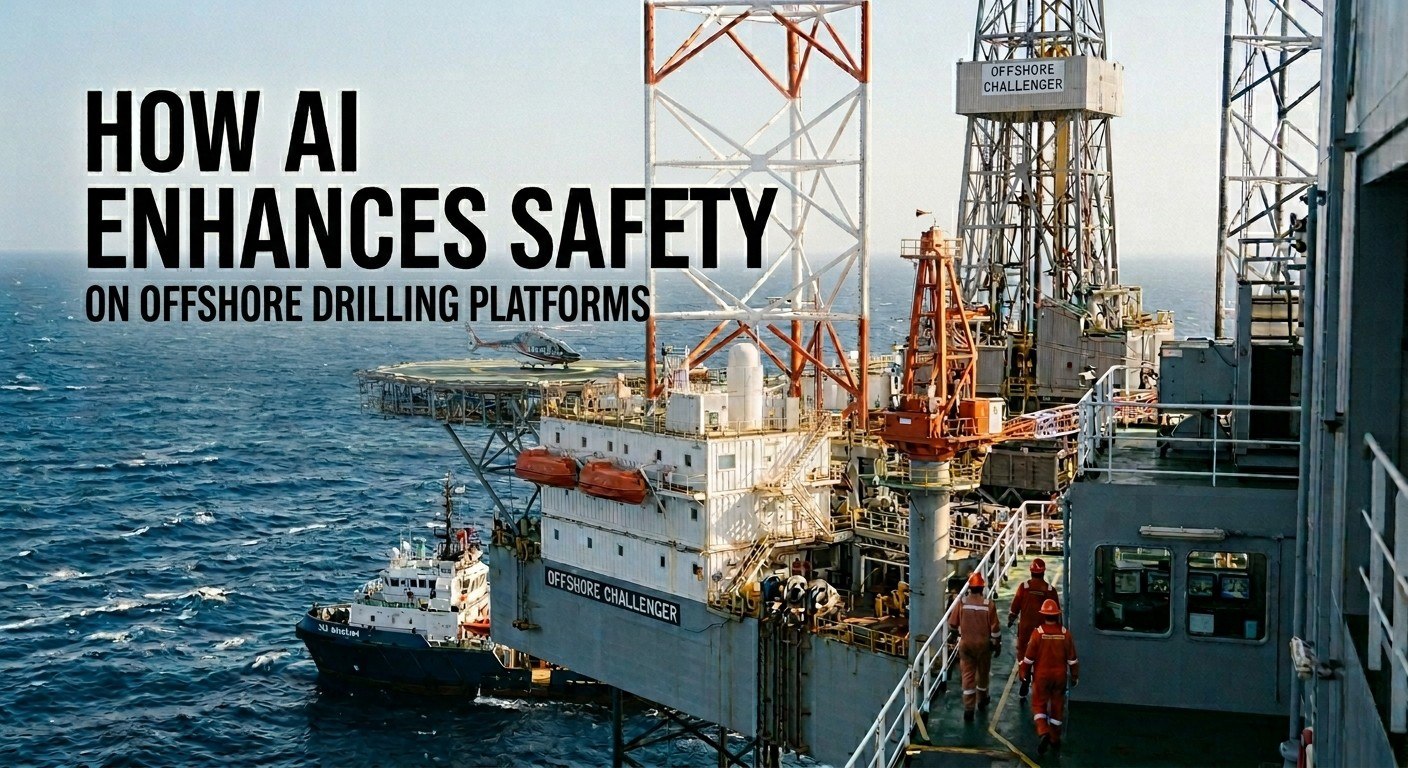
An AI model that runs perfectly in a cloud environment onshore can fail completely the moment it's asked to run on an offshore platform, and the reason rarely has anything to do with the model itself. Offshore platforms operate on satellite-only connectivity with bandwidth measured in kilobits where an onshore facility would have fiber, power budgets that are shared across life-critical systems before anything else gets a share, and equipment rooms where every device installed in a classified area has to be explosion-proof certified before it can be powered on at all. A deployment architecture built around onshore assumptions runs into every one of those limits within the first week, whether that shows up as a model that can't sync fast enough to be useful, a device that draws more power than the platform can spare, or a sensor that simply can't be installed in the zone where the data actually needs to be collected. None of these are AI problems in the traditional sense; they're deployment architecture problems that have to be solved before the model ever gets a chance to prove its value, and a working session with our team can walk through how that architecture is built for a platform with your specific constraints.
Overview · Offshore AI Architecture
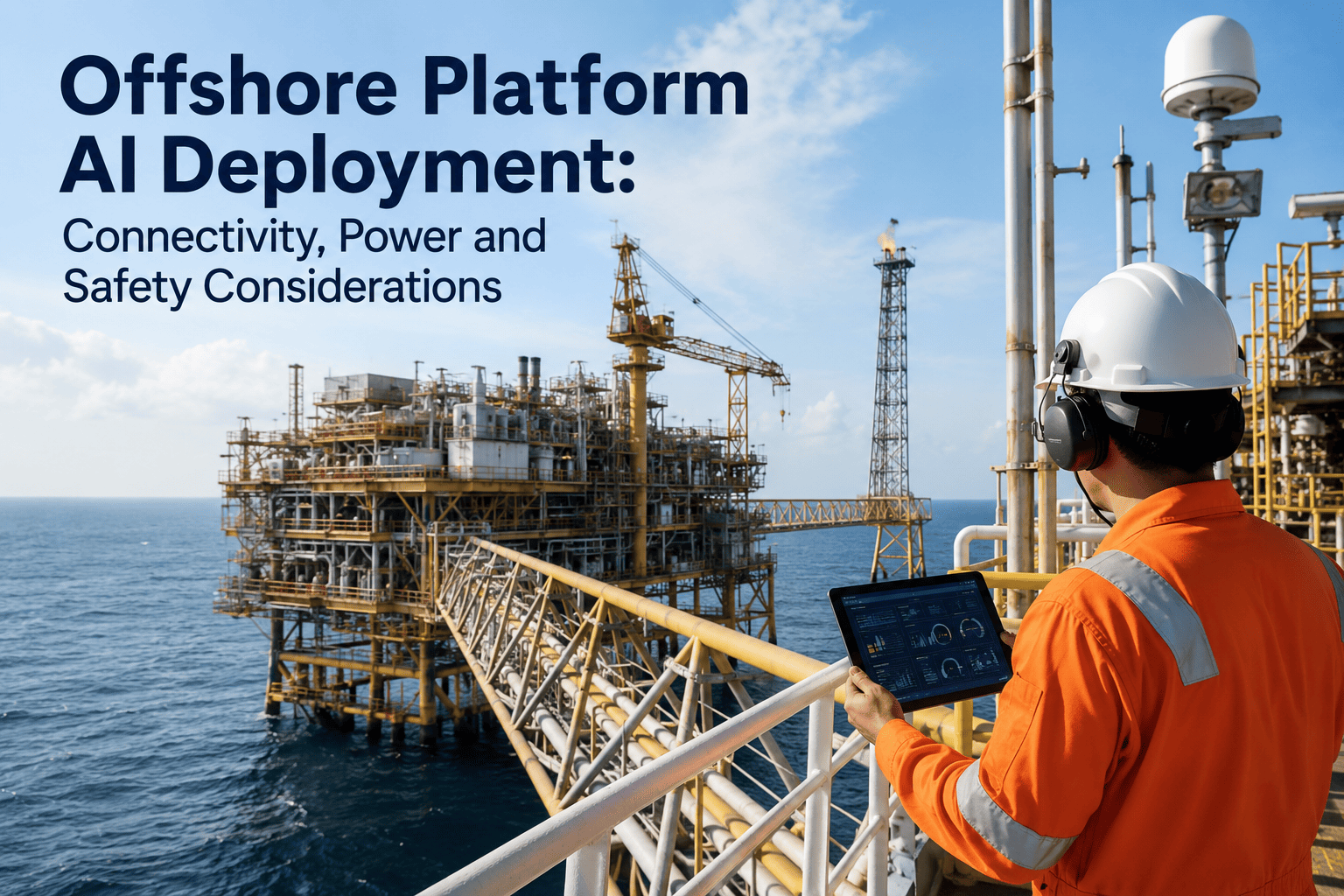
Offshore Platform AI Deployment: Connectivity, Power, and Safety Considerations
A practical architecture guide for running AI on offshore platforms, built around the four constraints that actually determine whether a deployment works out there: satellite-only connectivity, limited power budgets, hazardous area certification, and weight and space restrictions.
Connectivity
Satellite-Only
Area Rating
Class I / Zone 1
Footprint
Weight & Space Limited
Why Onshore Architecture Doesn't Transfer
Four Constraints That Break a Standard AI Deployment
Most AI deployment patterns assume a few things that simply aren't true offshore: reliable low-latency connectivity back to a cloud environment, power that scales with compute demand, standard-rated hardware that can go wherever the data is, and enough physical space to add another equipment rack without a fight over deck weight. An offshore platform inverts every one of those assumptions. Connectivity runs over satellite links with real bandwidth ceilings and latency that makes constant cloud round-trips impractical. Power is generated and distributed against a fixed budget that life-safety and process systems get first claim on. Any device installed in a hazardous area has to carry Class I Division 1 or 2 certification, or the equivalent Zone 1 or Zone 2 rating under ATEX and IECEx, before it can be powered on near a wellhead, compressor, or storage tank. And every kilogram added to a platform competes against a weight budget that was set at design time and rarely has much room left in it. A deployment plan that doesn't account for all four at once tends to work in a lab and stall the moment it reaches the platform.
Architecture Pattern
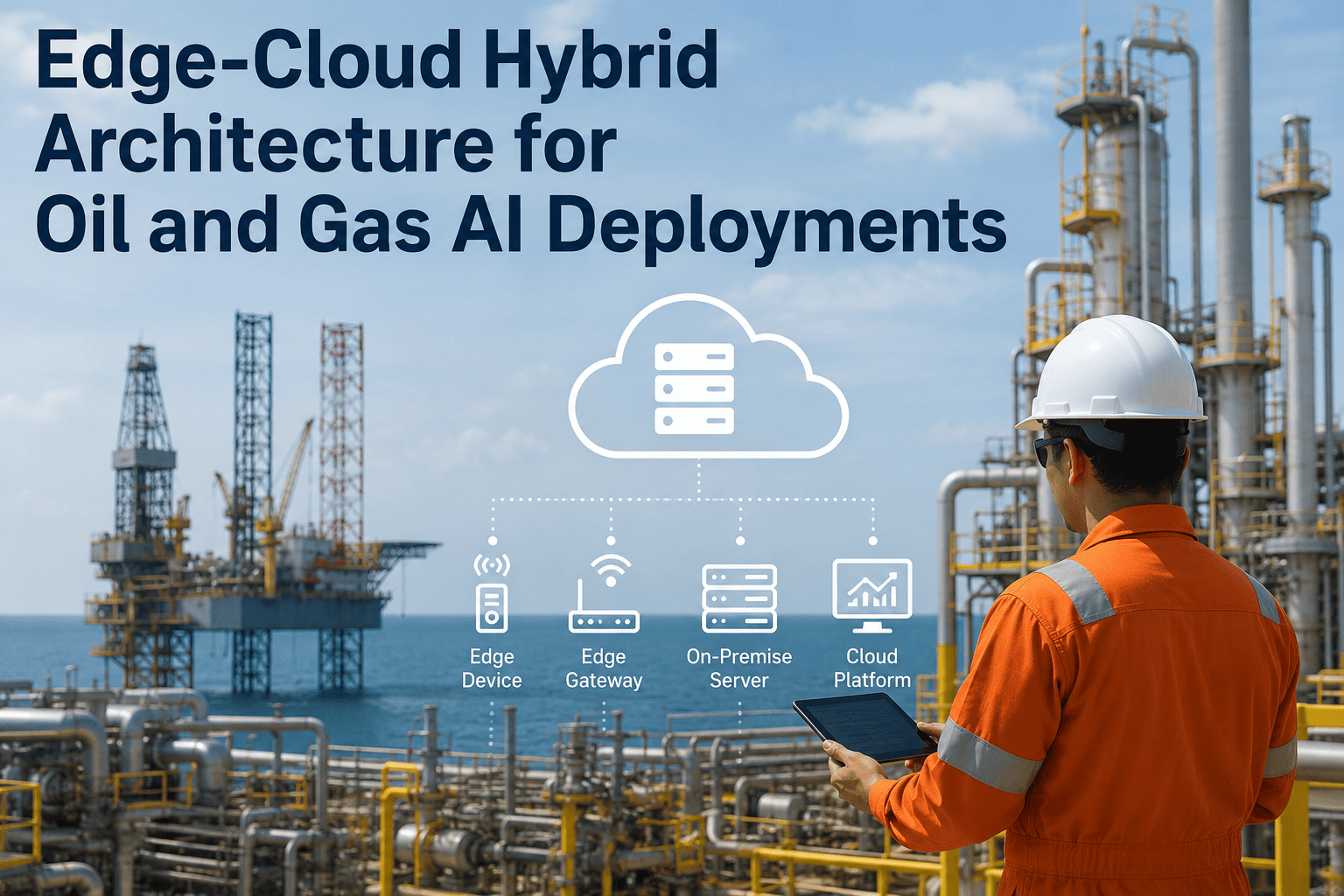
Edge-First Processing With Scheduled Satellite Sync
The pattern that actually holds up offshore inverts the typical cloud-first design: inference runs locally on the platform, close to the sensors generating the data, and only the results that matter get sent back over the satellite link on a schedule the bandwidth budget can actually support. Raw sensor streams stay on the platform where storage is cheap and bandwidth isn't a constraint; what travels over satellite is a small, prioritized payload instead of a continuous firehose the link was never sized to carry.
01
Sensor Layer Vibration, pressure, temperature, and process data collected at the equipment, rated for the zone it sits in.
02
Edge Inference Low-power compute on the platform runs the model against local data, flagging anomalies without waiting on a round trip.
03
Prioritized Sync Only flagged results, summaries, and critical alerts are queued for the next satellite window instead of raw streams.
04
Onshore Aggregation Results roll up across the fleet for trend analysis, model retraining, and fleet-wide comparisons back onshore.
Hazardous Area Requirements
What Zone Rating Actually Determines for Equipment Placement
Where a device can physically be installed on the platform is decided by the hazardous area classification of that location, not by what the device is capable of measuring. Getting this wrong late in a deployment usually means re-specifying hardware after it's already been ordered.
| Classification | Typical Location | What Equipment Needs |
|---|
| Zone 0 / Class I Div 1 (continuous) | Inside process vessels, compressor housings | Intrinsically safe or flameproof rated devices only |
| Zone 1 / Class I Div 1 | Wellhead areas, pump rooms, near process skids | ATEX/IECEx or UL-listed explosion-proof enclosures |
| Zone 2 / Class I Div 2 | Surrounding skid areas with good ventilation | Increased-safety rated equipment, still certified |
| Unclassified / Safe Area | Control rooms, living quarters, office spaces | Standard industrial hardware, no explosion rating needed |
Map Your Own Platform's Constraints Before Specifying Hardware
Every platform has a different mix of connectivity bandwidth, power headroom, and zone-rated space. A short session maps those constraints against an actual deployment architecture before any equipment gets ordered.
Applied Example
Why a Cloud-Dependent Model Fails the Moment It Reaches the Platform
Consider a compressor vibration monitoring model built and validated onshore using continuous high-resolution streaming data sent to a cloud environment for inference. It performs well in testing, where connectivity is unlimited. Moved to the actual platform, the same model tries to stream that same volume of data over a satellite link with a fraction of the bandwidth, and either the link saturates or the platform's power budget can't sustain a device drawing enough to keep a constant connection alive. The fix isn't a better model, it's a different architecture: the vibration analysis runs at the edge on the platform itself, comparing readings against learned baselines locally, and only sends an alert over satellite when a reading actually crosses a threshold worth flagging. The model catches the same bearing wear it was designed to catch, the satellite link only carries the handful of alerts that matter in a given week, and the platform's power draw stays within what was budgeted for the equipment rack from the start.
Cloud-Only vs Edge-Only vs Hybrid Architecture
Three Deployment Patterns, Three Very Different Outcomes Offshore
Not every AI workload needs the same architecture, and picking the wrong one for a given use case is usually what drives cost overruns and missed timelines on offshore projects. Cloud-only designs assume connectivity that doesn't exist offshore. Edge-only designs solve the connectivity problem but lose the benefit of fleet-wide trend analysis across a company's full set of platforms. A hybrid pattern keeps the responsiveness of edge inference while still rolling results up to a shared onshore view.
Cloud-Only
Works onshore, fails offshore where bandwidth and latency can't support constant round trips.
Edge-Only
Responsive and bandwidth-light, but isolates each platform without a fleet-wide view.
Hybrid Edge + Sync
Local inference for speed, scheduled sync for fleet visibility within the bandwidth budget.
What's Actually at Stake
Where a Mismatched Architecture Actually Costs a Project
The cost of getting offshore deployment architecture wrong rarely shows up as a single failed test; it shows up as a slow accumulation of rework. Hardware gets specified before the hazardous area classification is confirmed, then has to be re-ordered once it's clear the original device isn't rated for the zone it needs to sit in, adding weeks to a schedule that offshore logistics windows make expensive to slip. A model that assumes constant connectivity gets deployed, saturates the satellite link, and either gets throttled into uselessness or starts competing with operationally critical traffic for the same limited bandwidth. And a device that draws more power than expected forces a difficult conversation about what else on the platform has to give up capacity to accommodate it, a conversation that's much easier to avoid than to win after the fact. None of these failure modes are really about whether the AI model works. They're about whether the deployment plan accounted for the platform it was actually going to run on.
Every offshore deployment I've been part of that ran into trouble had the same root cause: someone designed the AI architecture around the data center it was easiest to build in, then tried to fit it onto a platform afterward. The platform doesn't negotiate on power budget or zone classification, so the architecture has to be built around those limits from the first design conversation, not adjusted after the hardware is already on order. Once teams start with the connectivity and power constraints as the starting assumptions instead of an afterthought, the rest of the deployment tends to go a lot more smoothly.
Tobias Reinholt-Achebe
Offshore Digitalization Architect · 15 years in upstream automation and controls
Getting Started Guidance
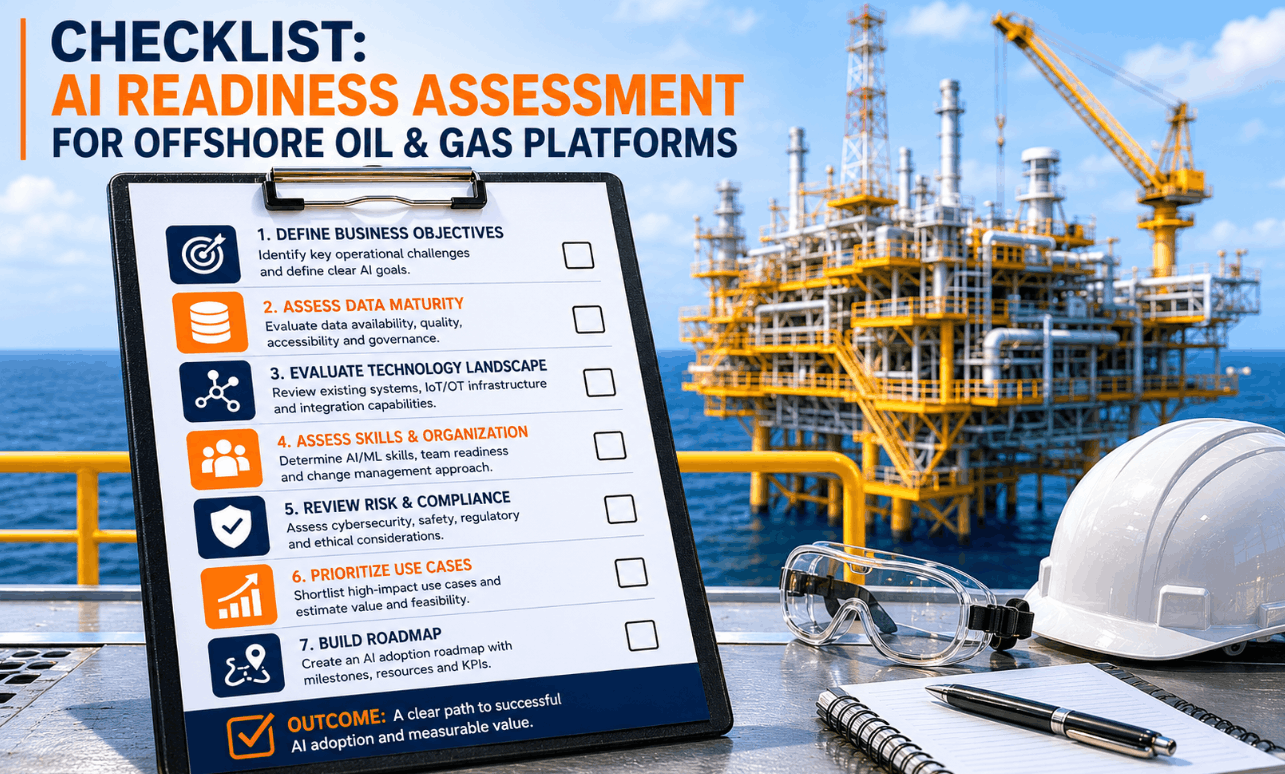
What to Confirm Before Specifying an Offshore AI Deployment
Answering these up front determines how much of the architecture is a standard pattern versus a custom build for your platform.
| Question | Why It Matters |
|---|
| What's the actual available satellite bandwidth and latency? | Determines how much data can realistically sync per window |
| How much spare power capacity exists in the equipment rack? | Sets the ceiling for edge compute hardware options |
| What hazardous area zone does each sensor location fall under? | Decides which certified hardware options are even eligible |
| How much deck weight and rack space is actually free? | Shapes whether new hardware or existing infrastructure gets used |
Common Questions
Offshore AI Deployment — Frequently Asked
These are the questions engineering and digitalization teams tend to ask first when scoping an AI deployment for an offshore platform.
Can AI models actually run reliably with satellite-only connectivity?
Yes, as long as the architecture is designed around that constraint rather than assuming continuous cloud connectivity, which usually means running inference locally on the platform and syncing only prioritized results back over the satellite link on a set schedule. Trying to stream raw sensor data continuously over a satellite connection is where most offshore deployments run into trouble.
Book a demo to see how a bandwidth-aware architecture is designed for a specific link.
Does edge compute hardware need to be explosion-proof rated everywhere on the platform?
Only in classified hazardous areas, which typically includes anywhere near wellheads, compressors, process skids, and storage systems, while control rooms and other unclassified safe areas can use standard industrial hardware. Getting the zone classification right for each installation point is what determines whether a device needs Class I Division 1, Division 2, or no explosion rating at all.
Contact support to review the classification for your installation points.
How much power does an edge AI deployment actually need to budget for?
Power draw depends heavily on how much compute runs at the edge versus what gets deferred to onshore processing, and low-power edge hardware options exist specifically to fit within the tight power budgets typical of offshore equipment racks. The right approach is usually to right-size the edge compute to the specific inference workload rather than defaulting to the same hardware used in an onshore data center.
Book a session to size a power budget against your platform's available capacity.
Can models still be improved or retrained without constant cloud access?
Yes, models can run locally on the platform between sync windows while training data and performance metrics queue up for the next scheduled satellite transfer, allowing retraining and fleet-wide model improvements to happen onshore on a periodic cycle rather than requiring a live connection. This keeps the platform-side system fully functional even during connectivity gaps.
Ask our team about the retraining cycle for your fleet.
How does this scale across a fleet of multiple platforms with different constraints?
Each platform can run its own edge deployment sized to its specific bandwidth, power, and zone constraints, while results still roll up into a shared onshore view for fleet-wide comparison and trend analysis, so a platform with tighter constraints doesn't have to run a lesser version of the same underlying model. The architecture adapts per platform without fragmenting the fleet-wide picture.
Book a call to see how this applies across your specific fleet.
Build an AI Deployment Around Your Platform's Actual Constraints, Not a Data Center's
iFactory designs edge-first AI architecture for offshore platforms, working within your actual satellite bandwidth, power budget, hazardous area classifications, and weight limits instead of forcing a cloud-first pattern onto a platform that can't support it.