Most oil and gas operators evaluating an AI platform end up comparing vendors against whatever criteria happened to come up in each individual sales call — one vendor gets asked about SCADA integration, another gets asked about pricing, and by the final decision meeting, no two vendors were actually measured against the same yardstick. That gap is rarely visible until months after signing, when a platform that looked strong on the demo turns out to have no offline mode for a remote pad, no IEC 62443 alignment for the security team, or a licensing model that triples in cost once every well site is connected. Visit iFactory's support page to see how a structured evaluation framework compares against an ad hoc vendor shortlist.
15 Criteria That Actually Separate a Production-Ready O&G AI Platform From a Demo
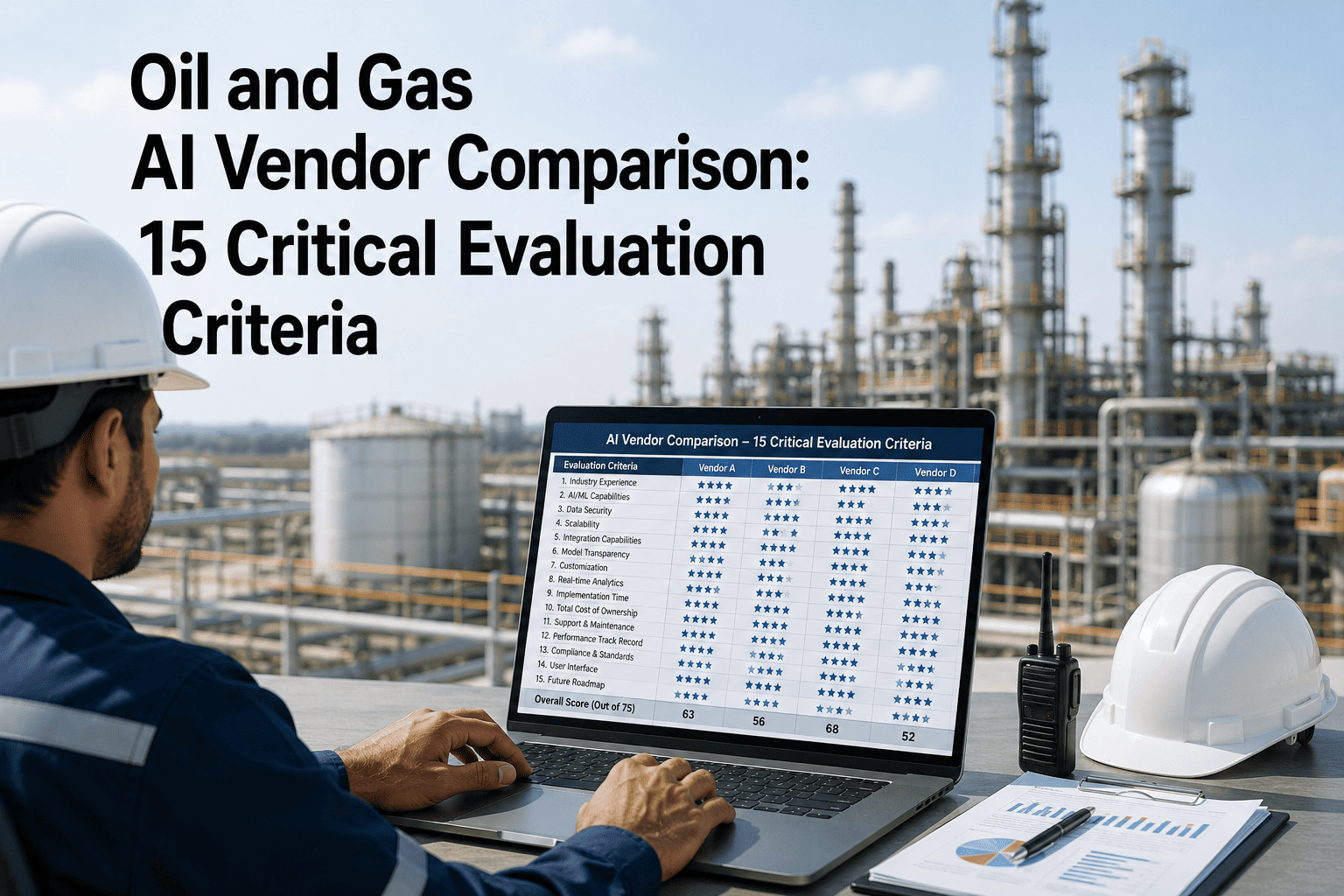
Deployment architecture, cybersecurity posture, AI trustworthiness, and total cost of ownership rarely get evaluated with the same rigor in a single RFP. This framework groups all 15 into four categories so every vendor gets measured against the same standard.
Why an Ad Hoc Vendor Shortlist Almost Always Backfires
A typical O&G AI procurement process runs through several demos, a handful of reference calls, and a pricing negotiation — but rarely a single consistent checklist applied identically to every vendor in the running. Each demo tends to highlight that vendor's specific strength, which means the evaluation team walks away impressed by different things from different vendors instead of comparing all of them against the same operational, security, and commercial requirements. The cost of that inconsistency rarely shows up during the sales process itself — it shows up months later, once implementation is underway and a gap nobody asked about during the demo turns into a change order, a delayed go-live, or a security review that stalls the rollout entirely.
The Demo Bias Problem
A vendor demo is built to showcase what the platform does best, not to answer the specific questions your OT security, integration, and finance teams actually need answered — leaving critical gaps undiscovered until implementation is already underway.
The Split-Ownership Problem
Sourcing wants faster time to value, security wants IEC 62443 alignment, and finance wants total cost of ownership — when each function evaluates the vendor separately against its own criteria, no one owns the full 15-point picture until it's too late to renegotiate.
Category 1: Deployment & Architecture
A platform that runs beautifully on a cloud demo environment can behave very differently once it has to operate against a real SCADA historian, a remote well pad with intermittent connectivity, and control-system protocols that predate the vendor's own product roadmap.
On-Premise or Edge Deployment
Confirm the platform can run fully on-site or at the edge, not only as a cloud-hosted service — many operators require this for latency, connectivity, or data governance reasons tied to critical process control.
Native SCADA / DCS / Historian Integration
Ask exactly which historian and control system connectors ship natively versus which require custom middleware built and maintained by your own integration team after go-live.
Offline / Degraded-Network Operation
A remote well site or platform with intermittent connectivity needs the platform to keep functioning locally and sync when connectivity returns, rather than going dark the moment the link drops.
Legacy Protocol Support
Verify support for OPC-UA, Modbus, and DNP3 alongside modern APIs — much of the installed base in oil and gas still runs on these protocols, and a platform that only speaks REST leaves a real integration gap.
Score Your Own Shortlist Against All 15 Criteria in One Session
iFactory walks through each of the four evaluation categories against your actual SCADA environment, security requirements, and site connectivity — so the comparison reflects your operation, not a generic demo script.
Category 2: Security & Compliance
Industrial control environments in oil and gas run long-lived, safety-critical equipment that can't tolerate the kind of intrusive scanning or trial-and-error patching common in IT security practice. A vendor's security posture needs to reflect that reality specifically, not a generic enterprise SaaS security policy repurposed for OT. This is also the category where a vendor's marketing language and its actual engineering practice diverge most often, since "enterprise-grade security" on a slide rarely maps to a specific, verifiable standard unless you ask for one directly.
IEC 62443 Security Level Alignment
Ask which Security Level (SL 1 through SL 4) the platform is designed and validated against, and whether that claim is backed by third-party certification or only a self-assessment.
Cybersecurity Management System Fit
Confirm the vendor can support your organization's IEC 62443-2-1 cybersecurity management system requirements, including how they document risk assessments and supplier obligations under 62443-2-4.
Zero Trust Network Architecture
Check whether access between the AI platform and the control network follows zero trust principles — explicit verification at every connection point — rather than a flat network trust model that widens the attack surface.
Data Residency & Sovereignty
Confirm exactly where process data, model outputs, and any operator-specific training data physically reside, and whether that location satisfies your jurisdiction's regulatory and internal data governance requirements.
| IEC 62443 Security Level | What It Protects Against | Why It Matters for AI Platforms |
|---|---|---|
| SL 1 | Casual or coincidental exposure | Baseline expectation; insufficient alone for a platform touching production control data |
| SL 2 | Intentional violation using simple means | Typical minimum for platforms with any network path into an OT environment |
| SL 3 | Intentional violation using sophisticated means | Common target for platforms integrated directly with SCADA or DCS systems |
| SL 4 | Intentional violation using sophisticated means with extended resources | Reserved for the highest-consequence assets; rarely required outside safety instrumented systems |
Category 3: AI Trustworthiness & Process Expertise
A general-purpose language model with an oil and gas skin is not the same thing as a platform built on process expertise, and the difference shows up exactly when an operator needs the AI's output the most — during an abnormal condition where a wrong or unfounded recommendation carries real safety consequence. This category is harder to evaluate in a single demo than deployment or pricing, which is exactly why it tends to get the least rigorous scrutiny even though it carries the highest operational risk.
Hallucination Prevention & Guardrails
Ask specifically how the platform prevents a confident but fabricated recommendation from reaching an operator, and what happens when the model genuinely doesn't have enough data to answer reliably.
Domain-Specific Process Validation
Confirm the underlying models were trained and validated on oil and gas process data specifically, not adapted from a generic industrial or consumer dataset with a thin layer of domain terminology on top.
Explainability & Audit Trail
Every AI recommendation touching a safety-critical decision should trace back to the specific data and logic that produced it, so an operator or auditor can reconstruct why the system recommended what it did.
Safety-Critical Decision Validation Workflow
Confirm there's a defined human-in-the-loop checkpoint before any AI recommendation can directly affect a safety-critical process, rather than the platform being positioned for closed-loop control from day one.
Category 4: Commercial & Total Cost of Ownership
The license fee quoted in a proposal is rarely the number that determines whether a platform was actually worth the investment two years in — integration effort, training time, and who owns ongoing tuning tend to matter far more to the real total cost. Because these costs are usually spread across different budget lines and different fiscal years, they're also the easiest category to underestimate at the exact moment a decision is being finalized.
Total Cost of Ownership Beyond the License
Ask for a full cost breakdown covering integration work, staff training, ongoing model tuning, and support tiers — not just the per-site or per-user license figure that headlines the proposal.
Implementation Timeline & Ownership
Clarify who owns each implementation milestone — the vendor's professional services team, a third-party integrator, or your own internal staff — and what happens to the timeline if any of those resources slip.
Live Production References
Request a reference site running the platform in live production, not a pilot, on infrastructure comparable to yours — and ask that reference directly about the gap between the sales pitch and day-to-day operation.
| Cost Category | License-Only View | Full Total-Cost-of-Ownership View |
|---|---|---|
| Software | Per-site or per-user license fee | Same license fee, plus any tier upgrades triggered by scale |
| Integration | Often excluded from the initial quote | SCADA/historian connector build, custom middleware, testing time |
| Training | Rarely itemized | Operator and engineer onboarding hours across every shift |
| Ongoing Tuning | Assumed included | Model retraining, threshold recalibration as processes change |
Building the Evaluation Team Around All Four Categories
No single department has visibility into all 15 criteria on its own, which is exactly why an evaluation run by one function tends to produce a decision the other functions end up relitigating during implementation. Assigning clear ownership of each category before the first vendor demo is what keeps the framework from collapsing back into an ad hoc process once the sales calls actually start.
Engineering & OT Security
Owns the Deployment & Architecture and Security & Compliance categories — validating SCADA connectivity, offline behavior, IEC 62443 alignment, and zero trust network design against the actual control environment the platform will touch.
Process & Data Science Review
Owns the AI Trustworthiness category — running hallucination and edge-case tests against real historical data, and confirming the explainability and human-in-the-loop workflow actually holds up for safety-critical decisions.
Sourcing and finance typically take the Commercial & TCO category, negotiating the contract only after the other three categories have already cleared their own thresholds — reversing that order, and negotiating price before security and engineering have signed off, is one of the most common reasons a deal gets renegotiated or unwound after the fact.
Common Mistakes When Running a Vendor Evaluation
The mistakes below show up repeatedly across O&G AI procurement cycles, and nearly all of them trace back to evaluating vendors against whatever each function cared about most, rather than a shared framework applied consistently to every candidate.
Letting the Demo Set the Criteria
Evaluating each vendor mainly on what its own demo chose to highlight means the comparison reflects each vendor's marketing priorities instead of your actual operational requirements.
Treating Security as a Late-Stage Checkbox
Bringing OT security into the evaluation only after a vendor is functionally selected often surfaces IEC 62443 or network architecture gaps too late to influence the decision without a costly restart.
Skipping the Full TCO Conversation
Comparing vendors on license price alone routinely produces a decision that looks cheaper on paper and materially more expensive once integration and training costs land in year one.
Accepting Reference Calls Chosen by the Vendor
A reference site hand-picked by the vendor tends to describe the best possible outcome — ask instead for a reference running a comparable use case and connectivity environment to your own.
Scoring a Vendor Against the Full Framework
Once each criterion has been discussed with a vendor, the evaluation is more useful as a comparative record than as a collection of unstructured notes. A simple scoring approach — rating each of the 15 criteria on a consistent scale and totaling by category — turns four separate conversations with sourcing, security, engineering, and finance into one shared view the whole evaluation team can actually compare side by side.
| Score | What It Means | Action |
|---|---|---|
| 2 — Fully Met | Vendor demonstrates the capability directly, with documentation or a live reference to support it | No further validation needed for this criterion |
| 1 — Partially Met | Capability exists but with meaningful gaps, workarounds, or an unverified claim | Flag for deeper technical validation before shortlisting |
| 0 — Not Met | Capability is absent, roadmap-only, or the vendor could not answer the question directly | Treat as a disqualifying gap for pass/fail categories like Security & Deployment |
A vendor that scores well across Deployment and Security but weakly on AI Trustworthiness is a very different risk profile than one that scores well everywhere except Commercial terms — the category breakdown matters more than a single combined total, since a low score concentrated in one category points to a specific, addressable gap rather than a vendor that's simply weaker across the board.
Frequently Asked Questions
Do all 15 criteria carry equal weight in the evaluation?
No. Most operators find that Security & Compliance and AI Trustworthiness carry more weight than Commercial criteria, since a platform that fails on cybersecurity or produces unreliable recommendations can't be salvaged later by a better contract. Deployment & Architecture criteria often act as pass/fail gates — a platform that can't integrate with your SCADA environment or operate offline at a remote site is disqualified regardless of how it scores elsewhere. Visit support to see how weighting is typically structured for a specific operating environment.
How long should a full 15-criteria vendor evaluation take?
A structured evaluation covering all four categories with two to three shortlisted vendors typically runs four to eight weeks, including reference calls and a technical proof of concept against real site data. Rushing this timeline is one of the most common reasons a gap in security posture or integration depth doesn't surface until after the contract is signed. Book a demo to walk through a proof-of-concept scope sized to your evaluation timeline.
What's the difference between a vendor claiming IEC 62443 alignment and being certified?
Alignment is a vendor's own statement that its product or development process follows 62443 principles, while certification means an accredited third-party body has independently verified that claim against a specific Security Level or Maturity Level. Certification carries more weight in a procurement decision, but even self-assessed alignment should come with documentation you can review rather than a verbal assurance on a sales call.
How do you actually test for hallucination prevention before signing a contract?
Run the platform against a set of real historical scenarios from your own operation where you already know the correct answer, including a few edge cases with genuinely insufficient data, and check whether the platform flags uncertainty honestly or produces a confident but wrong answer. A vendor confident in its guardrails should welcome this test rather than resist it. Contact support to see how this kind of validation test is typically structured.
Should the evaluation team include finance and legal, or just engineering and IT?
All four should be involved before a vendor is selected. Engineering and IT typically validate the Deployment and AI Trustworthiness criteria, security reviews the Security & Compliance category, and finance and legal own the Commercial & TCO criteria and contract terms — a decision made without all four perspectives tends to resurface unresolved questions during implementation instead of before signing.
Run Your Shortlist Through the Full 15-Criteria Framework
iFactory walks your evaluation team through deployment, security, AI trustworthiness, and total cost of ownership against your actual SCADA environment — so the vendor decision holds up well past the demo.