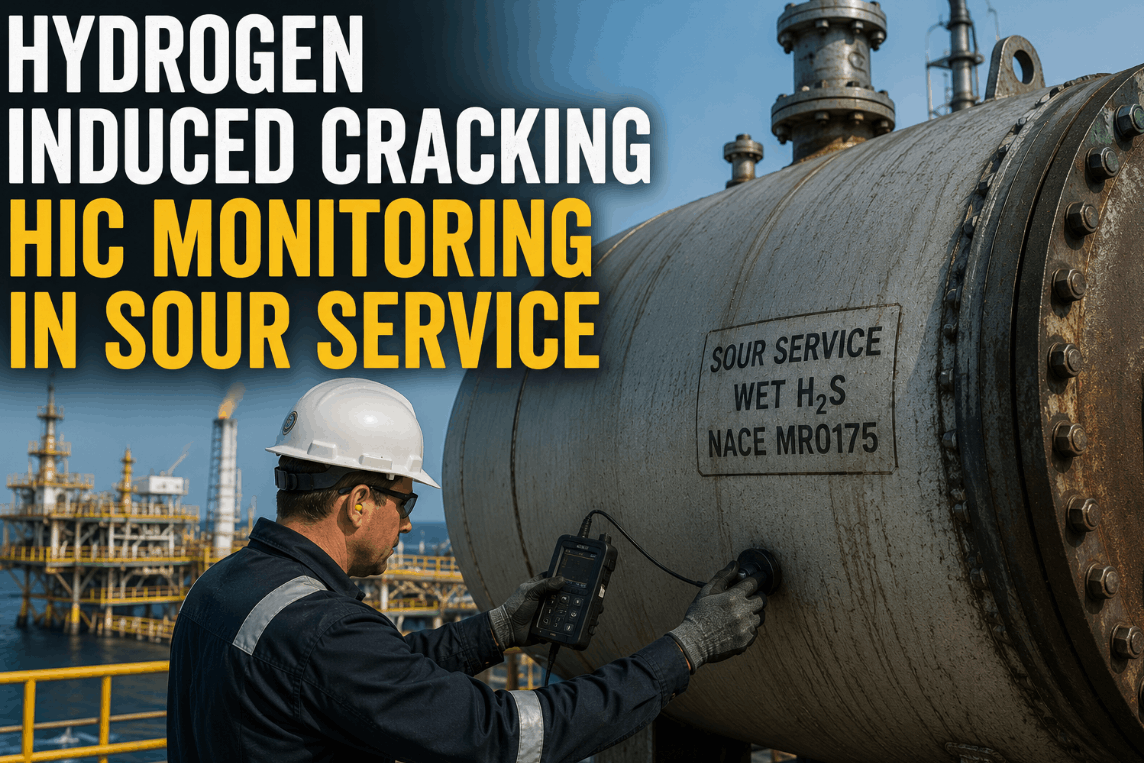
A pipeline can pass every hydrotest, show no external corrosion, and still be carrying cracks that started from the inside out — not from metal loss, but from hydrogen atoms working their way into the steel and pulling it apart at a microscopic level. That is what makes hydrogen induced cracking, stress-oriented HIC, and sulfide stress cracking different from ordinary corrosion threats: they are driven by wet H2S chemistry acting on the steel's own microstructure, and a pipeline can be structurally compromised without ever losing a measurable amount of wall thickness to corrosion. Sour service — any system handling fluids with enough H2S to trigger these mechanisms — is governed by NACE MR0175/ISO 15156 for material selection and by a specific set of inspection methods that general corrosion surveys simply do not catch. This guide covers what separates HIC, SOHIC, and SSC, how material selection under NACE MR0175 prevents them, which inspection methods actually detect them, and how operating envelope management keeps a system from drifting into sour service without anyone noticing. Teams managing sour service assets can book a 30-minute demo to see how iFactory tracks H2S exposure, hydrogen probe readings, and HIC inspection intervals against a live asset registry.
Hydrogen Induced Cracking & Sour Service Pipeline Integrity
How HIC, SOHIC, and sulfide stress cracking form in wet H2S environments, what NACE MR0175 requires for material selection, which inspection methods detect internal hydrogen damage, and how to manage the operating envelope that keeps a system out of sour service in the first place.
Three Damage Mechanisms, One Root Cause
Every one of these mechanisms starts the same way: atomic hydrogen is generated at the steel surface as a byproduct of the corrosion reaction between iron and H2S, and instead of combining harmlessly into hydrogen gas at the surface, some of it diffuses directly into the steel. What happens next depends on the steel's microstructure and the stress it is under, which is why one root cause produces three distinct failure patterns.
Hydrogen Induced Cracking
Diffused hydrogen collects at internal inclusions, laminations, or banding in the steel and recombines into hydrogen gas, building internal pressure until the steel cracks around the inclusion. These cracks run roughly parallel to the pipe surface and can occur with no applied stress at all — clean, unstressed plate steel with dirty inclusions is enough.
Stress-Oriented Hydrogen Induced Cracking
The same internal hydrogen blistering as HIC, but applied or residual stress — commonly near a weld heat-affected zone — reorients the crack growth so individual HIC blisters link up through the wall thickness instead of staying flat. A through-wall stack of linked cracks is far more likely to reach critical size than isolated flat HIC damage.
Sulfide Stress Cracking
A hydrogen embrittlement mechanism affecting hard microstructures — high-strength base metal, untempered weld metal, or a hard heat-affected zone — under tensile stress in a sour environment. SSC does not need inclusions or corrosion pits to start, and failure can be sudden and brittle, which is why hardness control is the primary defense against it.
What Counts as Sour Service
NACE MR0175/ISO 15156 defines sour service based on the partial pressure of H2S in the system rather than a simple concentration number, because total system pressure changes how much actual H2S the steel is exposed to even at the same gas percentage. A stream with a low H2S percentage at high total pressure can carry enough H2S partial pressure to qualify as sour, while the same percentage at low pressure might not. This is exactly why a pressure change, a composition shift from an upstream source, or a process upset can silently move a system across the sour service boundary even when nothing about the pipeline itself has changed — which is why operating envelope monitoring has to track pressure and composition together, not either one alone.
Material Selection Under NACE MR0175
NACE MR0175/ISO 15156 sets the material qualification rules a sour service pipeline has to meet before it goes into operating envelope, or before it can be classified as fit for a given sour environment.
Hardness limits
Carbon and low-alloy steel base metal, weld metal, and heat-affected zones are all subject to maximum hardness limits, commonly referenced around 22 HRC, because hardness above that threshold correlates directly with SSC susceptibility. Weld procedures for sour service pipe are qualified specifically to keep the heat-affected zone under this limit.
Post-weld heat treatment
PWHT is used to temper hard microstructures created during welding, reducing residual stress and hardness in the heat-affected zone to bring it back within the qualified limit. Skipping or under-executing PWHT on a sour service weld is one of the most common root causes of an in-service SSC failure.
HIC-resistant plate qualification
Plate steel destined for sour service is qualified through standardized HIC susceptibility testing before it is ever rolled into pipe, screening out steel with the inclusion density and banding that make HIC likely, rather than trying to catch the problem after the pipeline is built.
Documented material traceability
Every heat of steel and weld procedure used on a sour service line needs a documented qualification record tying it back to its NACE MR0175 compliance basis, since a material substitution without that traceability is effectively an unqualified material in service.
Inspection Methods That Actually Detect Hydrogen Damage
| Method | What It Detects | Where It Fits |
|---|---|---|
| Ultrasonic shear-wave testing | Internal HIC and SOHIC cracking not visible from the surface | Primary method for sour service plate and pipe body scanning |
| Automated ultrasonic mapping (AUT) | Extent and orientation of HIC damage across a wide surface area | Used for baseline surveys and periodic re-inspection of known-risk zones |
| Wet fluorescent magnetic particle inspection | Near-surface cracking, particularly SOHIC near weld heat-affected zones | Targeted inspection of welds and weld-adjacent base metal |
| Hydrogen permeation probes | Real-time hydrogen flux entering the steel from the process side | Continuous monitoring, early warning of a shift in corrosivity |
| Time-of-flight diffraction (TOFD) | Through-wall crack sizing and depth, especially for SOHIC stacking | Follow-up sizing once shear-wave screening flags an indication |
Standard corrosion-focused inspection — wall thickness UT gauging, visual inspection, or radiography alone — routinely misses HIC and SOHIC because these mechanisms do not necessarily remove metal; they create internal cracks in steel that can still measure full nominal wall thickness.
Managing the Operating Envelope
Track H2S partial pressure continuously, not periodically. A quarterly lab sample can miss a process upset that pushes the system into sour service for days before the next sample is taken.
Monitor pH and chloride alongside H2S. These three variables interact — a change in one can shift the effective severity of the sour environment even if H2S partial pressure alone stays flat.
Reconcile upstream source changes against material qualification basis. A new feedstock, blended stream, or upstream field change can alter H2S content without any physical change at the pipeline itself.
Escalate hydrogen probe trend changes immediately. A rising hydrogen flux reading is often the earliest available signal that conditions are moving toward active HIC or SSC risk, well before a scheduled inspection would catch it.
Frequently Asked Questions
Does a pipeline have to lose wall thickness for HIC or SOHIC to be dangerous?
No, and that is exactly what makes these mechanisms harder to catch than ordinary corrosion. HIC and SOHIC cracks form inside the steel around inclusions and along the heat-affected zone without necessarily removing any metal from the wall, so a section can pass a standard wall thickness UT survey with a full-nominal reading while carrying cracking that a shear-wave scan would flag immediately. This is the core reason sour service assets need crack-detection methods layered on top of standard corrosion monitoring rather than relying on wall loss surveys alone.
Can a pipeline built for sweet service later become sour service without any physical modification?
Yes, and it happens more often than operators expect. If an upstream source changes, a blended stream shifts composition, or a process upset changes system pressure, the H2S partial pressure the pipeline is exposed to can cross the sour service threshold even though nothing about the physical pipeline changed. Contact iFactory Support for help setting up automated alerts when process chemistry trends toward a sour service reclassification.
Why does hardness control matter so much for sulfide stress cracking specifically?
SSC is a hydrogen embrittlement mechanism that becomes far more likely as steel hardness increases, because harder microstructures are more susceptible to hydrogen trapping and brittle fracture under tensile stress. This is why NACE MR0175 sets maximum hardness limits on base metal, weld metal, and heat-affected zones rather than relying on chemistry composition alone — two steels with identical chemical composition can have very different SSC susceptibility depending on how they were welded and heat treated.
How often should hydrogen permeation probes be checked versus running a full HIC inspection survey?
Hydrogen permeation probes are designed for continuous or near-continuous monitoring and act as an early warning system for a shift in corrosivity, while a full shear-wave or AUT HIC survey is a periodic, resource-intensive inspection typically scheduled on a fixed interval or triggered by a probe trend change. A rising or unstable hydrogen flux reading is one of the most reliable triggers for moving up a scheduled HIC survey rather than waiting for the next calendar-based inspection. Book a demo to see how probe trend alerts can automatically flag an inspection for rescheduling.
Is PWHT always required for sour service pipeline welds?
PWHT requirements depend on the specific material specification, wall thickness, and weld procedure qualification basis under NACE MR0175/ISO 15156, and are not a blanket requirement applied identically to every sour service weld. What is consistent across sour service programs is that any weld procedure claimed to be sour-service qualified needs documented hardness testing evidence showing the heat-affected zone meets the qualification limit, whether that result was achieved through PWHT or through a controlled welding procedure that avoided excessive hardness in the first place.
Sour service integrity depends on catching what corrosion surveys miss.
iFactory ties H2S operating envelope data, hydrogen probe trends, HIC and SOHIC inspection results, and material qualification records to every asset in a sour service network, so a drift toward sour conditions or a hardness qualification gap gets flagged before it becomes a failure. A 30-minute demo builds a live view against your own pipeline data.