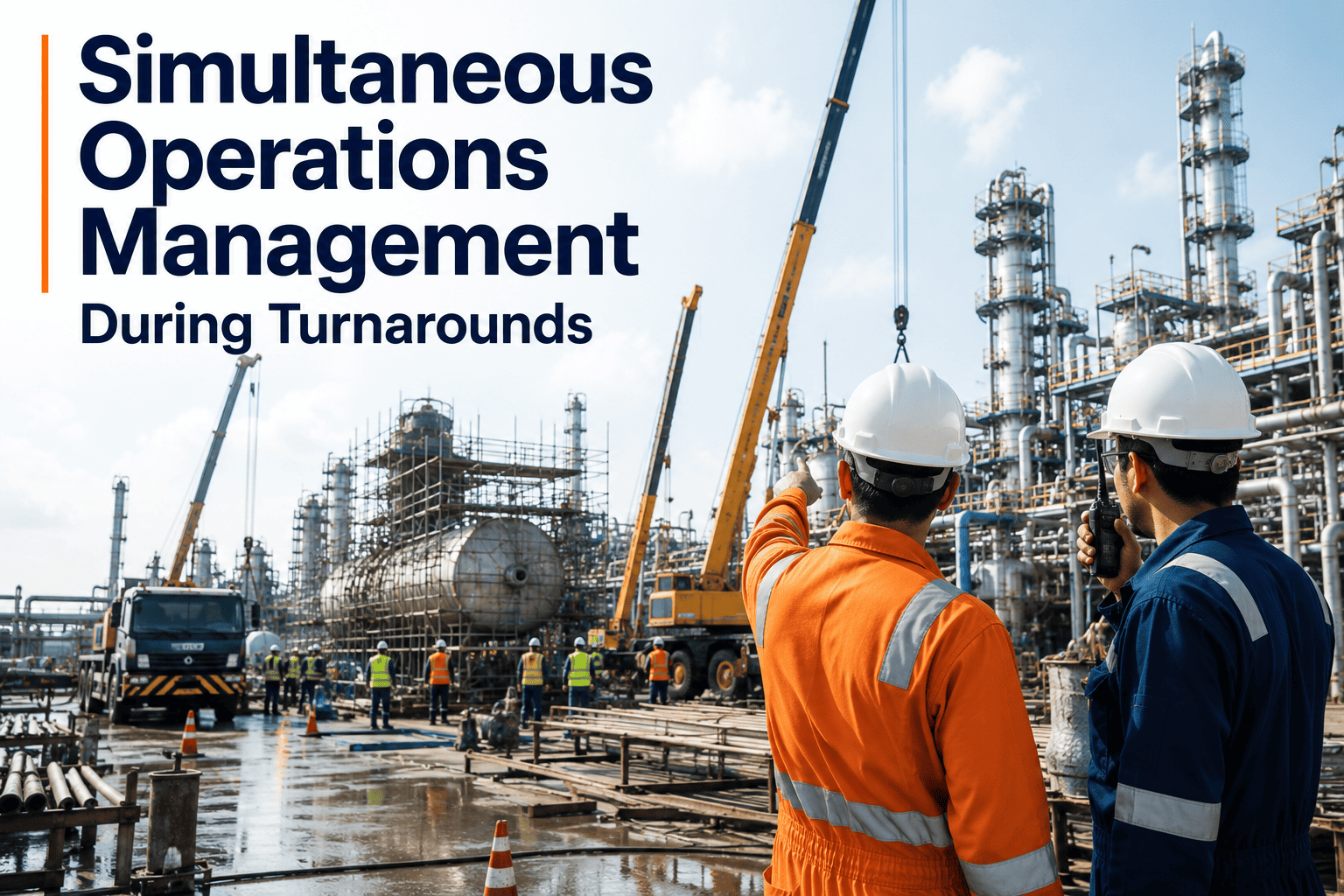
A refinery turnaround packs months of maintenance work into a shutdown window measured in weeks, and during that compressed period, hundreds of activities overlap in the same physical space at the same time. Crane booms swing over live process lines while scaffold crews build above workers cutting flanges on vessels that may still contain residual hydrocarbons. This is simultaneous operations, or SIMOPS, and it is the single most dangerous planning dimension of any turnaround because the hazard does not come from any single task but from the unexpected interaction between tasks that were each approved individually but never assessed as a combination. Managing those interfaces manually through paper matrices and morning coordination meetings works when the operation count is low, but it breaks down rapidly at turnaround scale. Teams looking for a more reliable approach can Book a Demo to see how digital SIMOPS management brings visibility to every operational interface.
Every Overlap Between Turnaround Tasks Is a Risk Until You Prove It Is Not.
Digital SIMOPS management identifies, assesses, and controls every operational interface across hundreds of concurrent activities before the shutdown begins.
Three Levels of SIMOPS Conflict That Turnaround Planners Must Control
Not all simultaneous operations carry the same consequence. The severity of a SIMOPS conflict depends on what happens when the interface fails: a dropped load over a live line is categorically different from two painting crews sharing a staircase. Effective SIMOPS management begins by classifying every potential interface into one of three severity bands so that control measures match the actual risk level rather than applying a blanket approach that under-protects critical interfaces and over-controls minor ones.
Incompatible Activities That Must Never Overlap
Hot work above unisolated hydrocarbon piping, crane lifts swinging over pressurized process areas, and confined space entry beneath active venting operations. These combinations create scenarios where a single failure mode can produce a catastrophic outcome regardless of how well each individual task is executed.
Activities That Can Coexist Only With Specific Controls
Scaffold erection within the swing radius of an active crane, multiple contractor crews working in adjacent plant areas with shared access routes, and excavation near unidentified buried utilities. These combinations are manageable but require documented controls, defined barriers, and real-time communication between the affected work groups.
Activities That Require Awareness But Not Special Interfaces
Mechanical bolting in one area while electrical isolation work proceeds in a separated zone, insulation removal on a cold-exchanged vessel while structural steel repairs happen on an adjacent rack. These tasks operate in proximity but with sufficient physical separation that standard permit conditions provide adequate interface control.
Why Turnarounds Create the Highest SIMOPS Density in Any Plant Operation
During normal operations, a refinery might have fifteen to twenty active work permits at any given time, spread across enough physical area that most tasks have no spatial overlap. A turnaround changes that equation entirely by compressing six to twelve months of maintenance scope into a four to six week shutdown window, driving the concurrent activity count from tens to hundreds and forcing hundreds of tasks into the same congested unit footprint.
The SIMOPS Matrix — Visualizing Where Activities Can and Cannot Coexist
A SIMOPS matrix is the foundational tool for mapping activity compatibility. Each cell in the matrix represents the intersection of two activity types, and the cell color indicates whether that combination is compatible, compatible with controls, or incompatible. The matrix below shows a simplified example for four common turnaround activity types. In a real turnaround, the matrix expands to cover every activity category in the scope, and each cell is backed by a specific risk assessment and control protocol.
Six Operational Interfaces That Cause the Most Turnaround Incidents
Analysis of turnaround incident reports across refineries and petrochemical plants consistently identifies the same interface categories as the source of the most serious near-misses and recordable injuries. These six categories account for the vast majority of SIMOPS-related events, and each one requires a distinct assessment methodology and control strategy that generic safety permits do not adequately address.
Crane Operations Over Live Process
A crane boom passing over a pressurized line creates a dropped-load scenario where the consequences extend far beyond the immediate work area. The entire swing path must be verified against the as-built location of every process line, and any overlap requires either a process isolation or an alternative lift plan that avoids the conflict zone entirely.
Hot Work Near Unisolated Hydrocarbons
Welding, grinding, or cutting within a defined radius of piping or equipment that has not been fully isolated, drained, purged, and gas-tested creates a direct ignition hazard. The challenge during turnarounds is that isolation status changes continuously as systems are progressively handed over, meaning the hot work boundary must be updated in real time as the shutdown progresses.
Scaffold Erection Over Active Work Zones
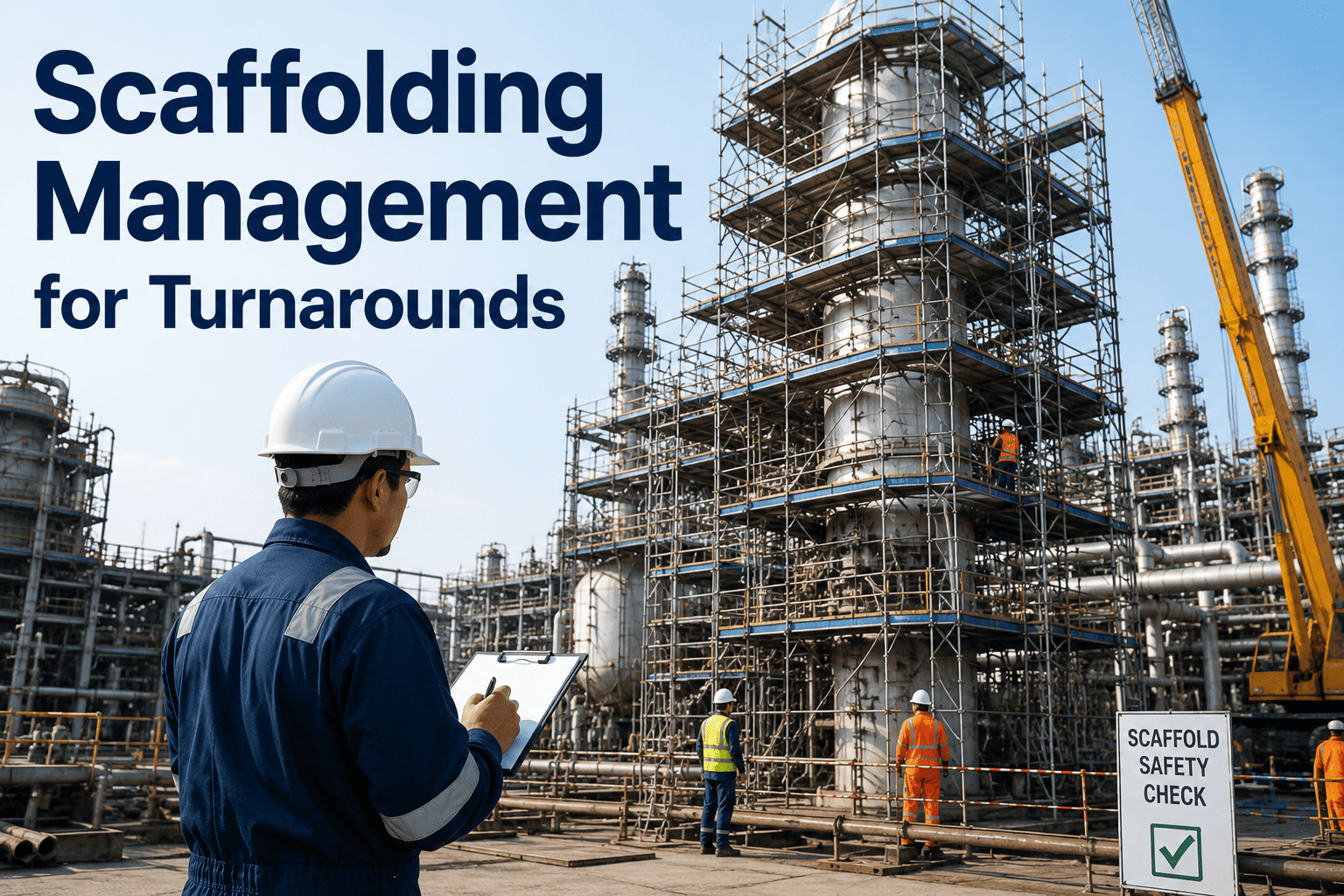
Scaffold materials being hoisted or dropped from height while workers perform tasks beneath the scaffold build area is a recurring exposure during turnarounds when scaffold crews and mechanical crews are scheduled in parallel to compress the critical path. Control requires either vertical separation with catch platforms or sequential scheduling that eliminates the overlap.
Multi-Contractor Area Sharing
When three or four contractors occupy the same plant area simultaneously, each with its own safety orientation, permit system, and supervision structure, the coordination burden multiplies. Interface incidents in this category typically involve one contractor creating a hazard such as a trip hazard, opening, or temporary barrier removal that another contractor walks into without awareness.
Excavation Near Buried Utilities
Turnaround scope often includes civil work such as foundation repair, drainage modification, or new piping trenches that require excavation in areas where underground utilities may not be accurately located on existing drawings. A SIMOPS interface exists between the excavation crew and every buried line, and the risk increases when the excavation is near live process lines that cannot be isolated for the civil work window.
Temporary Equipment in Process Areas
Generators, welding machines, hydrotest pumps, and temporary lighting setups placed in congested process areas create trip hazards, electrical exposure, and noise interference that affects adjacent work crews. The SIMOPS challenge is that temporary equipment locations change throughout the turnaround as work fronts advance, requiring continuous spatial awareness rather than a one-time assessment.
Paper SIMOPS vs Digitally Managed SIMOPS
The traditional approach to SIMOPS management relies on a paper matrix spreadsheet that is reviewed during daily coordination meetings, with conflicts identified through manual cross-referencing of permit boards and work schedules. A digital SIMOPS approach replaces that static document with a living system where activity locations, timing, and compatibility rules are maintained in a structured database that flags conflicts automatically as the plan evolves.
Paper-Based SIMOPS
Digital SIMOPS Management
The Digital SIMOPS Management Workflow
Effective SIMOPS management follows a repeating cycle that begins during pre-shutdown planning and continues through every day of execution. The workflow is not linear because each change to the schedule or scope can create new interfaces that must be assessed, meaning the cycle runs continuously from the first planning meeting until the last work permit is closed out at turnaround completion.
Interface Identification
Every task in the turnaround scope is entered with its planned location, timing, and activity type. The system cross-references all task pairs against the compatibility matrix and generates a list of every interface where activities overlap in space and time, including interfaces that develop when schedule changes push previously separated tasks into the same window.
Risk Assessment
Each identified interface is assessed for consequence severity, likelihood of interaction failure, and existing control measures. The assessment produces a risk rating that determines whether the interface requires a formal SIMOPS permit, a control plan with specific barriers, or is acceptable under standard task permits without additional controls.
Control Assignment
For every interface that exceeds the acceptable risk threshold, specific control measures are assigned and documented. Controls may include physical barriers, exclusion zones, sequential scheduling to eliminate time overlap, additional fire watch coverage, or dedicated interface coordinators assigned to monitor the boundary between the affected work groups.
Continuous Monitoring
During execution, the system tracks active interfaces against the live permit status and schedule position. When a schedule delay pushes a crane lift into the same window as a hot work permit, or when scope growth adds a new task in an area with existing interfaces, the system flags the change immediately so the coordination team can assess and respond before work begins.
What Plants Measure After Implementing Digital SIMOPS Management
The transition from paper-based to digital SIMOPS management produces measurable improvements in the metrics that turnaround directors track most closely. These results come from structured deployments where the digital system was operational from the planning phase through execution closeout, covering the full turnaround cycle rather than being introduced partway through the shutdown.
Reduction in interfaces discovered for the first time during execution, meaning the vast majority of conflicts are identified and controlled before any worker is exposed to the overlapping activities in the field.
Reduction in the time required to review, approve, and issue SIMOPS permits because the compatibility assessment and control documentation are generated automatically from the interface data rather than assembled manually for each permit.
Reduction in recordable incidents and serious near-misses attributed to unmanaged operational interfaces, measured across multiple turnaround cycles at the same facility before and after digital SIMOPS implementation.
See Every SIMOPS Conflict Before It Reaches the Field.
Bring your turnaround scope to a live demo and watch the digital SIMOPS system identify and classify every operational interface automatically.
SIMOPS Management During Turnarounds — Common Questions
How is a SIMOPS matrix different from a standard permit-to-work system?
A permit-to-work system assesses the hazards of each individual task in isolation, ensuring that a specific hot work job or confined space entry has the right controls for that task alone. A SIMOPS matrix goes further by assessing what happens when two or more permitted tasks exist in the same area at the same time. The permit system does not inherently check whether a crane lift permit and a hot work permit in the same unit create a combined hazard that neither permit addresses individually, and that gap is exactly what the SIMOPS matrix is designed to close.
Who is responsible for SIMOPS management during a turnaround?
The turnaround director or shutdown manager holds overall accountability for SIMOPS management, but the function is typically delegated to a dedicated SIMOPS coordinator or interface management team during execution. That team is responsible for maintaining the matrix, reviewing new interfaces as the schedule evolves, ensuring control measures are implemented, and escalating unresolved conflicts to the turnaround director for decision. In a digital system, much of this coordination workload is handled automatically, allowing the SIMOPS team to focus on the judgment calls that require human decision-making rather than manual cross-referencing.
Can SIMOPS management be applied to partial shutdowns or only full turnarounds?
SIMOPS management applies to any situation where multiple work activities overlap in the same physical area, which includes partial shutdowns, unit-level maintenance windows, and even heavy construction periods on operating plants. The complexity and number of interfaces will be lower in a partial shutdown compared to a full turnaround, but the methodology is identical. Many plants that first implement digital SIMOPS for a major turnaround subsequently apply the same system to smaller shutdowns because the incremental effort is minimal once the platform and compatibility rules are established.
How does the system handle schedule changes that create new interfaces during execution?
When a schedule change is entered into the digital system, whether it is a delay that pushes two tasks into the same time window or a scope addition that introduces a new activity type in a congested area, the system automatically re-evaluates all interfaces affected by the change. Any new conflicts are flagged immediately with their severity rating, and the affected task supervisors and the SIMOPS coordinator receive a notification. This replaces the manual process of discovering during a morning meeting that yesterday's schedule slip has created an unmanaged interface that workers are already walking into.
What does it take to implement digital SIMOPS for an upcoming turnaround?
Implementation begins with defining the activity types, compatibility rules, and severity thresholds that match the specific facility and turnaround scope. The existing schedule and work breakdown structure are loaded into the platform, and the system generates the initial interface register. From there, the SIMOPS team validates the results, refines the rules, and begins the iterative process of assessing and controlling each interface before the shutdown window opens. Teams that want to see the workflow in action can Book a Demo or connect with the iFactory Support team for a technical scoping session tailored to their turnaround scope.
Your Next Turnaround Will Have Hundreds of Overlapping Tasks. Will You See Every Interface?
Digital SIMOPS management gives your coordination team the visibility to control every conflict before it becomes an incident.