.png)
Every undetected foreign particle in a vial, syringe, or biologic solution is not a quality control footnote — it is a deferred liability. A single contamination event that bypasses manual inspection can cascade into a Class I FDA recall involving an average of 400,000 product units and 1.3 years of remediation time. Contamination and impurities account for 37% of all drug recalls — the single largest cause of product withdrawal across a decade of FDA enforcement data. The operational cost of inaction dwarfs the investment in AI-driven automated visual inspection by orders of magnitude. This is the financial case for replacing legacy inspection with a unified AI vision platform — and why the C-suite conversation begins with margin preservation, not merely compliance.
Is Your Pharma Line Exposed to a Contamination-Driven Recall?
iFactory's AI automated visual inspection platform detects foreign particles in vials, syringes, and solutions — eliminating the false-reject rate and compliance gap that legacy AVI systems cannot close.
What iFactory AI Vision Detects That Human Inspectors Miss
Manual visual inspection of parenteral products operates at human fatigue thresholds and cannot deliver the 100% throughput coverage mandated by FDA and EMA for injectable dosage forms. iFactory's AI vision engine applies deep learning models trained on millions of validated defect images to classify and reject non-conforming units in real time — without the false-reject variability that inflates batch loss. Consult our architects to review detection benchmarks for your container format.
Particulate Matter
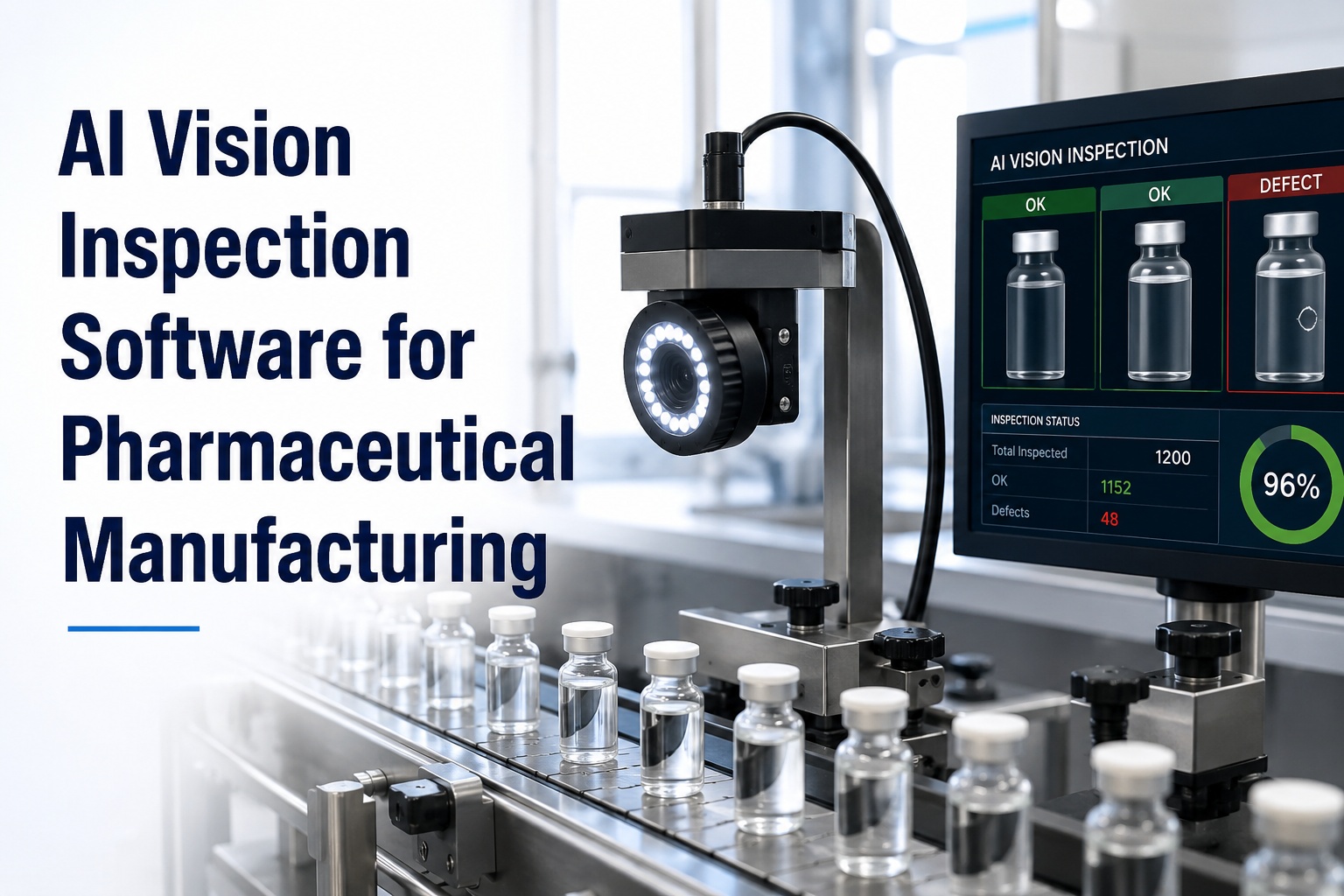
Detects sub-visible and visible foreign particles — glass fragments, metal shavings, rubber stopper debris, and fibers — in liquid-filled vials and ampoules at full production speed with zero fatigue drift.
Container Integrity
Identifies hairline cracks, glass delamination, stopper misalignment, and crimp cap defects across prefilled syringes, vials, and cartridges — defects routinely invisible under standard production lighting.
Fill Level & Cosmetic
Validates fill volume accuracy, label placement, lot code legibility, and cosmetic surface defects simultaneously — replacing multiple legacy inspection stations with a single high-throughput AI pass.
Cross-Contamination
Detects residual contamination from prior product runs in multi-product biologics facilities — a critical risk cited in 2024 FDA enforcement actions and Annex 1 contamination control strategy reviews.
Legacy Friction vs. iFactory Optimized Excellence
The gap between legacy manual inspection and an integrated AI vision platform is not incremental — it is structural. The table below translates operational friction into financial and regulatory exposure for C-suite capital allocation decisions on quality infrastructure. Book a Demo to model this gap against your facility's throughput data.
| Inspection Dimension | Legacy Manual / Conventional AVI | iFactory AI Vision | Executive Impact |
|---|---|---|---|
| Particle Detection Rate | 70–80% under fatigue conditions | 99.7% consistent across all shifts | Recall Risk Eliminated |
| Throughput Capacity | 60–120 units/min (operator-limited) | 400+ units/min automated | 3× Revenue Throughput |
| False Rejection Rate | 8–15% batch yield loss | Below 0.5% with AI calibration | Direct COGS Recovery |
| Regulatory Audit Trail | Manual log, operator-dependent | Immutable digital record, 21 CFR Part 11 | FDA-Ready Compliance |
| Staff Dependency | High — inspector burnout, turnover risk | Minimal — 1 operator manages full line | Workforce Cost Reduction |
The Financial Escalation of a Single Missed Particle
A foreign particle missed at the inspection stage does not stay contained — it escalates. Each stage in the contamination cascade multiplies the financial and reputational cost exponentially. The visualization below maps how a QC event compounds into systemic enterprise liability when undetected by legacy inspection systems.
Particle bypasses manual inspection. Batch released. Undetected liability enters the supply chain.
Regulatory notification triggered. Internal investigation launched. Customer-facing crisis management begins.
Class II recall initiated. Average 400,000 units quarantined. Production halted for root cause investigation.
Consent decree risk. Import alert exposure. 483 observations on inspection records. Facility remediation mandated.
Voluntary or forced market exit. Brand equity destruction. Patient access disruption and shareholder value impairment.
Teams that understand this cascade book a demo to model how AI visual inspection intercepts it at Stage 1 — eliminating every downstream cost and compliance consequence.
Four Dimensions of Enterprise Value from AI Particle Detection
Healthcare executives managing both operational excellence and patient safety mandates receive measurable returns across four mission-critical dimensions — each tied to a distinct P&L and risk governance line item when AI inspection replaces legacy QC infrastructure.
Patient Safety ROI
Every contaminated injectable unit detected before distribution represents an avoided adverse event, a prevented hospitalization, and a protected patient outcome — a zero-harm commitment made operationally real.
Staff Burnout Elimination
Repetitive visual inspection is the highest-attrition task in pharmaceutical QC. AI inspection eliminates the cognitive load of monotonous inspection cycles, redeploying skilled staff to exception handling and process improvement.
Revenue Throughput Gain
With throughput exceeding 400 units per minute and false-reject rates below 0.5%, AI vision directly recovers batch yield lost to manual variability — representing tens of millions in recovered COGS for high-volume facilities.
Regulatory Confidence
A fully immutable 21 CFR Part 11 audit trail for every inspection event transforms FDA readiness from a reactive preparation to a permanent operational state — reducing inspection observation risk to near zero.
From Legacy Inspection to AI-Verified Zero-Defect in Five Phases
iFactory's structured deployment methodology eliminates the integration risk that has caused AI inspection pilots to stall at proof-of-concept across the industry. Each phase is time-boxed, fully documented, and tied to measurable quality KPIs approved by your regulatory affairs team. Consult our architects to build your facility-specific deployment schedule and validation protocol.
Baseline Inspection Audit
Quantify your current false-reject rate, throughput per inspector, and historical 483 observation trends to establish a validated performance baseline for ROI modelling.
Shadow Mode Deployment
Deploy AI inspection in non-interfering parallel mode alongside your existing line. Capture detection performance data for 30 days without any production dependency or line stoppage.
IQ / OQ / PQ Qualification
Execute the complete GAMP 5-aligned validation protocol. All IQ, OQ, and PQ documentation is produced and reviewed by your quality team before any regulatory submission is initiated.
Live Production Integration
Cut over to AI-primary inspection with full 21 CFR Part 11 audit trail activation. LIMS, MES, and batch record connectors go live, eliminating manual data transcription from Day 1.
Continuous Model Improvement
AI models self-improve with every production run. Monthly performance reviews benchmark detection accuracy against USP <790> thresholds and flag any emerging defect morphologies for model retraining.
Book a Strategic Workflow Audit for Your Inspection Line
Our pharmaceutical AI architects will map your current inspection workflow against the contamination cascade and quantify the financial gap between your current throughput and zero-defect performance.
Compliance Standards iFactory AI Inspection Addresses
Government and healthcare regulators have issued unambiguous guidance that 100% inspection of parenteral products for foreign particulate matter is not optional — it is the baseline expectation. iFactory's platform is designed against this regulatory architecture from the ground up, not retrofitted for compliance as an afterthought. Book a Demo to review our regulatory alignment documentation for your target market jurisdiction.
FDA current Good Manufacturing Practice regulations for finished pharmaceuticals. Requires documented procedures and validated inspection of each lot of finished drug product.
United States Pharmacopeia standards for visible and sub-visible particulate matter in injections. Defines acceptance criteria and inspection methodology for injectable containers.
European Union GMP requirements for sterile medicinal products. The 2022 revision mandates a formal Contamination Control Strategy applicable to all sterile manufacturing operations.
FDA regulations governing electronic records and signatures. iFactory's audit trail architecture satisfies all Part 11 requirements for data integrity, access controls, and audit logging.
AI Foreign Particle Detection — Executive FAQs
Does iFactory's platform meet FDA 21 CFR Part 11 and USP <790> requirements?
Yes. The platform generates a fully immutable, time-stamped digital audit trail for every inspection event, satisfying 21 CFR Part 11 electronic records requirements. Detection algorithms are validated against USP <790> visible particulate limits and <1790> container closure integrity guidance — ensuring every batch release is defensible to regulators. Book a Demo to review our validation documentation.
What is the typical ROI timeline for deploying AI visual inspection?
Most facilities achieve payback within 12–18 months, driven by three value streams: recovered batch yield from reduced false rejects (typically 8–15% of product previously scrapped), inspector headcount reallocation, and avoided recall exposure. For high-volume sterile injectables lines, the financial case typically closes in under 12 months. Book a Demo to access our ROI modelling tool.
Can the platform integrate with existing LIMS, MES, and batch record systems?
Yes. iFactory provides certified integration connectors for leading LIMS, MES, and ERP platforms. Inspection results, defect images, and statistical summary reports are pushed directly to your existing quality record infrastructure — eliminating manual transcription and closing the audit gap that regulators flag during FDA inspections.
How does the AI handle biologics containers where particle visibility is reduced?
The AI engine applies specialized deep learning models calibrated for optically complex containers — including low-fill vials, frosted ampoules, and high-viscosity biologics. Multi-angle illumination combined with rotating inspection geometry ensures particles below conventional detection thresholds are identified and classified before any reject decision is executed.
What does the Operational Gap Audit involve for our facility?
Our architects conduct a structured review of your current inspection throughput, false-reject rate, regulatory observation history, and staff deployment model. The deliverable is a quantified gap report mapping your current state against an AI-optimized baseline, with a phased implementation roadmap. Book a Demo to schedule your audit session.
How is the platform validated for GMP environments during implementation?
Implementation follows a formal qualification protocol: IQ, OQ, and PQ documentation is produced for every deployed station, aligned with GAMP 5 guidelines for computerized systems validation. Our team provides all validation master plan templates and summary reports required for FDA inspection readiness from Day 1 of go-live.
Launch Your AI Particle Detection Pilot — Zero Disruption to Current Production
iFactory deploys alongside existing inspection infrastructure in a non-interfering shadow mode, validating detection performance before any production dependency is created.


.png)