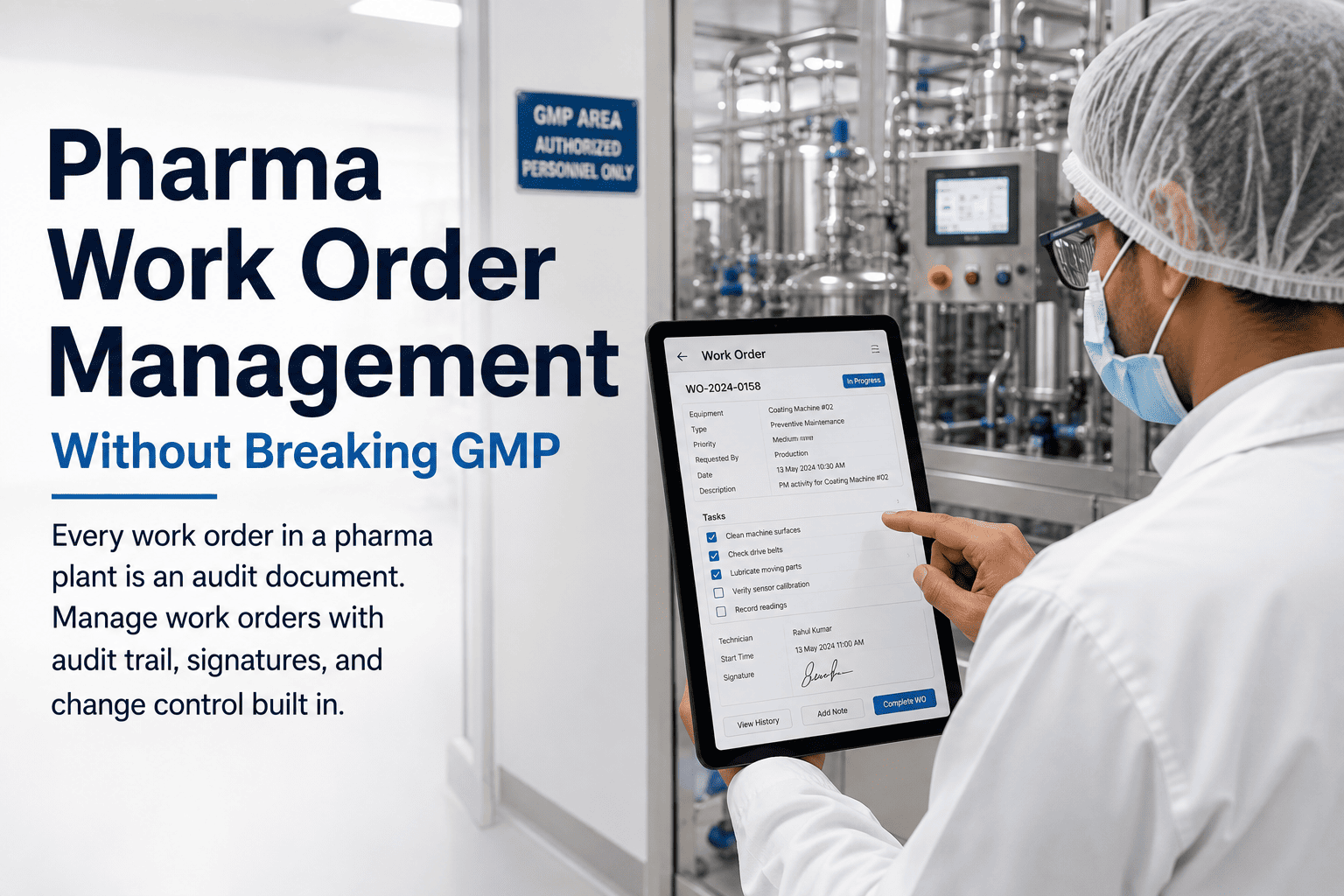
In most plants, a work order is a to-do item. In a pharma plant, it's an audit document. When an FDA investigator arrives and asks for every work order, inspection, part replacement, and electronic signature on your fill-finish line for the past 24 months, that request either produces a clean, queryable record in minutes — or it becomes a very different kind of inspection. The stakes are not abstract: over 65% of FDA warning letters to pharmaceutical manufacturers cite deficiencies in maintenance and equipment records, and 483 observations for inadequate maintenance records have risen 34% since 2022. The gap is almost never the repair itself — it's the disconnect between what the technician did in the field and the auditable, 21 CFR Part 11-compliant record that GMP requires. Managing work orders in pharma means building audit trail, electronic signatures, and change control into the workflow so every maintenance activity is traceable, approved, and inspection-ready by default. To see a GMP work order flow end to end, book a demo.
MAINTENANCE RELIABILITY · PHARMA WORK ORDER MANAGEMENT
Every Work Order Is an Audit Document. Manage It Like One.
In a GMP environment, a repair isn't finished when the equipment runs — it's finished when the record is signed, traceable, and tamper-evident. iFactory builds approval workflows, Part 11 electronic signatures, audit trails, and change-control linkage into the work order itself, so compliance is a byproduct of the work, not a second job after it.
65%+
Of FDA warning letters cite maintenance and equipment records
+34%
Rise in 483s for inadequate maintenance records since 2022
$180K–$2.4M
Batch rejection cost from a single undetected calibration lapse
Part 11
The electronic-records rule a generic CMMS can't satisfy
Why a Pharma Work Order Can't Be a Generic Work Order
A standard CMMS work order answers one question: what got fixed. A pharma work order has to answer a harder set — who authorized it, was the equipment qualified when the work happened, was any change to a GxP-critical asset assessed and approved, who signed off, and can every one of those facts be proven with a tamper-evident record an FDA investigator will accept. That's the difference between documenting maintenance and generating regulatory evidence. A CMMS that produces PDFs without cryptographic audit trails doesn't just fall short of best practice — during a data-integrity inspection, it becomes the finding.
The Record Is Part of the Product
In pharma, the maintenance record isn't documentation about the work — it's part of the compliance evidence that supports batch release. A perfectly executed repair with a missing signature or an unlinked deviation is, to an inspector, a GMP failure regardless of whether the equipment worked flawlessly afterward.
Audit Trails Must Be Tamper-Evident
Part 11 requires every record to carry a complete audit trail of all entries and modifications — who made the change, when, and the original value. A generic system that lets a field get overwritten with no trace of the prior value creates exactly the data-integrity gap investigators treat as a critical failure, not a minor observation.
Signatures Are Legally Bound to a Person
An electronic signature under Part 11 must use secure credentials tied to a specific individual and cannot be shared or reused. A shared login, a generic "maintenance" account, or a signature that can't be attributed to one qualified, trained person undermines the entire chain of accountability the regulation is built to protect.
Every Change Touches the Qualified State
A replacement part, a configuration tweak, or a revised PM procedure on GxP-critical equipment isn't just a repair — it's a change that can affect the validated state. Without change-control linkage built into the work order, an ordinary maintenance action can silently move equipment out of qualification, and no one knows until an audit.
The financial exposure isn't close. A single major GMP maintenance documentation observation drives remediation and lost-production costs that dwarf any CMMS investment by a factor of a hundred or more. The work order system isn't an IT line item in pharma — it's the difference between a clean inspection and a consent decree.
The Four Pillars of GMP Work Order Management
Effective pharma work order management rests on four requirements that a generic CMMS treats as optional and a validated pharma system treats as mandatory. Every pharma work order has to satisfy all four at once — and the failure of any single pillar is enough to turn a routine repair into an inspection finding.
PILLAR 1
Documented Approval Workflows
Every work order on GxP-critical equipment requires documented authorization before execution — multi-level approval, risk assessment, and verification that the assigned technician is trained and qualified for the task. The workflow enforces the authorization gate rather than relying on a supervisor to remember it, so a job can't proceed to the floor until it's been approved by the right role and the technician's training record is verified.
PILLAR 2
Electronic Records & Audit Trails
Part 11-compliant electronic signatures with user authentication and role-based access, plus a complete audit trail that records every entry and modification with timestamp, user identity, and the original value. Records are immutable — protected against unauthorized change — and retrievable in human-readable form for the full retention period. This is the pillar a PDF-generating CMMS fails, because a PDF has no cryptographic trail of what changed after approval.
PILLAR 3
Deviation & Change Control Linkage
Every maintenance-initiated change to GxP-critical equipment — a replacement part, a configuration change, a revised procedure — routes through a change-control record with risk assessment, impact evaluation, and quality approval. Deviations link to their root-cause and CAPA closure evidence directly from the work order, so the corrective action ties back to the equipment record and the closed loop is documented rather than scattered across separate systems.
PILLAR 4
Equipment Qualification Tracking
Each critical asset carries its qualification status, calibration currency, and GMP risk level on its record, and the system escalates automatically when a calibration interval is set to lapse before the next batch cycle. A work order can surface whether the equipment was in a qualified state at the moment the work occurred — the exact question an investigator asks, answered from the record rather than reconstructed under pressure.
See a Part 11 Work Order Flow on Your Own Equipment
Bring your equipment register, approval structure, and a recent work order to the call. iFactory engineers will walk the full flow — approval gate, e-signature, audit trail, change-control linkage — mapped to your site's roles and SOPs, and show what an inspection export looks like.
A GMP Work Order, Stage by Stage
The difference between a compliant and a non-compliant work order isn't a single control — it's that compliance is enforced at every stage of the lifecycle, not bolted on at the end. Here's how a corrective work order on a GxP-critical asset moves through the flow, with the compliance gate that governs each step.
1
Request & Risk Classification
The work order is raised against a specific asset carrying its GMP risk level and qualification status. The system classifies whether it touches GxP-critical equipment, which determines the approval path — a routine non-critical job and a change to a qualified fill line do not follow the same route.
2
Documented Approval Gate
For GxP-critical work, multi-level authorization and risk assessment are enforced before the job reaches the floor. The assigned technician's training and qualification record is verified automatically — an untrained or uncertified assignment is blocked rather than caught later.
3
Change-Control Determination
If the work involves a replacement part, configuration change, or procedure revision, it routes through change control with impact assessment and quality approval before execution. A planned change is evaluated first; an unapproved change made under pressure becomes a deviation requiring CAPA — and the system knows the difference.
4
Mobile Execution & Signed Capture
The technician executes against the approved SOP on a mobile device, capturing measurements, parts with lot numbers, photos, and an authenticated electronic signature at the point of work — including in cleanroom and offline environments. The record is built as the work happens, not reconstructed from memory afterward.
5
Review, Closure & Audit Trail
Closure is reviewed and signed, any deviation is linked to its CAPA, and every entry and modification is written to an immutable audit trail with user, timestamp, and original value. The completed package — work order, signatures, and trail — is instantly exportable in the format an investigator requests.
When Maintenance Meets an Emergency Breakdown
The hardest GMP work order isn't the planned one — it's the 2 a.m. breakdown on a critical batch, where the pressure to fix fast collides with the requirement to document everything. This is precisely where paper systems and generic CMMS platforms fail, because the compliance step gets skipped in the rush and reconstructed badly afterward. A validated system handles the emergency without abandoning the controls.
THE TRAP
Fix First, Document Never
Under batch-loss pressure, a technician makes the repair and swaps a part without raising a change record. The equipment runs, the batch is saved — but a change to GxP-critical equipment was made without prior approval. That's now a deviation requiring root-cause investigation and CAPA, discovered weeks later when the paperwork doesn't reconcile.
THE CONTROL
Emergency Change Control
A validated system provides an emergency change-control path: fast QA approval with limited initial documentation, so the urgent fix proceeds without bypassing the control entirely. The full record is completed immediately after, the change is formalized if permanent, and the deviation-versus-change distinction is captured correctly the first time rather than argued about later.
The regulatory line is clear: a planned modification goes through change control before execution; an unapproved change made without prior approval is recorded as a deviation and must go through CAPA first. The value of a purpose-built work order system is that it routes the emergency correctly in the moment — keeping the fix fast and the record defensible, instead of forcing a choice between the two.
Generic CMMS vs Validated Pharma Work Orders
The gap between a generic CMMS and a Part 11-validated pharma system isn't cosmetic — it's the difference between records that survive an inspection and records that trigger one. The comparison below is what an investigator actually probes during a data-integrity inspection.
Facilities running paper or generic CMMS see a materially higher deviation rate than those on validated digital work order systems. The difference isn't that their technicians are worse — it's that their system doesn't enforce the controls, so the gaps that become findings are left to human diligence under production pressure, which is exactly when diligence slips.
What This Changes for the Maintenance Team
A GMP-grade work order system is often perceived as more overhead for the maintenance team. In practice, when the controls are built into the workflow rather than layered on top, it removes the compliance burden that used to fall on technicians as extra paperwork — and takes the fear out of an inspection.
01
Compliance Stops Being Extra Work
When the signature, the audit trail, and the change-control routing are built into the work order, the technician does the job and the compliance record assembles itself. There's no separate logbook to fill out later, no reconstructing what happened at end of shift — the controls ride along with the work rather than competing with it.
02
The Wrong Assignment Gets Blocked
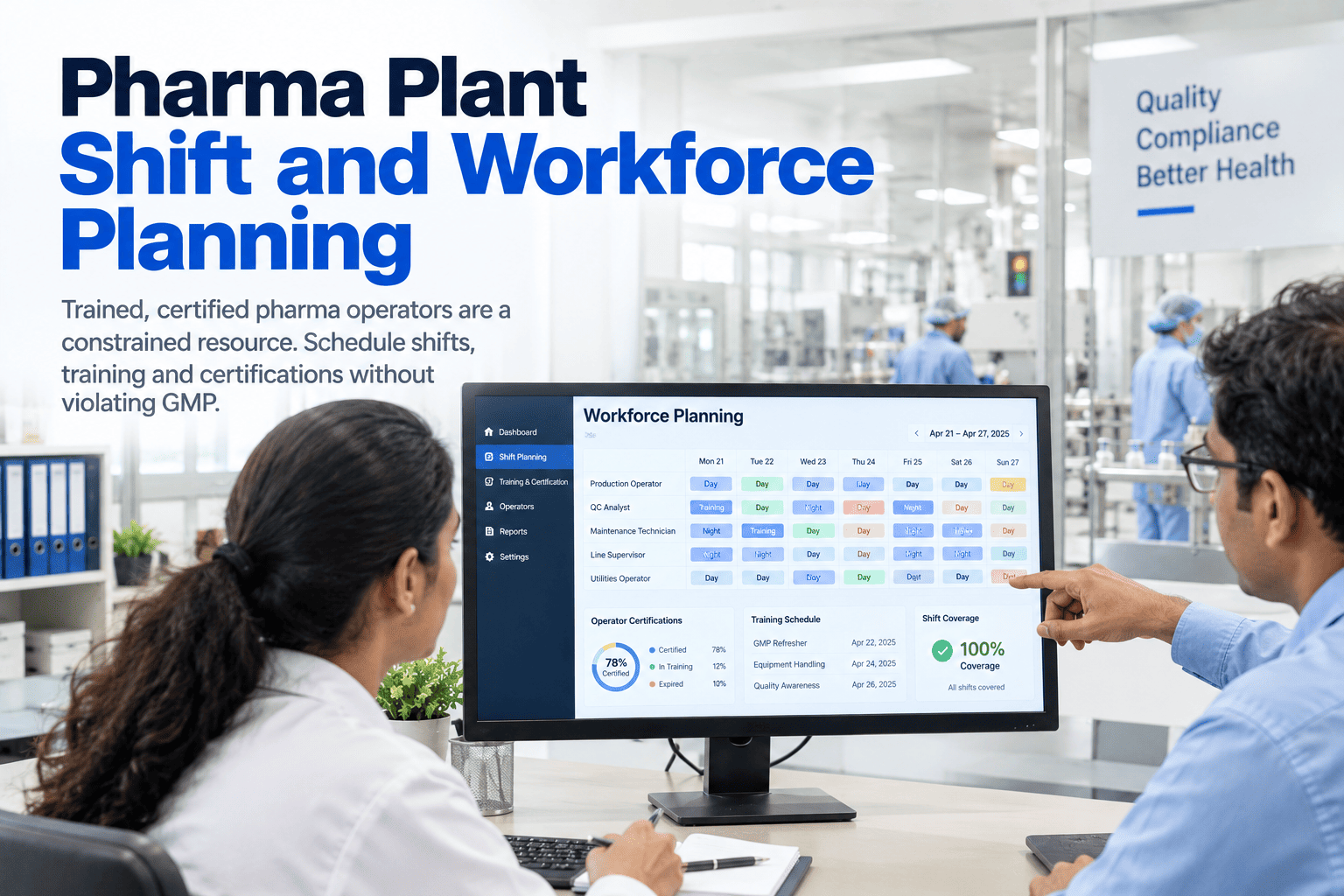
Because training and qualification are verified at the approval gate, a technician can't be assigned GxP-critical work they aren't certified for, and an untrained assignment is stopped before it reaches the floor. The team is protected from the kind of assignment error that turns into a finding no one intended to create.
03
Emergencies Stay Defensible
The emergency change-control path means a 2 a.m. breakdown fix doesn't force a choice between saving the batch and staying compliant. The team fixes fast under a fast-track approval, and the record is complete and correctly classified — so the heroic repair doesn't become next month's deviation investigation.
04
Inspections Stop Being a Six-Week Scramble
When an investigator requests 24 months of records, the response is a one-click export in their format rather than weeks of pulling binders and reconciling spreadsheets. The team stays in an inspection-ready state continuously instead of dropping everything to prepare each time an audit is scheduled.
How iFactory Deploys a Validated Work Order System
Deploying a Part 11 system in a GMP environment requires more than software configuration — it requires validation, workflow design, and audit-trail activation before a single work order is issued in production. iFactory brings a pre-validated framework so this happens without an IT project or a validation-consultant engagement.
1
Equipment Registry & GMP Classification
Critical equipment is registered with qualification status, calibration requirements, and GMP risk level, and work order templates are configured to your existing SOPs and validation documentation — producing a validated equipment registry with classification and approval routing.
2
Workflow & Signature Configuration
GMP work order forms are built with electronic-signature fields, deviation linkage, and Part 11 audit trails, and the change-control workflow is activated with risk-assessment routing and quality approval gates configured to your site's access structure and roles.
3
Validation Package & Qualification
A pre-built IQ/OQ/PQ documentation package aligned to GAMP 5 and FDA Computer Software Assurance guidance is applied, so the system is qualified for GMP use without a blank-slate validation project or an external consultant engagement.
4
Mobile Go-Live & Compliance Dashboard
Technicians go live on mobile execution with offline cleanroom capability, and a live compliance dashboard surfaces calibration currency, open deviations, CAPA status, and change-control backlog to QA and engineering in real time.
Frequently Asked Questions
The questions pharma maintenance and quality teams ask most often before moving work order management onto a validated system.
Isn't our existing CMMS good enough if we're careful with documentation?
The problem isn't your team's care — it's that a generic CMMS leaves the controls to human diligence under production pressure, which is exactly when gaps appear. A system that exports PDFs without a cryptographic audit trail can't prove what changed after approval, shared logins break signature attribution, and change control lives in a separate system connected only by manual links. Investigators treat those data-integrity gaps as critical GMP failures, not minor observations, and facilities on generic systems show measurably higher deviation rates as a result. To see where your current system would expose you,
book a demo.
What exactly does 21 CFR Part 11 require of a work order system?
Part 11 requires four things of any system creating electronic records subject to FDA inspection: authenticated electronic signatures tied to a specific individual with role-based access, a complete audit trail recording every change with timestamp, user identity, and original value, data-integrity controls that prevent unauthorized modification, and documented system validation. Records must also be retrievable in human-readable form throughout the retention period. A work order system meeting these can produce a tamper-evident record an investigator accepts; one that can't creates direct inspection risk, since inspectors increasingly examine CMMS records as a routine part of pharma plant inspections.
How does the system handle an emergency repair on a critical batch?
Through an emergency change-control path designed for exactly that pressure. When equipment breaks down during a critical batch, the system allows fast QA approval with limited initial documentation so the urgent fix proceeds without bypassing the control entirely, then requires the full record to be completed immediately after. This matters because a change made to GxP-critical equipment without any prior approval is automatically a deviation requiring root-cause investigation and CAPA. The emergency path keeps the repair fast and the record defensible, so a batch-saving fix doesn't turn into a compliance problem discovered weeks later when the paperwork won't reconcile.
Does deploying a validated CMMS require a long validation project?
Not with a pre-validated framework. Any system used to create or maintain electronic records subject to FDA inspection does require qualification under Part 11 and GMP expectations — but iFactory provides a pre-built IQ/OQ/PQ documentation package aligned to FDA's Computer Software Assurance guidance and GAMP 5, including risk-based test scripts and supplier qualification. That turns validation from a blank-slate project requiring an external consultant into an applied, configured package. The result is a validated go-live without a separate IT project or a validation-consultant engagement, deployed without disrupting production scheduling or existing validation timelines.
How does change control connect to the work order without slowing the team down?
Change control is linked directly from the work order rather than living in a disconnected system, so the routing happens inside the workflow the technician is already using. When a job involves a replacement part, configuration change, or procedure revision on GxP-critical equipment, the system routes it through impact assessment and quality approval automatically, and links any resulting deviation to its CAPA closure evidence against the equipment record. The team doesn't manage a separate change-control process on the side — it's built into the work order flow, which is what keeps the closed loop documented without adding a parallel administrative task. Contact
iFactory support to see the change-control routing in detail.
MAKE EVERY WORK ORDER INSPECTION-READY BY DEFAULT
Manage Pharma Work Orders Without Ever Breaking GMP.
Approval workflows, Part 11 electronic signatures, tamper-evident audit trails, and change-control linkage built into every work order — with a pre-validated IQ/OQ/PQ package and one-click inspection export. Protect the batch, protect the qualified state, and pass the audit at once.



.png)