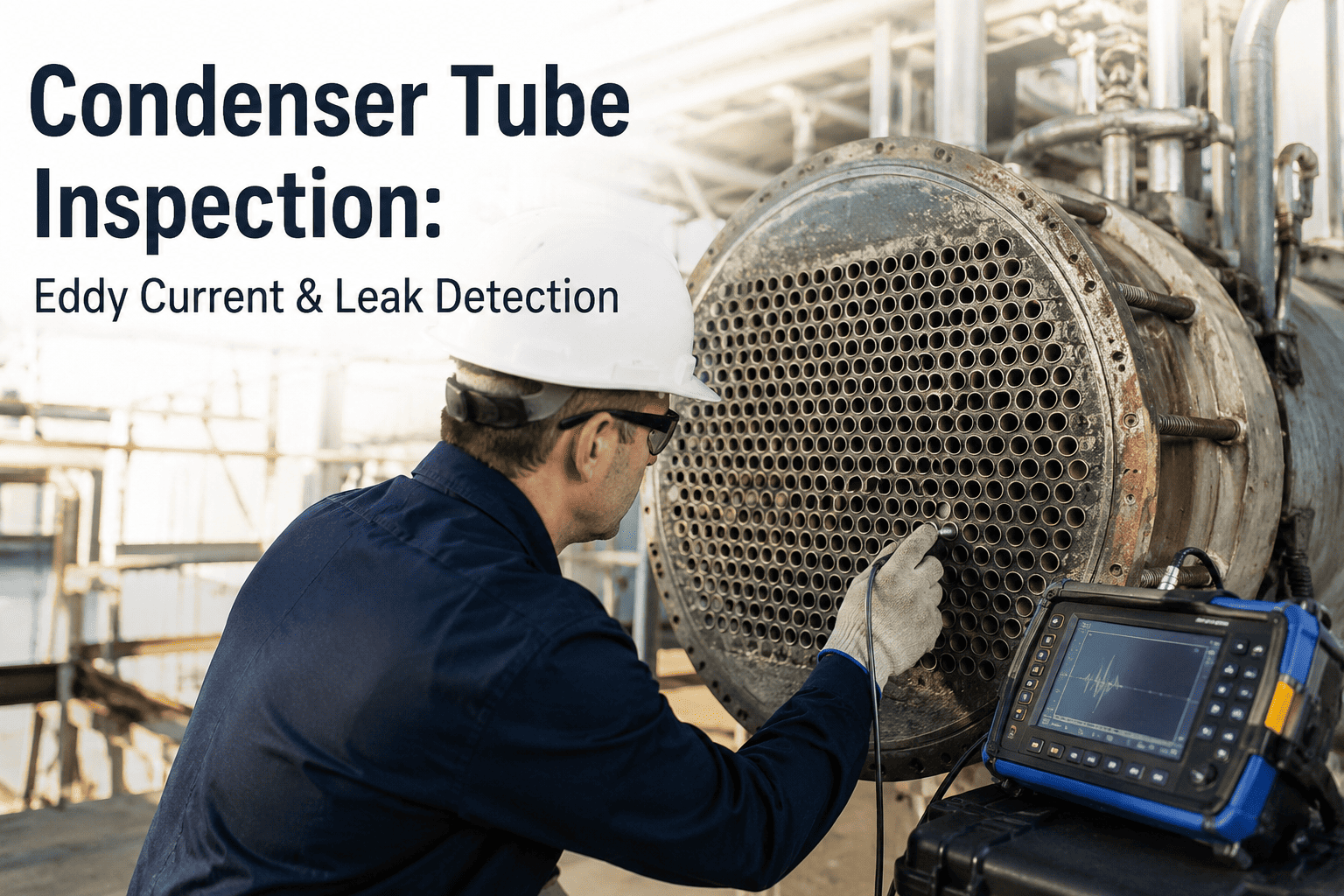
Ultrasonic thickness gauging finds general wall loss and misses almost everything else that actually takes a power plant down. Localized corrosion under insulation, cracking in a weld heat-affected zone, and graphitization in cast iron piping all slip past a basic UT grid scan, then show up later as an unplanned outage. The plants that stopped getting surprised switched to a layered toolkit — phased array for volumetric coverage, time-of-flight diffraction for weld sizing, and pulsed eddy current for the corrosion that hides under insulation and coatings. None of these techniques is new, but most plants still default to whichever one the inspection contractor showed up with. Book a demo to see how iFactory matches the right NDE method to each asset automatically instead of leaving that call to whoever's on shift.
Advanced NDE · Power Plant Reliability · Inspection Technology
PAUT, TOFD, and Pulsed Eddy Current: Choosing the Right Advanced NDE Method for Every Asset
A single default inspection method finds a fraction of what's actually degrading in a power plant. iFactory tracks which method was used where, and flags assets that are overdue for the technique that would actually catch their failure mode.
Why This Matters Now
The Cost of a Missed Defect Class
Every NDE technique has a detection window it was engineered for, and outside that window it simply does not see the defect at all, not with reduced confidence but with a genuine blind spot. Graphitization in cast iron piping is a good example: it can create crater-like surface defects that lead to sudden ruptures with essentially no warning sign, and conventional ultrasonic testing struggles badly with cast iron because of its high signal attenuation. A plant running only UT grid scans against that piping is not getting a partial picture, it is getting almost no picture at all for that specific degradation mode. The same blind-spot problem shows up wherever a single default method is applied across an asset class that actually contains several different failure mechanisms.
This is also why on-stream inspection during operation matters as much as outage-window inspection. Phased array corrosion mapping is regularly used to monitor piping and equipment while a plant continues running, improving turnaround efficiency by catching general and localized corrosion trends before they force an unplanned shutdown, provided the method is actually being pointed at the right assets on the right schedule.
The Three Core Techniques
What PAUT, TOFD, and Pulsed Eddy Current Are Each Actually Good At
Every advanced NDE method was developed to solve a specific detection problem that older techniques struggled with. Understanding what each one was built for is the fastest way to stop misapplying them.
01
Phased Array Ultrasonic Testing (PAUT)
PAUT steers a beam electronically across dozens of small elements instead of moving a single transducer by hand, which lets one scan cover a much wider weld or corrosion-mapping area with multiple display formats captured and stored for later review. It is the workhorse choice for new construction weld verification and general corrosion mapping across piping and vessel shells, and unlike radiography it carries no radiation exposure risk during an outage. Because the captured data set can be reopened and reinterpreted later, a PAUT scan run today can still answer a question a reliability engineer asks two outages from now, which is not something a manual single-probe reading can offer.
02
Time-of-Flight Diffraction (TOFD)
TOFD measures the time it takes diffracted sound waves to travel from a crack tip back to the receiver, which makes it unusually precise for sizing crack height and depth compared to amplitude-based techniques. It is frequently paired with PAUT on critical welds, using PAUT to find and characterize an indication and TOFD to confirm exactly how deep it runs before a repair decision is made. That depth number is often the single input that decides whether a weld gets ground and repaired immediately or scheduled for monitoring until the next outage, which makes TOFD's precision worth the added scan time on any weld where the decision actually matters.
03
Pulsed Eddy Current (PEC)
PEC uses an electromagnetic pulse to measure average wall thickness through insulation, coatings, and even some cladding without removing them, making it the only practical option for scanning corrosion under insulation across long runs of piping. It also handles cast iron and other materials that give ultrasonic testing trouble due to signal attenuation, though it is best used as a screening tool that flags zones for a more precise follow-up method. Combining PEC with array-style probes further speeds up coverage, letting a crew screen a full pipe rack in the time it would previously take to strip and scan a handful of isolated test points.
Getting Started
Building an Advanced NDE Program Without Overhauling Everything at Once
Most plants do not need to replace their entire inspection contract to benefit from a layered advanced NDE approach. The highest-value starting point is usually the asset class with the worst track record of surprise findings, since that is where the wrong-method problem is already costing money in unplanned work.
Start With Insulated Piping
Long insulated runs are the most common blind spot in a conventional UT-only program, and adding a PEC screening pass is usually the fastest win, since it requires no full insulation removal to get a first read.
Layer TOFD Onto Critical Welds Only
Full TOFD deployment across every weld in a plant is rarely necessary. Reserving it for welds with prior crack indications or safety-critical service concentrates the added cost where it actually changes a repair decision.
Track Method Coverage by Asset, Not Just Findings
A record that only logs pass or fail results loses the information needed to know whether an asset was actually scanned with a method capable of finding its specific failure mode, which is the gap that causes repeat surprises.
Method Selection
Which Failure Mode Points to Which Method
The fastest way to waste an outage day is to run the wrong NDE method against a failure mode it was never designed to catch. This matrix maps the most common power plant degradation types to the technique that actually finds them.
Failure Mode
Best Method
Why
Corrosion under insulation
Pulsed Eddy Current
Scans through insulation without stripping it off, covering long pipe runs quickly
Weld volumetric defects
Phased Array UT
Wide-area electronic beam steering catches porosity and inclusions across the weld volume
Crack depth sizing
Time-of-Flight Diffraction
Diffracted-wave timing gives far more precise depth measurement than amplitude methods
Surface and near-surface cracking
Eddy Current Array
High sensitivity to tight surface-breaking indications without surface coupling fluid
General wall thinning, cast iron
Pulsed Eddy Current
Electromagnetic method avoids the high attenuation that defeats ultrasonic testing on cast iron
iFactory Matches the NDE Method to the Asset Before the Outage Starts.
Stop relying on whichever technique the contractor brought. Every asset gets flagged with the method its specific degradation history actually calls for.
Know the Limits
Where Each Advanced Method Still Falls Short
No single NDE technique covers every scenario, and knowing where a method struggles is just as important as knowing where it excels.
PAUT at High Temperature
Ultrasonic coupling and attenuation both degrade above roughly 200°C, and confidence in corrosion mapping accuracy drops further as surface temperature climbs, which limits reliable on-stream use on hot piping without specialized probes. Studies evaluating phased array corrosion mapping accuracy across a range of elevated temperatures have found the technique still workable up to that threshold, but with meaningfully wider uncertainty than a room-temperature scan, so results near the temperature limit should be treated as directional rather than definitive.
TOFD Near-Surface Blind Zone
TOFD has a documented near-surface region where sizing accuracy drops, so it is usually paired with a complementary surface technique rather than used alone on welds where near-surface cracking is a concern. Pairing it with eddy current array or dye penetrant on the surface layer closes that gap, giving full-depth coverage instead of leaving the region closest to the weld cap under-inspected.
PEC as a Screening Tool Only
Pulsed eddy current reports an averaged thickness over its footprint, so it is genuinely strong at flagging general corrosion zones but is not built to precisely characterize an isolated small pit the way a point-source ultrasonic reading can. Newer array-style PEC probes narrow this gap somewhat by improving spatial resolution, but a flagged zone should still get a targeted point reading before a run or repair decision is finalized.
Layered Inspection Workflow
How the Three Methods Work Together Across One Outage
The strongest inspection programs do not pick one method and stop. They layer methods in sequence, using a fast screening pass to find where to look closely and a precise method to confirm what was found.
Step 1
Pulsed eddy current sweeps insulated piping and vessel runs quickly, flagging zones with unexpected wall loss without requiring insulation removal at every location.
Step 2
Flagged zones get insulation stripped locally and a phased array scan characterizes the corrosion pattern or weld indication in detail, capturing a storable data set for trending.
Step 3
Any crack-like indication found by PAUT gets sized precisely with time-of-flight diffraction before a repair, replace, or run decision is made against fitness-for-service criteria.
Step 4
Every result across all three methods is logged against the same asset record, so the next outage starts from a documented history instead of a blank inspection sheet.
From the Field
What Changed When the Program Stopped Defaulting to One Method
For years our default was a UT grid scan on everything, because that's what the contract crew always brought first. We were missing corrosion under insulation entirely on long horizontal runs because nobody wanted to strip enough lagging to check properly. Once we started running PEC as a first pass across those runs, we found active corrosion zones on lines that had passed every prior inspection. The UT wasn't wrong, it just was never being pointed at the right spots because the screening step was missing.
— Reliability Engineer, Combined Cycle Facility
3 methodsNow layered instead of one default technique
CUI zonesFound only after adding a PEC screening pass
Conclusion
Advanced NDE Only Works If the Right Method Reaches the Right Asset
PAUT, TOFD, and pulsed eddy current each solve a different detection problem, and none of them is a universal replacement for the other two. The plants that get the most value from advanced NDE are not the ones with the most expensive equipment, they are the ones that consistently route the right method to the right failure mode instead of running whatever technique happens to be available that outage.
iFactory keeps a record of which method was used where, tracks results against each asset's specific degradation history, and flags when a different technique would catch something the last inspection missed. Book a demo to see your inspection history mapped by method and asset.
Frequently Asked Questions
Advanced NDE Methods — Common Questions
Is phased array ultrasonic testing more expensive than conventional UT?
PAUT equipment and technician certification cost more upfront than conventional single-element UT, but the wider scan coverage per pass and the ability to store and later review captured data typically reduces total inspection time on large welds and vessel areas, which often offsets the higher per-hour rate over a full outage scope.
Book a demo to see how method selection affects overall outage inspection time in your specific asset mix.
Can pulsed eddy current replace ultrasonic thickness gauging entirely?
Not entirely. PEC is excellent as a fast screening tool that covers insulated or coated piping without removal, but it reports an averaged thickness over a footprint rather than a precise point reading, so isolated pitting or small localized defects are better confirmed with a point-source ultrasonic measurement once PEC has flagged the general area of concern.
Why pair TOFD with phased array instead of using either alone?
PAUT is strong at finding and roughly characterizing an indication across a wide scan area, while TOFD is specifically strong at precisely measuring how deep that indication actually runs using diffracted wave timing rather than amplitude. Using PAUT to find and TOFD to size gives a more complete and defensible picture than either method provides alone, particularly for fitness-for-service decisions on critical welds.
Does advanced NDE eliminate the need for radiography?
Not universally, but it has significantly reduced reliance on radiography in many power plant applications because ultrasonic-based methods avoid radiation exposure and area evacuation requirements during an outage, and they generally provide faster turnaround. Radiography still has applications where its specific imaging characteristics are preferred, so the two are often used as complementary rather than fully interchangeable techniques.
How should a plant decide which assets get which advanced NDE method?
The decision should follow the asset's documented degradation history and material type rather than defaulting to whichever technique an inspection contractor happens to bring. Insulated piping with any corrosion under insulation history should default to a PEC screening pass, critical welds with prior crack indications should get PAUT plus TOFD, and cast iron or high-attenuation materials should route to electromagnetic methods over conventional ultrasonic.
Contact support for help mapping your asset list to the right default method.
Stop Letting the Inspection Contractor's Default Method Decide What Gets Found
Track every NDE result by method and asset, and let iFactory flag when a different technique would catch what the last scan missed.