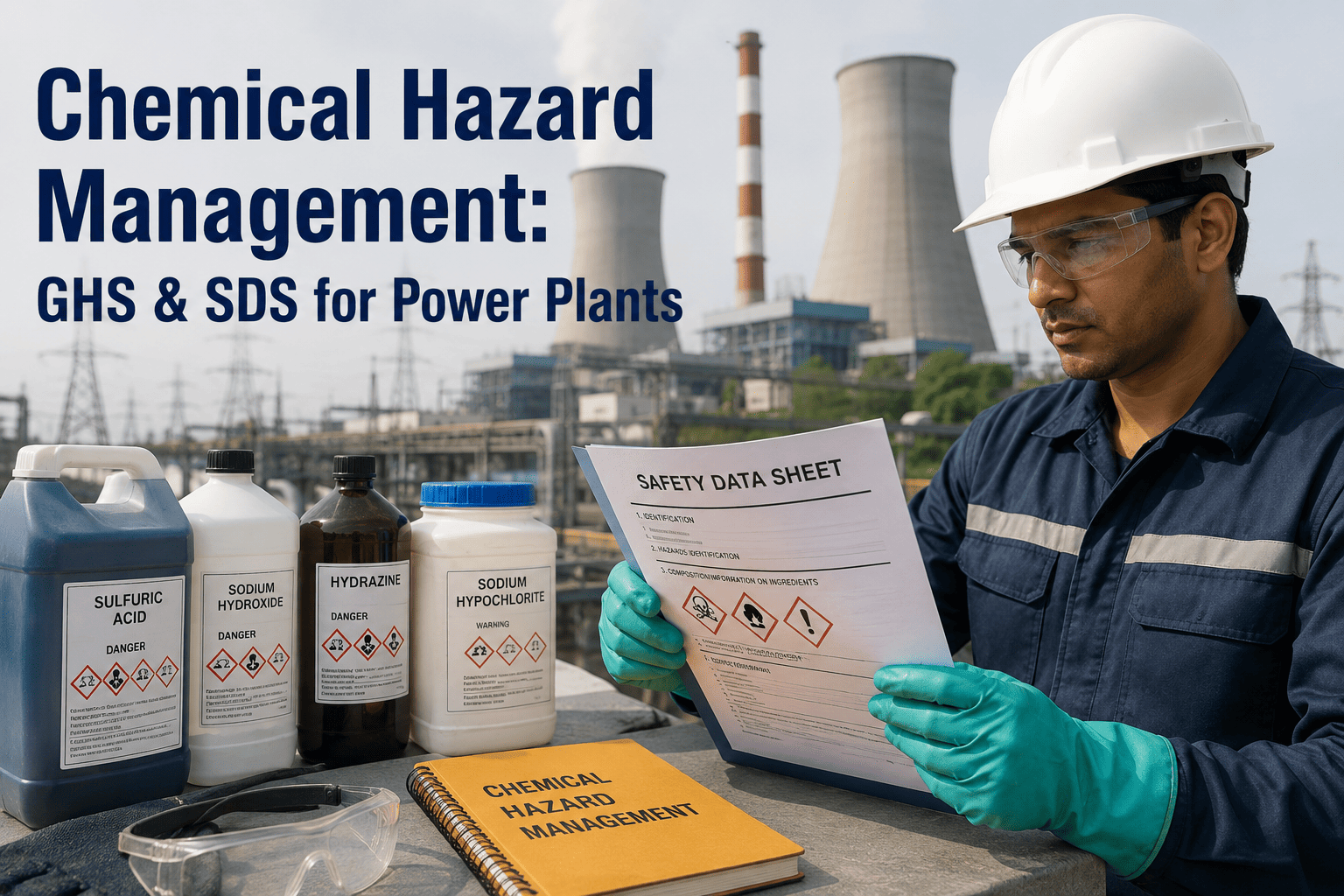
Power plants store and handle more chemical types than most people realize — from chlorine for cooling water treatment and hydrazine for boiler chemistry to sulfuric acid for demineralizer regeneration and ammonia for NOx control. A single mislabeled container or an outdated Safety Data Sheet can trigger an OSHA citation, an EPA reportable quantity event, or a worker exposure incident that shuts down a unit for days. The Globally Harmonized System provides the framework, but the real challenge is operational — keeping your chemical inventory current, your SDS library accessible within seconds, and your hazard communication program auditable at any moment. To see how iFactory digitizes your entire chemical management workflow, book a 30-minute demo.
Chemical Hazard Management in Power Plants: The Complete GHS and SDS Compliance Guide
How plant safety teams manage chemical inventories, maintain SDS libraries, select PPE, and stay audit-ready across treatment systems, fuel handling, and maintenance operations — without drowning in paperwork.
The Chemical Landscape Inside a Power Plant
Every area of a power plant handles chemicals, but the hazard profiles differ dramatically between zones. A chemical that is routine in the water treatment building can become a reportable spill event if it migrates to the turbine hall drain system. Understanding the chemical inventory by plant zone is the first step in building a hazard management program that actually protects workers and passes regulatory scrutiny. The zone breakdown below represents the typical chemical profile of a 500 MW pulverized coal unit — gas, combined cycle, and biomass units will have variations, but the zone-based framework applies universally.
Highest Chemical Density, Highest Turnover Rate
The water treatment plant is typically the most chemical-intensive area in the facility. Sulfuric acid and sodium hydroxide are used in demineralizer regeneration cycles that can occur daily during peak operation. Chlorine or sodium hypochlorite is dosed into cooling water to control biological growth. Phosphate compounds, amines, and hydrazine are blended and injected into the boiler feedwater system to control scale, pH, and oxygen. This zone alone can account for 40 to 50 distinct chemical SKUs with varying hazard classifications — corrosives, toxic substances, and oxidizers stored in close proximity, often with incompatible materials on adjacent shelving or in adjacent rooms.
Toxic Chemicals Under High Pressure and Temperature
Boiler chemistry chemicals are injected directly into high-pressure systems where a leak or mis-dose has immediate safety implications. Hydrazine, a known carcinogen regulated under OSHA substance-specific standards, is stored in bulk tanks and day tanks with dedicated containment, piping, and ventilation. Oxygen scavengers, pH adjusters, and condensate polisher regeneration chemicals all require SDS access at the point of use — not just in the water treatment lab. Operators handling these chemicals need PPE selection tied directly to the SDS Section 8 exposure limits and the actual operating conditions of the system they are servicing, which can include high temperature, high pressure, and confined space entry requirements simultaneously.
Bulk Storage With Reportable Quantity Thresholds
Wet FGD systems use limestone slurry and may handle hydrochloric acid for pH trimming in the absorber loop. Ammonia or urea is stored in bulk for selective catalytic reduction systems, often in quantities that exceed EPA Tier II reporting thresholds and require Tier II chemical inventory reporting under EPCRA Section 312. A single 20,000-gallon anhydrous ammonia tank can trigger multiple federal and state reporting obligations, and the SDS library for this zone must include not just the pure chemicals but the reaction byproducts and waste stream characteristics that create secondary hazard classifications. Spill response planning for this zone requires quantified containment calculations and notification procedures tied to reportable quantity thresholds in 40 CFR 302.
Scattered Inventory, Highest Mislabeling Risk
Maintenance shops, turbine deck areas, and outdoor storage locations accumulate a diffuse inventory of solvents, lubricants, degreasers, paints, adhesives, and cleaning compounds that is the hardest to track and the most likely to be found with missing or outdated labels during an inspection. Parts washers may contain petroleum distillates or chlorinated solvents. Welding operations introduce compressed gases, flux compounds, and arc welding fume hazards. The challenge in this zone is not the hazard severity of any single chemical — it is the sheer number of low-volume, high-variety chemicals spread across dozens of locations, each one requiring a current SDS, a GHS-compliant label, and a documented hazard communication training record for every worker who may encounter it.
GHS Compliance: What OSHA HCS Actually Requires in Practice
The OSHA Hazard Communication Standard (29 CFR 1910.1200), aligned with the Globally Harmonized System since 2012, establishes six core requirements that every power plant must satisfy. Most plants believe they are compliant because they have an SDS binder somewhere and containers have labels. But OSHA compliance audits consistently reveal gaps in the operational details — training documentation, label accuracy for secondary containers, SDS currency, and the written program itself. The six requirements below are presented in the order they are most frequently cited during inspections, from most to least common violation.
Written Hazard Communication Program
Every covered employer must maintain a written hazard communication program that describes how the facility meets each HCS requirement — container labeling, SDS management, employee training, and the list of chemicals present. The program must identify the person responsible for each element and describe how non-routine tasks like confined space chemical exposures or contractor chemical use are covered. The most common gap is a program document that exists but has not been updated to reflect current chemical inventory, organizational changes, or new OSHA guidance. An outdated written program is treated the same as no program during an inspection.
SDS Access and Currency
Employers must ensure that a current SDS is available for every hazardous chemical in the workplace and that employees can access the SDS library without barriers within 24 hours of a request — in practice, this means electronic access on plant floor terminals or physical binders within reach of every work area. The citation rate on this requirement is high because plants add new chemicals, change suppliers, or receive SDS revisions from manufacturers and fail to update the library. An SDS that is more than 5 years old for a chemical still in use is a presumptive violation unless the employer can document that a current version was requested and not yet received from the manufacturer.
GHS-Compliant Container Labeling
All containers of hazardous chemicals must bear a GHS-compliant label with the product identifier, signal word, hazard pictograms, hazard statements, precautionary statements, and supplier information. This applies to secondary containers — spray bottles, dip containers, mix tanks, and any vessel into which a chemical is transferred from its original shipping container. The most frequent violation is secondary containers in maintenance areas and field locations that carry only a hand-written chemical name with no hazard information. OSHA treats an unlabeled secondary container of a hazardous chemical as a serious violation with a per-instance penalty structure.
Employee Training and Competency Verification
Workers must be trained on the hazards of the chemicals they work with before their first assignment, and retraining is required when a new hazard is introduced. Training must cover GHS label elements, SDS format and content, and the specific physical and health hazards of the chemicals in their work area. The gap is not usually the absence of training records — it is the inability to demonstrate that training was specific to the actual chemicals the worker encounters and that the worker demonstrated comprehension. Signed attendance sheets without content documentation or competency assessment do not satisfy the standard in an inspection context.
Chemical Inventory List Maintenance
The written program must reference a current chemical inventory that identifies every hazardous chemical present in the workplace by product name and includes the location where it is used or stored. The inventory must be cross-referenced to the SDS library so that every chemical on the list has a corresponding SDS. Plants frequently fail this requirement when chemicals are added through purchase orders that bypass the environmental health and safety review process — a maintenance technician orders a solvent online, it arrives without EHS review, and it enters the workplace with no inventory entry, no SDS, and no label beyond the shipping container.
Contractor Hazard Communication
When contractors bring chemicals onto the site or work in areas where plant chemicals are present, the host employer must ensure that contractors are informed of the hazards, have access to SDS, and that their employees are trained. Similarly, the contractor must inform the host employer of any chemicals they bring. The typical gap is a contractual requirement that exists on paper but is not operationalized — contractors arrive with their own chemical containers, no SDS exchange occurs, and neither party can document the hazard communication during a post-incident investigation or inspection.
SDS Management: The 16 Sections That Matter Most for Power Plant Operations
Every Safety Data Sheet follows the same 16-section format mandated by GHS. But for power plant safety teams, not all sections carry equal operational weight. Section 8 (exposure controls and PPE) drives your daily PPE selection. Section 6 (accidental release measures) drives your spill response plan. Section 7 (handling and storage) drives your chemical segregation program. The breakdown below highlights which sections demand active management attention versus which are reference-only for most plant personnel.
Hazard Identification
Signal word, hazard pictograms, and hazard statements that determine your label content, training requirements, and emergency response classification. This section drives everything downstream — if the classification is wrong, your entire program for that chemical is wrong.
Accidental Release Measures
Emergency procedures, containment methods, and environmental precautions that form the basis of your spill response plan for each chemical. This section must be translated into site-specific spill kits, containment capacities, and notification procedures that match your actual plant drainage and containment infrastructure.
Handling and Storage
Incompatibilities, storage temperature ranges, and ventilation requirements that determine your chemical segregation matrix and storage room design. Storing incompatible chemicals based on convenience rather than this section is the most common root cause of chemical reaction incidents in industrial facilities.
Exposure Controls and PPE
Permissible exposure limits, respiratory protection requirements, glove material compatibility, and eye protection specifications that directly determine what PPE your workers wear for each task. This section must be cross-referenced to your actual task conditions — the SDS gives general guidance; your program must specify PPE for each specific task and exposure scenario.
Identification, Composition, and Properties
Product identification, ingredient disclosure, and physical-chemical properties. Essential for inventory management and emergency response, but these sections do not change frequently and require only periodic verification rather than active management.
Physical, Stability, and Toxicological Data
Technical data on flash points, auto-ignition temperatures, stability conditions, and toxicological endpoints. Critical for process safety analysis and risk assessment but accessed infrequently during routine operations.
Ecological, Disposal, Transport, and Regulatory
Environmental impact, waste disposal codes, DOT shipping classifications, and regulatory listings. Important for waste management and Tier II reporting but typically managed by the environmental compliance function rather than the frontline safety team.
Chemical Storage Segregation: The Compatibility Rules That Prevent Reactions
Storing incompatible chemicals in the same area is one of the most dangerous and most preventable failures in chemical hazard management. OSHA and NFPA provide compatibility guidance, but translating those guidelines into a practical storage plan for a power plant with 140-plus chemical SKUs requires a structured approach. The segregation matrix below covers the major hazard classes found in power plants and the minimum separation requirements between them. Any deviation from these rules requires a documented risk assessment and engineering controls that compensate for the reduced separation.
| Hazard Class | Must Be Separated From | Minimum Separation | Common Power Plant Chemicals |
|---|---|---|---|
| Flammable Liquids | Oxidizers, Corrosives | 20 ft or fire-rated barrier | Diesel fuel, acetone, methanol, mineral spirits |
| Oxidizers | Flammables, Organics, Reducers | 20 ft or fire-rated barrier | Sodium hypochlorite, hydrogen peroxide, permanganate |
| Corrosive Acids | Corrosive Bases, Flammables, Oxidizers | Same room, separate shelf or cabinet | Sulfuric acid, hydrochloric acid, nitric acid |
| Corrosive Bases | Corrosive Acids, Metals | Same room, separate shelf or cabinet | Sodium hydroxide, potassium hydroxide, ammonia solution |
| Toxic Substances | All other classes (isolated storage) | Dedicated locked enclosure with ventilation | Hydrazine, formaldehyde, benzene-based solvents |
| Compressed Gases | Flammables, Oxidizers (separate gas types) | Secured upright, separated by gas type, chained | Nitrogen, argon, acetylene, oxygen, propane |
| Reactive Chemicals | Water, Acids, Bases, Oxidizers | Isolated storage, temperature controlled | Calcium carbide, sodium metal, phosphorus compounds |
PPE Selection by Hazard Class: Matching Protection to the Actual Risk
PPE selection for chemical handling in power plants must be driven by the SDS Section 8 data cross-referenced to the specific task conditions — not by what is available in the supply cabinet or what the previous shift was wearing. The table below maps the minimum PPE requirements for each major hazard class to the typical tasks performed in power plant chemical handling operations. These are minimum standards; job hazard analysis for specific tasks may require upgrades based on exposure duration, concentration, temperature, and the potential for splash or immersion.
| Hazard Class | Eye Protection | Glove Material | Body Protection | Respiratory |
|---|---|---|---|---|
| Corrosive Acids | Chemical splash goggles + face shield | Neoprene, nitrile, or butyl rubber | Acid-resistant apron or suit for bulk handling | None unless misting; then half-face with acid gas cartridge |
| Corrosive Bases | Chemical splash goggles + face shield | Nitrile or neoprene | Chemical-resistant apron for transfer tasks | None for normal handling; half-face if misting potential |
| Toxic Carcinogens | Chemical splash goggles | Butyl rubber (check SDS compatibility) | Full chemical suit for bulk handling or spill response | Supplied air for handling hydrazine and known carcinogens |
| Flammable Liquids | Safety glasses with side shields | Nitrile for most hydrocarbons | Flame-resistant coveralls if ignition source present | Organic vapor cartridge if ventilation is inadequate |
| Oxidizers | Chemical splash goggles | Nitrile or neoprene | Standard work clothing; chemical apron for bulk transfer | None unless dusting; then P100 half-face |
| Compressed Gases | Safety glasses | Leather or reinforced for cylinder handling | Steel-toe boots, metatarsal guards for cylinder movement | SCBA for confined space entry with inert gas potential |
Spill Response Protocol: The Six-Step Framework for Chemical Releases
Every power plant chemical spill response plan must be specific to the chemicals present, the containment infrastructure available, and the notification chain required by federal, state, and local regulations. The six-step framework below provides the operational structure — the specific actions within each step must be populated from your SDS Section 6 data, your plant drainage maps, and your regulatory reporting obligations. A generic spill response plan that does not reference specific chemicals, specific locations, and specific quantities is a compliance gap, not a compliance solution.
Recognize and Assess
The first responder identifies the released chemical from the container label or area signage, estimates the quantity released, and assesses whether the release exceeds the reportable quantity threshold in 40 CFR 302. This assessment determines whether the response is a routine cleanup or a notification event. If the chemical cannot be identified, the response must proceed as if the worst-case hazard classification applies until the material is confirmed. All initial assessments must be communicated to the shift supervisor within five minutes of discovery.
Isolate and Contain
Eliminate ignition sources for flammable releases. Stop the source if it can be done safely — close a valve, right a container, or shut a pump. Deploy containment materials — absorbent booms, dikes, or drain covers — to prevent the release from reaching floor drains, storm water systems, or waterways. Containment is the single most time-critical action because once a chemical enters the drainage system, the release becomes an environmental event with reporting obligations that cannot be reversed.
Notify and Escalate
If the release exceeds the reportable quantity, notify the National Response Center, state emergency response commission, and local emergency planning committee per EPCRA requirements. Internal notification must reach the plant manager, environmental coordinator, and safety manager within the timeframe specified in your spill response plan — typically 30 minutes. Document the notification time, recipients, and information provided for every notification event. Failure to notify is a separate violation from the spill itself and carries independent penalties.
Clean Up and Decontaminate
Trained spill response personnel wearing PPE specified in the SDS Section 8 for the released chemical perform the cleanup using absorbent materials compatible with the chemical — note that some absorbents react with certain chemicals. All spilled material and contaminated absorbent must be collected, containerized, labeled as hazardous waste, and staged for disposal in accordance with the waste disposal guidance in SDS Section 13. Decontaminate the affected area and verify that no residual chemical remains using appropriate detection methods.
Document and Report
Complete a spill incident report documenting the chemical, quantity, cause, response actions, notifications made, and disposal method. Include photographs of the release area, containment actions, and any environmental impact. The report must be filed with the environmental compliance file and reviewed in the next management-of-change review if the spill revealed a gap in containment, labeling, training, or storage practices. OSHA requires that near-miss events — releases that did not result in exposure but could have — are also documented and investigated.
Root Cause and Corrective Action
Conduct a formal root cause analysis for every reportable release and every near-miss event. Common root causes in power plants include incompatible chemical storage leading to container failure, secondary container mislabeling leading to wrong spill response, missing or outdated SDS leading to incorrect PPE selection, and inadequate containment allowing release to reach the drainage system. Each root cause must have a documented corrective action with an owner, a deadline, and a verification step that confirms the action was implemented and effective.
Your SDS Library Is Only as Good as Your Ability to Find the Right Sheet in Under 60 Seconds
iFactory digitizes your entire chemical inventory, links every container to its current SDS, flags outdated documents automatically, and puts hazard information at every worker's fingertips on any device. No more binders. No more missing sheets. No more citations for inaccessible SDS during an OSHA walk-through.
Five Compliance Gaps That Cost Power Plants Millions Every Year
Chemical hazard management failures in power plants do not always result in a dramatic spill or an OSHA inspection. More often, they create a slow accumulation of risk — outdated SDS that lead to wrong PPE, mislabeled containers that cause wrong spill response, missing training records that compound violations during an investigation. The five gaps below are the ones most frequently identified in compliance audits and incident investigations across the power generation industry, and each one is preventable with the right systems and processes in place.
SDS Library Drift — The Silent Compliance Killer
Chemical manufacturers update their SDS an average of 2.3 times per product per five-year period due to revised toxicity data, new regulatory classifications, or updated handling guidance. Most plants receive these updates via email or fax and never file them into the active SDS library. Over a five-year period, a plant with 140 chemical SKUs can accumulate over 300 outdated SDS documents that workers are relying on for PPE selection and spill response. When OSHA audits the library and finds SDS from 2019 still in use for a chemical whose classification was updated in 2022, the citation applies to every location where that chemical is present, multiplied by the number of workers who had access to the outdated document.
Secondary Container Label Failure Across Distributed Locations
Primary containers arrive from suppliers with GHS-compliant labels, but the moment a chemical is transferred to a spray bottle, a dip container, a mix tank, or a sample jar, the secondary container must also carry a GHS-compliant label. In power plants, secondary containers are scattered across maintenance shops, turbine decks, outdoor storage areas, and contractor staging locations. During a typical audit, 30 to 50 percent of secondary containers are found with incomplete or missing labels. Each unlabeled secondary container of a hazardous chemical is a separate serious violation with a current penalty of up to $16,131 per instance.
Training Records That Cannot Withstand Scrutiny
Hazard communication training records must demonstrate that each worker received training specific to the chemicals in their work area, covering GHS label elements, SDS format, and the physical and health hazards of the chemicals they encounter. Many plants maintain only a general HAZCOM training sign-in sheet with no documentation of content, no link to specific chemicals, and no competency verification. When OSHA requests training records for a specific worker involved in a chemical incident and the only documentation is a sign-in sheet from three years ago with no content detail, the training citation is virtually guaranteed and the penalty escalates because the employer cannot demonstrate due diligence.
Chemical Inventory Blind Spots From Uncontrolled Procurement
Chemicals enter power plants through multiple channels — formal purchase orders through the EHS review process, maintenance orders placed directly by technicians, contractor-supplied chemicals, and sample products from vendors. Any chemical that enters without EHS review bypasses the inventory update, the SDS filing, the labeling requirement, and the training obligation. In plants that audit their physical inventory against their documented inventory, the discrepancy is typically 15 to 25 percent — meaning 20 to 35 chemicals in a 140-SKU plant are present but not tracked, not labeled, and not covered by the hazard communication program.
Spill Response Plans That Exist on Paper But Not in Practice
Every power plant has a spill response plan. Many of those plans are generic documents copied from a template and populated with chemical names but not linked to specific locations, specific containment infrastructure, or specific notification procedures. When a real spill occurs, responders discover that the plan does not specify where the spill kits for that chemical are located, does not identify which floor drains in that area can be blocked, and does not provide the exact notification numbers and reportable quantity thresholds for the released chemical. The plan fails at the moment it is needed most, and the post-incident investigation reveals that the gap was always there but was never tested through a realistic drill.
How iFactory Digitizes Chemical Hazard Management End to End
The compliance gaps described above share a common root cause: manual processes that depend on individual diligence, paper systems that cannot scale across hundreds of chemicals and dozens of locations, and disconnected databases that prevent cross-referencing between inventory, SDS, labeling, training, and spill response. iFactory addresses every one of these gaps in a single platform that connects your chemical data to your operational workflows in real time.
Every chemical in your plant is logged with product name, manufacturer, CAS number, hazard classification, storage location, quantity on hand, and the date the SDS was last verified. The inventory is searchable, filterable by zone or hazard class, and always current because it is updated at the point of chemical receipt — not weeks later when a paperwork stack reaches the EHS desk. When a new chemical arrives, the receiving technician scans the container barcode, and iFactory automatically requests the SDS from the manufacturer database if it is not already in the system.
iFactory maintains a live SDS library linked to your chemical inventory. When a manufacturer updates an SDS, the system flags the change, alerts the responsible EHS coordinator, and archives the previous version with a full revision history. Every SDS in the library has a verified date, and the system generates an automatic alert when any SDS has not been verified within your specified interval — typically 12 months. Workers access the SDS library from any plant terminal or mobile device in under 10 seconds by scanning a container barcode or searching by chemical name, location, or hazard class.
When a chemical is transferred to a secondary container, the operator selects the source chemical from the iFactory interface on a plant floor terminal, and the system generates a GHS-compliant label with the correct product identifier, signal word, pictograms, hazard statements, and precautionary statements pulled directly from the current SDS. The label prints on a GHS-compatible printer with the correct color and format — no handwriting, no guessing at hazard classifications, no risk of an outdated label being copied from an old container. Every label generated is logged with a timestamp and operator ID for audit traceability.
iFactory extracts PPE requirements from SDS Section 8 for every chemical in your inventory and cross-references them to your task-based job hazard analyses. The result is a PPE matrix that shows every worker exactly what protection is required for every chemical task they perform — and the matrix updates automatically when an SDS is revised with new exposure limits or PPE recommendations. If a manufacturer downgrades the glove compatibility rating for a solvent you use daily, the PPE matrix flags the change and alerts the affected workers and their supervisors before the next shift.
Hazard communication training records in iFactory are linked to specific chemicals, specific zones, and specific workers. When training is completed, the system records the content covered, the chemicals referenced, and the competency verification method — written test, practical demonstration, or supervised task completion. When a new chemical is added to a zone, the system automatically identifies every worker assigned to that zone and generates a training assignment that must be completed before the worker handles the new chemical. This eliminates the training gap that occurs when chemicals are added faster than the training schedule can accommodate.
When a spill is reported in iFactory, the system immediately pulls the SDS Section 6 data for the identified chemical, displays the containment and cleanup procedures on the responder's device, shows the location of the nearest compatible spill kit, identifies which floor drains in the area can be blocked, and calculates whether the estimated release quantity triggers reportable quantity notifications. The notification module generates pre-populated notification forms with the correct agency numbers, reportable quantity thresholds, and required data fields — reducing the notification time from 30 minutes of manual form-filling to 5 minutes of verification and submission.
Want to see how iFactory connects your chemical inventory, SDS library, PPE matrix, and spill response in one platform? Book a 30-minute platform walkthrough with our team.
Frequently Asked Questions
Does OSHA require electronic SDS access, or are physical binders still acceptable?
OSHA accepts both electronic and physical SDS access methods, but the standard requires that SDS be readily accessible to employees during each work shift and that access be provided without barriers. In practice, electronic access is now the preferred and most defensible method because it eliminates the risk of missing pages, outdated revisions, and binders that are not returned to their designated location. However, electronic systems must be available on devices that are accessible in every work area where chemicals are used — a system that only works in the EHS office does not satisfy the requirement for workers in the water treatment building or the maintenance shop. iFactory deploys on plant floor terminals and mobile devices to ensure SDS access meets the OSHA accessibility standard everywhere chemicals are present. To see the deployment options for your facility, book a demo.
How often do Safety Data Sheets need to be updated in a power plant?
There is no fixed regulatory interval for SDS updates — the requirement is that the employer must maintain the most current version of the SDS available from the chemical manufacturer or importer. In practice, manufacturers update SDS an average of two to three times per five-year period per product, driven by changes in toxicological data, regulatory reclassifications, or updated handling guidance. The employer's obligation is to obtain and file the updated SDS when it becomes available, which means the plant must have a process for requesting current SDS from suppliers at regular intervals and verifying that the SDS on file matches the current manufacturer version. Best practice is to verify every SDS in the library at least annually and to subscribe to manufacturer update notification services for high-hazard chemicals like hydrazine, chlorine, and anhydrous ammonia.
What is the difference between GHS and HCS, and does our plant need to follow both?
The Hazard Communication Standard (HCS) is the OSHA regulation at 29 CFR 1910.1200 that requires chemical hazard communication in all covered workplaces. The Globally Harmonized System (GHS) is the international framework for chemical classification and labeling that OSHA adopted into the HCS in 2012 through a final rule. In the United States, compliance with HCS means compliance with the GHS-aligned version of the standard — there is no separate GHS obligation. Your plant must follow HCS, which now incorporates GHS classification criteria, label elements, and SDS format. If you are complying with the current HCS, you are GHS-compliant by definition. If you need help auditing your current HCS program against the latest requirements, contact the iFactory support team for a structured gap assessment.
How does iFactory handle contractor chemicals that are brought onto our site?
iFactory provides a contractor chemical registration module that allows contractors to submit their chemical inventory electronically before arriving on site. Each submitted chemical is cross-referenced against the plant's approved chemical list and hazard classification database. If a contractor chemical is not on the approved list, the system routes it to the EHS team for review, SDS collection, and approval or rejection before the chemical arrives on site. Once approved, the contractor chemical appears in the plant's master chemical inventory with its SDS, hazard classification, and storage location, and it is visible to plant workers in the areas where the contractor will be operating. This eliminates the compliance gap where contractor chemicals are present but not tracked in the host employer's hazard communication program.
What happens during an OSHA chemical hazard inspection, and how does iFactory help us prepare?
During a chemical hazard inspection, the OSHA compliance officer will request your written hazard communication program, your chemical inventory list, access to your SDS library, and training records for selected workers. They will then walk through the plant, check container labels against the SDS on file, verify that secondary containers are labeled, confirm that SDS are accessible from work areas, and interview workers to assess whether they understand the hazards of the chemicals they work with. iFactory prepares you for every element of this inspection: the written program is maintained as a live document that reflects current inventory and procedures, the chemical inventory is always current and cross-referenced to verified SDS, secondary container labels are generated from live SDS data so they are always accurate, and training records are linked to specific chemicals and competencies. When the compliance officer asks to see the SDS for a chemical they spot on a shelf, your team can pull it up in seconds from any device — and the system logs the access for the audit trail. For a pre-inspection readiness assessment, schedule a demo and we will walk through the inspection workflow on your actual chemical inventory.
Turn Chemical Hazard Management From a Liability Into a Competitive Advantage
iFactory gives your safety team a single platform that connects chemical inventory, SDS management, GHS labeling, PPE selection, training documentation, and spill response into one auditable, inspection-ready system. Stop managing chemicals in spreadsheets and binders. Start demonstrating compliance confidence to OSHA, your insurance carrier, and your workforce.