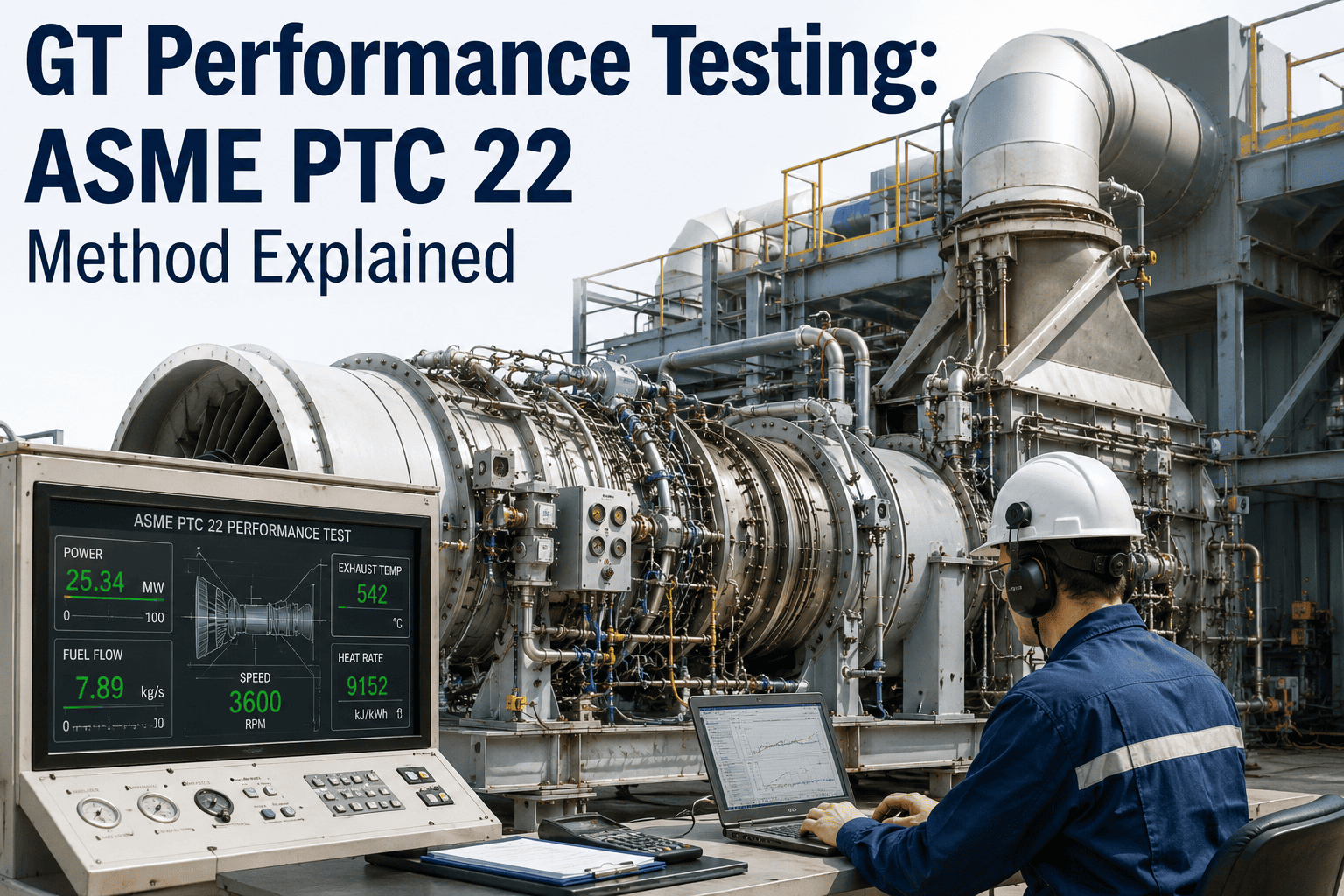
A gas turbine performance test only means something if the numbers it produces can survive scrutiny, and that is precisely what ASME PTC 22 exists to guarantee. The standard governs how output, heat rate, and efficiency are measured and corrected to reference conditions, and it is unforgiving about instrumentation accuracy, test duration, and correction methodology in ways that a casual internal test simply cannot replicate. Getting a PTC 22 test wrong does not just produce a bad number, it can void a performance guarantee claim or misrepresent years of gradual degradation as normal variation. Book a demo to see how iFactory keeps the instrumentation and data trail a PTC 22 test depends on continuously audit-ready.
ASME PTC 22 Turns a Turbine's Output Claim Into a Number You Can Actually Defend
Whether the test is settling a performance guarantee dispute, quantifying degradation since commissioning, or verifying an upgrade's promised gain, PTC 22 is the methodology that makes the resulting number defensible in front of an owner, an OEM, or a regulator. iFactory keeps the underlying instrumentation calibration and data continuity that every PTC 22 test relies on in order from day one.
Why a Casual Internal Reading Cannot Substitute for a PTC 22 Test
Control room instrumentation is calibrated and maintained for operational purposes, not for the tighter accuracy tolerances a formal performance test requires, and the difference matters enormously once a result is used to settle a contractual guarantee or make a capital decision about a repair or upgrade. A one or two percent instrumentation error is operationally irrelevant for running the plant day to day, but it is often larger than the actual degradation or improvement the test is trying to measure in the first place.
PTC 22 addresses this by specifying instrument grade and calibration traceability, minimum test duration to average out transient noise, and a defined correction methodology that normalizes the raw reading to standard reference conditions so results from different days, seasons, or even different sites can be compared meaningfully. Skipping any one of those three pillars produces a number that looks precise but is not actually defensible.
What Every Credible PTC 22 Test Requires
Preparing for Test Day: What Gets Checked Before the Turbine Even Runs
Most PTC 22 test failures or disputed results trace back to preparation gaps rather than problems on the day of the test itself, since a test built on uncalibrated instruments or an unstable ambient window cannot be salvaged by careful execution alone.
| Preparation Item | What Auditors Check | Typical Timing |
|---|---|---|
| Instrument calibration | Current calibration certificates for every test instrument | Within 30-90 days of test |
| Fuel sampling plan | Composition analysis method and sampling frequency | Confirmed prior to test window |
| Ambient condition window | Forecast stability and acceptable deviation range | 48-72 hours before test |
| Data acquisition system check | Logging interval, redundancy, and synchronization across instruments | Day before test |
| Test procedure sign-off | All parties agree on method before data collection begins | Prior to test day |
Why Correction Curves Are the Part Most Often Done Wrong
Raw test-day output and heat rate numbers are almost never directly comparable to a manufacturer's guarantee figure, because the guarantee was written against ISO standard reference conditions and the test almost certainly did not happen at exactly those conditions. Correction curves translate the as-tested result to what output and heat rate would have been at reference conditions, and using the wrong curve set, an outdated curve revision, or applying corrections in the wrong sequence is one of the most common sources of disputed results.
The correction process typically accounts for ambient temperature, barometric pressure, relative humidity, and fuel lower heating value, applied through manufacturer-supplied curves specific to that turbine model and configuration. Because these curves are proprietary and model-specific, a test conducted without the current, correct curve set for the exact unit configuration produces a corrected number that looks legitimate but will not hold up if challenged.
The Hardest Part of a PTC 22 Test Is Everything That Happens Before Test Day
iFactory maintains continuous instrumentation calibration records, ambient condition logging, and fuel composition history, so when a performance test is scheduled the data trail is already there instead of being reconstructed under time pressure.
Test Uncertainty: The Number Nobody Wants to Talk About But Every Test Needs
Every PTC 22 test result should be reported alongside its calculated measurement uncertainty, since a corrected output figure without an uncertainty band is an incomplete result. Uncertainty analysis accounts for instrument accuracy, calibration tolerance, and test duration, and a well-instrumented test typically achieves an overall uncertainty in the low single-digit percentage range for output and heat rate measurements.
Two distinct categories of uncertainty feed into the final figure: systematic uncertainty from instrument calibration accuracy, and random uncertainty from variability in readings across the test duration. A test with excellent instrumentation but too short an observation window can still end up with a wider uncertainty band than expected, because random uncertainty shrinks with additional averaging time in a way that better instruments alone cannot compensate for. This is one of the more common surprises for teams running their first PTC 22 test, expecting instrumentation quality alone to determine the final precision.
Where Test Execution Most Often Goes Wrong
What a Completed Test Actually Tells You
Turning a Single Test Into a Long-Term Performance Record
The value of a PTC 22 test compounds over time far more than any single test result implies on its own. A test run in isolation tells you where the unit stands today, but a series of properly documented tests, run under consistent methodology and correction curve revisions, builds a degradation trend line that is far more useful for capital planning than any individual data point. Plants that treat each test as a standalone event, filed away after the report is delivered, lose most of that compounding value.
Building that longitudinal record requires the same discipline applied to every test in the series, using the same correction curve version wherever possible, documenting any hardware or control system changes between tests, and keeping calibration and fuel sampling records organized in a way that a future test, possibly run by a different team years later, can be directly compared against the earlier baseline without ambiguity about methodology differences. This is often the single biggest gap between plants that get real strategic value from performance testing and those that treat it as a one-off compliance exercise repeated every few years with no continuity between events.
Common Questions About ASME PTC 22 Performance Testing
How often should a plant run a formal PTC 22 test rather than relying on routine operational data?
There is no universal mandated frequency outside of contractual guarantee testing, but most reliability programs run a formal test at commissioning, after any major hot gas path or compressor work, and then periodically, often every one to three years, to track degradation on a defensible basis rather than relying solely on trended operational data that lacks the correction rigor a formal test provides. Units approaching a major overhaul decision or a performance-based maintenance contract renewal are especially good candidates for a fresh test to establish current baseline condition. Book a demo to discuss a testing cadence that fits your maintenance planning cycle.
Can a plant's own operations team run a PTC 22 test, or does it require a third-party testing firm?
A qualified in-house team can run a PTC 22 compliant test provided the instrumentation, calibration, and procedural rigor meet the standard's requirements, and many owner-operators do exactly this for internal degradation tracking. Tests tied to a contractual guarantee dispute or a warranty claim, however, are usually better served by an independent third party, since the credibility of the result in a dispute setting often depends on demonstrable independence from either party's interest in the outcome.
What ambient conditions make a test day unsuitable, and how far in advance should that be known?
Rapidly shifting ambient temperature, unstable barometric pressure, or precipitation affecting inlet conditions during the test window can all push measurement uncertainty outside acceptable bounds, since the correction methodology assumes reasonably stable conditions throughout the observation period rather than a single snapshot reading. Most test procedures specify an acceptable ambient stability window, commonly a few degrees of temperature variation over the test duration, and checking the forecast 48 to 72 hours ahead allows rescheduling before mobilizing test instrumentation and personnel unnecessarily. Contact support for guidance on setting acceptable ambient windows for your site.
Why do two tests run a few months apart on the same turbine sometimes show contradictory results?
Contradictory results between tests usually point to a methodology inconsistency rather than genuine machine behavior changing that quickly, most commonly a different correction curve revision being applied, inconsistent fuel sampling methodology, or instrumentation that drifted out of calibration between the two events. Before concluding the turbine's actual condition changed, it is worth auditing whether both tests used identical correction curves, equivalent instrument grades, and comparable test durations, since even small procedural differences can produce results that look like real degradation but are actually measurement artifacts.
Does continuous condition monitoring reduce the need for periodic formal performance tests?
Continuous monitoring and formal PTC 22 testing serve complementary rather than substitute roles. Continuous data is excellent for spotting trends and anomalies in near real time using operational-grade instrumentation, but it generally lacks the calibration rigor and correction methodology needed to produce a contractually defensible output or heat rate figure. The most effective programs use continuous monitoring to decide when a formal test is warranted, then run the PTC 22 test to establish the defensible number that decision actually needs. Book a demo to see how continuous monitoring and formal testing fit together in one program.
When Test Day Arrives, the Data Trail Should Already Be Ready
iFactory keeps the instrumentation calibration and condition history your next PTC 22 test depends on organized and continuous, well before the test is even scheduled.