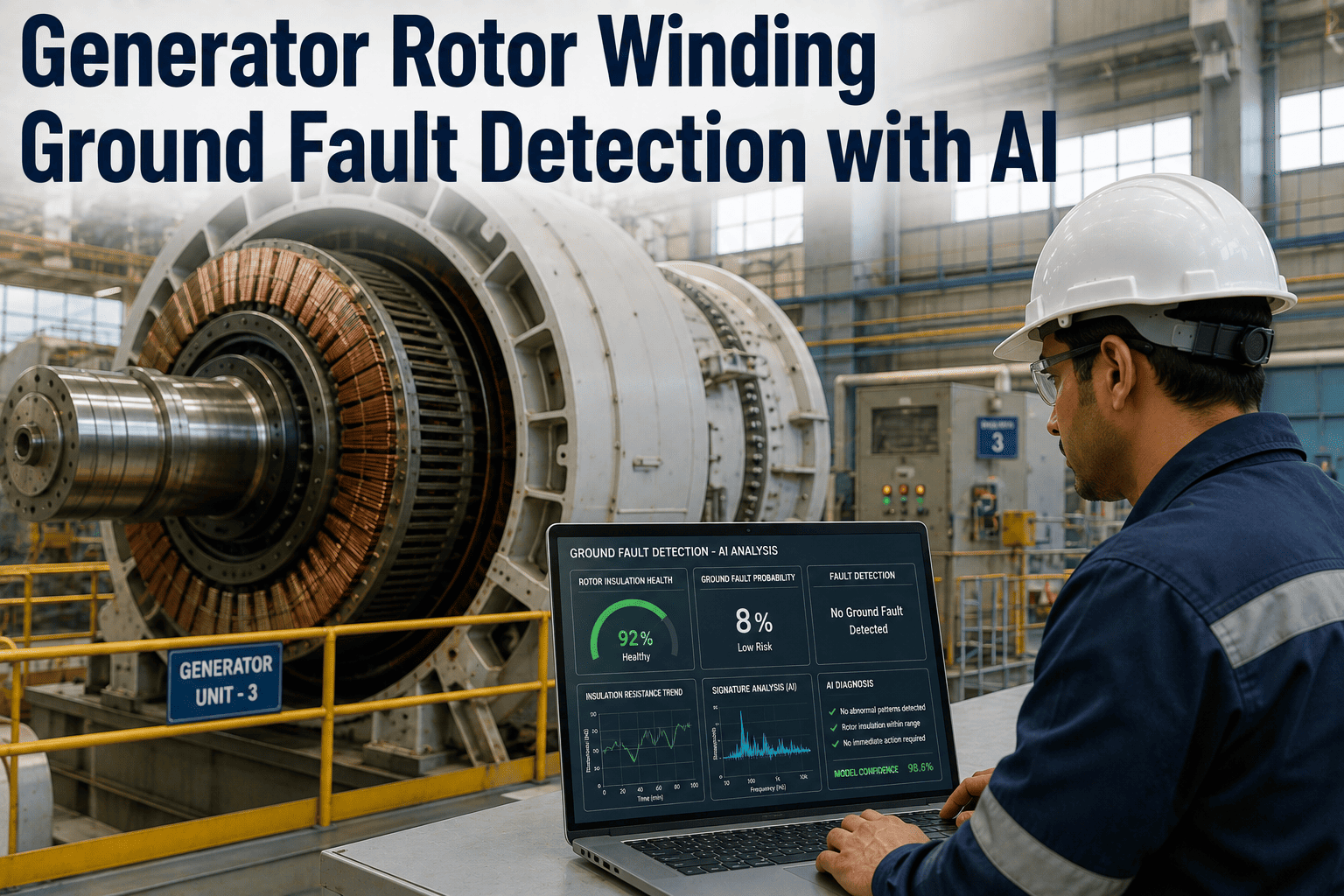
A generator rotor ground fault rarely announces itself. A single ground fault on its own usually will not trip the unit — most generators can run safely with one ground point present — but it removes the margin that protects against a second fault, and a second ground or an inter-turn short that develops on top of it can mean a forced outage, a damaged rotor, and a repair bill that runs into the millions once rewind and balancing costs are included. Rotor winding faults develop slowly, through insulation degradation from thermal cycling, vibration, and contamination, which is exactly why periodic offline testing during scheduled outages so often misses the early stages entirely. Continuous, AI-based rotor health monitoring closes that gap by watching flux signatures and impedance trends between outages, not just during them. Plant teams wanting to see how continuous rotor monitoring compares to their current testing interval can Book a Demo.
Why Rotor Ground Faults Are So Easy to Miss Until It's Late
Rotor winding insulation fails gradually — through thermal cycling, mechanical vibration, and slow contamination buildup — and a single ground fault often produces no operational symptom at all. That combination is exactly why rotor faults tend to surface as an expensive surprise rather than a planned repair.
Unplanned Forced Outage
A second ground fault or an inter-turn short developing on top of an undetected first fault typically forces an immediate unit trip, with none of the lead time a planned outage would allow for parts, crew, and schedule coordination.
Catastrophic Rotor Damage
An advanced inter-turn short can generate localized heating and mechanical imbalance severe enough to require a full rotor rewind, and in the worst cases, replacement — repair scopes that can keep a unit offline for months.
Capacity Derating Risk
Some rotor conditions force operators to run the unit below rated capacity to manage risk until a repair outage can be scheduled — a quiet but real revenue cost that accumulates for as long as the fault goes unaddressed.
Missed Outage-Window Testing
Offline rotor testing typically happens once per major outage cycle — often years apart — leaving a wide window in which a developing fault can progress from early insulation degradation to a forced trip without ever being observed.
How a Rotor Winding Fault Actually Progresses
Rotor faults move through a recognizable sequence of stages, and the earlier a stage is caught, the more repair options remain on the table — from a scheduled rewind to a much smaller, targeted intervention.
Insulation Degradation
Thermal cycling, vibration, and contamination gradually reduce insulation resistance between winding turns, with no measurable electrical fault present yet.
Single Ground Fault
Insulation breakdown at one point creates a path to the rotor shaft or field, typically without triggering a trip but removing protective margin.
Inter-Turn Short
Adjacent turns short together, producing localized heating, flux asymmetry, and often detectable vibration signatures from magnetic imbalance.
Multiple Ground / Failure
A second ground fault combined with the first typically forces a trip, and can produce severe localized damage requiring major rotor repair.
Rotor Fault Detection Methods Compared
No single test catches every stage of rotor fault progression, which is why a layered detection strategy — combining offline and online methods — consistently outperforms reliance on any one technique alone.
| Method | What It Detects | Test Type | Key Limitation |
|---|---|---|---|
| Rotor impedance / RSO testing | Ground faults, winding asymmetry | Offline, during outage | Only reflects condition at the moment of test |
| Flux probe analysis | Inter-turn shorts | Online, during operation | Requires probe installation in the air gap |
| Partial discharge monitoring | Early insulation degradation | Online, continuous | More established for stator than rotor circuits |
| Thermal imaging | Localized heating from shorts | Periodic, offline or online | Limited visibility into internal winding condition |
| AI-based health trending | Gradual multi-signal degradation trends | Continuous, combines the above | Requires baseline data to establish trend confidence |
How Flux Probe Analysis Detects Inter-Turn Shorts
A flux probe mounted in the generator air gap measures the magnetic flux distribution around the rotor circumference while the unit is running. A healthy rotor produces a symmetric flux pattern pole to pole — an inter-turn short changes the effective ampere-turns in the affected coil, which shows up as a measurable asymmetry in that flux signature. Because this is an online measurement, it can catch a developing short between outages, well before the next scheduled offline test would ever see it.
A healthy-condition flux profile is established across all poles as the reference for comparison.
The probe records flux data continuously during normal operation, across varying load conditions.
Each pole's flux signature is compared against the others and against the established baseline for asymmetry.
A sustained asymmetry beyond normal variation flags a likely inter-turn short for follow-up offline confirmation.
Rotor Impedance and RSO Testing Explained
Recurrent surge oscillograph (RSO) testing and rotor impedance testing remain the standard offline methods for confirming rotor winding condition during a scheduled outage. Both work by applying a known electrical signal to the rotor winding and comparing the response pole to pole — since all poles are wound identically, any meaningful difference in response points to a winding abnormality such as a short or a developing ground path.
Signal Injection
A surge or low-voltage test signal is applied sequentially to each pole of the de-energized rotor winding.
Waveform Comparison
The resulting response waveform for each pole is overlaid against the others — identically wound poles should produce closely matching traces.
Deviation Analysis
A waveform that deviates meaningfully from the others indicates a likely shorted turn or ground path in that pole, guiding where further inspection should focus.
What AI-Based Rotor Health Trending Adds
Individual tests each capture one signal at one point in time. AI-based rotor health trending combines those signals into a continuous, cumulative picture of rotor condition — catching the kind of slow, multi-signal degradation that no single snapshot test would flag on its own.
Multi-Signal Correlation
Flux probe asymmetry, impedance test history, vibration signatures, and thermal data are analyzed together rather than reviewed as separate, disconnected reports.
Trend Detection Over Time
Gradual drift across multiple outage cycles is often more meaningful than any single test result — trending surfaces that drift long before it crosses a hard alarm threshold.
Confidence-Scored Alerts
Rather than a binary pass/fail, condition indicators are scored with confidence levels, helping engineers prioritize which developing signals need offline confirmation first.
CMMS-Integrated Work Planning
A confirmed developing fault feeds directly into maintenance planning, giving the team lead time to schedule a rotor repair as planned work instead of an emergency response.
From Missed Outage-Window Test to Caught-Early Repair
Consider a composite combined-cycle plant where the last offline RSO test, run during a scheduled outage roughly two years earlier, showed no significant pole-to-pole deviation. With only that single data point to rely on, the operations team had no visibility into rotor condition for the two years between outages. After adding continuous flux probe monitoring and AI-based trending, the system flagged a gradually widening flux asymmetry on one pole several months before the next scheduled outage — well within the range consistent with an early-stage inter-turn short. The finding gave the plant time to plan a targeted rotor inspection and repair during the next scheduled outage window, rather than discovering the fault as a forced trip mid-cycle. The repair scope that followed was a fraction of what a fully progressed fault would have required.
Getting Started With Continuous Rotor Monitoring
Review your last two to three RSO or rotor impedance test results to establish a baseline trend, not just a single-point pass or fail.
Confirm whether flux probes are already installed and whether their data is being captured continuously or only reviewed periodically.
Identify the interval between your current offline testing cycles and how much operating time passes without any rotor-specific test data.
Map how a flagged rotor condition would currently reach the maintenance planning process, and where that handoff could be faster.
Prioritize units with the highest criticality or the longest gap between outages for continuous monitoring first.
Frequently Asked Questions: Generator Rotor Ground Fault Detection
Can a generator keep running with a single rotor ground fault?
Most generators are designed to operate safely with a single ground fault present, since a single fault alone typically does not complete a damaging current path. The real risk is a second ground fault or an inter-turn short developing while the first goes unaddressed, since the combination is what typically forces a trip and causes damage. This is exactly why detecting and tracking a first fault early — rather than waiting for it to combine with a second — matters as much as detecting the second fault itself.
What is the difference between RSO testing and flux probe analysis?
RSO and rotor impedance testing are offline methods performed during a scheduled outage, comparing electrical response across poles on a de-energized rotor to identify ground faults or shorted turns. Flux probe analysis is an online method that measures magnetic flux distribution while the unit is running, making it capable of catching an inter-turn short as it develops between outages rather than waiting for the next offline test. The two methods are complementary — flux probe data flags a likely developing issue, and offline testing during the next outage confirms it. Teams weighing which combination fits their units can Book a Demo to review their current testing approach.
How early can AI-based trending catch a developing rotor fault?
Because AI-based trending correlates flux, impedance, vibration, and thermal signals over time rather than relying on a single test crossing a hard alarm threshold, it can often surface a gradually widening asymmetry months before it would show up as a confirmed fault on a scheduled offline test. The exact lead time depends on how fast the specific degradation mechanism is progressing, but the core advantage is visibility during the long gap between outages that periodic testing alone cannot cover.
Do I need to install new sensors to start rotor health monitoring?
Some plants already have flux probes and vibration monitoring installed but are only reviewing that data periodically rather than continuously trending it — in those cases, the fastest path to better visibility is connecting existing sensor data into a continuous monitoring and trending workflow. Units without flux probes installed may need that hardware added, typically during a scheduled outage, to enable online inter-turn-short detection. Support contact iFactory Support can help assess what a specific unit's current instrumentation supports.
What happens if a rotor fault is caught too late?
A fault caught only after it has progressed to a multiple-ground condition or a significant inter-turn short typically forces an unplanned outage and can require a major rotor repair — rewinding affected coils, rebalancing the rotor, and in severe cases replacing rotor components entirely, work that can keep a generating unit offline for an extended period. Catching the same fault at the early insulation-degradation or single-ground stage generally allows for a smaller, planned intervention scheduled around an existing outage window instead.