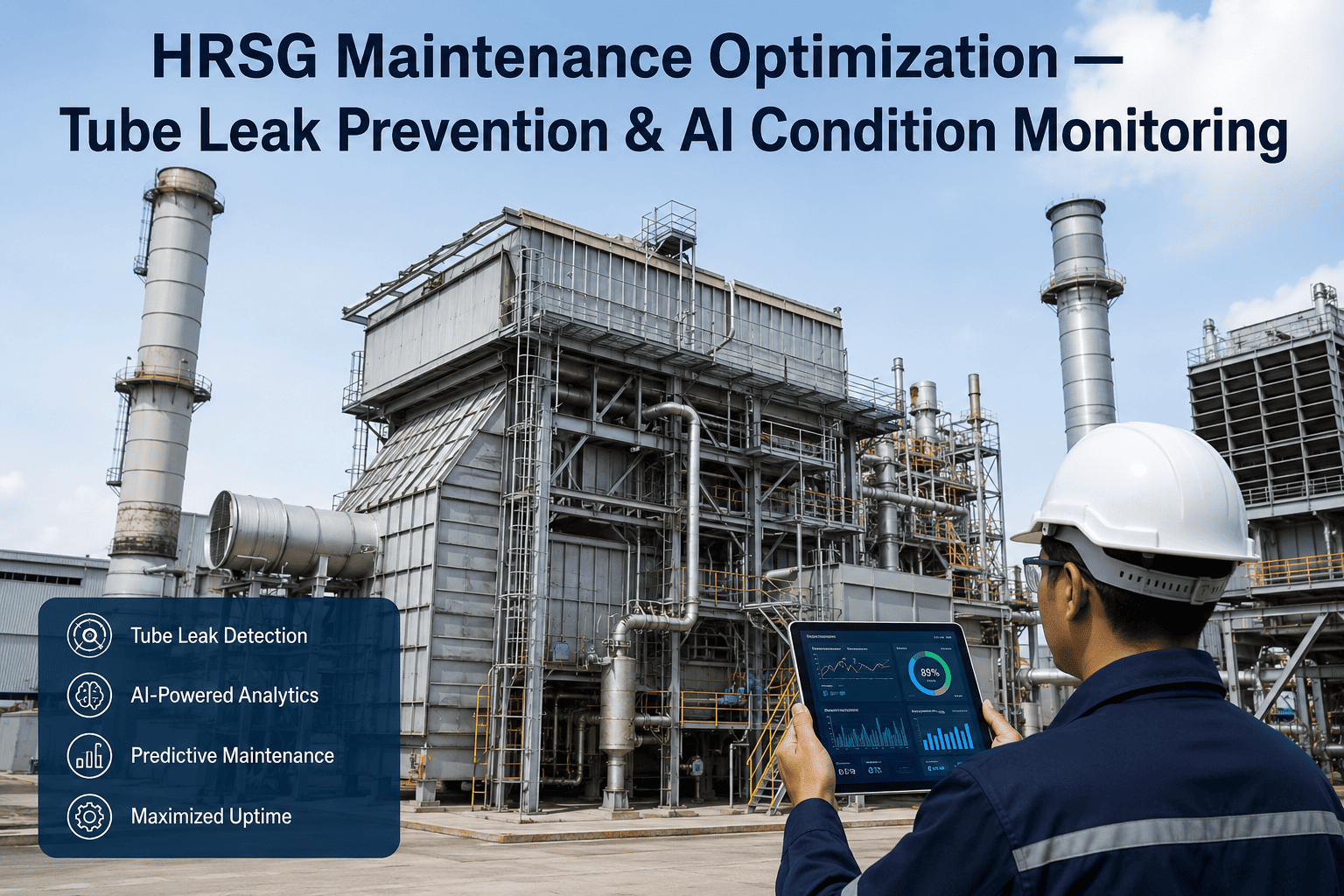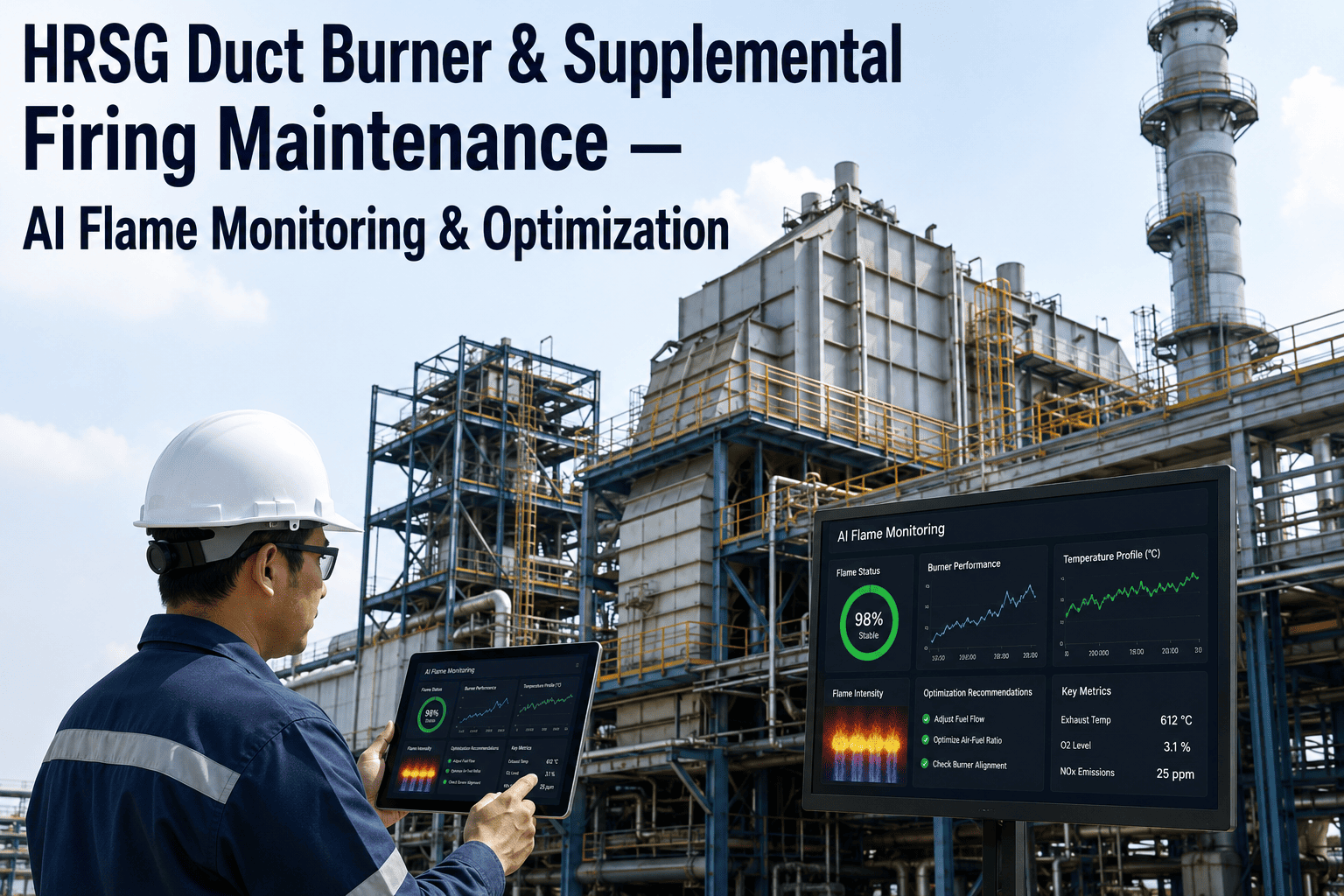
In combined-cycle power plants and industrial cogeneration facilities, the Heat Recovery Steam Generator (HRSG) duct burner—also known as a supplemental firing system—plays a pivotal role in boosting steam production during peak demand periods. These burners, strategically positioned in the exhaust gas path upstream of the heat recovery sections, enable operators to raise the gas turbine exhaust temperature from roughly 500-600°C to over 900°C, dramatically increasing steam generation capacity by up to 30% or more. However, the extreme thermal gradients, variable fuel gas compositions, and stringent emissions regulations (especially for NOx and CO) make duct burner maintenance a high-stakes challenge. Traditional inspection methods relying on manual thermography or periodic borescope checks often miss early signs of flame instability, burner tip degradation, or duct liner cracking. At iFactory, we deploy AI-driven flame monitoring and combustion optimization systems that analyze real-time spectral data, temperature profiles, and acoustic signatures to predict failures before they cause unplanned outages or emissions exceedances. Our deep learning models are trained on thousands of hours of burner operation data, enabling them to detect subtle anomalies like flame lift-off, burner-to-burner imbalance, or liner hot spots with 95%+ accuracy. For enterprise maintenance teams managing multiple HRSG units, this translates to extended run times, reduced forced outage rates, and optimized fuel consumption. If you are ready to transform your duct burner maintenance strategy with industrial AI, book a demo to see how our platform integrates with your existing CMMS and DCS systems.
Elevate Your HRSG Performance Now
Stop unplanned duct burner outages. Achieve 30% more steam capacity with AI-precise flame control.
Flame Stabilization & Lift-Off Prevention
Duct burner flame lift-off occurs when the flame front detaches from the burner tip, often due to high velocity exhaust gas or improper fuel-air mixing. This condition can lead to incomplete combustion, increased CO emissions, and potential damage to downstream heat transfer surfaces. Our AI models continuously monitor flame ionization signals and acoustic emissions to detect lift-off precursors 2-3 seconds before conventional systems, enabling real-time fuel trim adjustments that restore stability.
Duct Liner Thermal Integrity Mapping
The duct liner, typically made of refractory or ceramic fiber, experiences intense thermal cycling. Cracks or spalling can create hot spots that accelerate metal fatigue in the duct shell. We deploy a network of distributed temperature sensors combined with infrared thermography data, feeding a convolutional neural network that generates a live thermal map of the liner surface. Alerts are triggered when any 1m² area exceeds 50°C above baseline, allowing targeted repairs during planned outages.
NOx & CO Emissions Compliance Optimization
Supplemental firing often conflicts with emissions targets, as higher firing rates can spike thermal NOx. Our system uses a multi-objective reinforcement learning agent that balances steam demand against NOx and CO limits. By adjusting burner staging and fuel distribution across multiple burners, we achieve up to 15% lower NOx without sacrificing capacity. Real-time emissions data is fed back into the model, ensuring continuous adaptation to fuel variability and ambient conditions.
Burner Tip Wear & Erosion Prediction
Burner tips exposed to high-temperature, particulate-laden exhaust gas erode over time, altering flame geometry and combustion efficiency. We analyze high-frequency vibration signatures and gas pressure drop trends to estimate remaining useful life of each burner tip. Predictive maintenance alerts are generated 30-60 days before failure, enabling just-in-time replacement that avoids unplanned derates.
AI Implementation Roadmap for Duct Burners
Sensor Deployment & Data Acquisition
Install IoT-enabled flame scanners, thermocouple arrays, and acoustic microphones at each burner. Data is streamed to edge gateways at 10 Hz for real-time analysis.
Model Training & Baseline Calibration
Historical operating data (6-12 months) is used to train deep neural networks. Baseline is established for each burner's flame signature, thermal profile, and emissions output.
Real-Time Anomaly Detection & Alerts
AI models run continuously, flagging deviations beyond 3-sigma thresholds. Alerts are pushed to the maintenance team via mobile app and integrated into the CMMS work order system.
Closed-Loop Combustion Tuning
For plants with automated fuel valves, the AI sends setpoint adjustments to the DCS every 5 minutes to optimize flame stability and emissions, reducing operator workload.
Duct Burner Failure Modes & AI Detection Capabilities
| Failure Mode | Traditional Detection | AI Detection Method | Lead Time |
|---|---|---|---|
| Flame Lift-Off | Visual inspection | Acoustic + ionization signature analysis | 3-5 seconds |
| Duct Liner Cracking | Quarterly thermography | Continuous thermal mapping CNN | 7-14 days |
| Burner Tip Erosion | Annual borescope | Vibration + pressure drop trend ML | 30-60 days |
| Fuel-Air Imbalance | Excess O2 trim | Multi-burner flame spectrum correlation | Real-time |
| NOx Spike | Periodic CEMS | Predictive emissions model | 10-15 minutes |
Transform Your Duct Burner Reliability
Join leading power producers using AI to eliminate unplanned outages and maximize peak capacity.
Fuel Flexibility & Composition Adaptation
Modern HRSG duct burners often fire a blend of natural gas, hydrogen, and process off-gases. Variations in Wobbe index and hydrogen content can dramatically alter flame speed and stability. Our AI models incorporate real-time gas chromatograph data to predict combustion behavior for any fuel mix, automatically adjusting burner parameters to maintain optimal flame shape and emissions. This capability is critical for plants transitioning to hydrogen co-firing, where even 5% hydrogen can change flame dynamics.
Burner-to-Burner Imbalance Detection
In multi-burner duct firing systems, uneven fuel distribution can cause some burners to run rich while others are lean, leading to hot spots and increased NOx. Traditional methods rely on manual traverse testing every few months. Our AI analyzes the cross-correlation of flame intensity signals from all burners, identifying imbalances in real-time. Corrective fuel valve adjustments are suggested to the operator or executed automatically, ensuring uniform heat release across the duct cross-section.
Duct Liner Refractory Lifecycle Management
Duct liners are typically rated for 3-5 years of operation, but actual life depends on thermal cycling frequency and peak temperatures. Our AI system tracks cumulative thermal exposure using a damage accumulation model, predicting remaining liner life with ±10% accuracy. This allows maintenance teams to schedule refractory replacements during planned outages rather than reacting to emergency failures. We have documented cases where this approach extended liner life by 18 months through optimized firing patterns.
Frequently Asked Questions
How does AI flame monitoring differ from traditional flame scanners?
Traditional flame scanners typically use a single UV or IR sensor to detect the presence or absence of flame, providing a binary safety signal. In contrast, our AI system analyzes a multi-dimensional spectral signature from each burner, capturing fine-grained data on flame temperature, shape, stability, and emissions precursors. This enables predictive insights such as impending lift-off, fuel-air imbalance, or burner tip degradation, which are invisible to conventional scanners. For a deeper technical comparison, visit our support documentation on advanced flame analytics.
What is the typical ROI for implementing AI on HRSG duct burners?
Based on deployments across 15 combined-cycle plants, the average payback period is 8-12 months. Savings come from three primary sources: a 30-50% reduction in forced outage rates (each outage costing $100k-$500k in lost production), a 2-5% improvement in fuel efficiency through optimized combustion, and extended component life (burner tips, duct liners). Additionally, avoiding NOx penalties can save $50k-$200k annually depending on regulatory limits. For a detailed ROI calculator tailored to your plant, book a demo with our team.
Can the AI system integrate with existing DCS and CMMS platforms?
Yes, our platform is designed for seamless integration via OPC UA, Modbus TCP, and REST APIs. We have pre-built connectors for major DCS vendors (Siemens, ABB, Emerson, Honeywell) and CMMS systems (SAP, Maximo, Infor). The AI outputs can be displayed on existing operator HMI screens or as a standalone dashboard. Data exchange is bidirectional, allowing the AI to send setpoint adjustments to the DCS and receive work order confirmations from the CMMS. Integration typically takes 2-4 weeks. Contact support for a compatibility checklist.
How does the system handle variable load conditions and startups?
Our AI models are trained on data spanning the full operating envelope, including startups, shutdowns, and load ramps. During transient conditions, the system switches from steady-state optimization to a transient-safe mode that prioritizes flame stability and avoids aggressive tuning. Separate models are used for warm starts (after a short shutdown) and cold starts (after a long outage), as flame dynamics differ significantly. The system automatically detects the operating regime and selects the appropriate model. Learn more about our transient handling algorithms in the technical white paper.
What maintenance is required for the AI system itself?
The hardware sensors (flame scanners, thermocouples, microphones) require periodic cleaning and calibration per manufacturer guidelines, typically every 6-12 months. The AI models are updated quarterly using the latest operational data to adapt to any drift in burner characteristics or fuel composition. Our remote monitoring team performs these updates automatically, with no on-site intervention needed. The system includes self-diagnostics that alert you if any sensor is drifting out of spec. Visit our support portal for a preventive maintenance schedule template.
Ready to Redefine Duct Burner Maintenance?
Deploy AI-powered flame monitoring and combustion optimization in your HRSG fleet. Achieve 95% anomaly detection accuracy and 30% more peak capacity.