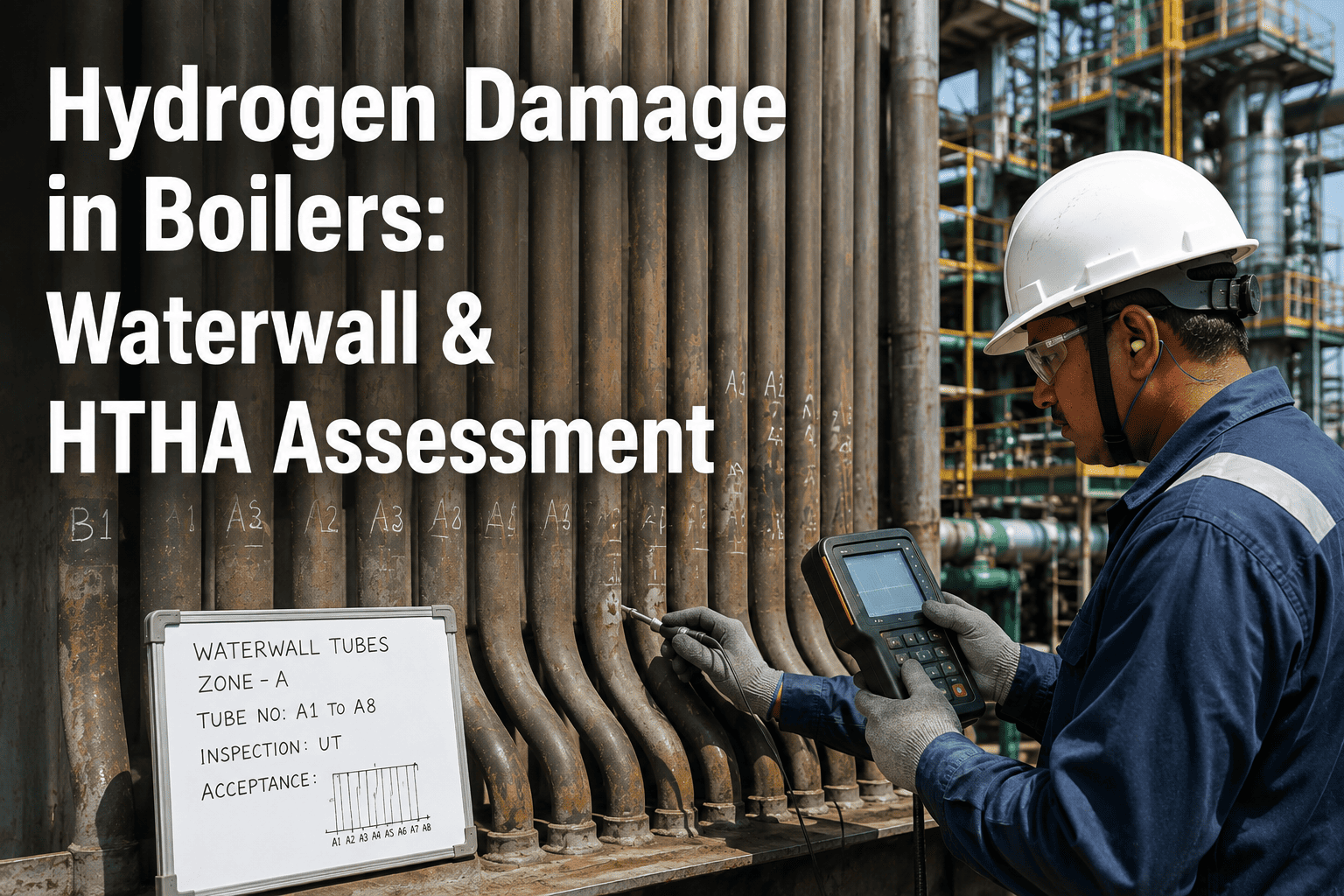
Hydrogen damage in a boiler waterwall doesn't show up on a UT thickness survey the way ordinary wall loss does. The tube can measure full thickness and still be one thermal transient away from a rupture, because the damage is a network of internal fissures that form when atomic hydrogen reacts with carbon in the steel to create methane bubbles at grain boundaries. High-temperature hydrogen attack follows a related mechanism in refinery-type piping operating in hydrogen service. Both can progress from undetectable to catastrophic faster than almost any other boiler damage mechanism. This guide breaks down how each forms and which inspection methods actually detect it, with support from iFactory's hydrogen damage monitoring program for teams managing this risk plant-wide.
Two Mechanisms, One Root Cause: Atomic Hydrogen
Hydrogen damage and high-temperature hydrogen attack both begin the same way — atomic hydrogen, small enough to diffuse directly into the steel's crystal lattice, penetrates the metal and reacts with carbon dissolved in the steel to form methane. Because methane molecules are too large to diffuse back out, they accumulate at grain boundaries, building internal pressure that eventually creates microscopic fissures. String enough fissures together and they link into a crack network that runs parallel to the surface, invisible from outside and often invisible to standard UT thickness measurement because the wall hasn't actually lost material — it has been internally decarburized and fissured while staying dimensionally intact, which is exactly what makes both mechanisms so dangerous relative to failure modes that give warning through progressive, measurable wall thinning.
Underdeposit Corrosion Origin
Occurs beneath porous internal deposits on waterwall tubes where acidic corrosion products locally generate atomic hydrogen at the tube wall. The hydrogen diffuses inward through the tube ID, reacting with carbon in the steel itself. Concentrated almost exclusively at the point of deposit buildup — often tied to a specific chemistry excursion or a high-heat-flux zone.
Process Hydrogen Environment Origin
Occurs in carbon and low-alloy steel piping and vessels exposed to hydrogen partial pressure at elevated temperature — most common in refinery hydroprocessing units but relevant to power plants with hydrogen-cooled generators, hydrogen production units, or cogeneration facilities with refinery-adjacent process equipment. Governed by the API Nelson Curves relating temperature, hydrogen partial pressure, and time to attack onset.
Confirm Whether Your Equipment Is at Risk
iFactory reviews your waterwall chemistry history and process hydrogen exposure data against Nelson Curve limits to flag which components warrant a dedicated hydrogen damage assessment.
The Detection Problem: Why Standard NDE Falls Short
Conventional inspection methods were developed to find wall thinning, cracking that breaks the surface, or volumetric flaws like porosity — none of which describe how hydrogen damage presents. A tube or pipe wall affected by hydrogen damage retains close to its original thickness because no material has been removed, so straight-beam UT thickness gauging, the most common field NDE method in any boiler or piping program, will report a healthy reading right up until the component fails. Radiography struggles for a similar reason — the fissure network has low contrast against sound material and is easy to miss unless the beam angle happens to align with the fissure orientation, which in practice means a component can pass both routine methods repeatedly while damage continues to accumulate undetected beneath the surface.
Straight-Beam UT Thickness Gauging
Measures wall thickness only. Will not detect internal fissuring that hasn't yet caused measurable dimensional change. Routinely passes components that are already significantly damaged.
Conventional Radiography
Can occasionally reveal advanced fissure networks as a loss of density, but requires the beam to align favorably with fissure orientation and misses early-stage damage almost entirely.
Wet Fluorescent Magnetic Particle (WFMT)
Effective only for surface-breaking damage. Hydrogen damage that hasn't yet reached the surface, which is most of it in early stages, will not be detected.
Advanced Ultrasonic Backscatter (AUBT)
Purpose-built to detect internal fissuring by measuring scattered ultrasonic response rather than a simple time-of-flight thickness reading. Currently the most sensitive field-deployable method for both waterwall hydrogen damage and HTHA, and the method most codes and standards now point to for confirming or ruling out damage in susceptible components.
Metallography — cutting a sample and examining it under a microscope — remains the definitive confirmation method for hydrogen damage because it can directly observe decarburization and fissure networks at the grain level. It is also destructive, which limits its use to boat samples from components already suspected of damage rather than a general screening tool. In practice, most integrity programs use AUBT as the primary field screening method across suspect populations, then confirm positive or ambiguous findings with metallography before making a run/repair/replace decision.
Interpreting AUBT results well requires an experienced operator, and results are frequently reported on a qualitative severity scale — none, minor, moderate, or severe fissuring — rather than a single quantitative number the way a UT thickness reading is. That qualitative element makes AUBT programs more dependent on operator training and inter-lab consistency than most other NDE methods, and it is worth confirming that any inspection vendor performing AUBT work has documented, verifiable experience specifically with hydrogen damage detection rather than general ultrasonic testing credentials. A moderate finding from an inexperienced operator and a moderate finding from a specialist reviewing the same data can lead to meaningfully different run/repair/replace recommendations, which is why cross-referencing field AUBT results against metallography on at least a sample basis remains standard practice even for experienced inspection providers.
Screen Suspect Components Before They Screen Themselves
iFactory tracks which waterwall zones and hydrogen-service components fall into your highest-risk category and schedules AUBT screening on a risk-ranked basis rather than a blanket calendar.
Identifying Which Components Are Actually Susceptible
Screening every tube and every hydrogen-service component with AUBT is neither practical nor necessary. Susceptibility screening narrows the population to the locations where hydrogen damage is mechanistically plausible, and it starts from different data depending on which mechanism is in play, which is why a generic plant-wide inspection budget rarely produces the best risk reduction per dollar spent compared to a targeted susceptibility-driven approach.
| Screening Input | Waterwall Hydrogen Damage | HTHA |
|---|---|---|
| Primary risk driver | History of underdeposit corrosion or chemistry excursions | Operating temperature vs Nelson Curve limit for alloy |
| Key records to review | Boiler water chemistry logs, condenser leak history | Process piping isometrics, material certs, operating history |
| Highest-risk zones | Burner-zone waterwall tubes, areas with prior deposit findings | Reactor effluent piping, heat exchanger tubes in hydrogen service |
| Screening tool | AUBT plus deposit weight density sampling | AUBT plus Nelson Curve compliance review |
What Happens After Damage Is Confirmed
A confirmed hydrogen damage finding does not automatically mean immediate shutdown, but it does mean the affected component's remaining service life can no longer be evaluated using standard fitness-for-service rules developed for wall loss or surface cracking, because the failure mechanism and its progression rate are fundamentally different. Engineering assessment typically involves quantifying the extent and density of fissuring found through metallography, evaluating whether the damage is isolated or represents a broader population risk across similar components, and determining whether temporary operating restrictions — reduced pressure or temperature — can safely extend service life until a planned replacement window, always documented against the specific fitness-for-service methodology applicable to hydrogen-damaged material rather than a generic corrosion-based calculation.
For waterwall tubes, the more consequential finding is often not the individual damaged tube but what it reveals about chemistry control across the whole boiler. Underdeposit hydrogen damage rarely occurs in isolation; a single damaged tube usually indicates a chemistry or deposit condition that has been affecting a much larger population of tubes in the same zone, which is why a hydrogen damage finding should trigger both a component-level engineering assessment and a broader review of water chemistry trends leading up to the finding.
Documentation matters as much as the technical assessment itself. Every confirmed hydrogen damage finding should generate a written record covering the detection method used, the extent and severity of fissuring observed, the population review conducted to identify related at-risk components, and the specific operating or chemistry corrective actions taken in response. That record becomes essential not only for the immediate repair decision but for demonstrating, years later during a regulatory audit or insurance review, that the plant identified and responded appropriately to a known damage mechanism rather than treating an isolated tube failure as an unexplained event.
Why Hydrogen Damage Findings Rarely Stay Isolated
One of the most consequential aspects of hydrogen damage is how rarely it turns out to affect only the single component where it was found. In waterwall boilers, deposit formation is driven by heat flux distribution and flow patterns that are largely consistent across an entire zone of tubes rather than unique to one location, which means a tube found with confirmed hydrogen damage during an outage is usually a sentinel finding for a broader population that experienced the same chemistry excursion or deposit accumulation under similar conditions. Treating that single tube as an isolated repair, without extending the assessment to neighboring tubes in the same zone, is one of the most common ways plants end up with a repeat failure within one or two subsequent outages.
The same logic applies to HTHA in process piping. If a section of piping is found to have operated above its Nelson Curve limit for a sustained period, every other component in the same piping system constructed from the same material and exposed to the same process conditions carries comparable risk, even if it has not yet shown confirmed damage on AUBT screening. A defensible response to a positive hydrogen damage finding therefore always includes a documented population review — identifying every component sharing the same exposure history — rather than treating the finding as a single point repair. iFactory maintains component population groupings tied to shared exposure history specifically so that a single confirmed finding automatically flags the full at-risk population for review, rather than requiring an engineer to reconstruct that population manually from piping isometrics after the fact. This grouping logic applies equally to a cluster of waterwall tubes sharing the same burner-zone heat flux profile and a run of hydrogen-service piping fabricated from a single heat of material on the same date.
Preventing Hydrogen Damage Before It Starts
Because hydrogen damage cannot be repaired once it occurs, the highest-value investment in most programs is prevention rather than detection. For boiler waterwalls, that means controlling the conditions that allow underdeposit corrosion to establish in the first place: maintaining boiler water chemistry within specified limits, responding immediately to any condenser tube leak rather than tolerating a slow leak for weeks before repair, and following a chemical cleaning schedule aggressive enough to remove deposits before they reach the thickness where underdeposit acidic conditions become likely. Deposit weight density sampling during outages — physically removing a tube section and quantifying deposit buildup — gives a much more direct read on risk than chemistry logs alone, since two boilers with similar chemistry histories can accumulate very different deposit loads depending on local heat flux and flow conditions, and that difference in accumulated deposit is often a better predictor of near-term risk than the chemistry log alone would suggest.
For HTHA-exposed equipment, prevention centers on staying within Nelson Curve limits through operating discipline and design margin rather than relying on repeated screening to catch damage after the fact. Any capital project or process change that would increase operating temperature, raise hydrogen partial pressure, or introduce new piping into hydrogen service should include an explicit Nelson Curve check as part of the engineering review, not as an afterthought discovered during commissioning. Material upgrades to more resistant alloys — moving from carbon steel to a chromium-molybdenum grade, for example — are far cheaper to specify during design than to retrofit after HTHA has already been confirmed in the field.
Frequently Asked Questions
Build a Hydrogen Damage Program That Catches Risk Early
iFactory connects your boiler water chemistry history and process hydrogen exposure data to a risk-ranked AUBT screening schedule, so suspect components get found before they fail.