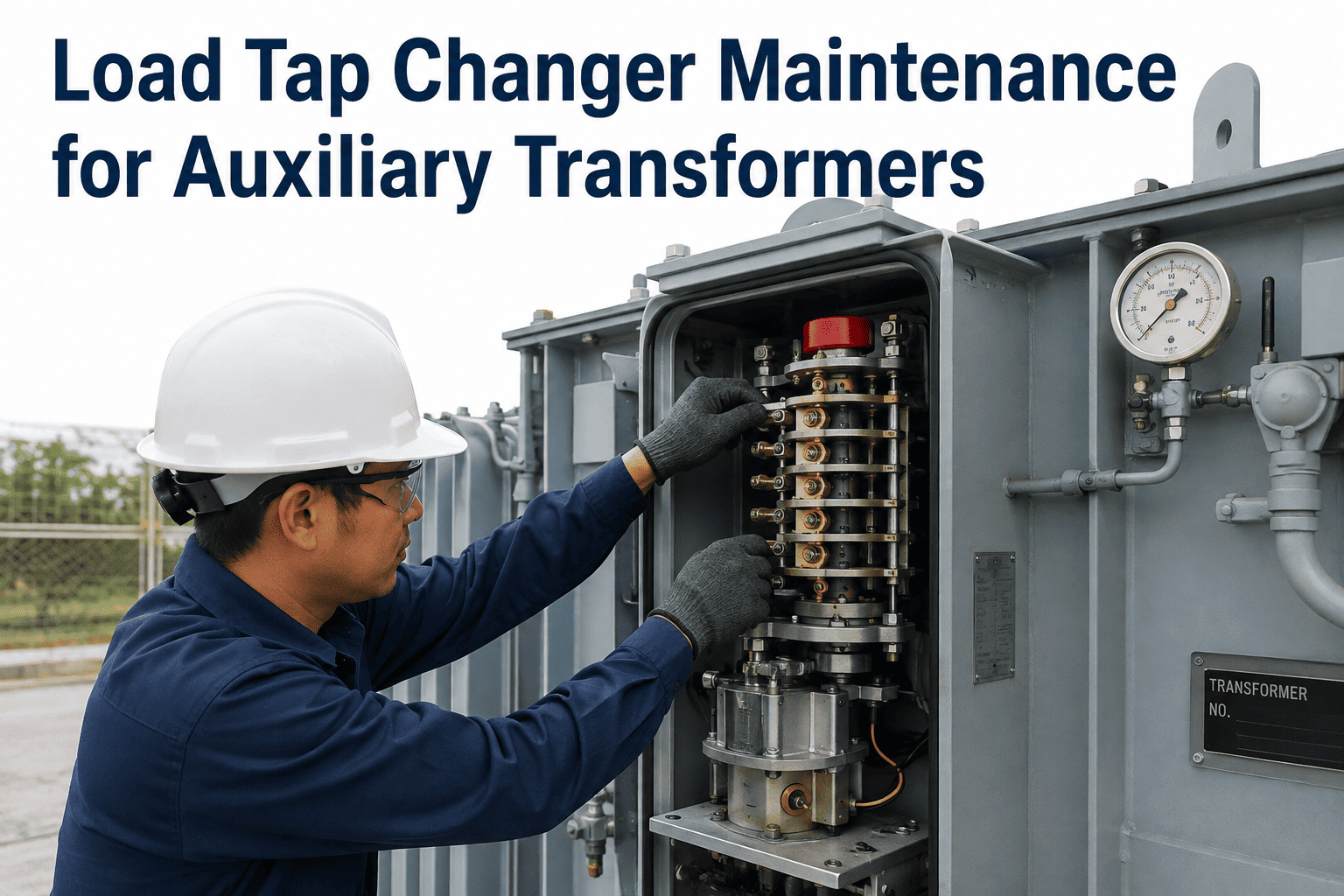
When an auxiliary transformer's on-load tap changer starts arcing on transition, the plant doesn't get a warning label first, it gets a forced outage during a load swing nobody scheduled around. Contact wear develops slowly across thousands of tap operations, insulating oil degrades in ways that stay invisible until a dissolved gas result comes back abnormal, and diverter switch timing drifts just enough to leave a contact under load longer than the design ever allowed. Most plants still catch these patterns during a scheduled overhaul years after the wear actually started, by which point resistance readings are already trending toward replacement instead of repair. iFactory tracks tap operation counts, contact resistance trends, and oil test results against one maintenance record per unit, so a drifting LTC gets flagged before a transition failure does. You can book a demo to see it running against your own transformer fleet and existing test procedures.
Track Every Tap Operation Before Contact Wear Becomes a Forced Outage
iFactory logs tap operation counts, contact resistance readings, oil test results, and diverter switch timing against a single maintenance record per transformer, so a unit trending toward failure gets flagged while repair is still an option.
Contact Wear Doesn't Announce Itself, It Accumulates Quietly
An on-load tap changer on an auxiliary transformer can operate thousands of times a year responding to voltage swings that nobody in the control room ever notices individually. Each transition arcs briefly across the diverter switch contacts, and that arcing is normal by design, but the cumulative erosion it causes is not linear. A contact that looks fine at operation two thousand can be dangerously close to its resistance limit by operation twenty-five hundred, and without a running count tied to resistance trend data, the only way to know is to open the tank and measure.
The problem compounds because auxiliary transformers rarely get the same monitoring attention as the main step-up unit. A generator step-up transformer usually has dissolved gas analysis running continuously and a dedicated condition monitoring budget, while the auxiliary transformer feeding station service power is often checked on the same fixed calendar interval regardless of how hard its tap changer has actually been working. A unit running under frequent load-following duty can rack up years of expected operations in a fraction of the time, and a calendar-based inspection schedule has no way of catching that acceleration until the next planned outage arrives.
Signs Your LTC Needs Attention Before the Next Overhaul
Most tap changer failures give off warning signs long before a transition actually fails, but those signs are scattered across different sources: an oil lab report, a resistance test sheet, and an operator's log of unusual noise or hesitation during a tap change. Reviewed together they tell a clear story. Reviewed separately, each one looks minor on its own and gets deferred to the next planned outage.
The operators standing closest to the equipment often notice the earliest signals without realizing their significance. A tap change that used to complete with a single crisp click now takes a beat longer, or the motor drive sounds like it is working slightly harder than it used to. None of that shows up on a test sheet, but logged consistently against the same unit record as the formal test data, it becomes part of the same trend line that resistance and gas results build over time.
Three Data Points That Predict LTC Trouble Before It Happens
Not every measurement taken on a tap changer carries the same predictive weight. Three data points consistently show up in the record ahead of an actual failure, and tracking them together, rather than as isolated test results filed in different places, is what turns a maintenance program from reactive to genuinely predictive.
The value of these three data points isn't in any single reading, it's in how they move relative to each other over time. A resistance reading that's climbing while gas levels stay flat points toward a mechanical or surface issue rather than an oil chemistry problem. Gas levels climbing while resistance stays stable can point toward an oil quality issue unrelated to contact wear. Seeing both trends side by side, tied to the same operation count, narrows down the likely cause well before a technician ever opens the tank to look.
LTC Maintenance Isn't Just Good Practice, It's a Standards Requirement
Tap changer maintenance intervals and test methods aren't arbitrary, they're set by standards bodies and manufacturers based on documented failure modes across decades of fleet data. Following them closely, and being able to show the record when an insurer or regulator asks, is what separates a defensible maintenance program from one built on memory.
Compliance with these standards also matters at moments a maintenance team doesn't get to choose, such as an insurance audit following an unrelated incident elsewhere on site, or a corporate reliability review that asks every plant in a fleet to show its LTC test history in a common format. A record built to match the resistance, timing, and gas thresholds these standards define holds up under that kind of scrutiny in a way a collection of scanned test sheets rarely does.
Stop Waiting for the Next Scheduled Overhaul to Find Out
iFactory ties operation counts, resistance trends, and oil results to each tap changer automatically, flagging a unit before it reaches a condition that forces an unplanned outage. Book a demo and see it against your own fleet.
What Changes When LTC Condition Data Lives in One Place
A logbook and a digital condition record can technically hold the same numbers, but only one of them can be trended automatically, checked against operation count in real time, and pulled up instantly when a planning team is deciding whether a unit can safely run through the next season.
The difference shows up most clearly during outage planning, when a team has to decide in a matter of days whether a tap changer can safely run through another operating season or needs to come apart during the current window. A manual process means pulling old test sheets, calling whoever ran the last oil sample, and estimating the operation count from memory. A tracked record means the trend, the current count against rated life, and the last gas result are already sitting in one place, turning a days-long scramble into a five-minute review.
| Factor | Manual Logbook | iFactory LTC Tracking |
|---|---|---|
| Operation Counting | Read from a mechanical counter periodically, easy to miss between visits | Logged automatically and compared against rated contact life continuously |
| Resistance Trending | Compared manually against the last one or two test sheets on file | Plotted across the full test history with drift flagged automatically |
| Oil and Gas Data | Lab reports filed separately from mechanical test records | Linked directly to the same unit record as resistance and timing data |
| Outage Planning | Requires pulling multiple files to justify deferring or advancing service | Condition summary available instantly for planning and scheduling decisions |
| Audit Readiness | Reconstructed from paper and spreadsheets when requested | Always current and exportable for insurers, regulators, or corporate review |
Teams Who Can't Afford an Unplanned LTC Outage
Auxiliary transformer reliability sits close enough to unit availability that a tap changer failure rarely stays a minor issue, which is why LTC condition tracking tends to matter most to a specific set of teams inside a plant or fleet.
What these teams share is exposure to the downside of a surprise: a plant that loses station power mid-startup, a service provider whose repair recommendation gets second-guessed without data behind it, or a commissioning team whose baseline numbers become the only reference point available years later when a trend needs interpreting. A shared, accurate condition record removes a lot of that exposure regardless of which side of the relationship a given team sits on.
What's Actually Behind a Diverter Switch Reaching End of Life
When a diverter switch fails outright, the immediate cause is usually contact damage or a stalled transition, but the root cause almost always traces back further, to one of a small number of recurring conditions that a consistent tracking record makes easy to spot.
Each of these root causes leaves a trace in the data well before it becomes a failure: a coking problem shows up first in gas trend and then in resistance drift, a deferred oil change shows up as an operation count exceeding the interval, and drive fatigue shows up as transition timing creeping upward. Tracking all three against the same unit record is what turns three separate lagging indicators into one leading one.
Questions Maintenance Teams Ask First
Give Every Tap Changer a Condition Record That Actually Predicts Failure
iFactory ties operation counts, resistance trends, and oil results together for every LTC in your fleet, so nothing drifts toward failure unnoticed. Book a demo and see it running on your own units.