A commercial building's utility bill hides two separate problems that most facilities teams solve separately: the cost of electricity and the cost of heat. Micro-CHP collapses both into a single on-site process, capturing the heat that a fuel cell, Stirling engine, or micro-turbine would otherwise reject and routing it into space heating, domestic hot water, or process loads instead of paying for it twice. Facility and energy managers evaluating a move toward on-site generation can Book a Demo to see how iFactory tracks generation, thermal recovery, and building load against a single performance model.
MICRO-CHP + FUEL CELLS + STIRLING ENGINES + ON-SITE GENERATION
Micro-CHP for Commercial Buildings: Fuel Cell and Stirling Engine Economics Compared
iFactory gives facilities and energy teams a single view of generation output, thermal recovery, and payback tracking across fuel cell, Stirling engine, and micro-turbine CHP installations under 50 kW.
Why Micro-CHP Is Back on the Table for Mid-Size Buildings
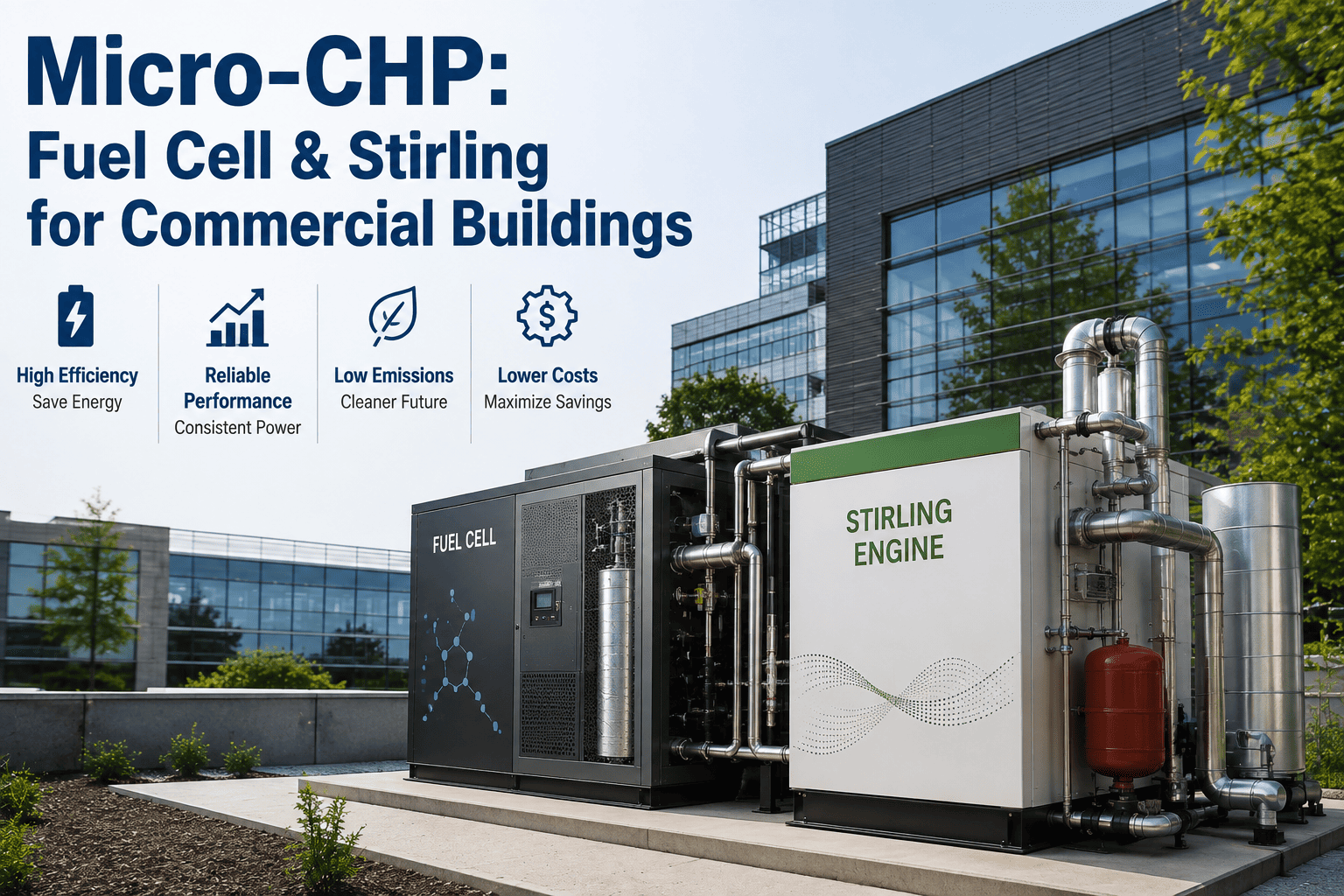
For years, combined heat and power stayed a large-industrial-site tool because the smallest viable units were too big, too loud, and too expensive for a mid-size commercial building. That has changed. Units under 50 kW electrical output now exist as fuel cells, Stirling engines, and micro-turbines, sized to sit inside a mechanical room and run alongside a conventional boiler rather than replace an entire plant. The pitch is straightforward: generate electricity on site, capture the heat that generation always produces, and use that heat instead of buying it separately from a gas-fired boiler. The complication is that the three leading technologies behave very differently, and choosing the wrong one for a building's actual heat-to-power ratio is the single most common reason a micro-CHP project underperforms its business case.
30–40%
Typical electrical efficiency of fuel cell micro-CHP, well above combustion-based alternatives
85–90%
Combined heat and power efficiency achievable when thermal output is fully utilized on site
10–15 yrs
Typical payback horizon for a properly sized unit matched to a stable base heat load
Three Technologies, Three Very Different Operating Profiles
The technology decision is not primarily about efficiency numbers on a spec sheet — it is about how well a unit's heat-to-power ratio matches the building it will serve. A hotel with continuous domestic hot water demand behaves nothing like an office with a heating load that disappears every summer, and the wrong technology match turns a promising payback calculation into a unit that sits idle half the year.
Fuel Cell CHP
Converts fuel to electricity electrochemically rather than through combustion, producing the highest electrical efficiency of the three technologies along with near-silent operation and very low emissions. Heat output is comparatively lower relative to power output, which makes fuel cells the strongest fit for buildings where electricity is the priority and heat recovery is a secondary benefit rather than the main driver.
Stirling Engine CHP
An external combustion design that produces relatively little electricity per unit of fuel but a large proportion of usable heat, giving it the lowest power-to-heat ratio of the mainstream options. It suits buildings with a strong, steady heat demand and a comparatively modest electrical requirement, and its mechanical simplicity gives it long service intervals and low vibration.
Micro-Turbine CHP
Sits between the other two in heat-to-power ratio and tolerates continuous, high-hour operation well, making it a common choice for buildings that run generation nearly around the clock, such as hospitality or healthcare facilities with constant hot water and space conditioning needs.
The Heat-to-Power Ratio: The Number That Decides Everything
Every micro-CHP technology has a fixed heat-to-power ratio, and every building has its own ratio of heat demand to electrical demand across the year. A project only pays back on schedule when those two ratios stay reasonably close for most of the operating year — because any heat the building cannot use gets vented or wasted, and any electricity the unit cannot sell or use behind the meter loses most of its value. This is why a technology that performs beautifully in one building type can underperform badly in another with a similar peak load but a different seasonal pattern.
| Building Type | Load Pattern | Best-Fit Technology |
| Hotel or hospitality |
Continuous hot water, steady occupancy load |
Micro-turbine or Stirling engine |
| Office building |
Heat load drops sharply outside heating season |
Fuel cell, sized to base electrical load |
| Hospital or care facility |
Constant heat and power demand, high reliability need |
Fuel cell or micro-turbine, often paired |
| Multi-family residential |
Strong domestic hot water base load |
Stirling engine |
| Light industrial / process |
Variable heat load tied to production schedule |
Micro-turbine with thermal storage buffer |
Oversizing a unit against the building's true base load is the most expensive version of this mistake, because a unit that cycles on and off to chase peaks runs less efficiently, wears out faster, and captures far less of its rated thermal output than the same unit running continuously against a steady base load with a boiler covering the swing above it.
Building an accurate ratio requires more than a single design-day snapshot. Electrical and thermal demand should be logged across a full heating and cooling season, since a building's heat-to-power ratio in January can look completely different from its ratio in July, and a technology selected purely on peak-day numbers will frequently be the wrong choice for eight or nine months of the year. Facilities teams that skip this step often discover the mismatch only after a full year of operating data shows the unit's thermal output going unused for long stretches, by which point the capital has already been committed.
Where the Payback Case Actually Comes From
A micro-CHP business case rests on displacing two separate purchases — grid electricity and boiler fuel — with a single fuel input, and the strength of that case depends on the spread between the price of grid power and the price of the fuel used to generate it on site, not on efficiency numbers in isolation.
Spark Spread
The gap between the cost of grid electricity and the cost of the fuel used to generate it locally is the single biggest driver of payback speed. A wide spread makes almost any reasonably sized unit attractive; a narrow spread punishes an oversized or poorly matched one badly.
Capacity Factor
Hours of near-continuous operation against a stable base load matter more to payback than peak output. A smaller unit running 7,000+ hours a year against a matched base load consistently outperforms a larger one that idles half the time.
Heat Utilization Rate
Recovered heat only has value if the building actually uses it. A unit sized for a heat load that disappears for six months of the year effectively runs as an expensive, undersized power-only generator during that stretch.
Maintenance and Service Life
Fuel cell stacks, Stirling engine seals, and turbine bearings each carry different replacement intervals and costs, and a payback model that ignores mid-life overhaul costs will overstate returns significantly by year eight or ten.
Barriers That Actually Stop Micro-CHP Projects — and What Addresses Them
Most micro-CHP projects that stall do not stall because the technology failed to perform. They stall earlier, at the point where the building's operations team either cannot get clean visibility into whether the unit is delivering its modeled savings, or cannot justify the upfront cost against a payback period that competes with every other capital project on the list.
High Upfront Capital Cost
Installed cost per kW for fuel cell and Stirling systems remains high relative to grid power alone, which pushes many projects toward financing structures such as energy-as-a-service agreements that shift capital risk away from the building owner while still capturing the operating savings.
Export Compensation Gaps
In many markets, credit for electricity exported back to the grid during low-demand periods falls well short of retail rates, which is why sizing a unit to the building's base load rather than its peak load protects the economics from relying on export income that may not materialize.
Limited In-House Technical Familiarity
Facilities teams accustomed to a conventional boiler plant often lack the specific knowledge needed to monitor generation performance, fuel stack health, or thermal recovery efficiency, which is where structured monitoring against expected performance curves closes the knowledge gap.
Unclear Performance Tracking Post-Install
Once a unit is commissioned, many buildings lose the thread on whether it is actually hitting the modeled electrical and thermal output, which means underperformance can go unnoticed for months and quietly erode the payback timeline.
GENERATION MONITORING + THERMAL RECOVERY TRACKING
Track Whether Your CHP Unit Is Actually Hitting Its Modeled Payback
iFactory connects generation output, thermal recovery, and maintenance history into one dashboard so facilities teams can see performance drift before it turns into a missed payback target.
A Sizing and Selection Checklist Before Committing to a Technology
1
Chart the building's electrical and thermal load across a full year, not just a design-day peak, since seasonal swing is what determines real capacity factor.
2
Calculate the building's own heat-to-power ratio and compare it against each candidate technology's typical ratio before evaluating vendor quotes.
3
Size the unit against the base load floor, not the peak, and let a conventional boiler continue covering peak swing above that floor.
4
Confirm the local export compensation rate before assuming any income from surplus generation sold back to the grid.
5
Build mid-life stack, seal, or bearing replacement costs into the payback model rather than treating year one economics as representative of the full service life.
Financing Structures That Change the Capital Equation
Because installed cost per kW is the single biggest objection facilities teams raise against micro-CHP, the financing structure chosen for a project often matters as much as the technology selection itself. A building that cannot justify a large capital outlay against competing priorities such as roof replacement or HVAC upgrades is not necessarily a poor candidate for CHP — it may simply need a different ownership model for the equipment.
Direct Capital Purchase
The building owns the unit outright, captures the full spread between generation cost and avoided utility spend, and carries full responsibility for maintenance and mid-life overhaul costs. This structure produces the strongest long-run returns but requires the largest upfront commitment and the most in-house familiarity with the technology.
Energy-as-a-Service Agreement
A third party owns, installs, and maintains the unit, and the building pays a fixed rate for the energy it delivers, similar in structure to a power purchase agreement. This removes capital risk and maintenance burden from the building owner in exchange for a smaller share of the long-run savings, and it is increasingly the default entry point for buildings without in-house CHP expertise.
Utility or Incentive-Backed Programs
Many jurisdictions offer rebates, tax incentives, or accelerated depreciation schedules specifically for on-site combined heat and power, which can materially shorten the payback period when layered on top of either ownership structure above. Eligibility and value vary widely by location and technology, which makes confirming current program terms an essential step before finalizing a business case.
Regardless of the ownership structure selected, the underlying performance risk does not disappear — a poorly matched technology or an oversized unit will underperform its modeled savings whether the building owns it outright or pays a third party for the energy it delivers. This is why performance monitoring against the original sizing model matters just as much under an energy-as-a-service contract as it does under direct ownership, since the building's utility bill savings still depend on the unit actually hitting its rated output.
Frequently Asked Questions: Micro-CHP for Commercial Buildings
Which micro-CHP technology has the best payback for a typical office building?
Offices tend to have a heating load that drops sharply for much of the year while electrical demand stays relatively steady, which usually favors a fuel cell sized to the building's base electrical load rather than a Stirling engine sized around a heat demand that disappears every summer. The actual answer depends heavily on local utility rates and the specific spread between grid electricity cost and fuel cost, so a proper year-round load profile is worth building before selecting a technology. Facilities teams weighing this decision can
Book a Demo to model the comparison against real building data.
How long does a micro-CHP unit typically take to pay back its installed cost?
Payback periods commonly fall in the ten-to-fifteen-year range for a well-matched installation, though this varies significantly with local electricity and fuel pricing, the strength of the spark spread, and how consistently the unit runs against a stable base load. Projects that oversize the unit against peak rather than base demand routinely see payback stretch well beyond that range because unused thermal output and low capacity factor erode the savings that the original model assumed.
Can a micro-CHP unit run alongside an existing boiler rather than replacing it?
Yes, and in most well-designed installations this is exactly how it should be configured — the CHP unit covers the building's steady base heat and power load while the existing boiler continues to handle peak swing above that floor. This approach protects the CHP unit's capacity factor, since it keeps running continuously against demand it can reliably meet rather than cycling on and off to chase peaks it was never sized for.
What ongoing maintenance does micro-CHP require compared to a standard boiler?
All three leading technologies require more specialized maintenance than a conventional boiler, including periodic fuel cell stack replacement, Stirling engine seal service, or turbine bearing and combustor inspection, each on its own interval and cost profile. Facilities teams without in-house experience in these systems typically rely on a service contract with the equipment vendor, and tracking maintenance history against actual generation output is what reveals whether the unit is degrading ahead of schedule. Contact
iFactory Support for guidance on structuring performance-linked maintenance tracking, particularly when a service contract ties vendor payments to demonstrated output rather than a flat annual fee.
How do we know if a micro-CHP unit is actually delivering its modeled savings after installation?
The only reliable way is to continuously compare metered electrical output, recovered heat, and fuel consumption against the original modeled curves rather than relying on the vendor's commissioning report as a one-time snapshot. Performance drift often shows up first as a gradual drop in heat recovery efficiency before electrical output visibly declines, which means a facility relying only on utility bill comparisons can miss months of underperformance before the payback timeline is visibly affected.
ON-SITE GENERATION + THERMAL RECOVERY + BUILDING ENERGY PERFORMANCE
Model Your Building's Fit for Micro-CHP Before You Commit Capital
iFactory helps facilities and energy teams compare fuel cell, Stirling engine, and micro-turbine options against real load data, then tracks performance against the payback model once the unit is running.