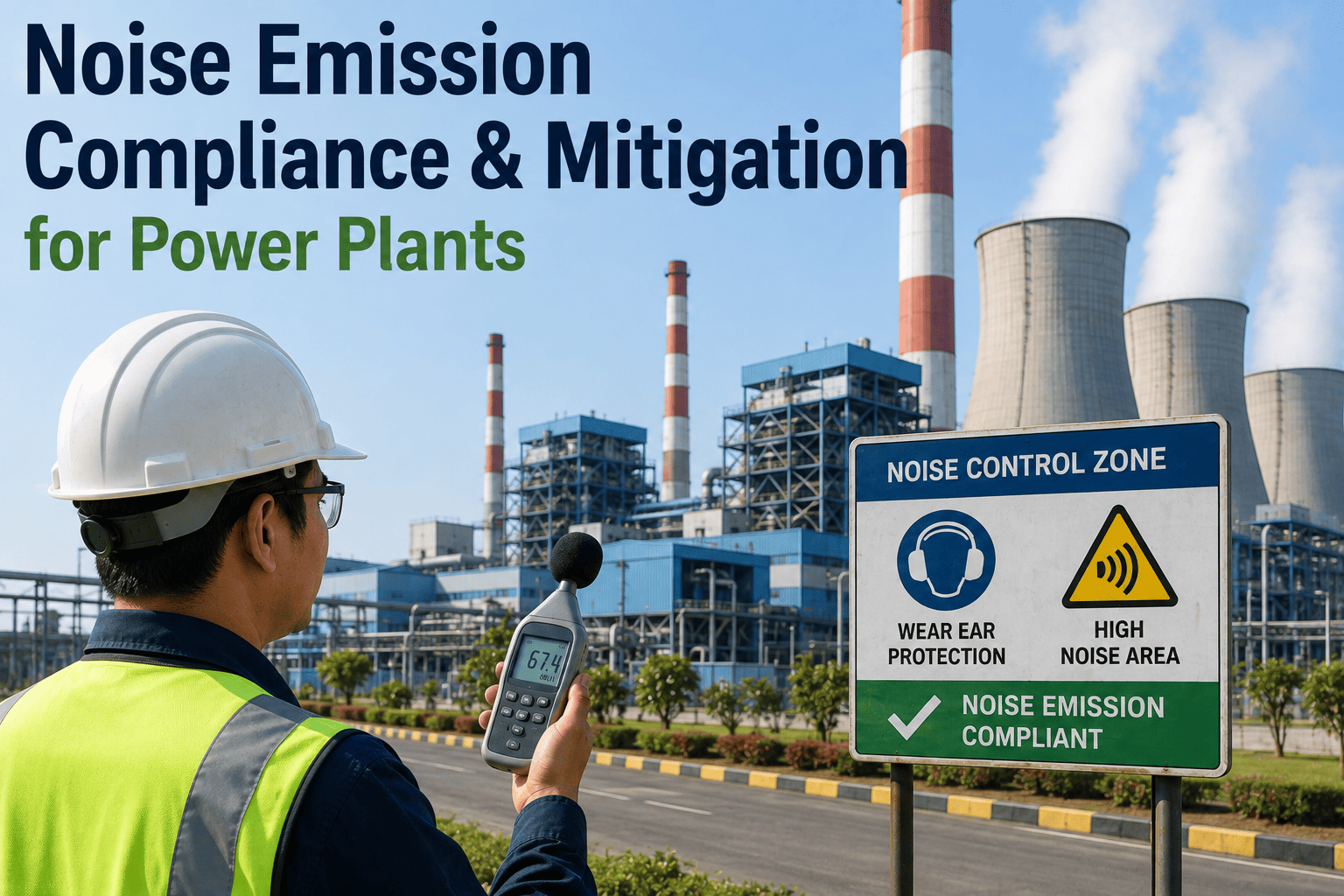
Noise is one of the only emissions a power plant produces that neighbors can measure with a phone app and report the same night. There's no single federal noise standard either — since the EPA's noise abatement office was defunded decades ago, enforcement fell to a patchwork of state and local ordinances with property-line limits ranging from 45 to 70 dBA depending on zoning and time of day. That patchwork is why noise compliance often gets treated as an afterthought until a complaint arrives, at which point retrofitting a silencer onto equipment never designed for it costs far more than planning ahead would have. iFactory helps plants track noise data the same way they track vibration or thermal data — continuously and by location — and our team can show you how that tracking works for your site.
The Emission Regulators Actually Show Up To Measure With A Meter
Community noise limits vary by ordinance, zoning, and time of day, but the pattern repeats everywhere: nighttime residential limits sit far below what most plant equipment produces unmitigated, and the gap between compliant and non-compliant is decided at the property line, not inside the fence.
Two Different Compliance Problems, One Plant
Noise compliance at a power plant is really two separate obligations that get managed by different teams, measured against different standards, and enforced by different bodies, even though they both trace back to the same rotating equipment. Community noise compliance is about what crosses the property line and reaches the nearest residence — governed by whatever local ordinance applies, with limits that shift by zoning and time of day. Occupational noise compliance is about what workers are exposed to inside the fence, governed federally by OSHA's permissible exposure limit, with its own separate triggers for engineering controls and hearing conservation programs. Treat these as one problem and you'll under-address one of them; a plant that meets its OSHA obligations indoors can still generate a nighttime residential noise complaint from equipment two hundred feet outside the building.
Why A Passing Noise Study Isn't The Same As Staying Compliant
Most plants encounter noise limits for the first time during permitting, when a consultant runs a study, confirms predicted levels meet the applicable ordinance, and the project moves forward. That study is a snapshot, not a guarantee, and treating it as the final word on noise compliance is how plants end up surprised years later. Equipment wears and its acoustic signature changes — bearings, fan blades, and silencer packing all degrade gradually in ways that raise noise output well before they trigger a maintenance alarm for any other reason. Land use around the site changes too, and a buffer of open land or trees that provided real attenuation at permitting can disappear as nearby development grows closer, shrinking the margin the original study assumed. Neither of those shifts shows up unless someone is actively re-measuring, which is exactly the gap between a plant that passed its permit and a plant that stays compliant for the life of the facility.
Where The Noise Is Actually Coming From
A useful noise mitigation plan starts with knowing which pieces of equipment are contributing the most to the problem, because the fix for a low-frequency compressor rumble is completely different from the fix for a high-frequency valve hiss, and spending mitigation budget on the wrong source wastes money without moving the property-line number at all.
Mitigation Options Ranked By Where They Sit In The Noise Path
Every noise control method works by intervening somewhere along the path from the source to the receptor, and the further upstream you can intervene, the less mitigation you typically need everywhere else. That's why the industry generally recommends addressing noise at the source during design rather than relying entirely on a barrier at the fence line to catch what escapes.
| Mitigation Method | Point Of Intervention | Typical Use Case |
|---|---|---|
| Exhaust silencers | At the source, inside the duct or stack | Turbine and compressor exhaust paths, HRSG stacks |
| Acoustic enclosures | At the source, around the equipment | Generators, compressors, individual noisy components |
| Vibration isolation mounts | At the source, structural path | Pumps, fans, and rotating equipment transmitting noise through the structure |
| Sound walls / barriers | Along the path, between source and receptor | Property-line mitigation where source treatment alone isn't sufficient |
| Duct and pipe insulation | Along the path | Reducing radiated noise from ductwork and piping runs |
| Operational scheduling | At the receptor, by time | Shifting loud maintenance activities away from nighttime hours |
The Complaint That Cost More Than The Silencer Would Have
A combined-cycle facility built near a growing residential development had passed its initial noise study comfortably, with the closest homes over a thousand feet away and heavily wooded terrain providing natural attenuation. Years later, new construction cleared much of that buffer and residents began filing complaints tied specifically to nighttime cooling tower and auxiliary steam valve noise. Because the original design hadn't included silencers sized for a future without the tree buffer, retrofitting acoustic treatment onto equipment already in continuous service required planned outages, custom-fabricated enclosures, and a multi-month engineering and installation timeline — the kind of post-construction expense that industry analyses have specifically flagged as the costly outcome of treating noise mitigation as a problem to solve only if a complaint arrives, rather than planning for it during design.
What Effective Community Engagement Adds On Top Of Compliance
Meeting the legal decibel limit and avoiding neighbor frustration are not automatically the same thing, and treating them as identical is a common miscalculation. A facility can be technically compliant while still generating steady low-level friction with nearby residents if noise levels sit close to the limit consistently rather than well beneath it, or if noise character rather than sheer volume is the actual irritant — a persistent low hum is often more noticeable and more complained-about than a louder but more variable sound. Plants that proactively share noise monitoring data with local officials, or that give advance notice before planned high-noise maintenance activities like steam blows or turbine testing, tend to accumulate far more goodwill than plants that only communicate after a complaint has already been filed. That goodwill matters directly at permit renewal time, when a community's general sentiment toward a facility can influence how closely a new noise study gets scrutinized.
Track Noise Like You Track Every Other Emission
iFactory logs noise survey results, engineering control status, and complaint history against your equipment asset register, so property-line trends and occupational exposure data live in the same record instead of separate binders.
What A Complaint Actually Sets In Motion
Once a formal noise complaint is filed, the process that follows is rarely quick or informal, and understanding it helps explain why proactive monitoring is worth far more than it costs. A regulator or municipal noise officer typically arranges a site visit to take independent sound level measurements at the complainant's property, often at the specific time of day the complaint referenced. If those measurements confirm a violation, the plant is generally notified and given a window to take corrective action before penalties apply, though in some jurisdictions those penalties can accumulate on a per-day basis until the issue is resolved. Beyond the direct cost of any fine, a documented violation can complicate future permit renewals or expansion approvals, since regulators and community boards tend to remember which facilities have a track record of noise complaints when a new application comes across their desk.
Building A Noise Management Program That Holds Up
A one-time noise study satisfies a permitting requirement. A noise management program is what actually keeps a plant compliant year after year as equipment ages, neighborhoods grow closer, and enforcement attention shifts.
Frequently Asked Questions
The questions below come up repeatedly across plants navigating community and occupational noise requirements together, and getting clear answers early tends to save significant rework later.
Is there a single federal noise limit power plants have to meet?
Not for community or environmental noise specifically. The EPA was originally given authority over noise pollution control under the 1972 Noise Control Act, but its Office of Noise Abatement and Control was defunded in the early 1980s, and responsibility for environmental noise regulation has sat with state and local governments ever since. That means the applicable limit for any given plant depends entirely on the state, county, or municipal ordinance covering that site, along with any project-specific conditions attached to its permit. The one federal standard that does apply universally is OSHA's occupational noise exposure limit, which governs worker exposure inside the facility rather than what reaches neighboring properties. Our team can help confirm which ordinances and standards apply to your specific site.
What triggers a hearing conservation program requirement?
Under OSHA's Hearing Conservation Amendment, employers must implement a hearing conservation program once worker noise exposure reaches or exceeds an 8-hour time-weighted average of 85 dBA, using an 85 dBA action level with a 5 dB exchange rate. That program typically includes noise monitoring, audiometric testing, hearing protection, and employee training, along with recordkeeping that regulators expect to see documented and current during any inspection. NIOSH recommends a more conservative 85 dBA limit as a full exposure limit rather than just an action threshold, and some jurisdictions or corporate policies apply stricter internal standards than the federal minimum requires, so it's worth checking whether your organization has adopted a tighter internal target than OSHA's baseline.
Why do some jurisdictions regulate specific frequencies instead of just overall noise level?
Overall dBA measurements can miss noise that's genuinely disruptive because a single loud tone at one frequency is often far more noticeable and irritating to the human ear than the same total sound energy spread across a broad range. States with octave band restrictions regulate the frequency content of plant noise directly, not just the combined level, specifically to catch tonal noise from equipment like transformers, fans, or turbines that might pass an overall dBA limit while still generating persistent complaints. A discrete-tone penalty in many ordinances effectively lowers the allowable limit when a prominent tone is present, which is why plant noise assessments increasingly need frequency-based analysis, not just a single sound level meter reading.
How much does retrofitting noise mitigation cost compared to designing it in from the start?
Retrofitting is consistently more expensive than designing mitigation into the original equipment layout, largely because major noise sources are difficult to access and modify once installed and operating continuously in a live plant. Industry cost analyses of gas-fired facilities have specifically warned that treating noise as a problem to solve only after a complaint arrives is a high-risk approach that can lead to substantial post-construction expenses, lost generation during retrofit outages, and potential litigation or liability costs that dwarf the original mitigation budget. Sizing silencers and enclosures correctly during initial design, even accounting for the modest upfront cost and any associated efficiency trade-off, is broadly recognized across the industry as the lower-cost path over the full life of the plant.
Can a plant that meets OSHA limits still fail a community noise ordinance?
Yes, and this is one of the more common gaps plants run into. OSHA's exposure limit governs noise inside the facility as experienced by workers over an 8-hour shift, using its own measurement methodology and averaging period. A local noise ordinance governs a completely different metric — the sound level at the property line or nearest residence, often measured against much lower limits, particularly at night. A plant can be fully compliant on the occupational side while a specific piece of equipment, like a continuously running cooling tower fan, still exceeds a nighttime residential limit measured hundreds of feet away. Book a demo to see how both compliance tracks get managed together.
Stop Managing Noise Compliance In Separate Spreadsheets
iFactory brings noise survey data, engineering control maintenance, and occupational exposure records into one platform, so compliance is something you can see coming instead of something you find out about from a complaint.